Results Day: best of days, worst of days.

It’s a love / hate thing.

On the one hand results day is a wonderful moment of celebration when all the hard work put in by students and staff is publicly celebrated, a moment when young people can reflect on what they’ve achieved and where they’re going. Everyone seems to be interested in how we’ve done and it’s one of the few occasions the media actively seek us out for positive stories.

But it’s also one of those moments when we get the sense that everything we do is being boiled down to a few numbers and letters published once a year. All our students’ growth and development, everything we’ve done to help them to become rounded and reflective young adults ready to make their mark on the world is summed up in a string of raw data. Such reductionism is outdone only in its crudeness by the harsh distillate of the single inspection grade for a whole institution. And why is it so hard to catch the media’s eye for good news stories during the rest of the year dammit?

I guess these are yin and yang; two necessary sides of the same coin. If we can’t sum up our work in very simple terms for the world to see, the world can’t begin to understand our work.

So here are a few health warnings when trying to make sense of results day news:

1. Take all claims made by institutions themselves with a heavy pinch of salt. They may be accurate but they (we) will select those nuggets of results news which reflect best on their achievements. It’s our moment in the spotlight and we need to show our best side. Be particularly wary of rankings and comparisons; one sixth form may well be the ‘top’ in its area for pass rates, others might be ‘top’ for high grades, numbers of passes or improvement or one of any number of measures.

2. Pass rates don’t tell the whole story. Pass rate news tends to dominate results day and this can smack of the ‘narcissism of small differences’. Most A-level providers now have pass rates in the high 90’s and the difference between 99% and 95% is not necessarily down to the excellence of the provider. A more selective sixth form, one which ‘weeds out’ students more stringently before entering them or one whose students simply have higher GCSE grades on entry may actually be underperforming compared to a sixth form with a slightly lower pass rate. This principle also applies to ‘high grade’ pass rates which can vary greatly based on the cohort profile.

3. Numbers of subjects achieving 100%. It’s always impressive to be able to reel off a list of subjects where students achieve 100%. However, this can be deceptive. A sixth form with an increased number of 100% subjects may have done less well because more of these subjects have very small entry numbers. 100% of 2 A-level Spanish candidates is still only 2 students.

4. Trends can be deceptive. It’s clearly a good thing if a sixth form’s results are on a strong upward trend but this is not necessarily a sign of institutionally driven improvement. It could also mean they’ve changed their entry policy and become more selective or it could be due to a completely random change in the profile of their cohort.

5. So we should be looking more at value added? Yes, although some of the measures are a bit crude, this gives a better sense of how students are doing against how they would be expected to do. The strongest predictor of A level grades is a student’s GCSE grade profile. There is a difference of several percentage points between the predicted pass rates of students with average GCSE grades of, say, A or B or C. So the proportions of these different students in a cohort makes a big difference to a sixth form’s expected pass rates (and high grade profile). Unfortunately, no value added measures are available on results day itself.

6. Don’t’ extrapolate too much from individual cases. These individual success stories help us to see the human side of achievement. But they are individual and may be exceptional. To understand the performance of a sixth form we need to know how typical it is that their students get into the university course, training opportunity or job they were aiming for. This progression information isn’t fully available on results day either.

When comparing providers based on data and averages it’s worth remembering that there are many good reasons why a particular provider may not be ‘average’. Fair judgements usually require a range of different data sliced in different ways and none of this is available on results day. Really objective judgements about sixth forms require deeper questioning as well as visits.

So, results day is all about the headlines. Let’s celebrate, tell our stories and bask in the attention. But the fine-grained analysis which helps us really understand performance has to wait for another day.
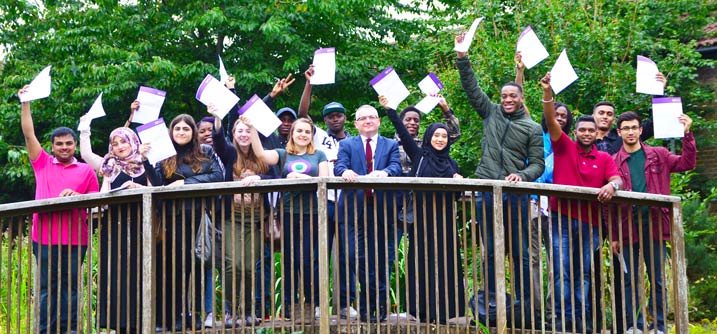
newvic-resultsday-2015

See also:

How to choose a sixth form (August 2014)

How to make a strong college application (Feb 2015)

Your college interview (Feb 2015)

Posted in Education, Learning resources | Tagged , , , , , , , , | 1 Comment

Reducing culture to memes

The economy of ideas #2

Human culture is such a complex and fluid assemblage of shared knowledge, ideas, beliefs, attitudes, perspectives and practices. How can we even begin to analyse and usefully study it?

One way is to break it down into its smallest recognisable units and study their propagation and the relationships between them instead of looking at the whole. We can isolate the simplest component ideas from broad cultural movements. It can be useful to break things down into parts which can be described and studied one at a time.This kind of reductionism has its place and much scientific investigation relies on this approach.

This is at the root of the idea of memes or units of culture which was popularized by Richard Dawkins’ when he coined the term in The Selfish Gene (1976). The idea is that these are ‘hosted’ in human brains and are more or less successful because of their ability to survive and replicate; leaping from brain to brain. The transmission metaphor is also genetic; ‘copying’ with some ‘mutation’ thrown in.

But rather than breaking things down to then build them up again, this rather fundamentalist reductionism which sees genes as the key ‘actors’ in evolution, more significant than organisms or ecosystems, also regards memes as more significant than the wider cultural ecology they are part of. This leads to language and religion being described as ‘viruses’ or ‘memeplexes’ occupying human brains rather than complex human behaviours substantially shaped by us.

In her book Science and Poetry (2001) the philosopher Mary Midgley describes this kind of reductionism as ‘the atomistic habit of breaking up wholes into ultimate units‘ and adds: ‘We can now have cultural atomism as well, the idea that culture too has an atomic structure, being composed of ultimate units known as memes.’

However, in reality, ideas, values and beliefs are connected in varied and complex ways in a range of belief systems shaped by the people who produce them, are exposed to them, change them and are changed by them – in other words by events and history. So we are dealing with socio-historical phenomena which can only be fully understood by looking at the social-historical level as well as at the level of the individual human in the here and now.

The actual tools of cultural studies draw on sociological, anthropological, historical, political and other perspectives and techniques to try to explain culture at the social level. This seems more appropriate than reducing culture to memes because culture is an emergent social phenomenon. This approach may not qualify as a science but it is better equipped to do justice to the many layers, meanings and antecedents of even the simplest cultural phenomena.

Consider the idea, or meme, of universal comprehensive public education. To even entertain such a concept we need shared ideas of a state which can tax and spend for the public good and the idea of public institutions such as schools for all. These ideas build on prior ideas of equality and democracy as well as particular perspectives on psychology, education, educability and human nature itself. So the idea of the comprehensive school does not just spring up out of the blue, it is a product of the interplay of various ideas and can only emerge when those ideas are already fairly well established. Such a meme couldn’t even exist, let alone thrive, without these preconditions. And even when it is out there in the popular imagination, it still requires political struggle to bring about the changes needed to establish it in practice.

So treating cultural evolution as a competition between individual memes floating around in the meme pool of our collective brains fails to acknowledge the complexity of human culture and behaviour. If we see cultural transmission as based on mere copying or imitation, we really are giving up on critical reflection, rationalism and all those capacities which make us human.

This doesn’t make it meaningless to study ideas as separate things or to ask why particular ‘catchy’ ideas are so ‘catchy’, we just need to remember that ideas don’t exist in a social vacuum, they come from us, they relate to us and we use them and change them.

Taking a ‘meme’s eye’ view of culture neglects the social level – the very level at which culture operates. Reducing culture to memes is like reducing social transactions to economic ones or reducing human nature to genetics. It’s dangerously short-sighted and misses the big picture.

See also:

The economy of ideas #1 The marketplace of ideas (July 2015)

Learning is dialectical (April 2015)

Education as a whole and in its parts (November 2014)

brain2

Posted in Education, Philosophy | Tagged , , , , , , , , | Leave a comment

Edward Lear in Corsica

LearEdward Lear (1812-1888) is probably best known for the limericks and nonsense rhymes of his Book of Nonsense (1846) but he was also an accomplished and well-travelled zoological, botanical and landscape artist.

He was the twentieth of twenty-one children born into a middle-class family in what was then the village of Holloway near London. When the family fell on hard times, his parents abandoned him and he was brought up by two older sisters. He showed early talent and soon developed into a serious ornithological draughtsman employed by the Zoological Society and then by the Earl of Derby who kept a private menagerie.

Lear’s first publication was Illustrations of the Family of Psittacidae, or Parrots (1830). His paintings were well received and he was compared favourably with the naturalist Audubon. He was also a pianist and composer and specialised in musical settings of Tennyson poems, which the poet himself approved of. Lear seems not to have had much success with relationships. He formed a passionate long-term attachment to a barrister, Franklin Lushington, but these feelings were not reciprocated with the same intensity

He visited Albania, Egypt, Germany, Greece, Italy, India and Sri Lanka among other countries. While travelling he produced large quantities of beautiful and distinctive coloured wash drawings which he converted later in his studio into oil and watercolour paintings as well as prints for his travel books.

His landscapes are often dramatic views with strong light and dark, intense contrasts of colour and a preference for romantic, jagged mountainscapes.

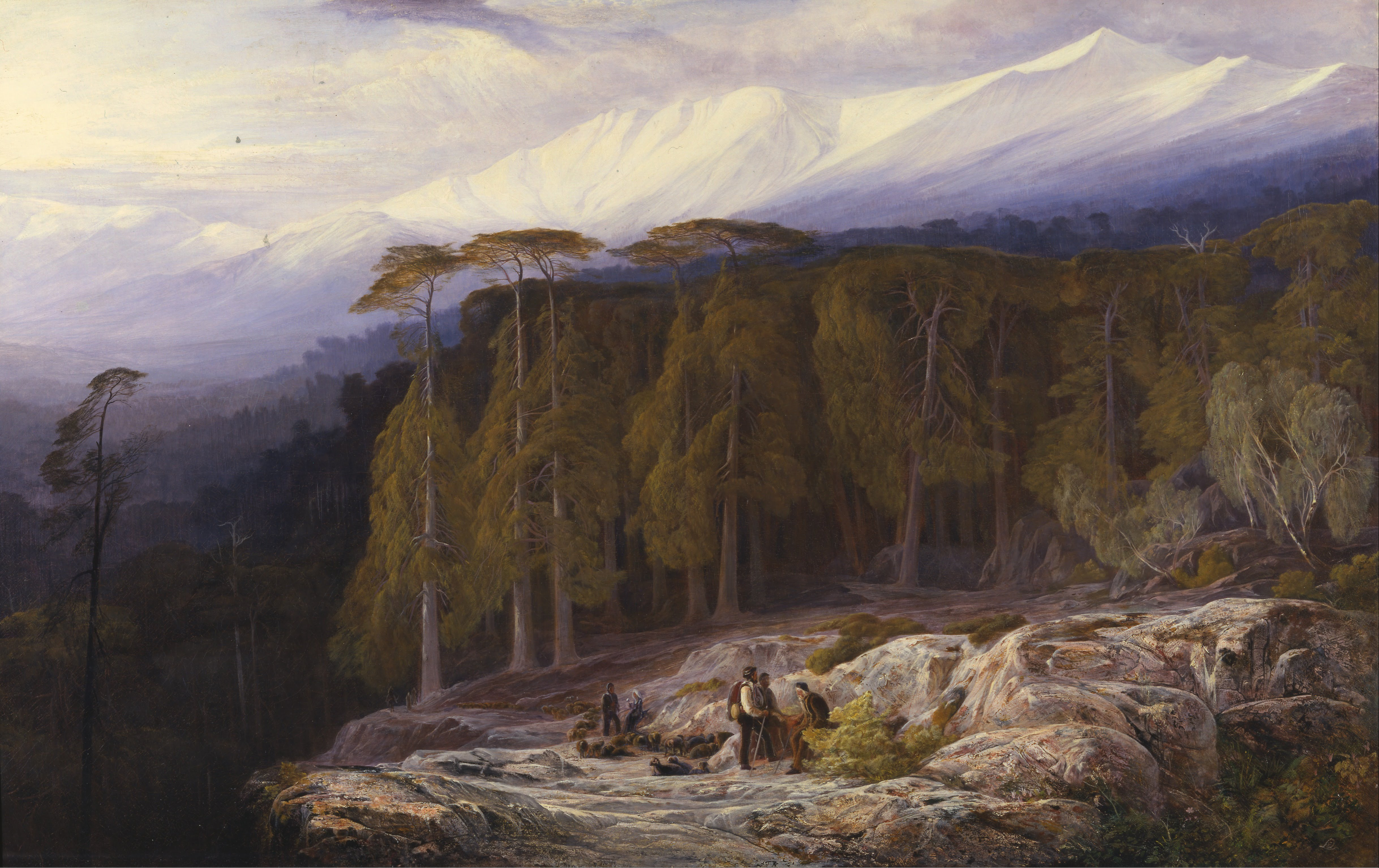
He toured Corsica in 1868 and his striking renderings of the coast near Piana and the Forest of Valdoniello are representative of the work the island’s varied landscape inspired in him. The record of his travels, Journal of a Landscape Painter in Corsica (1870) contributed to making Corsica fashionable among the more adventurous Victorian travellers around  a century after James Boswell’s An Account of Corsica had brought the island to the attention of Georgian readers in 1768.

Lear Piana

Edward_Lear_-_The_Forest_of_Valdoniello,_Corsica_-_Google_Art_Project


At the start of the journal, Lear shares some of his pre-travel anxieties:

Will there be anything worth seeing in Corsica? Is there any romance left in that island? Is there any sublimity or beauty in its scenery? Have I taken too much baggage? Have I not rather taken too little? Am I not an idiot for coming at all? Thus, and in such a groove, did the machinery of thought go on, gradually refusing to move otherwise than by jerky spasms…Are there not Banditti?

Once on the island, he was very taken by the Corsican maquis:

…the excessively rich foliage which is the characteristic clothing of the all the hills. This ‘maquis’ or robe of green covering every part of the landscape except the farthest snowy heights, is beyond description lovely, composed as it is of myrtle, heath, arbutus, broom, lentisk and other shrubs, while, wherever there is any open space, innumerable crimson cyclamen flowers dot the ground and the picturesque but less beautiful hellebore flourished abundantly. There groups of ilex or chestnut rise above the folds of exquisite verdure…

Lear was critical of the Corsican practice of vendetta; long-term grudge-bearing which often led people to violent revenge:

If a man had received an injury, and could not find a proper opportunity to be revenged on his enemy personally, he revenged himself on one of his enemy’s relations. So barbarous a practice was the source of innumerable assassinations.‎

Overall, he felt that Corsica had some way to go before fulfilling its potential:

The position of Corsica, its climate, its fertility, the brilliant qualities of its people, unite to claim attention to this privileged spot. Unhappily, labour has not as yet called forth its natural riches, rivalries are transmitted from father to son for years and the population, idle in the midst of universal progress, seems condemned to a fatal immobility.

Economically and socially things have moved on since then, but the distinctive maquis which Lear experienced is still omnipresent.

There is little evident crossover from Lear’s travels to his nonsense rhymes, but at least one of his limericks features a Corsican character if not a Corsican theme:

There was a young lady of Corsica,

Who purchased a little brown saucy-cur;

Which she fed upon ham

And hot raspberry jam,

That expensive young lady of Corsica.

Another Lear limerick:

There was an old man of the South,

Who had an immoderate mouth;

But in swallowing a dish,

That was quite full of fish,

He was choked, that old man of the South.

has been translated into Corsican by Marcu Biancarelli as:

Era un avu ‘llu meziornu

A bucca com’e un fornu

Ma inguttindusi un piatu

Di peciu appruntatu

Si sturzo, quidd’avu ‘llu meziornu.

(from Mediterraneans magazine, summer 2001)

A facsimile of the entire Journal of a Landscape Painter in Corsica is available here.

See also:

John Minton in Corsica (July 2015)

Paoli in London (March 2015)

Conrad in Corsica (August 2014)

Seneca in Corsica (August 2014)

Corsican proverbs and sayings (August 2014)

Corsica: a poem (July 2015)

Posted in Culture, History | Tagged , , , | 2 Comments

Let Us Be Midwives! Sadako Kurihara

Let Us Be Midwives! An untold story of the atomic bombing

by Sadako Kurihara, translated by Richard Minear

Night in the basement of a concrete structure now in ruins.

Victims of the atomic bomb jammed the room;

It was dark—not even a single candle.

The smell of fresh blood, the stench of death,

The closeness of sweaty people, the moans.

From out of all that, lo and behold, a voice:

“The baby’s coming!”

In that hellish basement,

At that very moment, a young woman had gone into labour.

In the dark, without a single match, what to do?

People forgot their own pains, worried about her.

And then: “I’m a midwife. I’ll help with the birth.”

The speaker, seriously injured herself, had been moaning only moments before.

And so new life was born in the dark of that pit of hell.

And so the midwife died before dawn, still bathed in blood.

Let us be midwives!

Let us be midwives!

Even if we lay down our own lives to do so.

Sadako Kurihara

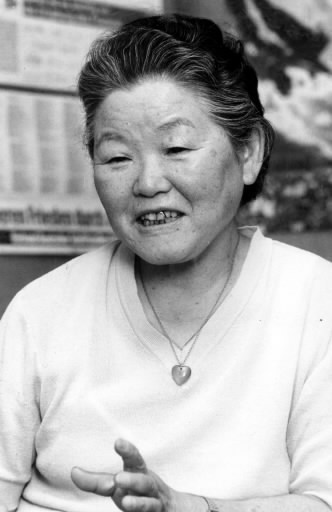
Sadako Kurihara (1913-2005)

The poet, writer and peace activist Sadako Kurihara  lived in Hiroshima and survived the atomic bombing of August 1945. She is best known for this poem Umashimenkana, translated as ‘Let us be midwives’. The poem is based on Kurihara’s own experience in a shelter under the Sendamachi post office in the aftermath of the destruction of Hiroshima. In reality, the midwife survived and was later able to meet the child she had delivered.

After the war Sadako Kurihara took up writing along with her husband Kurihara Tadaichi, and was fully engaged in the worldwide peace and antinuclear movements. In 1960 she wrote Auschwitz and Hiroshima: Concerning Literature of Hiroshima about the writers’ responsibility for remembrance. In 1969 she founded a citizens’ group Hiroshima Mothers’ Group against A-Bombs and H-Bombs and published an anthology of poetry about Hiroshima The River of Flame Running in Japan. The following year she started the journal, The Rivers in Hiroshima. She also edited journals, wrote essays.

See also:

Nazim Hikmet: Hiroshima and Strontium 90 (April 2015)


Posted in Poetry | Tagged , , , , , | 1 Comment

Keri Facer and the future-building school

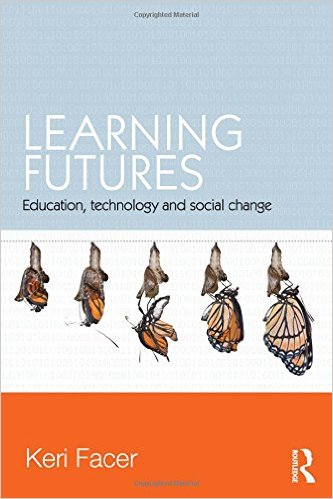
Facer bookIn her brilliant book Learning Futures – Education, technology and social change (2011) Professor Keri Facer suggests that we should be creating what she calls future-building schools rather than future-proof schools based on equipping young people to compete in the global economy.

Keri Facer argues that we need schools which can:

  • teach us how to create and marshal collective knowledge,
  • nurture our capacity for democracy and debate and build solidarity,
  • act as midwives for sustainable economic practices that can strengthen our communities,
  • help us work out what intelligence and wisdom mean and how to deal with new and dangerous knowledge

Simply preparing our students for an uncertain future by helping them to be flexible and adaptable is not an adequate response to the social change we are experiencing. We need a vision of a better alternative future and schools, as universal public services, can be ‘prefigurative spaces’ where people can model today how they might want to live tomorrow.

The characteristics of such a school would include being a public space at the heart of its community, being committed to interdependence and seeing itself as a laboratory for building social futures. It sees itself as part of a much wider network of people and institutions and draws on them in its work. It is

“a platform for creating a conversation about the future…a resource which harnesses and amplifies the potential of a community to educate its young people…a powerful engine for social change…”

The future-building school takes seriously its responsibility to equip its students for the future by contributing to a debate about the futures that are in development and those we might want and allowing people to rethink their assumptions about what is possible.

Keri Facer devotes a whole chapter to an account of a visit to a possible future-building school in 2035. I always enjoy such fleshed-out practical descriptions of the future – they have something in common with utopian, and dystopian, fiction. They are thought experiments which shouldn’t be treated as detailed blueprints or prescriptions although they do require their creators to nail some human colours to their theoretical framework. They remind us that history has not ended and that the basis of our current way of doing things is not permanent; things do change, things can be different and maybe even better.

Keri Facer describes this chapter (chapter 8) as a utopian vision and offers it as a resource and a tool for opening up the possibilities of the future-building school. What might it feel like? How might it be arranged? What sort of teaching and learning might be going on? What difficulties might it face? This is a ‘plausible utopia’ built from ‘educated optimism’ about how we could respond to the socio-technical developments, environmental challenges and economic disruptions of the near future. It is well worth reading the whole book but if you only have time for 15 pages, chapter 8 cannot fail to inspire and you can read it for yourself here (from p.109).

At a time when austerity threatens our imagination as well as our public services, we need a broad and expansive social vision of education more than ever. It serves as a useful starting point for further discussion and debate about the better future we could build.

I plan to review Learning Futures properly in a future post and also to start anthologising different visions of the future of education in this blog.

See also:

My own future scenarios, describing 2 possible future education systems for England in 2020 is in: Market madness: condition critical (June 2015)

No austerity of the imagination (July 2015)

For a pragmatic idealism (June 2015)

Roberto Unger on school as the ‘voice of the future’ (April 2015)

Posted in Education, Education Futures, Reviews | Tagged , , , , , , , , , | Leave a comment

A Bauhaus education for the 21st century?

bauhaus-building

We are familiar with the clean functional lines of the influential modernist Bauhaus school of design founded in Weimar, Germany by Walter Gropius in 1919. The Bauhaus school was more than a training ground for designers, it was based on a set of values which influenced their whole approach including the educational philosophy underpinning their programmes.

The New Vision (1938) by the experimental Hungarian photographer Laszlo Moholy-Nagy summarises the educational vision of the Bauhaus school. Although it was aimed at students of art and design, it has a wider relevance which has stood the test of time. We can still learn lessons from the Bauhaus about the place of knowledge, skill and utility within a broad general education for all. Moholy-Nagy’s aim in writing The New Vision was to stimulate all those interested in art, research, design and education and promote the integration of theory and practice.

Bauhaus education places the human at the heart of the curriculum and starts from the idea that everyone is talented. It requires actual life examples of strong-minded people leading others onward, the integration of intellectual achievements in politics, science, art, technology and all the realms of human activity and the existence of centres of practical education.

There is an emphasis on self-knowledge and individual flourishing as well as collective effort:

“…the right of the individual to a satisfying occupation, work that meets their inner needs and a release of human powers.”

“Only the person who understands themselves and co-operates with others in a far-reaching programme of common action can make this effort count.”

There is also a commitment to abolish the supremacy of intellectual work over manual work and to value craftsmanship:

“the machine cannot be used as a short cut to escape the necessity for organic experience” (Lewis Mumford).

Bauhaus education recognises that education, design and production are all part of an economic structure. It is not opposed to technical progress, but adopts it. Technology should never be the goal, only the means; to be exploited for the benefit of all. Each of us has to “crystallize our place as a productive unit in the community of mankind”.

One of the objectives of Bauhaus education is “to keep alive in adults the child’s sincerity of emotion, truth of observation, fantasy and creativity.” Rather than adopt a rigid teaching system, learning at the Bauhaus emerged from teachers and students working in close collaboration, exploring new ways of working with materials, tools and machines to respond to challenges.

If this sounds hopelessly ‘progressive’, it is worth bearing in mind that the Bauhaus courses emphasised the systematic acquisition of knowledge and skill starting from the basic elements; the “ABC of expression”. This was always done in a way that integrated intellect and emotion rather than through the learning of unrelated facts. The workshop training took students through the properties and techniques necessary to work with all materials (wood, metal, textiles, clay, glass, stone, plastics etc.) and the use of colour, light, surface, space, volume and display.

Function is defined broadly, not as a pure mechanical service but in terms of its psychological, social, historical and economic components.

Beyond the evident benefits of educating more design-literate students and citizens, the wider Bauhaus education philosophy can usefully be applied to general education today:

  • The broad, democratic conception of what it means to be human.
  • The belief in the educability of everyone.
  • The cultivation of the individual who can work well with others
  • The emphasis on function and usefulness in their broadest sense.
  • The integration of theory and practice rather than their separation.
  • The nurturing of human creativity as it emerges from an informed and skilled starting point.
  • The benefits of an interdisciplinarity which is based on solid disciplinary foundations.

All but one of the quotations are from The New Vision and come from Oliver Tomas’s excellent blog which seems to be currently unavailable.

bauhaus_course Bauahus_logo_Schlemmer

Posted in Culture, Education | Tagged , , , , , , , , , | Leave a comment

‘Not for Profit’ by Martha Nussbaum

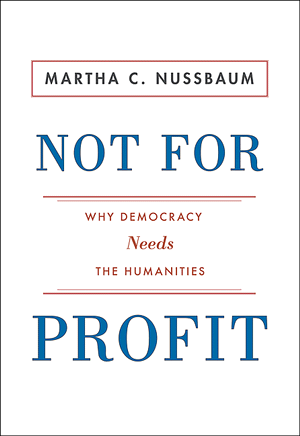
In Not for Profit (2010), the U.S. philosopher and academic Martha Nussbaum argues that we are in the midst of a global crisis in education. Why? Because we are too willing to neglect the skills we need to keep democracy alive; the ‘humanistic’ aspects of science and social sciences are losing ground as nations choose to prioritise profit and short-termism.

Nussbaum has no objection to scientific, technical or vocational education for economic growth as long as this is not to the detriment of the arts and humanities which develop the ability to think critically, transcend local loyalties and approach global challenges as a ‘citizen of the world’. In her view, all educational projects should be judged by how well they prepare people to live in a diverse, plural democracy and no system is doing well if it only benefits an elite.

Education for democracy

An education for democracy, by contrast to education for profit, should be based on a human development paradigm and offer a threshold level of opportunity to all citizens to:

  • Examine, reflect, argue, debate and ‘think well’ about political issues.
  • Recognise fellow citizens as equal.
  • Demonstrate concern for others.
  • Understand a wide range of human stories and a variety of complex issues.
  • Judge political leaders critically.
  • Think about the good of the nation as a whole.
  • See the nation as part of a complex world order.

In order to sustain democratic institutions based on respect, education must fight to help democracy prevail against hierarchy and simplistic dichotomous thinking. This can result from our own anxiety about our weakness and vulnerability in the face of overwhelming or apparently insurmountable problems. Education needs to work with children’s increasing capacity for compassion and concern and their ability to see things from another’s point of view.

People can act worse when they find themselves in pernicious structures which allow them to be anonymous or unaccountable, which discourage dissent or which de-humanize others. Instead, the content and pedagogy of education can reinforce structures which do the opposite.

The importance of argument

The ability to argue in the Socratic way is of great value to democracy and a liberal arts education can strengthen dialogic, imaginative and independent thinking skills. Socratic reasoning is a social practice which should shape our institutions as well as our teaching and this is well within the reach of all education systems. Philosophy should be an essential part of education; we need to infuse critical thinking into pedagogy and give students a chance to practice what they have learnt by debating and writing.

People need to be educated to see their deeds and the reasoning behind them as their responsibility. A lack of self-examination can lead to a lack of clarity about goals and people who are too easily influenced, defer too readily to authority or peer pressure and treat each other without respect.

Nussbaum reviews attempts to address this from Rousseau, Pestalozzi, Frobel, Alcott and Mann to Dewey and Tagore and quotes from the syllabus Tagore wrote for his own pioneering school in India:

“Our mind does not gain true freedom by acquiring materials for knowledge and possessing other people’s ideas but by forming its own standards of judgement and producing its own thoughts.”

Global citizenship

The greatest problems we face as human beings – whether economic, environmental or political – are global in scope and we have no hope of solving them unless different and distant people can come together and co-operate in new ways. Our education systems should equip us to function as ‘citizens of the world’. In this context Nussbaum quotes Model United Nations projects and the Future Problem Solving Program International (FSPI) approvingly as examples of initiatives which help students design solutions to global problems using critical thinking and imagination.

While knowledge is no guarantee of good behaviour, young people need to learn about global history, global economics, the world’s religious traditions, the differences between us as well as our shared human needs. World citizenship should be taught as part of the basic liberal arts portion of the curriculum and include basic economics, global justice, philosophy and political theory.

These are realistic demands in U.S. higher education, where a liberal arts approach to degree level courses is common. In the U.K. specialisation generally starts young and we are just beginning to see some liberal arts thinking in the design of a few undergraduate degrees – but there is a long way to go before liberal arts curricula cease to be the exception and become widely available.

Literature and the arts

We can’t relate well to our complex world with facts and logic alone. We need the ability to imagine what it might be like to be someone else; a narrative imagination and a cultivation of sympathy. This requires a humanities and arts curriculum. Dewey, for example, insisted that studying ‘fine art’ should not be contemplative or cut off from the world; children should not be taught that imagination is only useful in the domain of the imaginary. Instead they need to see the imaginary dimension applied to the world around them. For Tagore, the arts cultivate sympathy, promote self-cultivation and responsiveness to others. One cannot cherish in others what one has not explored in oneself.

The arts, by generating pleasure in acts of subversion and reflection, generate a dialogue with the assumptions of the past and cultivate minds that are open, flexible and creative.

In conclusion

Nussbaum is concerned that education for democratic citizenship is in retreat. We maintain that we love democracy, self-government, freedom of speech, respect for difference and understanding of other but we are thinking far too little about how to transmit these values to the next generation. Distracted by the pursuit of wealth we are turning out profit-makers rather than thoughtful citizens.

“The real clash of civilization is a clash within the individual, as greed and narcissism contend against respect and love. All modern societies are losing the battle. If we do not insist on the crucial importance of the humanities and the arts, they will drop away because they do not make money.”

In Not for Profit Nussbaum makes a clear and persuasive case for an education for human development and democratic global solidarity. It deserves our support and these are surely the very values which should guide us in developing our school and university curricula. However, we must not underestimate the difficulties. At many levels, reason, civilisation and broad human flourishing are ranged against barbarism, irrationalism or narrow instrumentalism and the balance of power is too often in favour of the latter.

See also:

Defending liberal education (May 2015)

Valuing student research (March 2015)

Gramsci’s grammar and Dewey’s dialectic (December 2014)

Debating the Liberal Arts (October 2014)

Learning to love liberal education (October 2014)

Trivium 21c by Martin Robinson (August 2014)

Post-16 citizenship in tough times (May 2014)

martha_nussbaumNot for profit

Posted in Education, Reviews | Tagged , , , , , , , , , , , , | Leave a comment

For a National Education Service

Jeremy Corbyn, who is standing for the Labour leadership, is the first leading politician to advocate a National Education Service as far as I know. His speech on this can be read here.

So what might an N.E.S look like? How might it be brought about? Could English education experience its N.H.S moment?

I wrote about this in the Spring edition of the journal Forum as part of an article making the case against marketization in education. I concluded by imagining two different futures for English education following the 2015 general election, one (Future A) based on an extension of marketization and the other (Future B) on the development of a National Education Service. The full piece can be read here, but I thought I would also offer an updated post-election case for this future here.

Creating a National Education Service

The new progressive majority at Westminster was aware of the level of popular dissatisfaction with the incoherence and chaos people were experiencing across all the phases of education and was clear about the need for change. Continuing with the reforms of the previous government was clearly not an option.

National politicians asked themselves whether the answers might perhaps be found in the imagination and daily practice of the people actually concerned with education. So within a few weeks of the election they launched a national Great Debate about the purpose and organisation of education in England. This willingness to listen to people turned out to be their most radical decision.

The Great Debate aimed to involve everyone in considering a few simple questions:

  • What do we want from education?
  • What is an educated person?
  • How do we ensure that everyone gets the best possible education?

The initial Great Debate was given a month in order to focus everyone’s minds and instil a sense of urgency. It was conducted on-line, using social media, in public meetings large and small, inside and outside school classrooms and in outreach activity to ensure that everyone, including children and young people, had the opportunity to express their views. Public involvement in the process was very high, different opinions were respected and the views of ‘experts’ and education professionals were given equal weight to those of everyone else.

As the Great Debate got going, people got excited. They were being listened to and they were setting the agenda. Having voted to hand power to politicians, they were now being asked how that power should be used. The discussions generated many brilliant ideas and the deliberation and aggregation process throughout the month meant that the most popular themes started to emerge and people could return to the debate at different stages.

It became clear quite early on that there was a real consensus that England needs a common national education system with both social and personal objectives to meet the needs of all its people.

One of the most popular emerging themes was “education needs to be like the NHS” and that was actually one of the key outcomes: a groundswell of support for a comprehensive national education system based on agreed common aims, cooperation and universalism rather than competition and selection.

Even before any policies were implemented, the sheer breadth and depth of the national debate gave people the confidence that change is possible and promoted a degree of optimism about the future. Another outcome was a real celebration of the work of teachers and pride in the work of students. Many participants said that learning directly about what happens in our schools and universities had surprised and impressed them and inspired them to get more involved themselves.

Following this Great Debate, the legal status of all publicly funded schools was quickly harmonised so that they all operated on the same basis. The school curriculum was redefined in terms of human flourishing as well as the fundamental knowledge and skills that everyone needs to build on to be a successful contributor to society. There was support for both breadth and specialisation at upper secondary level with no options being closed off at any age.

Once the national aims were agreed, the new system needed to be built from the existing one with collaboration around nationally agreed shared aims, core entitlements and funding as givens. The English regions were given the right to elect education councils to oversee the development of the system in their region using all the educational resources available. These elections gave the new councils a strong mandate to develop a distinctive approach for their area within the national aims. The limited funding available was boosted by a ‘partnership premium’, money previously tied up in competition and duplication. There was room for specialisation as well as regional and local innovation and some regions are now leading on different themes and sharing this work nationally and they have created new forums for action research, evaluation, curriculum and professional development.

The talents and skills of the nation’s young people were increasingly recognised and celebrated including their contribution to community and cultural life and the impact of their research. These are all valued within the school leavers’ National Baccalaureate.

There were the beginnings of a renaissance of adult education in various forms as universities worked with other parts of the education service to reach out more and respond to the needs and interests of all adults in their region. Reading groups, current affairs groups, cultural activity, community organising and volunteering all fed in to university extramural programmes with a consequential strengthening of both geographical and virtual solidarity.

In fact, the Great Debate has never really stopped. People found that they wanted to contribute to education and to help shape the new system. Momentum was built through local education forums across the country which informed the work of the new education councils and helped hold them to account between elections. People’s attachment to their education service and the idea of public service generally was strengthened by this activity.

Popular TV shows include ‘Amazing Youth’ presented by young people featuring a range of research and community projects they have conceived and led and ‘Speak Up’ where young people from all over the country get to express their views and make their case for social change which can then be voted on by the audience.

By the end of the government’s first term, educational inequality had not been abolished but there was some evidence that the gaps were narrowing. Not everyone was satisfied with the rate of progress and funding remained tight. However, people were proud of the ‘new’ system, positive about its contribution to society and optimistic about its future. There does seem to be a consensus around the aims and values established through the Great Debate. By the time of the next election, all the major parties were committed to the new system and the policy differences were mostly about resource allocation and curriculum priorities.

There is choice and diversity within this comprehensive system but very little advocacy of greater competition or market incentives. There is friendly rivalry between different parts of the service as they strive to offer the best to their communities but this is combined with a commitment to sharing what they do best to help the whole service improve.

See also:

Market madness – condition critical (June 2015)

Posted in Education policy | Tagged , , , , , , , | Leave a comment

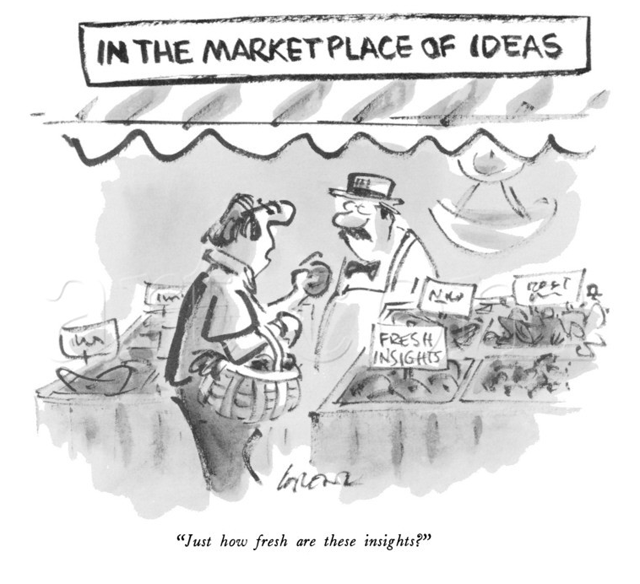
The marketplace of ideas

The economy of ideas #1

Can the application of market thinking to any aspect of learning be a good thing? If we support the idea of a universal, comprehensive education system free of markets, selection and hierarchies surely we have no use for market metaphors?

Maybe there is an exception; the so-called ‘marketplace of ideas’ metaphor first used by the philosopher John Stuart Mill in On Liberty (1859). The idea is broadly that in an open society with freedom of expression, different ideas and opinions confront each other in a free and open encounter. Bad or wrong ideas can be challenged and the best win out.

For this to work, a level playing field is needed where a wide range of views can be heard and where people have the evidence and critical skills to evaluate them rationally. The model lends itself well to scientific and technological discourse where truth, albeit provisional, is easier to establish and expert peer-review is common. Things get more difficult when the ideas which are doing battle are cultural, political or religious where belief and tradition play a bigger part.

The notion that all the various ideas and opinions available are swirling around in a social ‘marketplace’ is appealing. Good ideas will be picked up and adopted, or ’bought’ by more people depending on how attractive or useful they find them. They will be tested and sharpened in debate with alternatives. Some will catch on and ‘succeed’ as intellectual commodities while others fail. Some will change through use and evolve into quite different ideas.

Here, perhaps, is one market where we don’t need to be cash rich to have plenty of choice. So perhaps this is a marketplace where it is theoretically possible for us to be on an equal footing and play our part regardless of our actual wealth and power in the real economy. Nevertheless, to make wise purchases we do need a solid educational grounding, a commitment to reason and some decent judgement – things which can take a lifetime to acquire.

Even if this market seems free, the truth is that the ideas of those in power or those which are backed by the strong are generally dominant. Reason does not always win out and some pretty poor ideas can become influential if they are persuasively expressed. And if power and dominance are important factors, so are numbers. Ideas which have mass support will carry extra weight for good or ill. In a democracy, elections don’t establish the truth of ideas just the support they have. Being one of many in holding a particular view doesn’t make that view any more correct but wrong-headed ideas with widespread support are obviously harder to resist. For example, superstitions persist not because they have stood the test of rational challenge but because they are believed by many people and get passed on.

So where does this leave us as consumers of ideas in this less-than-free market? Do we give up and believe nothing? Or anything? Or do we just go with the majority for an easy life?

Like informed consumers in any real markets, we need to understand the choices which we have. To make the most of our position, we need to shop around and find the most reputable retailers. We need to cultivate healthy scepticism of the claims of salespeople and ask searching questions of their evidence, methods and motives while at the same time holding on to our hope that truth and wisdom can be found out there. In short, we need to be critical and ethical consumers while acknowledging that we will make the occasional unwise purchase and that we can always do better.

No matter how confusing our experience of the market of ideas is, we have to maintain a constant and utmost respect for truth and reason and distinguish them clearly from opinion and ideology. This doesn’t mean rejecting opinions or belief systems but as we develop our own, they should be built on foundations of truth and reason, open to challenge and informed by the sort of values which we can justify to ourselves and others.

The idea that human culture is developed through the competition between ideas for our attention and approval is pretty good. It’s not a bad place to start if we aspire to a better, more equal world based on truth, reason and mutual respect. We just need to be aware of all the distortions and injustices and recognise that the marketplace of ideas is not necessarily any freer or more democratic than the ‘real’ market.

Future posts will examine the idea of ‘memes’ and ‘powerful knowledge’.

See also:

Embracing the canon, resisting the canon (July 2015)

Learning is dialectical (April 2015)

Education as a whole and in its parts (November 2014)

Marketplace-of-ideas


Posted in Philosophy | Tagged , , , , | 1 Comment

Labour pains

Sapiens and Simplex are discussing the future of their party:

Sapiens: We need to make ourselves popular again…

Simplex:…but not adopt vote-winning policies.

Sap: We need to listen to the electorate…

Sim:…but not simply pander to what people want.

Sap: We need to be aspirational…

Sim:…but not raise people’s expectations too much.

Sap: We need to set out clear values…

Sim:…but not principles which seem too pure.

Sap: We need to become a mass party…

Sim:…but not attract too many people we might disagree with.

Sap: We need to show our economic competence…

Sim:…but not by proposing alternatives to austerity.

Sap: We need to expect the better-off to contribute more…

Sim:…but not be seen as ‘unfriendly’ to business.

Sap: We need to think the unthinkable…

Sim:…but not challenge received thinking.

Sap: We need to be radical…

Sim:…but not too different.

Sap: We need to win next time…

Sim:…but not by proposing much change.

Labour leadership

Simplex and Sapiens have also dicussed:

Education policy (Sep 2014) and the economic impact of exam results (Dec 2014)

Posted in Politics | Tagged , | 3 Comments

What’s at stake in the new post-16 Area-based Reviews?

Large and cost-effective v. small and inefficient?

In Reviewing post-16 Education and Training Institutions published 3 days ago the government suggests that we need ‘fewer, often larger, more resilient and efficient providers’. The implication is that larger colleges are better placed to provide high quality, plan strategically and survive austerity in the medium term. This is probably true and many in the college sector are already considering new forms of collaboration and federation to secure the range and quality of their local offer.

But if colleges overall are in declining financial health, this is partly due to the government itself which has subjected them to a succession of disproportionately large funding reductions, the latest of which have come after the final allocations and budgets have been set. These unplanned cuts will require emergency responses which will inevitably harm students.

The new programme of Area-based Reviews of post-16 provision proposed in the document could see a welcome return of some form of rational planning. If all the appropriate agencies can work with local communities and post-16 providers to take an objective view of local provision and agree on a different and better configuration using a range of criteria including quality, cost-effectiveness, geography and demand, this must be a good thing.

Because the pattern of provision is different in every area and different providers have different strengths, the proposed solutions will not all look the same. But wherever they take place, successful reviews will require imagination, system leadership and an appeal to the better instincts of all those involved.  We will be expected to rise above institutional self-interest in order to start building a better system for young people in our areas.

School sixth forms must be included

The guidance on how these reviews will be carried out is yet to be published and it is essential that all 16-19 provision in an area should be in scope. This means that school sixth forms must automatically be considered as part of the pattern of provision. If they are not, this would be a colossal missed opportunity.

If colleges have cost-effectiveness issues then surely the problem is even greater for small school sixth forms. Even counting only ‘key stage 5’ or advanced learners using the data for 2012,  the average English college had six times more advanced 16-18 year old students than the average school sixth form.

1,870 publicly funded school sixth forms in England had 169,400 key stage 5 (advanced) leavers in 2012. 320 publicly funded FE and sixth form colleges has 176,390 of the same type of students. This means that the average school sixth form had 91 second year advanced students compared to the average college which had 551. Were we to add those students studying at intermediate, foundation and entry levels and adult learners, the imbalance would be even more stark.

Incidentally, the university progression data in these same tables also shows that the average college sends over 4 times more students to university and more than double the number to Russell group universities than the typical school sixth form. The average school sixth form sends 51 students to university per year, of whom 14 progress to a Russell group university. The averages for all colleges are 215 and 33 respectively, with sixth form colleges being well above these averages.

Addressing cost-effectiveness and investing in quality and success must be a priority across all post-16 provision. To do this properly, we must include that provision which is already successful and efficient as well as that which is the most dispersed or least cost-effective.

Inclusive and comprehensive local systems

The document also suggests that the government wants to encourage ‘greater specialisation in genuine centres of expertise’ while also maintaining ‘broad universal access to high quality education and training for students of all abilities’. Squaring this circle may be easier with fewer colleges, but it will also require the creation of inclusive and comprehensive local systems – preferably made up of inclusive and comprehensive institutions. Otherwise the needs of the least qualified and most vulnerable young people are likely to be overlooked.

If these area reviews are comprehensive in scope, based on educational criteria and owned by local educators who have thought strategically and systemically about what is best for all 16-18 year olds in their area, they could be the catalysts for positive and sustainable change. There will certainly be much at stake and we cannot afford to fail.

BIS doc

Posted in Education policy | Tagged , , , , , , , , , , , , | 2 Comments

Poem: Corsica

Corsica

Corsica

Our island

Rest and refuge

So wild and warm

In our hearts and minds

Casting shadows on every other place

Always there and forever yearning for us

Cold spring water to quench our thirst

On a sun baked granite outcrop

Resting before entering the forest

Soft needles under foot

In pine shade

Corsica is

Alive

image1

Posted in Poetry | Tagged , | 1 Comment

Leçons sans paroles: comment la musique nous apprend à vivre

La musique est indispensable à la vie humaine mais nous trouvons difficile d’expliquer ses effets. Peut-on décrire les leçons qu’on pourrait extraire de notre expérience vécue de la musique ?

Voici au moins 10 choses que la musique peut nous apprendre :

  1. Ce sont nos rapports avec les autres qui nous définissent et nous accomplissons bien plus en agissant collectivement qu’en tant qu’individus. La musique, comme la vie, est profondément sociale. Elle réclame et suppose un public, même si ce n’est que l’interprète seul. La musique se produit souvent en collectivité – les voix et les lignes mélodiques différentes se mêlent pour donner un sens à l’ensemble. Récits différents s’emboitent pour créer un tout supérieur a ses éléments. Public et interprète éprouvent une expérience commune aux frontières souvent floues.
  2. Nous n’avons pas toujours besoin de paroles pour bien communiquer. Notre langage peut être très précis mais notre musique nous montre qu’il y a d’autres façons de décrire les choses et de toucher les autres – des façons à la fois efficaces et inexprimables.
  3. Tout à une fin, un début et une durée déterminée. Nous éprouvons la musique dans le temps, en commençant par l’anticipation, l’espoir et le frisson du premier son jusqu’à la mort du dernier. Chaque morceau rappelle la mortalité et la nature transitoire de la vie.
  4. Tout change. La musique progresse avec nous et nous emmène en parcours – un voyage ou l’avenir est formé par le passé. L’effet de ce que nous entendons est lié à ce que nous venons d’entendre. Cette musique nous changera et nous ne serons jamais plus la personne que nous étions il y a quelques moments.
  5. Une chose peut en représenter une autre. Nous sommes passionnés de symboles et de métaphores et nous trouvons moyen d’attribuer des significations humaines aux idées musicales. Motifs et mélodies nous permettent de décider nous-mêmes leur sens.
  6. Une même idée peut être interprétée de plusieurs façons. Une proposition fondamentale peut être infiniment développée, modifiée et embellie. Nos idées évoluent dans le jeu, l’expérimentation et l’invention. Les variations changent le thème dans certaines contraintes – c’est le modèle de l’évolution dans les règles mais qui peut nous mener à franchir nos limites.
  7. Les autres peuvent influencer nos émotions et changer notre humeur. Nous reconnaissons nos émotions chez les autres. Nos réactions à la musique nous rappellent que nous sommes très susceptibles au contenu émotionnel de ce qui se passe autour de nous.
  8. Le familier et la répétition nous confortent. Nous reconnaissons avec plaisir des motifs que nous connaissons déjà – cela renforce notre identité tout en nous permettant de construire du nouveau en nous servant d’éléments qui nous sont familiers.
  9. Le contraste et la différence sont stimulants. Les méthodes de choc saisissent notre attention et nous rappellent que nous sommes capables de changer d’avis. Changements de rythme, de volume, de timbre, d’ambiance et d’émotion nous intriguent et nous rappellent que le changement est toujours possible.
  10. Il y a plusieurs points de vue. Les ‘conversations’ entre voix différentes et instruments différents nous rappellent le dialogue, l’expression et l’exploration de nos différences. Elles nous rappellent aussi que ces différences peuvent se résoudre et créer de nouvelles synthèses. Les interprétations musicales différentes nous rendent ouverts aux perspectives différentes.

Ce sont des leçons importantes et d’une façon mystérieuse la musique peut nous aider à les apprendre sans paroles.

Traduit d’un billet publié en anglais en Novembre 2014

D’autres billets en Français :

L’autonomie : pourquoi ? (Avril 2015)

Laïcité, égalité, diversité (Mars 2015)

Citoyens multilingues, société multiculturelle (Mars 2015)

L’inspection en Angleterre (Décembre 2014)

Le numérique en questions : une perspective anglaise (Octobre 2014)

Socrate et le numérique (Juillet 2014)

Chansonsansparoles001

Posted in en Francais | Tagged , | Leave a comment

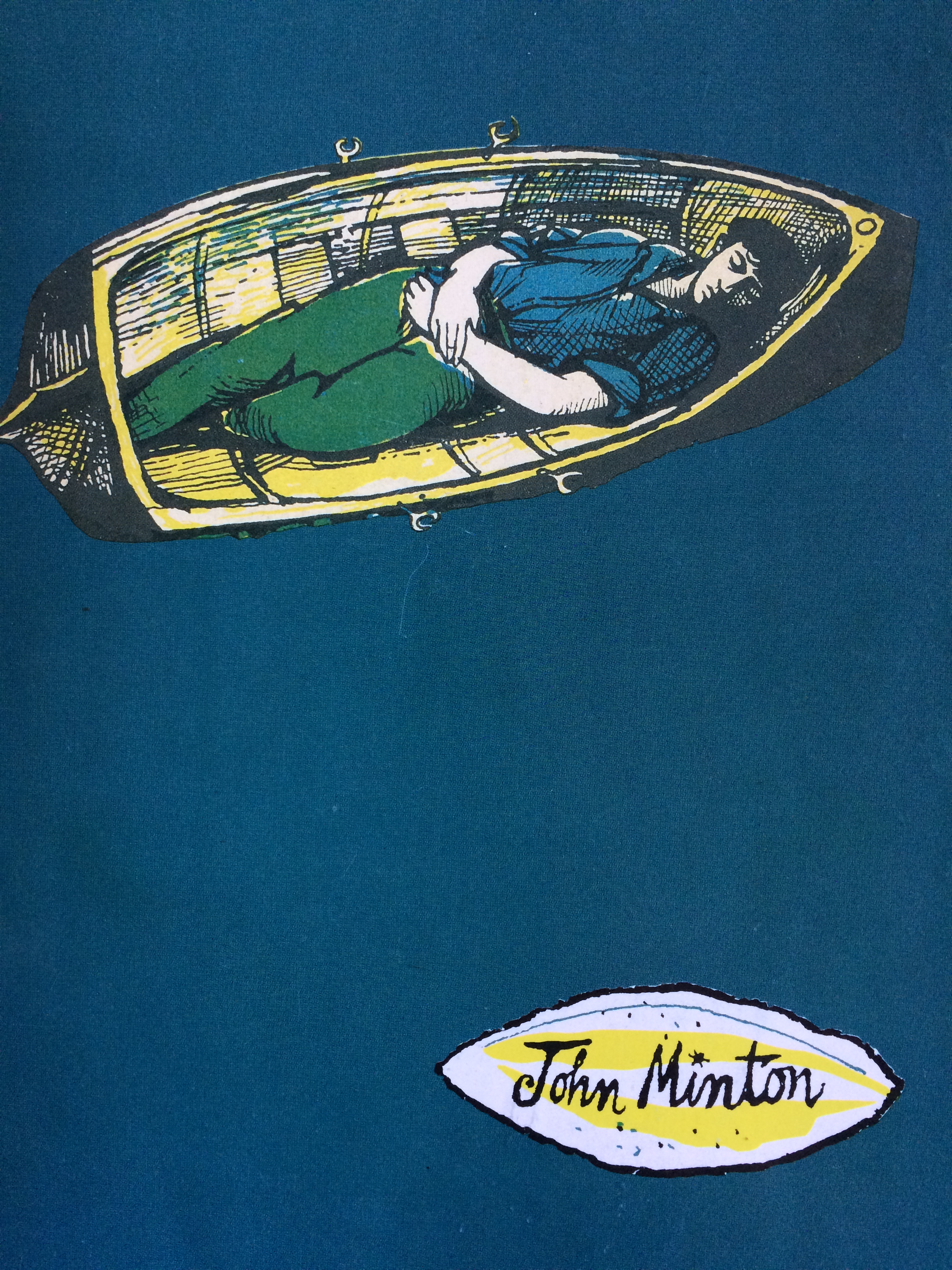
John Minton in Corsica

IMG_3991

John Minton (1917-1957) was a brilliant English artist and contemporary of Francis Bacon and Lucian Freud. He was one of the foremost English painters of the 1940’s and 50’s whose influences include De Chirico and the surrealists as well as Picasso and Matisse. He suffered much self-doubt and his career was described as meteoric in both its rise and its fall.

John Minton studied art at the St. John’s Wood Art Schools, then moved to Paris in 1939 and also visited the atmospheric ruined town of Les Baux-de-Provence. Back in London he registered as a conscientious objector in the early years of the Second World War. As a gay man at a time when homosexual activity was criminal he was able to experience some relative sexual freedom in wartime London while charting the urban and psychological devastation of the capital at the time.

He joined the Army’s Pioneer Corps in 1941 and was discharged in 1943 on grounds of ill-health. He started teaching at Camberwell School of Arts and Crafts and was much influenced by the famous Picasso and Matisse exhibition at the Victoria & Albert Museum in 1945-46. He was drawn to industrial and docklands scenes and gained a reputation as an ‘urban romantic’. He moved to the Central School of Arts and Design in 1946 and then to the Royal College of Art in 1949.

His wide ranging contribution to illustration and stage design contains beautiful and memorable work; for the Festival of Britain, London Transport and Ealing Studios. He designed textiles, wallpapers, posters, book illustrations and the costumes and scenery for John Gielgud’s 1942 production of Macbeth. His covers for Elizabeth David’s pioneering cookery books are instantly recognisable.

fig5_notebook_corsica

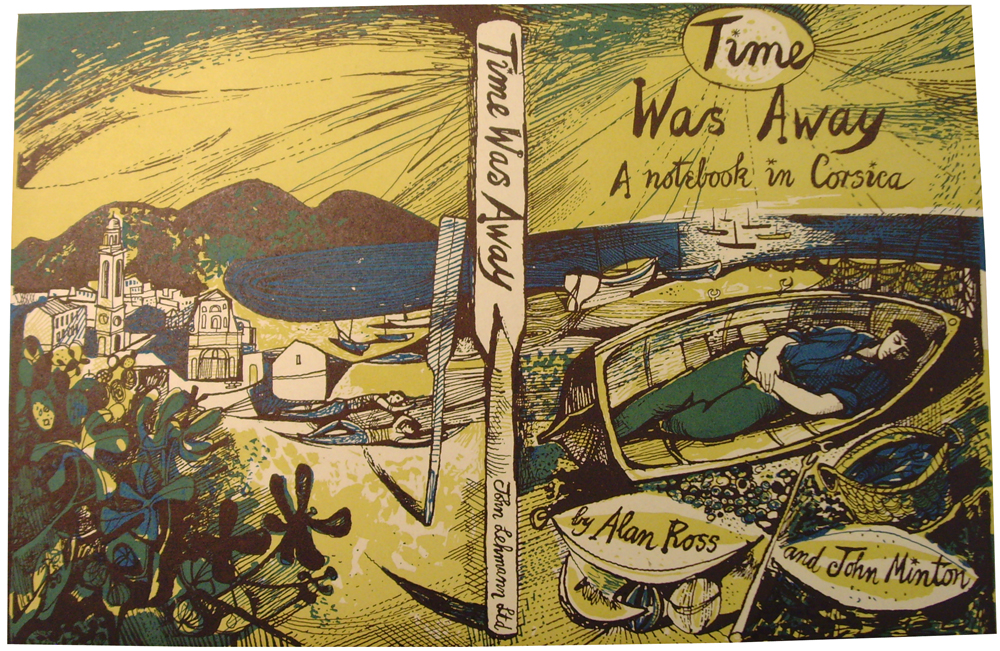
In 1947, a year before Dorothy Carrington and funded by the publisher John Lehmann he travelled to Corsica with the poet Alan Ross to work on a travel book Time Was Away – A Notebook in Corsica. This contributed to post-war Britain’s cultural rediscovery of the Mediterranean which was accompanied by a culinary rediscovery championed by Elizabeth David (also published by John Lehmann).

“It was rugged travel; the hotels where we stayed were basic and often dirty. We lived on bread, cheese, figs, pastis and wine. The bus journeys were slow and suffocating, with long stops for no particular reason. One day we would be languishing in the humid heat of an estuary, the next exhilarated by sweet mountain air, waking to forests and mountains.”

From Time Was Away by Alan Ross, Illustrated by John Minton.

Corte, Corsica 1947 John Minton 1917-1957 Purchased 1959 http://www.tate.org.uk/art/work/T00237

Corte, Corsica 1947 John Minton 1917-1957 Purchased 1959 http://www.tate.org.ukIMG_0184

In Corte, Corsica – the island’s historic capital is drawn as a mountain village in a composition which squeezes everything in and captures the essence of the place, from the river to the citadel and the mountains all of which seem to be supported by a single arch of the Punte Vecchiu bridge over the Tavignanu river. The sketchy rough-drawn map which was the frontispiece of Time Was Away is somehow infused with the the blazing sun and the smell of the sea.

Troubled by drink and relationship problems Minton turned towards narrative work. He was highly critical of the growing abstract movement which he felt was killing the skill of observation. He mocked abstraction and submitted at least one abstract painting to a group show under a false name and had it accepted. He later satirised the abstract artist as ‘Grisby Flatpattern’ in a magazine article.

John Minton’s work stands out for its truthful expressiveness. In a lecture on the meaning of art, he said:

“here is the living moment made concrete, the particular made from the general, the symptoms diagnosed, the order made from the disorder”

Sadly, his own search for order was not successful and he took his own life by overdosing on sleeping pills at his London home in 1957. His haunting unfinished painting ‘The Death of James Dean’ can be seen at Tate Britain.

The definitive biography of John Minton is Dance Till the Stars Come Down by Frances Spalding.

41GFJKZXNWL._AC_UL320_SR226,320_

Other posts on Corsican themes:

Seneca in Corsica (August 2014)

Conrad in Corsica (August 2014)

Paoli in London (March 2015)

Corsican proverbs and sayings (August 2014)

Posted in Culture | Tagged , | 5 Comments

Embracing the canon, resisting the canon

The BBC’s Ten pieces is a brilliant music education resource for primary schools based on a selection of 10 pieces which introduce children to classical music with a range of associated materials for schools to use. Although there is nothing specifically ‘primary’ about these pieces, they will be followed in the autumn by 10 carefully chosen secondary pieces.

We can disagree with the selection, it is drawn from a western canon and neglects more musical traditions than it includes. We could easily propose some very sound alternatives and each one might contain 10 entirely different pieces of music.

Does this invalidate this particular selection? Like all canons, Ten pieces is an introduction, a gateway to further experiences. It offers young people across the country the possibility of a shared experience of this music. Primary pupils across the country will be working on the same pieces and will be able to discuss them and become familiar with them collectively. The focus on just 10 pieces allows deeper study within a reasonable range while also providing a stepping stone to many other musical experiences via other work by the same composers, music with similar themes or in similar genres or even contrasting works.

So what are we saying when we propose a canon?

First of all we are saying: ‘we think his stuff is good, it’s worth getting to know because it will enrich your life and you’ll probably enjoy much of it too.’

We are also saying: ‘this stuff belongs to us all, it’s part of our cultural heritage and you’ll be missing out on a human entitlement if you don’t know about it and engage with it.’ More specifically, ‘it belongs to you’, it’s not being done to you or imposed on you. It will evoke a specific personal response in you and this will grow and change over time as you interact with this and other cultural products.

Finally, we are saying: ‘each of us can build our own personal canon drawn from the widest possible range of cultural experiences. For that to be possible, we need to be introduced to that full range, to understand what we can get from it and to be critical in our  response to it’.

Of course there is a danger that we might also be saying: ‘this stuff we’ve chosen is better than everything else and nothing else is worth considering’

Reinterpretations of classics can be controversial. Do they disrespect or enhance their canonical value? Contemporary attempts to refresh established works and make them ‘relevant’ by changing some aspects while keeping others don’t always add and can sometimes take away. But all new cultural activity draws on previous activity and taking inspiration from, or messing with, an acknowledged classic is not necessarily a sign of a lack of ideas and it guarantees neither success nor failure.

If we place a single canon on a pedestal and confer unique authority to its contents we can end up with an imposed model of cultural value. This is the path to fossilisation and cultural totalitarianism. It suggests a lack of confidence in our choices and a reluctance to justify them as well as a refusal to accept that radically different ways of seeing and doing things might actually improve on the old and established ways. Such an approach also implies a kind of cultural stasis which has never existed and suggests that all the best work has already been done – a kind of ‘end of culture’ which is just as ludicrous as the ‘end of history’.

On the other hand indulging in an ‘anything goes’ relativism which claims that all cultural products are of equal value and which rejects any attempt to apply objective standards, is to avoid making any judgements or acknowledging any kind of qualitative difference between cultural experiences. This offers no opportunity for genuine learning and must surely be a dead end.

If a canon, like a curriculum, is a ‘selection from the culture’ in Denis Lawton’s words – drawing on Raymond Williams concept of a ‘selective tradition’ –  the important question becomes ‘who is doing the selecting, on what authority and what is their perspective?’. It is only by broadening, diversifying and democratizing the process of canon-making or curriculum design that we can have important debates about culture and values. There can be many competing canons in the marketplace of ideas but they need to have some credibility and status in order to be worth criticising.

So I suggest that the best response to any proposed canon is a dual one; both embracing and resisting it. If it’s been designed with good motives, we should engage with it seriously on its own terms while also seeing it as one of many provisional and necessarily flawed attempts to summarise the best a culture has to offer. We can then challenge and debate it as part of a process of proposing improvements or even a completely fresh start. We need to take both a historical and critical perspective, doing justice to both the grammar and the dialectic.

To state the obvious: what matters to us matters. If it is worth describing, it is worth debating and disagreeing about. What others propose as a worthwhile canon is a challenge to all of us. And how we respond to that canon matters to each of us as we set about the lifelong task of building and arguing for our very own personal canon. But without a canon to embrace there is no canon to challenge.

See also:

Learning is dialectical (April 2015)

Gramsci’s grammar and Dewey’s dialectic (December 2014)

10 things music teaches us about life (November 2014)

Learning to love liberal education (October 2014)

Culture, tradition and values in education (March 2014)


sideelevation2

Posted in Culture, Education, Teaching and learning | Tagged , , , , , , , | 4 Comments