Which counts most 16-18: disadvantage or prior achievement?

What are the respective impacts of socio-economic disadvantage and prior achievement on student success post-16?

We now have measures which help us to understand and compare both. These data are very useful at institutional level to establish the difference between the profile of a particular sixth form and the national average, both in terms of disadvantage and prior achievement and therefore to contextualise the performance of students in that sixth form.

But what do the national data tell us about the relationship between these factors and student performance overall?

When sixth form colleges are ranked in terms of the socio-economic deprivation of their students and their success rates are divided into quartiles (25% of colleges) and compared, what emerges is…actually not very much.  At AS and A level, only in the least disadvantaged 25% of colleges do students do better on average with a success rate of 88% while students in each of the three other quartiles, including the most disadvantaged 25%, achieve on average a steady 85% success rate. For advanced vocational courses, the relationship is inverted with students in the most disadvantaged quartile achieving 83% success rates on average while each of the others achieve 82%. Neither of these relationships provides any correlation and certainly not in a consistent direction.

The figures at level 2 and level 1 are even more difficult to interpret. From most disadvantaged to least disadvantaged, they are:

Level 2: 87%, 84%, 81%, 88%

Level 1: 88%, 89%, 83%, 86%

Hardly what one would call a pattern in either case.

These data are from the 2012 Ofsted Socio-economic performance indicator (SEPI) report.

So, there would seem to be little evidence for our intuitive sense that more disadvantaged students face more barriers to success and would therefore be expected to achieve lower success rates. While this may be true at 16, it doesn’t seem to be true at 18.

But when we look at the effect of prior achievement, the story is very different. All the available measures of value added confirm a strong link between prior achievement and A-level success rates and grades. In fact, the whole value-added methodology relies on this correlation. Nick Allen’s ‘Six dimensions’ report for example has average AS level success rates ranging smoothly from around 96% for students with an average GCSE point score of 7.0 or more down to below 60% for those students who started with GCSE point scores of 4.7 or below. At A-level, where there has been more ‘weeding out’ of lower achieving students, the correlation is still strong, ranging smoothly from around 98% to around 91%.

Students’ chances of getting high grades at A-level are dramatically affected by their prior achievement. If your average GCSE point score was 7.0 or above, you have an 80%+ chance of achieving a grade A*-B at A level, while at the 4.7 end of the range that chance is barely 15%.

These data are form the Nick Allen ‘six dimensions of performance report’ for 2014 and are overall averages. There are significant variations by subject.

The message seems clear: students who do well at advanced level are those who have already done well at GCSE level and it seems that this deterministic message rolls through the whole of a young person’s schooling meaning that there may well be a strong correlation between the performance of young children at primary school and their eventual sixth form performance. The depressing conclusion is that we’re not really breaking the cycle of disadvantage.

But what about those socio-economic data which seem to suggest no real correlation between disadvantage and achievement at 18?  Well, these should be taken with a heavy dose of contextual salt. The students progressing onto, and entering, qualifications at each level post-16 are only the subset of the whole cohort who have met the entry requirements for those qualifications. They have already crossed an important threshold and are therefore already selected for success. Any impact of socio-economic disadvantage on their success will already have happened and, if it is negative, this will prevent them from even getting to the starting post of the higher qualifications.

If we really want to understand the impact of socio-economic disadvantage on achievement at 18, we should compare the profile of those who do well with the profile of the whole age cohort. When this is done, I suspect a rather more depressing message emerges. There is a lot more that education and society as a whole have to do before we can say that opportunities are genuinely equal for all young people.


Posted in Education | Tagged , , , , , , , , | Leave a comment

‘Lo! A child is born’ – Hugh MacDiarmid

From Lo! A child is born by Hugh MacDiarmid (1892-1978)

I thought of a house where the stones seemed suddenly changed

And became instinct with hope, hope as solid as themselves,

And the atmosphere warm with that lovely heat,

The warmth of tenderness and longing souls, the smiling anxiety

That rules a home where a child is about to be born.

The walls were full of ears. All voices were lowered.

Only the mother had the right to groan or complain.

Then I thought of the whole world. Who cares for its travail

And seeks to encompass it in like loving kindness and peace?

The full poem is available hereMACDIARMID/HUGH/MORGAN.

The collected works of Hugh MacDiarmid are available here:

Posted in Poetry | Tagged , | 2 Comments

Market madness #6 Students as commodities: premium, discount and remaindered

Eddie Playfair's avatarEddie Playfair

Enrolment is always a challenge. We come back from our holidays to an empty college. Like someone organising an open house, we’ve stocked up on a range of snacks and drinks for our guests but we can’t really be sure that anyone will actually turn up. It’s conceivable that every single person who said they would come will find something better to do. We start with no students and we have to enrol every single one before we can start doing our job and actually teach them.

Ideally, of course, our future students are already out there, having made their minds up ages ago after visiting, given much though to their application, attended an in-depth interview, been well advised and made a well-considered choice. They turn up with the results they expected and enrol on the course they said they wanted. Everything goes swimmingly and before you know it the…

View original post 521 more words

Posted in Education policy | Tagged , , | Leave a comment

Market madness #5 Qualifications as currency

A series of short posts about the marketisation of public education: #5 Qualifications as currency.

All economies need a currency which we all use to represent the value we give to things and which can be exchanged for real things. A currency allows us to convert labour into goods or capital and back again.

In a credentialised education economy, qualifications are effectively the currency. They represent an investment of effort and commitment to acquire knowledge and skill to a certain level and they can be traded in the labour market for access to further educational and job opportunities. More currency equals a greater chance of success and understandably everyone one wants more of that.

Individuals are judged by the qualfications they have obtained and there is a strong correlation between the highest level of qualification achieved and lifetime earnings.

Education providers are also judged by the volume and type of qualifications their students obtain. For example, A-level grades can be converted to points making it easy to quantify the value of qualifications from A* to E. There is also considerable differentiation, with facilitating A-levels at the high-value end of the market and vocational qualifications in the bargain basement. In fact, despite having a UCAS tariff, these qualifications are not even the same currency at all in some markets, such as the performance tables.

So, as well as students themselves being judged by qualification measures, schools and colleges can be ranked by the volume and value of the qualifications they provide to their students. And as riches beget riches, the tendency is for those that have to attract more. This is true at the student level where those most likely to do well at one level are those who have already demonstrated the ability to do well at the level below. It is also true at the institutional level where attracting already successful students is the best guarantee of greater success.

As with the profit motive in the financial economy there is a real danger that the rush to accumulate currency takes precedence over the real productive and sustainable value of economic activity. Labour simply becomes a means of earning money and capital a means of accumulating more wealth with little thought given to human values and social purpose. Equally, with qualifications, we risk seeing the qualification as the goal rather than valuing the learning which it symbolises.

Also, the value of a qualification, like that of any currency, is affected by its supply or scarcity. The more common it is, the less value it has, leading to a recalibration of the currency’s value – devaluing it and sending people scurrying to look for a better, scarcer and therefore more valuable qualification.

Where being qualified and therefore ‘educated’ is a positional good we live with the paradox that the more skilled and qualified we all become, the lower the value of our qualifications – in effect we have to run faster to stand still.

One solution is to ration the supply of high grades to a fixed amount or to recalibrate upwards by constantly making qualifications ‘harder’. This preserves the inequalities inherent in the system and does nothing to recognise the real educational progress being made. Such economic solutions devalue our educational objectives.

Is it possible to imagine a different system? One where learning and demonstrating skill are valued without requiring constant measurement and comparison? Could we find ways to lift those learners who have least access to the all-important currency and help them achieve an agreed national threshold? Could we learn to celebrate learning and achievement without the need to endlessly rank and classify learners? Could we decouple education from the market?


All the Market Madness posts:

Market madness #1 Oversubscribed?

Market madness #2 “Choice and diversity”

Market madness #3 The well-informed educational consumer

Market madness #4 A good system can help schools improve

Market madness #5 Qualifications as currency

Market madness #6 Students as commodities: premium, discount and remaindered

Market madness #7 What markets do to us

Posted in Education policy | Tagged , , , | Leave a comment

Investing in East London’s future

Our annual analysis of the university destinations of our students always makes impressive reading. While we can’t guarantee that every former NewVIc student who progresses to a degree level course will get a graduate level job in a few years’ time, we can be fairly confident that they are acquiring the skills which will help them to be more competitive in the labour market.

Overall, 707 NewVIc students progressed to Higher Education in 2014. This year saw a 22% increase in the number progressing to the highly selective Russell Group institutions as well as equally selective and specialist universities such as SOAS, the Institute of Education, Ravensbourne and the University of the Arts, London. 73 NewVIc students progressed to Russell Group universities, 16 of whom were vocational students. 2 of our students progressed to Oxford University.

Of these 707 progressors, 343 had studied A levels and 364 had studied vocational courses such as BTEC Extended Diplomas. These vocational students often progress to the same degree courses as their A level peers and in some cases are better prepared for the demands of further professional study and like the young woman who progressed to a Law degree at Leeds University with a Extended Diploma in Science, they are not always bound by their vocational specialism.

Some people claim that vocational learners are ill-equipped to contribute to the economy or that somehow they are to blame for whatever skill shortages there are. This would appear to be disproved by the sheer numbers of our vocational students progressing to specialist and competitive degree level courses which will put them in a good position when they graduate.

83% of our class of 2014 are studying in the London area and will continue to live at home. Far from being a disadvantage for these students it means that they can keep their maintenance costs down and benefit from their existing support network. Many will also continue to volunteer or mentor in the local community or at their former college during their undergraduate years making a sustained commitment to community cohesion and developing their successors.

Taken as a cohort, the class of 2014 look like a team of professionals capable of running a small country. When you consider that this is just one of many East London colleges and a fairly typical year, the vital contribution of East London’s post-16 education providers becomes evident.

A brief summary of the degree courses of the NewVIc class of 2014 by broad area:

(the numbers don’t add up to 707 as the final course is unknown for a few of the students who progressed)

Science, Technology, Engineering and Maths: 205 students

Includes 69 engineers (aeronautical, civil, electrical, mechanical, software etc.), 52 health related (including 9 pharmacists/pharmacologists, 9 nurses, 6 podiatrists, 5 medical students, 3 radiographers and 2 optometrists), biologists, chemists, physicists, forensic scientists etc.

Economics, Business, Management and Accounting: 148 students

Includes 63 business, management and finance, 43 accountants and 15 economists as well as international business, marketing and human resources specialists.

Humanities and Social Sciences: 89 students

Includes 34 studying Psychology and related degrees, 16 studying Politics, development studies and international relations, 16 historians (including 1 Egyptologist), 8 sociologists, 7 geographers, 7 studying philosophy or religion and 1 anthropologist.

Visual and Performing Arts: 62 students

16 performing artists (dance, drama, music and music technology), 15 studying digital creative media and photography, 14 studying art, fashion, illustration, textiles and graphics, 11 studying film production or editing, and 6 architects.

Law and Criminology: 51 students

29 lawyers and 22 criminologists.

Education and Social Work: 51 students

24 studying early years or early childhood studies, 16 education studies including special needs, 9 teaching (primary and English), 2 studying social work.

Sport, Travel, Tourism and Event Management: 46 students

31 studying sports, coaching, PE or football studies, 15 studying tourism, airline and travel or event management.

English and Languages: 41 students

Including 14 students studying English literature, language or linguistics, 7 journalists and 7 creative writing students and 3 language students (1 Arabic, 1 German and 1 Hispanic studies).

While we are justly proud of these students’ achievements, it would be wrong to claim all the credit for their progression to university. It takes a whole education system to make an undergraduate and their primary and secondary education made a vital contribution to building their academic and social skills as one of our 2014 Oxford University progressors, Rumana, acknowledges here.

Looking at the fantastic range of degree courses our students are progressing on to it is clear that this cohort, like those before them, represents a colossal investment in the future of East London. Between them, they will be offering a phenomenal level of skill, dynamism and commitment to every sector of the economy of their city. Let’s hope that economy is ready to make the most of them.

More on NewVIc students’ achievements: College success with disadvantaged students.  How to achieve high university progression rates.   Guess what? Vocational students go to university too.   London’s colleges promoting social mobility.   Colleges are real engines of social mobility.

Full-time prospectus

Posted in Education, NewVIc | Tagged , , , , , , , , , , , , , , | Leave a comment

L’inspection en Angleterre

Comment fonctionne l’inspection des établissements en Angleterre? Comment est-elle ressentie par les enseignants et les chefs d’établissement sur le terrain ? Le bilan du système anglais est-il plutôt positif ou négatif ?

Si vous êtes enseignant en France vous aurez peut-être rêvé de travailler en Angleterre. Méfiez-vous, l’enseignement en Angleterre vous sera peut-être moins attirant après avoir consulté ce petit guide de l’inspection outre-manche.

Notre inspectorat national s’appelle OfSTED (Office for Standards in Education). C’est un organisme d’état quasi-autonome qui est responsable pour l’évaluation de la qualité de l’enseignement et de l’apprentissage dans tous les établissements : écoles, collèges, lycées et centres de formation.

OfSTED est dirigé par l’inspecteur en chef de sa Majesté – Her Majesty’s Chief Inspector (HMCI). Nommé par le gouvernement mais indépendant, il s’engage de façon très publique à l’amélioration des niveaux éducatifs et contribue ses opinions vigoureusement au débat national. Le titulaire actuel, Sir Michael Wilshaw est lui-même un ancien chef d’établissement du secondaire Londonien avec une réputation de ténacité et d’engagement sans compromis et ses inspecteurs sont formés à son image. Ses commentaires et son rapport annuel sont le sujet de nombreuses polémiques.

OfSTED emploie une haute direction permanente qui dirige les inspections, mais les équipes qui visitent les établissements sont sous-traités a des organismes privés sous contrat qui emploient des inspecteurs à temps partiel, ce sont souvent des cadres enseignants issus du terrain. OfSTED propose de réintégrer tous les inspecteurs dans leur emploi direct.

Il n’y a aucun  organisme officiel national pour le soutien des établissements en difficulté. Normalement, OfSTED n’a aucune relation avec l’établissement: ni avant ni après une inspection. Il n’y a que si l’établissement est jugé au-dessous de la moyenne à l’inspection que l’inspectorat leur propose un suivi en proximité ; une visite trimestrielle d’un inspecteur qui assure que les progrès sont rapides et maintenus.

On peut s’attendre à une inspection entre 2 et 6 ans d’intervalle. Ils sont très légers si l’établissement est très performant et plus fréquents si il y a une baisse du taux de succès étudiant. Le régime d’inspection change à chaque cycle, il est donc rare d’être inspecté deux fois de suite sous le même régime.

Il n’y a que 4 niveaux:

1: Exceptionnel,

2: Bon,

3: Besoin d’amélioration et

4: Insatisfaisant.

Il y a quelques années, avec 5 niveaux, il était possible d’être ‘moyen’ ou ‘satisfaisant’. Avec 4 niveaux ce n’est plus possible. Nous craignons donc tous le ‘grade 3’ et nombreux sont les établissements dont les résultats sont à la moyenne nationale qui le reçoivent. En effet, être à la moyenne nationale c’est avoir ‘besoin d’amélioration’.

Un rapport négatif d’OfSTED, en particulier un ‘grade 4’ peut mener à des interventions très rapides, dont  la fermeture ou la relance de l’établissement sous une nouvelle direction que ce soit un nouveau chef d’établissement, une nouvelle équipe de direction ou un nouveau conseil d’administration. L’inspection peut détruire les carrières, précipiter les démissions et les préretraites.

Les rapports sont d’une dizaine de pages et paraissent en public sur le site internet d’OfSTED et les medias les citent régulièrement et ils sont souvent  le sujet de débats publics. Ils ne sont pas universellement admirés ou respectés ; de nombreux professionnels et syndicats enseignants accusent OfSTED de jugements incohérents. Mais quand les jugements sont bons, les établissements eux-mêmes citent ces rapports et ‘OfSTED Outstanding’ ou ‘OfSTED Good’ figurent sur de nombreux web sites d’établissements même plusieurs années après leur inspection.

Avant le fait, l’inspectorat entreprend une analyse profonde des données et des statistiques disponibles. Ils forment des hypothèses à l’avance et ils se penchent surtout sur le taux de succès par rapport aux moyennes nationales, cela a un rapport étroit avec le succès au départ et c’est assez peu contextualisé. Ils cherchent à comprendre les résultats et les tendances récentes d’amélioration ou de régression. Ils étudient aussi le projet d’établissement et le rapport d’auto-évaluation annuels proposés par l’établissement et accessibles sur un site internet. Ils se demandent si tout cela fait preuve d’un engagement urgent pour l’amélioration.

Ofsted prévient l’établissement 1 jour ou 2 avant une inspection qui dure normalement de 3 à 5 jours. Typiquement, le chef d’établissement reçoit le coup de fil Jeudi pour l’arrivée des inspecteurs le Lundi prochain. Pas question de se détendre ce weekend la !

Que mesurent les inspecteurs? Les journées sont dominées par les observation de cours sans preavis et les ‘learning walks’ – promenades éducatives – qui peuvent suivre des thèmes, des étudiants ou enseignants. L’accent est fortement sur l’apprentissage et le vécu étudiant. Un cours bien préparé, ou l’enseignant fait preuve de son expertise – tout cela ne compte pour rien si les étudiants ne font pas preuve d’avoir acquis des connaissances a un rythme approprié.

Les inspecteurs proposent aussi des entretiens avec les responsables à tous les niveaux, membres du conseil d’établissement, la direction, les étudiants, les parents et les partenaires sociaux.

Les notes sont attribuées en 3 catégories :

  1. Les résultats : y compris le taux de succès, les progrès par rapport au point de départ, l’égalité des chances (analyse par gendre, ethnicité et besoins spéciaux), l’assiduité, le comportement et le taux de progression interne et externe, vers l’emploi ou l’université.
  2. La qualité de l’enseignement et de l’apprentissage: surtout basée sur les observations de cours, l’analyse des commentaires sur les devoirs et l’intégration des ressources, y compris du numérique.
  3. La direction et la gestion à tous les niveaux, gouvernance, direction et travail d’équipe de toute sorte. Les dispositifs de protection des mineurs et de prévention de l’extrémisme violent figurent aussi.

L’établissement reçoit aussi une note globale ; la moyenne de ces trois notes – par exemple un 3 si les notes sont : 3, 2 et 3. Chaque équipe inspectée reçoit aussi une note individuelle – par exemple Sciences et Maths, Anglais etc.

L’établissement nomme un membre de sa direction, le ‘nominee’, qui assure la liaison avec l’équipe d’inspection et assiste à une part de leurs discussions quotidiennes. Ce collègue ne peut pas participer aux jugements mais peut offrir de données ou des preuves pour informer le débat. Le président de l’équipe d’inspection fait un rapport oral quotidien au chef d’établissement et présente un bilan oral avec les propositions de notes le dernier jour de l’inspection – souvent en présence d’un représentant du conseil d’etablissement.

Apres le départ des inspecteurs, l’établissement se retrouve seul à gérer les conséquences ; le soulagement ou la déception et les effets sur le moral de l’équipe entière. Le rapport écrit sera publié environ 6 semaines plus tard et tous les éloges et toutes les critiques seront révélés au grand public.

C’est donc un système assez impitoyable et les avis sont partagés quant à savoir si l’éducation anglaise en bénéficie globalement.

Collègues Français, qu’en pensez-vous ?


Vous pouvez lire d’autres billets en Francais:

Le numerique en questions: une perspective anglaise

Socrate et le numerique 

Mon Français laisse beaucoup à désirer et je suis toujours heureux de recevoir vos commentaires et corrections.


Posted in Education, en Francais | Tagged , , , | 4 Comments

Gramsci’s grammar and Dewey’s dialectic.

James Donald’s ‘Dewey-eyed optimism’

Over 20 years ago I read a short review article which re-examined the relationship between knowledge, skill, vocationalism and a broad liberal education. It helped me see that progressive educators could value knowledge and tradition as well as equality and democracy. It helped confirm my view that a good education has to both embrace the canon and challenge it and that learning is dialectical in that it constantly pits the known against the unknown.

The article was James Donald’s Dewey-eyed optimism: The possibility of democratic education in the March/April 1992 edition of New Left Review (which was unusual in publishing two articles on education). It led me back to James Donald’s contribution to Is there anyone here from Education? which he co-edited in 1983 and his brilliant Sentimental Education from 1992. It also led me further back to John Dewey and Antonio Gramsci.

In the article, Donald considers the view of Dewey and others on the role of public education in creating and nurturing a democratic society. Rather than deriving the education system from fixed assumptions about human nature, identity or community, John Dewey writing in 1916 recommends an experimental approach which values continuous critical reflection about the way we do things and which allows for the possibility of social change. Several decades later, Richard Johnson, working at Birmingham University’s Centre for Contemporary Cultural Studies in the 1980’s develops the idea that schools are cultural institutions and imagines forms of education which do not impose a single identity in a diverse society but which are able to construct community through dialogue.

Reading this heady ‘democratic constructivism’ it was easy to get excited by the idea of the school as a site for building democratic and egalitarian social relations and to see our job as teachers as helping to build, or at least model, a better world from the bottom up. I’m still motivated by this while being reminded daily that we and our students inhabit the world as it is and that the materials for a better world are not always lying around in neat stacks waiting for us to pick them up.

It also occurred to me that accommodating and exploring difference requires some shared values, a common set of assumptions and skills in order for learners to venture out of their comfort zone. Strong affiliation to class, culture, religion etc. can provide a grounded confidence but this needs to be combined with an openness to difference, dialogue and conflict or it can be limiting and debilitating rather than liberating and affirming. Public education is a vital setting for building shared values as well as exploring difference.

And what of the place of knowledge in all this? James Donald asks whether public education can produce the ‘really useful knowledge’ which we all need. He turns to Antonio Gramsci, writing in the 1930’s, who emphasised the role of the school and teacher in instituting cultural norms, values and hierarchies. Donald wants to marry this need for tradition and knowledge with the practical Deweyan construction project. In his words ‘individual agency is always authorized in relation to such norms…education must involve the sceptical articulation of tradition – a necessarily recursive and experimental process.’

It seems to me that, to use the terms of the Trivium as recently refreshed by Martin Robinson, Donald is saying that we need to teach both grammar; the essential foundational, canonical knowledge, structure and rules, and the dialectic; the testing, questioning, challenging, ‘taking on’ and if necessary dismantling of that knowledge. So perhaps we need a democratic traditionalism as well as a dialectical radicalism: Gramsci’s grammar plus Dewey’s dialectic.

In the section on ‘radical vocationalism’ Donald is critical of the contemporary vocationalism which was based on spurious claims to deliver economic goods and is in fact de-skilling and an undermining educational practices. He argues for a democratic, modern and intellectual education for all which is not about preparing certain students for low-level occupations but makes it a priority for young people to understand work and the economy.

Claims that the right kind of vocational education will solve our economic problems are still being made and they are as spurious as ever. The divide between general/academic and vocational pathways is still alive and well and parity of esteem as elusive as ever. We would do well to consider the suggestion that a liberal, cultural and practical education for all young people may well be the best preparation we can give them for the labour market.

Donald is also critical of the ‘creativity and self-expression’ tendency among progressive educators. He regards the ‘disabling idea that education should be about the full expression of the development of people’s creative potential’ as being a ‘vaguely hedonist, vaguely puritan notion of teaching as therapy’. He feels that, together with the ‘rhetoric of education as displaced politics’ this ‘has been the undoing of so much progressive work’.

Donald is right to warn against the voluntary displacing of the teacher as a source of academic knowledge and cultural authority and he was doing so at a time when this was a far from common position. From displaced teachers to ‘displaced politics’, it is always worth being reminded that our aims should be developmental and universalist and not about reproducing existing inequalities or promoting any particular political view. Whether in citizenship or enterprise education or any other area, we need to avoid the many opportunities to indoctrinate which education offers while bearing in mind that education cannot be free of all ideology, even a basic consensus statement of national values has some ideological basis.

James Donald finds nothing outmoded in Dewey or Gramsci, in fact he regards them as ‘the only possible dynamic of democratic education’. I think he has a lot to offer a contemporary readership, above all the possibility of a synthesis of progressive and traditional strands of educational thinking which could really move the debate forward.

See also:

Learning to love Liberal Education

Review of Martin Robinson’s Trivium

Posted in Education, Philosophy, Reviews | Tagged , , , , , , , | 1 Comment

Exam success boosts the economy by £1.3 Billion?

Simplex and Sapiens are discussing the latest press release from the Department for Education.

Simplex: Have you seen the latest figures for GCSE results under this government? They’re truly amazing!

Sapiens: You mean the proportion of 16 year olds achieving 5 or more A*-C grades including English and Maths?

Sim: Yes, a really gigantic increase over 4 years!

Sap: Up 3.7% from 44.1% to 47.8%? Obviously good news but it’s still less than half the cohort.

Sim: Apparently this represents a truly enormous £1.3 Billion boost to our economy, so really outstanding news I’d say.

Sap: Based on assumed extra lifetime earnings of £60,000 each for 21,600 more young people?

Sim: Yes, a £1.3 Billion long term boost to the economy! Wow! That’s a really big number isn’t it? At this rate we’ll be qualifying ourselves out of the deficit.

Sap: Another way of saying this is an extra £1,224 per year per person, or £23.50 a week…

Sim: Well, if you insist on dividing things up then the numbers will get smaller…

Sap: Can you explain where this extra money is actually coming from?

Sim: Obviously more well-qualified students equals more earnings and hey presto…£1.3Billion!

Sap: But do these extra qualifications actually create new jobs or additional earnings?

Sim: Well…

Sap: Surely, all things being equal, more people with the same qualification level simply increases the competition between them for the same jobs and the better qualified will probably have greater access to the best paid work.

Sim: But all things aren’t equal, employment levels could rise, our economy could grow …

Sap: Indeed – and it could shrink too. None of which is directly caused by qualification levels.

Sim: Still…£1.3Billion eh?

Sap: Last time this was looked at in 2007, the lifetime earnings boost of 5 GCSEs or equivalent was estimated at £148,000 rather than today’s £60,000. And that was without even insisting on English and Maths.

Sim: Yes, but we’ve had a big recession since then.

Sap: You make my point for me.

Sim: You are such a spoilsport. Why can’t we just celebrate the success of our wonderful students?

Sap: I agree, let’s just do that.

Simplex and Sapiens have also discussed vocational education here.

Posted in Education | Tagged , , , , , | Leave a comment

Labour’s disappearing National Bacc

Has Labour ditched its commitment to a National Baccalaureate for 14-19 year olds?

According to the party’s Education and Children statement, Labour will ‘establish an overarching National Baccalaureate framework for all post-16 students which would include high quality academic and vocational courses’. This commitment follows the recommendation of the third report of the Independent Skills Taskforce chaired by Professor Chris Husbands of the Institute of Education. This report made the case for a broader curriculum framework for all young people based on 4 domains: core learning (GCSE, A level and vocational), maths and English, extended study or research and personal skills.

However, this key commitment doesn’t appear at all in Changing Britain Together, Labour’s latest summary of its main policy commitments in advance of the general election manifesto. The policies are drawn from the same Education and Children document but it seems that not all have made the final cut.

Instead, the section Creating opportunity for all young people only says: ‘Labour will introduce a new gold standard Technical Baccalaureate for 16-18 year olds’

The Husbands report supported the Tech Bacc but recommended that ‘the Tech Bacc should be part of a wider framework of skills, knowledge and experience; a new National Baccalaureate which all young people should undertake and which recognises learning and progression across the 14-19 phase.’ Husbands is recommending that the Tech Bacc should be contained within the broader and more inclusive National Bacc.

But, unless this is an accidental omission, it seems we are to get the part but not the whole. And we already have a Tech Bacc which is pretty good, so what’s new? If Labour’s Tech Bacc is anything like the government’s own version currently being piloted it is a welcome initiative which increases challenge and coherence in vocational programmes. But it is not the overarching one-nation framework we need and it does not really bridge the gulf between general and vocational programmes which forces students to make choices at 16 which are then difficult to un-make.

In Changing Britain Together, the Tech Bacc proposal is accompanied by a blistering attack on current vocational qualifications: ‘Our education system … has failed to provide alternatives for those who do not choose that [A level] path. As a result, many talented young people, for whom a quality vocational qualification would have been a better option, have been let down by a system that offers no clear route to a successful career’.

At best, this is gross hyperbole. The vocational qualifications being offered in post-16 colleges up and down the country are successfully providing very clear routes to professional careers. Just from my own college, 364 advanced vocational students progressed to university in 2014. They are studying for STEM, Business, Law, Art, Design, Media, Education and many other degrees, often on the same degree level courses as their A level peers. In that same year, how many of our students were able to find apprenticeships or full time training? A grand total of 18. The fact that there are so few employment vacancies for well qualified young people, including graduates, is an economic failure not an educational one. It’s simply not sustainable to blame vocational education for this.

So, how to explain the mystery of the disappearing Nat Bacc? Is Labour worried that it’s not a vote-winner? Or that it will divert from all the technical / vocational rhetoric? The reality is that such a development could command wide cross-party support and offer a popular way to symbolise what a one-nation 14-19 education means: a common framework for all, to stretch everyone beyond what is currently expected, to value different kinds of learning without segregating the ‘applied’ and the ‘theoretical’ and to celebrate the progress of all learners.

So, by all means let’s have the investment in apprenticeships and real jobs that young people so desperately need. But let’s also have the comprehensive framework which can bring all their learning together into a meaningful national award.

See also:

Building the Bacc from below

The forgotten 50% need a one-nation education system

Labour’s vocational vision: two-nation thinking wrapped in one-nation talk?

Posted in Education policy, Politics | Tagged , , , , , , , | Leave a comment

Building the Bacc from below

I was delighted to attend the National Baccalaureate summit on 28th November held at Highbury Grove School and hosted by Tom Sherrington, the headteacher. This was an opportunity for a range of people to take stock of the various baccalaureate-like frameworks which are currently available or in development and to consider the way forward following the report of the Independent Task Force chaired by professor Chris Husbands of the Institute of Education which proposed a National Baccalaureate (NB) for England. The summit was attended by educationalists and school leaders as well as representatives from the Department for Education and all the major awarding bodies.

We heard presentations about a number of different Baccs:

  • the Welsh Bacc which has recently be revised
  • The International Bacc, specifically the Middle Years and Diploma programmes
  • The AQA Bacc with its emphasis on broadening subjects and enrichment
  • The Mod Bacc at the Archbishop Sentamu Academy, Hull
  • The Headteachers Roundtable model

Liam Collins has posted a good summary of the presentations on the Headteachers’ Roundtable site here. I also circulated a briefing about the Sixth Form Bacc (SF Bacc) developed by the Sixth Form Colleges Association (SFCA) which is running successfully in 12 sixth form colleges and is awarded annually to around 2,000 students.

There has been strong support the idea of an inclusive national baccalaureate for all young people among practitioners for some time. It’s just that governments of either party have not had the political courage to follow though and create such a framework for England. The nearest we came to this in recent history was as a result of the Tomlinson report on 14-19 reform whose recommendation in 2004 of a common overarching diploma was rejected by the Blair government.

Tomlinson proposed a diploma framework at different levels which was made up of:

  • Main learning: specialist subjects which reflected young people’s strengths, interests and aspirations.
  • Core learning: compulsory English, maths and computing, taught and assessed in a way which related to their practical use.
  • An extended project: to replace coursework
  • The development of wider personal skills and citizenship and enrichment

Professor Ken Spours from the Institute of Education, a long standing advocate of baccalaureate frameworks, reminded us that there is nothing new in the call for a single inclusive and overarching framework based around what constitutes an educated young person. As Ken pointed out, every subsequent attempt will be seen as Tomlinson mark 2 and we need to learn from the failure to persuade government to adopt Tomlinson’s recommendations. One lesson stands out above all; the need to build a political consensus before any national launch, preferably based on successful practice on the ground.

Ken recommends 3 broad and overlapping stages for successful NB implementation:

  1. Preparation, consultation, design and capacity-building: to create a favourable context which sees bottom-up developments as concurrent with lobbying and persuading politicians.
  2. Using existing qualifications within an overarching National Baccalaureate: building on well-established general qualifications (A levels) and improved vocational qualifications within the new post-16 Programmes of Study and with a strong focus on skills for progression.
  3. Evaluation, refinement and more advanced design: looking years ahead towards more strongly collaborative local learning systems geared to providing the full range of opportunities to all young people.

Rather than relying mainly on persuading politicians to reform from above and waiting for them to act, those present agreed to adopt what Ken described as a civil society approach. In other words to act together as an independent network of institutions and awarding bodies to develop a voluntary new framework which could ultimately have the potential to work for the whole system. This bottom-up approach to curriculum change would require considerable collective maturity and compromise.

On the evidence of this summit, there is the will to try to make such an approach work and this is what was agreed. There will be further meetings and the project will seek to engage with politicians without being bound to electoral cycles or becoming dependent on political patronage.

In my view, such a development needs to:

  • Be based on clear, agreed values and make sense to parents and young people by offering something that is clearly better than what is available now. We need to create a consensus from the bottom and attract support from across the political spectrum.
  • Celebrate what young people know and can do and be able to generate new kinds of student achievement such as the ‘graduation masterpiece’. The benefits to all should be clear to all and it should be simple and compelling enough to be explainable persuasively by politicians when they are campaigning in elections.
  • Be inclusive and capable of containing the full range of current qualifications and existing Bacc frameworks without requiring them to change radically but without being so minimalist that it has no clear additional value or distinctive identity.
  • Be capable of being delivered at little or no additional cost. Post-16 learning in particular is desperately underfunded in England and there is a very strong case for additional resources. However, the case for curriculum change is too important to be seen as conditional on a demand for greatly increased funding. The Bacc argument may need to be won first before “now make sure it’s properly resourced” can become compelling.
  • Open up a longer term debate about the need for greater curricular breadth post-16 and be capable of evolving into a national framework which could work for all 14-19 year olds.

If we think all young people in England deserve a broader, more challenging and more inclusive upper secondary education we need to be ready to commit to the necessary constructive curriculum reform ourselves. So, let’s get to work and build our Bacc from the bottom up.

See my post here on the National Bacc from March this year. I have also posted here about the need for a sixth form student research culture.


Posted in Education policy | Tagged , , , , , , , | 1 Comment

A few things we know about the universe. Science in Society 7

The scale, origin and future of the universe

The Earth is one of the 9 known planets which orbit the Sun. It takes one year to make a complete orbit. The planets are very small compared with the distances between them. Other smaller objects also orbit the Sun, some on orbits which are very elliptical. These can come close to Earth or even hit it (meteors, meteorites). Others can form comets. Several of the outer planets are quite different in composition from the Earth, much larger and largely composed of gases. Only the Earth appears to be able to support life as we know it.

The solar system was formed about 5 billion years ago. Surface features of several other planets and moons show similarities to features on the Earth, suggesting a common origin. The Sun is a star. Stars form from clouds of gases being drawn together by the force of gravity. In stars hydrogen atoms join together (fuse) to form helium atoms. This fusion releases energy. This energy is emitted at a fairly constant rate until most of the hydrogen is used up, probably in about 5 billion years for our Sun.

The Sun is one of billions of stars clustered in a group called the Milky Way galaxy. The size of this galaxy is huge, even compared to the distances between our Sun and the nearest stars. Light travelling at 300 million metres per second takes about 100 000 years to get from one side of the galaxy to the other. Most of the galaxy is empty space. There are millions of other galaxies in the Universe. The distances between galaxies are very large compared to the size of the galaxies themselves.

The distances between the galaxies are not fixed, but increasing. The Universe is expanding. Furthermore, the further apart galaxies are from each other, the faster they are moving apart. This suggests that all the Universe, all of space, matter, energy and time started from a tiny size with a huge explosion, the Big Bang, which occurred 13.7 billion years ago (or 1.37×10¹⁰ years ago).

“The discovery of the Big Bang and the recession of the galaxies came from a commonplace of nature called the Doppler effect. We are used to it in the physics of sound. An automobile driver speeding by us blows his horn. Inside the car, the driver hears a steady blare at a fixed pitch. But outside the car we hear a characteristic change in pitch. To us, the sound of the horn elides from high frequencies to low…if the car is racing away from us, it stretches out the sound waves, moving them, from our point of view, to a lower pitch and producing the characteristic sound with which we are familiar….

Light is also a wave…The Doppler effect works here as well…An object receding from us at very high velocities has its spectral lines red-shifted. This red shift, observed in the spectral lines of distant galaxies and interpreted as a Doppler effect, is the key to cosmology.”

From ‘The Edge of Forever’ chapter 10 of Cosmos by Carl Sagan.

Sagan goes on to describe the partnership of Milton Humason, who worked the mule teams during the construction of Mount Wilson observatory in California and then became an skilled telescope operator, and Edwin Hubble, the astronomer who worked at Mount Wilson from 1919. Humason and Hubble analysed the spectra of different galaxies and found that the further away they were the more they were red shifted, suggesting that the universe is expanding. The theory of an expanding universe was proposed by the Belgian priest, poet and astronomer Georges Lemaitre in 1927, two years before Hubble published his findings.

Time, size and gravity

Time since other events: 5×10⁹ years ago: birth of the Sun, 4×10⁹ years ago: formation of the Earth, 2×10⁹ years ago: first sign of life on Earth, 105 years ago: early humans.

Size of the observable universe: 1028m, a typical galaxy: 1020m, distance from Earth to Sun: 1011m, diameter of Earth: 1.3×10⁷m, a human: 1.7×100m, an atom: 10-10m, an atomic nucleus: 10-15m.

Gravity is the force of attraction between any two masses, including planets, stars and other objects in the universe. The strength of the force is proportional to the masses of the two attracting objects and inversely proportional to the square of the distance between them. Gravity is a very weak force and is only significant for very large masses.

Newton’s law of universal gravitation                F = G (m1m2) / r2

Where F is the force of gravity (in N), G is the gravitational constant (6.67×10⁻¹¹ Nm2kg-2), m1 and m2 are the two masses (in kg) and r is the distance between them (in m).

Worth watching:

The history of the universe in 10 minutes: https://www.youtube.com/watch?v=-Ip5BAEfZuA

Carl Sagan’s Cosmos, Episode 10 The Edge of Forever covers Hubble, the redshift, the expanding the universe and the Big Bang: https://www.youtube.com/watch?v=o8ENNgO4z5c&index=10&list=PLBA8DC67D52968201The series dates from 1980 but is still a brilliant introduction. The whole series is available on YouTube.

Neil Degrasse Tyson’s Origins documentary is also excellent: https://www.youtube.com/watch?v=D-EXw5CdPtM

A useful interactive guide to scale in the universe: http://htwins.net/scale2/

In 2005, the story of Milton Humason and Edwin Hubble was made into a musical The Expanding Sky by Stan Peal.

Questions

  1. Research the size, ‘day’ length, ‘year’ length and composition of the planets in our Solar system.
  2. What do you think would count as evidence for extra-terrestrial life?
  3. How might our ideas about ourselves change if we found evidence of extra-terrestrial life?
  4. Define the following words: cosmology, elliptical, galaxy, light year.

200909041100

Posted in Learning resources, Science in Society | Tagged , , , , , , , , , , , , , , , | Leave a comment

Education as a whole and in its parts

Creating a successful learning community

Our college mission is to ‘create a successful learning community’. While this only applies to our small part of the education system it’s not a bad aspiration for the whole system. So what would be the implications of applying this mission to education as a whole as well as in one of its parts?

Creating…

The future will be built on the past and to create something worthwhile we need to understand where we’ve come from and acknowledge the insights, knowledge and skills which have been handed down to us. Every change we make is work in progress; provisional and contingent. But even small, gradual and incremental change to the parts can eventually lead to radical change to the whole; quantitative change can become qualitative change.

Our college will be a different place in 5 or 10 years’ time but it will be built on the college of today. For instance, radically increasing the number of students who are mentoring others, studying in learning circles or engaging in original research would change the nature of our institution. Equally significant changes will occur when all students are routinely engaging in ‘blended’ learning using mobile, connected devices. These things all exist today but they have not yet transformed the college.

What of the vision of creating a better system at a national or global level? System improvement requires system values and system leadership. These may be lacking at the moment but we cannot wait around for someone else to provide them. Everyone, students, professionals and politicians, can play a role in shaping the aims and values of one part of the system while also helping to create the machinery and relationships for the whole system to work better.

In developing a shared vision of what we could create, we need to avoid simply accepting existing models, whether organisational, economic, technological, or environmental. Instead, we need to imagine what kind of education would prepare for the kind of society we want. For instance: if we want a vibrant, democratic, participatory civil society how do we set about equipping all young people to exercise critical judgement and use democratic means to be active agents of social change?

Success:

What are our measures of success for both the parts and the whole? At the institutional level, success is generally defined in terms of the proportion of our students achieving particular outcomes or in terms of the judgements inspectors make about us. Success is established using quantitative snapshots eg: ‘80% positive student ratings, 91% progression to university, 86% Success Rates’ and qualitative measures seem too nebulous, eg: ‘increased independence and confidence’ or ‘improving the lives of people in East London’. By isolating the parts and judging them separately, we can miss the impact of the whole and end up looking for the weakest link and attributing blame. Employers or parents blame schools and colleges and vice versa, the tertiary sector blames secondary education which blames primary schools and we all rush headlong into a dead-end of mutual incomprehension.

If we take a lifelong view of education, we acknowledge that each stage and each part makes a vital contribution. Each stage and part would be seen as part of a whole; a local or national education system. Instead of blaming each other for system-failure the parts or stages could start to share system-responsibility.

For an educated person looking back at a life well lived, the success of their education is about the success of the whole as well as the contribution of the parts. Whether as a worker, citizen, friend, lover or family member, they flourished as a result of the whole education of a whole person, a complex multi-layered and multi-faceted process with all the spill-overs, contradictions and tensions that entails.

What if educators from all sectors came together regularly to discuss the best way to educate whole people; about language, science, history, society, music, thinking etc? Could we come out of our various silos, use our different forms of expertise and create a whole which is more successful at developing educated people? We would almost certainly need new measures of success if this sort of work was to be valued.

Maxine Greene wrote that: “World class achievement and benchmarks seem superficial, if not absurd, in a world filled with inequality, fear and uncertainty” and she argued that, amongst other things, we should “foster increasingly informed and involved encounters with art” and I would add “…with others”. Lev Vygotsky said: “Through others we become ourselves”

Learning:

The process of educating a whole person involves a multitude of successive educational experiences, some carefully orchestrated, others unplanned. Along the way it is impossible to establish the point at which that person becomes educated; the precise moment of transition from quantity to quality. But we need some consensus about what the educated whole person looks like: knowledgeable, determined, skilled, questioning, critical, confident, what else?

For us to acquire knowledge it needs to be reduced to parts but we need to avoid seeing it as atomized or disconnected. Like Rabindranath Tagore we want an education “where the world has not been broken up into fragments by narrow domestic walls”

There is no such thing as education for its own sake, it is always for a purpose and our purpose is defined in relation to others. A successful learning community for young adults needs to recognise that the transition from childhood to citizenship, apprentice to worker, dependent child to autonomous adult is not a sudden one, it is built gradually through experience and requires making mistakes.

Our learning is accredited and valued in its parts, through qualifications, diplomas, profiles and reports and it is experienced in parts by the whole person. Ralph Waldo Emerson wrote that “life is a succession of lessons which must be lived to be understood”. But to be part of a coherent education, these lessons must also be connected to the whole.

Community:

In the same way that our individual identity is defined in relation to society, the value of each individual’s learning is also defined by society. The confident, thoughtful, critical individual may only be a tiny part of their society but they becomes an active and influential citizen when they start to think and act in relation to the whole of their society.

Our schools and colleges need to model the good society by fostering the kind of social relationships we want to encourage, based on: equality, community cohesion, reciprocity, service; ‘doing things for others’. Valuing this would certainly require new measures of success.

We can create egalitarian islands within an unequal community, not to protect our students from injustice or deny them the reality of the world as it is but to equip them with the practice of more egalitarian social relationships and the ability to enjoy both “popular” and “high” culture without elitism, snobbery or exclusivity.

Young people are an underused and undervalued resource. We need to build on their need to be active, useful and valued; to make a difference and show solidarity with others. If we made service learning the norm in our college and went from 400 people volunteering regularly to all 3,000 community members doing so, quantity would become quality and the college would become a qualitatively different place; making a significant additional contribution to the local community and economy.

“Education is a social process” and “We only think when we are confronted with a problem.” John Dewey.

Addressing the whole and the parts

In order to describe and create the successful learning community we need both to see the world big and see the world small; to think holistically and systemically, eg: ‘What’s the big picture, the whole story?’ as well as reductively, eg: ‘What’s my own understanding, my own area of expertise, my own role?’ We need to value both the whole and the parts. The parts acquire new meaning in relation to the whole. The whole emerges from the parts and has different characteristics. It itself acquires new meaning as part of a bigger whole. We need to make connections across the system and in everything we and learn to translate between levels, eg: ‘How can I contribute to the success of the system? What does national policy change mean for me?’

We need to acknowledge tensions and contradictions and explore them and we shouldn’t edit out ideology, conflicts of interest or differences in outlook. The relationship between the parts and the whole is dialectical. As Lev Vygotsky said, “Development is precisely the struggle of opposites”.

The successful learning community will be constantly questioning and changing. We need to recognise and promote change, growth and transformation; in ourselves, in other people, in society and in our organisations. We each do this by working within our zone of influence where we can be most effective. We need to promote a sense of agency, and urgency within our organisations and among our students and remind ourselves that change is possible.

The challenges faced by each of us in our part of the whole can often be overwhelming and the changes we can effect on the part, let alone the whole, can seem pitifully minor. But thinking through the relationship between parts and wholes and the process of change gives us a perspective from which to face the future with hope and confidence on the basis that education really can help to create a better world.

“Education is the point at which we decide whether we love the world enough to assume responsibility for it.” Hannah Arendt.

Based on a speech given at the University of East London in March 2010.

Posted in Education, Philosophy | Tagged , , , , , , , , , , , , , | 5 Comments

Better inspection for all?

A critical evaluation of the proposed new Ofsted inspection framework

The current Ofsted consultation “Better inspection for all” proposes a new common inspection framework for schools, academies, colleges, training providers and Early Years settings to provide greater coherence in our inspection system. School sixth forms will be inspected and graded in the same way as colleges, using comparable performance measures. The new framework will place greater emphasis on safeguarding, the suitability of the curriculum and ‘preparation for life and work in Britain today’ includes a new cross-cutting theme of ‘personal development’ and more frequent inspections for providers previously judged as ‘good’.

Good schools or colleges

For good schools or colleges there will be more frequent but shorter inspections as 5 years or more is regarded as too long a gap between inspections. These inspections will be roughly every 3 years and focus on ensuring that good standards have been maintained. Inspectors will be looking to see that headteachers and leadership teams have identified key areas of concern and have the capability to address them. For those who can show this there will be no need for a full inspection and there will not be a full set of graded judgements.

Personal development, behaviour and welfare

The 3 current cross cutting themes are joined by a fourth: ‘personal development, behaviour and welfare’ and inevitably we will have many questions about what inspectors will assess and how judgements will be reached. For attendance and punctuality for instance, it would be helpful to have national averages available together with a sense of what sort of levels would be judged to be ‘good’ or ‘outstanding’ in any particular area of provision.

Inspectors will be judging to what extent the provision is promoting young people’s ‘self-confidence, self-assurance and knowledge of their potential to be a successful learner’. The second half of that statement (‘knowledge of potential…’) sounds at least 2 steps removed from anything which can actually be observed or measured. Skills development and growing confidence are vitally important processes but they take place over time and are difficult to demonstrate in a snapshot inspection. We will need to see very clear descriptors of the kind of student confidence and independent learning which inspectors will be looking for.

The ‘personal, social, moral, cultural and spiritual development’ section suggests that provision should ‘provide access to cultural experiences’. This is very welcome following a cycle where inspectors seemed singularly uninterested in the breadth and educational benefits of extra-curricular enrichment seeing it something students ‘enjoy’ but essentially a footnote to the real learning. We strongly believe in a cultural entitlement for all students. But it needs to be said that when funding for tutorial and enrichment was cut by 85% this massively reduced the resources available for such activity and following further rounds of cuts, many colleges have had no choice but to discontinue much of their enrichment offer. This is another area where specific and unambiguous descriptors will be needed.

Breadth, depth and relevance

Ofsted want ‘to ensure a high level of scrutiny of the curriculum or range of courses’ and are consulting about whether this should be graded separately. At the moment this appears in the ‘effectiveness of leadership and management’ theme where, amongst other things, there is a requirement to ‘provide a curriculum that has suitable breadth, depth and relevance so that it meets…the needs and interests of learners…’

This is difficult in post-16 settings where providers are trying to respond to learner demand while operating in very competitive markets, facing selective or niche competition. Under such circumstances it is not easy for any single provider to demonstrate ‘breadth, depth and relevance’ of its curriculum to the full cohort of young people in its area.

For example, what are inspectors to make of the 11-18 comprehensive school which is all-ability from 11-16 but has a very selective sixth form and tells over half of its year 11 students that they cannot meet the entry requirements of their own school’s sixth form and should go elsewhere post-16? Would this fail the test of breath and relevance?

We should certainly be concerned about the sum total of post-16 provision in an area and its breadth, depth and relevance to all young people in the area. Later in the same section, the framework suggests that providers should ‘influence improvement in other…providers’. But at the moment, in a highly marketized system there are no mechanisms or incentives for providers to work together to plan or develop a coherent local offer. Perhaps there should be a requirement to collaborate and if Ofsted wishes to take a view on the overall curriculum on offer in an area it should consider reintroducing some kind of area or ‘system’ inspection with the resulting recommendations applying to all providers. Any judgements on the breadth, depth and relevance of what any single provider offers risks being constrained by that provider’s self-proclaimed mission, which at post-16 can be as selective as they wish it to be. Unless there is a clear commitment to inclusivity and breadth in the curriculum offer, to meeting the needs of the least successful school leavers and to promoting community cohesion, we will not be able to address the gaps in provision or the damage done by highly selective and exclusive practices in many areas.

Given the patchy quality of schools’ careers advice and information, it is also not appropriate to hold individual post-16 providers to account for the aggregate consequences of poor decisions by young people they have not been able to give advice to. These decisions may have been influenced by factors other than their educational best interests and may distort the curriculum offer in an area.

Those ‘British values’

Providers are now to be judged on how well they promote ‘equality, diversity and fundamental British values’. Schools and colleges are generally values-driven and those values will be made explicit and will be evident in everything the institution does. We advocate, promote and try to exemplify such values as respect, equality, democracy, freedom of speech and critical engagement. We have yet to be told what is uniquely British about any of this.

The problem with placing the word ‘British’ in front of the word ‘values’ is that it suggests some exceptionally British national consensus which we all recognise but cannot express. In reality, ‘Britishness’ is a contested idea and interpretations will range from the nationalistic to the universal.

Lack of quantitative evidence in inspection reports

Inspection reports have not included high level achievement or tables for some time now. This makes it very difficult for readers to evaluate the performance of a provider objectively or to compare providers. A table of up-to-date nationally benchmarked data in each inspection report would be very helpful. Such data could be drawn from existing sources, for example Ofsted’s own data dashboard. This might also be an opportunity to report on achievement in different curriculum areas or course types which might compensate for the lack of curriculum area grades in the new system.

More guidance needed

OfSTED will produce inspection handbooks specific to each remit and set out in detail how each of the judgements will be reached and describe how the distinctive needs and expectations in different phases will be reflected. We certainly look forward to these particularly where there are new expectations.

logo (1)The consultation remains open until 5th December, so please consider responding.

Posted in Education, Teaching and learning | Tagged , , , , , , , , , , | Leave a comment

Alison Wolf on education and the economy

NewVIc autumn lecture: 12th November 2014

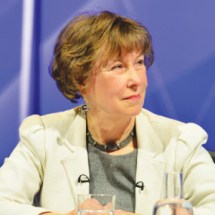
Alison-Wolf-QT-E98-300x300Alison Wolf is Professor of Public Sector Management at King’s College London and the author of the ‘Wolf Report’ commissioned by Education minister Michael Gove in 2010 to ‘consider how we can improve vocational education for 14-19 year olds and thereby promote successful progression into the labour market and higher level education and training routes.’ Given that the recommendations of her report were fully implemented by the government, Alison Wolf can be described as the architect of our current 16-18 programmes of study and the associated funding system. We were therefore delighted when she agreed to give the Autumn NewVIc lecture earlier this month.
The social and economic background

Alison started by reminding us of the reality of social and economic change over the past 10 years; the increase in educational participation, the collapse of the youth labour market and the decline in mid-level skilled jobs.

The educational context

The same period saw a huge increase in vocational awards at Key Stage 4 and the attempt to impose equivalencies between very different qualifications, many of which provided very low returns to young people. We know for example that among the most highly valued qualifications in the labour market are GCSE English and Maths which are recognised and understood by employers. The funding methodology, performance tables and accountability system encouraged behaviours and programmes which were not always in the best interests of young people.

The ‘Wolf Report’

page1-220px-The_Wolf_Report.djvuThe aim of the review was to get rid of some of the worst features of the system, introduce more autonomy for the professionals while incentivising high quality vocational courses which would be respected by employers. The underlying assumptions included:

  • A belief that early specialisation is undesirable; 14-16 year olds should follow a broad and largely common curriculum which does not pre-empt later choices.
  • A belief that achieving at least a grade C in GCSE English and Maths whether pre- or post-16 should be given much greater priority.
  • A belief that qualifications should be respected because of their value rather than by imposed equivalencies.
  • A belief that students should follow coherent programmes rather than simply accumulate qualifications.
  • The general education component of vocational qualifications should increase and a stronger emphasis on work experience post-16.

These are some of the recommendations that led to the new definition of programmes of study with their single full time funding rate and minimum requirements which include the expectation that all young people who haven’t yet achieved at least a grade C in GCSE English and Maths should be continuing to work towards this.

Looking forward

Towards the end of her talk, Alison looked forward to some of the challenges which face us:

  • We don’t yet have the substantial qualifications we need to fulfil the requirements of programmes of study for young people who are not heading for university.
  • ‘Resitting’ GCSE is quite a challenge for many and not everyone can achieve a grade C within a year.
  • Finding genuine high quality work placements is not easy and the supply of apprenticeships for 16 and 17 year olds is not increasing.
  • English post-16 routes are still too specialised by international standards.
  • Vocational options face a difficult choice between becoming too ‘academic’ and losing workplace value or continuing to have a relatively low status.

Challenging orthodoxies

41jy02pX6JL._SY344_BO1,204,203,200_I bought Alison Wolf’s Does Education Matter when it came out in paperback over a decade ago and have found it to be worth returning to many times since. At a time when we were in the grip of binary thinking, as we still are in many respects, it made an unapologetic case for a good general education for all young people and rigorously analysed the inflated claims made for the economic benefits of ‘vocational’ pathways in all the various forms they have taken over the years. Together with the work of Ken Spours and Ann Hodgson it helped me to develop my own thinking and strengthened my support for a broad general education entitlement which would include practical and vocational elements; an inclusive National Bacc in fact.

The following passage is a good summary of Alison Wolf’s case:

‘The more overtly and the more directly politicians attempt to organize education for economic ends, the higher the likelihood of waste and disappointment…British politicians are not unusual in believing that that they can improve their country’s economic performance through government–led education policies.

In the process, we have almost forgotten that education ever had any purpose other than to promote growth. To read government documents of even fifty years ago…gives one a shock. Of course their authors recognized that education had relevance to people’s livelihoods and success, and to the nation’s prosperity. But their concern was as much, or more, with values, citizenship, the nature of a good society, the intrinsic benefits of learning.’

From the Introduction to Does Education Matter? by Alison Wolf (Penguin, 2002)

Alison Wolf has transformed the priorities for 16-18 education in England and set us on a different path and we now need to rise to the challenge of fleshing out the genuinely educational programmes of study which can give young people the best possible start in life as learners, workers and citizens. She has also consistently challenged the orthodoxies of the ‘knowledge economy’, ‘skills shortages’ and doubted the ability of education to solve our economic problems. We need to continue to question the conventional wisdom about the relationship between education, skills and employment including any model which promotes narrow instrumentalism for the least successful students. We need to keep our eye on the goal of providing the good all-round education all young people need to flourish.

See also:

Do qualifications create wealth? (Jan 2015)

Other recent posts about vocational and liberal education:

Learning to love liberal education

Labour’s vocational vision

Guess what? vocational students go to university too

The National Bacc: a ‘one nation’ curriculum

Posted in Education policy | Tagged , , , , , , , , , , , | Leave a comment

Lessons without words: 10 things music teaches us about life

Music is a vital part of our lives but it is notoriously difficult to describe its effect on us in words. Can we try to describe some of the lessons we draw from our experience of music?

Here are 10 of the things we can learn through music:

1. We are defined by our relationship with others and we can achieve more by acting together: Music, like life, is intensely social. It assumes and requires an audience, even if that audience is a single performer listening to themselves. The production of music is so often social with different voices or instruments or melodic lines working together; combining and overlapping in ways which make sense. Contrasting accounts can fit together and produce something greater than the sum of the parts. Audience and performer share the experience and the boundaries are often blurred; as when the audience join in.

2. We don’t always need words to communicate: While language can be precise and specific, music shows that it is possible to be descriptive and reach people in ways that language cannot. It is effective but ineffable.

3. Everything is finite: everything has a beginning and an end and lasts for a finite length of time. We experience music in time; from the anticipation, hope and excitement of the opening sound to the dying of the last. Each self-contained piece of music is a reminder of transience and mortality.

4. Everything is changing: Music moves forward in time with us and takes us on a journey where the future is shaped by the past. The impact of what we are hearing now is shaped by what we have already heard. We will each be a different person when we hear the same music again and nothing happens exactly the same way again.

5. Things can represent other things: We love symbols and metaphors and we find ways to attribute human meanings to musical ideas; tunes, motifs so we decide ourselves what music means to us.

6. The same idea can be interpreted in many ways: A basic idea can be endlessly explored, embellished and modified. Our ideas evolve through playful, inventive and experimental processes. The cover version, the theme and variation or the development of a motif throughout a piece of music are models of evolution starting with certain constraints and rules from which to stretch and even break boundaries.

7. Other people can affect our emotions and change our mood: We identify and empathise with other human beings, we recognise our emotions in others and pick up on their feelings. Our response to music reminds us how susceptible we are to the emotional content of what is going on around us.

8. Repetition and familiarity are comforting: We get pleasure from recognising a theme or combination of sounds we’ve heard before. This helps reinforce our sense of identity while also allowing us to build the new using familiar elements from the past.

9. Difference and contrast are interesting: Shock tactics grab our attention and the appearance of the unfamiliar reminds us that we can ‘change our minds’ about something. Changes of rhythm, volume, sound quality and mood keep us interested and remind us of the possibility of change.

10. Dialogue helps us see things from a different perspective: When different instruments or voices seem to be in musical ‘conversation’ this reminds us of the process of dialogue and discussion where difference is expressed and explored, disagreement resolved and new understandings generated. Hearing different interpretations makes us aware of different perspectives.

These are important lessons and music in its mysterious non-verbal way can help us to learn them.

Copy of George Braque’s Man with Guitar by Gustavo Olmedo.go_art_man_with_guitar_copy_of_georges_braque_oil_painting_copy_by_gustavo_r_olmedo

Posted in Culture, music | Tagged , , , , | Leave a comment