Getting the children to play nicely

Once upon a time the children used to play nicely. They had quite a lot of freedom and invented all sorts of very involved activities. They played singly, in pairs, in small and large groups.  They developed constructive, co-operative, competitive and territorial games which were a pleasure to watch.

However, the children’s activity could get quite heated, tempers would rise, people would get upset and bad things would be said. Sometimes they got violent and some children would threaten others and even hit them. Occasionally things got out of hand and a child would get badly hurt.

Most of the children disliked the threat or use of violence in their activities because it really spoiled things. But when the problem seemed to be on the increase a few children decided that they should use knives to protect themselves.

The parents could see that the children were sometimes capable of threatening each other and didn’t want any of them to get hurt so they always told them off when they behaved aggressively. When they discovered that some of their children had knives they tried to explain that this was not making anyone safer – quite the opposite in fact. The children could see that this was right as a general rule but those that had knives still kept them, and even collected them because it made them feel safer. They knew they could use the threat of using a knife to settle arguments and get their own way.

Some of the children without knives tried to get hold of some in order to be able to stand up to those that already had them and the parents found it hard to argue against this.

Things got quite dangerous; a couple of children had been very badly hurt in a knife attack which was allegedly aimed at preventing further violence and, despite all the parents’ efforts, there were a number of further occasions when a fatal incident was narrowly avoided.

The parents did their best to persuade the children to cut down on the number of knives overall and often brought them together to discuss the problem. The children who had knives mostly took the view that they didn’t really want to use them but had to hang on to them to help ensure everyone was safe from other children who were less responsible.

Eventually, the parents did the obvious thing. With the children’s agreement, they got together and used their collective authority to confiscate all the knives and to ensure that no child ever had access to any. They started by saying they were just ‘looking after’ them for safe keeping but they soon destroyed all of them and made sure that no child could get a knife again. Anyone who even tried would be subject to the harshest sanctions on behalf of the entire community.

Taking all the knives out of circulation didn’t stop the children from disagreeing, arguing or occasionally fighting but it did mean that there was no danger that knives would ever be used to settle an argument.

Try reading countries for children, weapons of mass destruction for knives and United Nations for parents.

See also:

Let us be midwives! Sadako Kurihara (August 2015)

Nazim Hikmet: Hiroshima and Strontium 90 (April 2015)

cnd4

Posted in Politics | Tagged , , | Leave a comment

The problem with England’s post-16 area reviews

There is a contradiction at the heart of the government’s post-16 area reviews for England and it was clearly exposed the other day by the very civil servants tasked with implementing them.

Sixth form college principals and chairs of governors were told at a briefing last week:

“Ministers have a low tolerance of inefficiency and duplication”

This seems fair enough. Inefficiency and duplication are clearly bad things aren’t they?

Indeed they are. They are also a direct result of the increased post-16 market choice and competition which the government has promoted. A lot more small post-16 providers tends to lead to more inefficient provision and duplication of courses, with a real danger that ‘minority’ subjects become even less cost-effective in an area leading to reduced choice despite a proliferation of new providers.

If ministers are keen to root out inefficiency and duplication, no doubt they will want to focus on where it is most evident;  in some of the smallest providers and the most ‘crowded’ markets. The new post-16 area reviews should therefore include all post-16 provision wherever it is located and include value-for-money as one criterion, together with quality and geographical considerations.

However, the same audience was also told:

“Ministers don’t want to close school sixth forms which aren’t inadequate”

So, it seems that these reviews are really only about colleges. School sixth forms will, at best, be part of a general ‘assessment of provision’ in an area.

If efficiency really was the watchword then all 16-18 provision would be in scope. If ministers’ agenda is really to address inefficiency and duplication, they have not given their staff adequate tools to do the job. School sixth forms are not going to be reviewed and will not need to heed any review recommendations.

So that pretty much rules out any action on the first proposition then…

The review that really counts is the comprehensive spending review

Area reviews could have been the opportunity for a rational reappraisal of all educational provision for sixth formers as well as for adults in an area. Instead they will be a very partial process including only the 57% of 16-18 provision in colleges while leaving the 43% of provision in school and academy sixth forms completely out of the equation, despite the fact that they are all competing for the same students in the same market.

The truth is that the review which will really make a difference to college viability will be the one which sets how much more 16-18 education is to be cut; the forthcoming comprehensive spending review. And we won’t know the outcome of that until it actually happens in November.

Sadly, what is pushing colleges to consider new alliances, partnerships or mergers is not particularly the case for rational planning but the severe budget pressures forced on them by government. The comprehensive spending review seems set to increase this pressure.

Colleges have no choice but to participate in these reviews and to take the opportunity to demonstrate the positive contribution they make to the educational, social and economic development of their area. But they also have no choice but to explain why these reviews are flawed and to bring information about the full range of 16-19 provision to the table whilst also arguing for a properly resourced system of 16-19 education.

See also:

Imagining a better future is a first step (August 2015)

What’s at stake in the new post-16 area reviews? (July 2015)

ABR

Posted in Education policy | Tagged , , , , , , , , | Leave a comment

NewVIc breaks all its university progression records.

NewVIc-logo_inhouse-300

Newham Sixth Form College (NewVIc) has always had high rates of university progression, both in terms of numbers and the proportion of leavers progressing. These have consistently been well above the national and London averages. We are also very proud of the fact that more students eligible for free school meals progress to university from our college than from any other sixth form in England, based on 2012 data.

But this year, the college has surpassed all its previous records.

Our 2015 provisional university progression data show that:

  • 770 NewVIc leavers have progressed to university – a record.

Based on the national data for 2012, this would be the 5th largest cohort of university progressors from any sixth form in England.

  • This is 91% of all university applicants – a record.
  • This is 81% of the cohort of advanced leavers – including both A-level and vocational students as well as those who choose not to apply to university – also a record

This compares to a national university progression rate of 48% and an Inner London progression rate of 55% in 2012. Based on the 2012 data, this would be the 5th highest progression rate of any sixth form in England (below only 4 small school sixth forms with 300 progressors in total).

  • 90 NewVIc leavers progressed to Russell group universities – another record.

This figure has increased steadily and more than doubled over the last 3 years from 42 in 2012 and is the highest in Newham despite the recent creation of new selective sixth forms in our area which compete for potential Russell group applicants. This represents around 10% of the NewVIc cohort compared to a national proportion of 11% and an Inner London proportion of 8% in 2012.

Clearly, we are not yet able to compare like with like as the national data for 2015 is not available, but by any measure, these increases are remarkable; all the more so given that a higher than average proportion of our leavers come from vocational courses which generally have a lower university progression rate than A-level applicants.

How are these stunning results achieved? We can certainly point to much good practice in supporting student progression to university developed over many years at NewVIc and we are happy to share this. Good information, careful guidance, hard work and attention to detail are big elements of our strategy. However, there must be other contributory factors local to both London and to Newham. And the contribution of our excellent local primary and secondary schools must also be taken into consideration. If a sixth form achieves these high progression rates with students after 2 or 3 years, the schools these students attended for the previous 11 years must share the credit, so we could also usefully look further along the ‘supply chain’ to establish what works well.

See also:

Russell group numbers soar in Newham (August 2015)

From free school meals to university (April 2015)

NewVIc: highest number of disadvantaged students going to university (January 2015)

Posted in Education, NewVIc | Tagged , , , , , , | Leave a comment

Developing Labour’s vision for education

The heady summer campaign is over and a new leader has been elected. It’s time for the party to turn its attention to policy development as well as effective opposition. Across the whole spectrum of public policy, the party needs to build the alternative vision capable of winning in 2020.

In education the challenge is great. England lacks both a vision of what education is for and the system of public education capable of fulfilling our educational aspirations. The next government will inherit a chaotic market with a vacuum where a coherent national strategy or needs-driven planning should be. Different school types run by a bewildering range of unelected bodies will be competing in an unequal contest for students and results. Selection, both covert and overt will be increasingly prevalent and distinct segregated pathways from age 14 seen as the norm. Students seen as ‘less academic’ will be steered towards non-educational ‘training’ routes with reduced opportunities for breadth and depth of learning and no improved prospect of employment.

In the face of such a mess, will it be possible to turn things around and set a course in a more egalitarian and democratic direction? It will, but this will require nothing less than the creation of a new system. We need a system which can offer sensible answers to the key questions: what is education for? What kind of education do we want?  Education needs to have its ‘NHS moment’ where a commitment to doing things differently is forged. Such a commitment needs to be based on the wider public interest while also responding to the aspirations and ambitions of individuals. We’ve lost much of the ‘hard wiring’ which a good system needs and it will be necessary to build on the commitment of parents, teachers and other education staff to start to ‘re-wire’ our system based on different values.

So how do we begin?

  1. We need to work out what values we want to base education on. For Labour, there should be no question that these must be grounded in equality and opportunity for all. Our vision must be generous and inclusive; based on the belief that everyone can benefit from a full, broad education and everyone is entitled to access the best that our system can offer.
  2. All the resources of publicly funded education provision should be mobilised as part of a national education system. Requiring education providers to work together in the interests of their communities should release a ‘co-operative dividend’ by squeezing out much of the waste and inefficiency of market competition. The new system might not be based on markets but it can still offer diversity and allow for choice in a way which need not disadvantage anyone. The planning and regulation to ensure quality and equality will need to be light-touch, with a minimum of bureaucracy.
  3. There needs to be a new settlement between national, regional and local levels of government about where to locate different responsibilities. This would include a fair national funding system and admissions processes as well as a new level playing field with a single status for all schools which describes their degree of autonomy as well as their accountability to local and national government. This will mean a shift from competing academy chains towards local and regional collaborative networks. Strategic planning and decision-making should be transparent and subject to democratic scrutiny. A regional level will be needed for post-16 and higher education where catchments are wider and specialisation greater.
  4. Any national curriculum will need to command widespread support, to be broad and challenging and apply to all while allowing for some innovation and experimentation at school and regional levels. We should aim to give young people the tools and the opportunities to access the best our culture has to offer and to develop skills which allow them to make a difference in the world.

The architecture of such a national system could be created by a single Education Act of the ‘Reclaiming Education’ type early in the new parliament and we should be drafting this legislation now. But the work of building support for such a system, of embedding and developing it will need to come from ongoing deliberation, a continuing ‘great debate’ about the role of education in our society – both before and after 2020.

There will be many special interests to take on but the idea of a progressive national education service for all is one which surely has the potential to command majority support and help a party win elections.

Choosing a new leader is just the start of a process of renewal. It’s now time to start the debate that we need and make sure that it is informed by the best of our values.

See also:

Starting to think about a National Education Service (September 2015)

For a National Education Service (July 2015)

Market madness: condition critical (June 2015)

Market madness #4 A good system can help schools improve (August 2014)

Labour Party rose

Labour Party rose

Posted in Education policy | Tagged , , , , , , , , , , | Leave a comment

Starting to think about a National Education Service

The hysterical reaction from some quarters to the election of a new Labour leader has been quite extraordinary. In his first week in post after an overwhelming victory, Jeremy Corbyn has been portrayed as ‘the most dangerous man in Britain’ by parts of the media. With much Labour policy still to be developed, the Conservatives have been quick to attack with the mantra that Labour now represents “a threat to our national security, our economic security and your family’s security”. Such scaremongering does them no credit.

On education policy, some Conservative reaction was nearly as febrile:

Toby Young, writing as one of a panel of experts in a Daily Telegraph piece on Jeremy Corbyn is Labour leader: what could this mean for you? chose to attack the idea of a National Education Service. He acknowledged it might seem a ‘noble aim’ but claimed it would mean that ‘the state would seize control over all taxpayer-funded education’, ‘grammar schools would become bog-standard comprehensives’, ‘all the freedoms schools have fought for would be removed’ and ‘standards would decline’. In his opinion, this would add up to: ‘mediocrity for all rather than excellence for some.’

Education secretary Nicky Morgan’s line of attack was a little less apocalyptic. She warned that the clock could be turned back in the education debate and that we might lose ‘things in education that we have accepted that we want, such as heads and teachers and governors running the schools.’

The general case for a National Education Service can be read in a previous post here. Education in England is far from functioning as a coherent system capable of achieving any of the aspirations we might have for it; whether for greater opportunities or greater equality for all. If we were to launch a national drive to make the best of what’s on offer available to all our citizens, this could be the centrepiece of a winning programme and education could find its ‘NHS moment’.

Developing the policy that could make this a reality will require considerable discussion around both values and priorities. While doing so, it’s also useful to anticipate some of the objections the idea will face. These include:

1. ‘It would represent a huge centralizing ‘power grab’ by the state’: Recent years have seen a big shift of power to the national state in order to impose curricula, changes to the status of schools and to prevent local authorities from opening new schools. Labour needs to show how its plans would shift power back to accountable local authorities to plan provision and respond to the needs of their areas. The national state should not try to micromanage education but it does need to use its powers to regulate the system to ensure quality and equality and protect the most vulnerable learners. Providers receiving public funding should be publicly accountable and we are entitled to ensure that our money is being spent in the public interest. This does not require a big bureaucratic state, but can be achieved by a small, smart and often local, democratic state.

2. ‘It would force ‘bog-standard’ uniformity and reduce choice’: The current patchwork of ‘57 varieties’ of school with different ways of sorting and segregating learners or offering curriculum specialisms creates confusion, narrows opportunity and institutionalises inequalities. A better planned system could enhance choice while aiming for a good school for everyone. Incentives which encourage some friendly competition between providers or areas to innovate and experiment would be entirely compatible with a national planning framework. Labour needs to show how a local, regional and national system based on schools with a single status working together could help us achieve excellence for all and respond to all our various educational needs much better than the chaotic market we currently have.

3. ‘It would reduce standards’: We need to try to establish a consensus about what ‘standards’ mean, but clearly we would want a national system to be highly focused on offering the best to everyone and to promote high expectations. We know that selection does not raise standards but generally concentrates privilege. Selective admissions are all about keeping people out and Labour needs to make the comprehensive case for opportunities and high standards for all; bringing people in.

4. ‘It would be prohibitively expensive’: While there is a good case for spending more on education, the creation of a national education system does not depend on it. Despite damaging cuts and austerity, there are plenty of examples of waste and duplication in the current landscape. Better co-ordination and collaborative planning can ensure that resources are used more efficiently rather than being wasted on competition. If people feel a real sense of ownership of the system, they will support the case for improvements and be prepared to vote for them.

Labour now has the largest membership of any British political party and its members, whether new or long-standing, want to help shape policy. This is an exciting prospect and should be a broad and inclusive process of deliberation and refining, allowing plenty of time to put together a coherent and vote-winning alternative for 2020.

We can only hope that as the dust settles on the leadership election, the idea of a National Education Service, like other policy proposals, can be fully developed and debated in a calm and considered way.

See also:

For a National Education Service (July 2015)

corbyn-beard-getty_3384834b

Posted in Education policy, Politics | Tagged , , , , , , , , | 1 Comment

Seeking refuge in poetry

I am

So I have left everything

But I am something.

I have left everyone

But I am someone.

I have left there

But I am here.

Something, someone, here, now.

September 2015


Links to poems about the refugee experience:

We can all be refugees

We can all be told to go,

We can be hated by someone

For being someone

From We Refugees by Benjamin Zephaniah.


These Strangers, in a foreign World,

Protection asked of me –

Befriend them, lest Yourself in Heaven

Be found a Refugee –

Emily Dickinson.


Once we had a country and we thought it fair,

Look in the atlas and you’ll find it there:

We cannot go there now, my dear, we cannot go there now.

From Refugee Blues by W.H.Auden.


People run away from war.

Sometimes we get away.

Sometimes we don’t.

Sometimes we’re helped.

Sometimes we aren’t.

From People Run by Michael Rosen.


I am Syrian.

Exiled, in and out of my homeland, and

On knife blades with swollen feet I walk.

From I am Syrian by Youssef Abu Yihea, translated by Ghada Alatrash.


You have to understand

That no one puts children in a boat

Unless the water is safer than the land

No one burns their palms under trains beneath carriages

…no one would leave home

Unless home chased you to the shore…

From Home by Warsan Shire.


Rest easy immigration department, for I won’t be a heavy burden on you,

Thank you dear sea for welcoming us without a visa or a passport. Thank you to the fish who will share me without asking about my religion or political beliefs,

Thank you to the news channels who will report the news of the deaths for five minutes every hour for two days,

And thank you for grieving us when you hear the news…I’m sorry I drowned.

From I’m sorry I drowned – anonymous.


Because

It’s difficult to feel the edges of the words

‘refugee’

And

‘crisis’, because

These words stretch round the things’ outsides, until

We can’t see the end of either’s fences,

We feel discomfort

From Bicske by Joanna Walsh.

REfugees-400-x-216

Posted in Learning resources, Poetry | Tagged , | 1 Comment

Sharing the secrets of success

This is what I say to all new students at Newham Sixth Form College (NewVIc) after welcoming them on their first day:

Now you’ve enrolled and you’re about to start your first year as a sixth form student here, what advice can we give you to help you make a success of your studies? Every student is different but we know what all successful students have in common. We’ve seen tens of thousands over the years, we know what makes them succeed and we’re only too happy to share these ‘secrets of success’ with you. They’re not very secret and they won’t surprise you, but that doesn’t make them any less important.

Here are just 10 of them:

1. Take control, be responsible for your learning. You’ve chosen this college and you’ve chosen a programme which interests you – important adult decisions. You will get plenty of help from your teachers but they cannot do the work for you. It won’t all be smooth going, there will be ups and downs and there will be times when you feel under pressure because of your studies. Seek out the help you need but try to avoid blaming others. In the end, your success is mainly in your hands. The decisions you make and the work you do are the things which will have the greatest impact on whether or not you succeed.

2. Attend and be on time for all your classes. We know that students who attend are more likely to succeed. Your teachers have planned your programme of learning, if you’re not there for parts of it you’re obviously missing out. So your attendance target is 100%. Being late for class also means you miss out. Being punctual is about respect; respect for your teacher – who has planned a full lesson, respect for fellow students – who are inconvenienced when you arrive late and of course respect for yourself as a committed student.

3. Aim high and make sure you know what steps you need to take to get where you want to be. We assume you are ambitious and we will help you set ambitious targets which are also realistic and achievable. It will take time to lay all the foundations but this is your future you’re building so you need to keep hold of that ambition while doing all the important heavy work that’s needed to bring it about.

4. Keep up with your work steadily throughout the year. Your teachers have planned a programme which helps you take small steps to reach your big goal of doing well on your course. In order to achieve the big ‘scary’ targets such as your aspirational grades you need to break them down into smaller, less ‘scary’ short-term targets with specific deadlines. Every day, ask yourself: “What did I learn today?” then look forward and ask: “What do I still need to learn to achieve my goals?”

5. Get into good study habits. You have already shown skill in learning in order to get here. You now need to become an even more skilled learner. This means working out the skills you need to improve most and tackling those first – don’t put this off. Our skilled learner framework has 4 headings; you need to be Dedicated, Organised, Enquiring and Social and we can all develop these skills further and make better use of the study time and resources we have.

6. If you don’t understand, ask. Don’t be the student who doesn’t bother saying anything when you don’t ‘get it’ for fear of looking stupid. There’s nothing stupid about needing things explained and teachers are happy to explain things in lots of different ways. You will certainly feel much more stupid if you let things drift and fall behind later because you didn’t ‘get’ something important early on.

7. Try to enjoy your time at college. You are only here for a short time, so get involved in some of the fantastic activities on offer – whether to develop your existing skills or try something new. Take up some of the many opportunities available, make time to have fun and make new friends. We know from many former students that friends they’ve made at college are often friends for life.

8. Get involved and make a difference. You are young adults, you are starting to think about how you might make a difference in the world. You are not powerless; as a citizen you can help to bring about change at the local, national and international level, so how do you want to make your mark? As a member of this community you need to ask yourself: “What impact did I have on others today?” and you need to ask yourself: “Am I doing my best?” At college you will have many opportunities to make yourself heard and to think about all the challenges that we face and what we should do about them. Grasp those opportunities – don’t leave everything to others!

9. Get enough sleep and have a healthy diet. Tired, hungry students are not good learners.

10. Never forget why you are here. You will sometimes have to make choices between your studies and your social life. When the crunch comes, remember to put your education first. Your friends will still be around next week, but if you miss that final assignment deadline, it will be gone forever.

It all seems fairly obvious doesn’t it? But of course knowing it is not always the same as doing it!

So, welcome to NewVIc. You are now a lifelong member of our ‘successful learning community’. As a community we work together, learn from each other and with each other. We help, respect and care for each other. You will get a lot out of this community and you too can become a NewVIc success story. But as with other communities you will also need to put a lot in to make that happen.

For you, this is the start of a new adventure, an exciting new phase of your education. It’s a good time to look back at where you’ve come from as well as to look forward to where you’re going next. So look back and be proud of who you are and what you’ve achieved; be proud of your family, your culture, your language, your beliefs and all your achievements – you’ve already achieved a great deal, you are somebody and you have a lot to be proud of. But don’t stop there, look forward and become what you are capable of becoming which is so much more and we look forward to helping you on that journey.

“Be proud of who you are and what you’ve achieved and become what you are capable of becoming.”

See also:

The Skilled learner (June 2015)

gerdaHome

Posted in NewVIc, Parents, Students | Tagged , , , , , , , | Leave a comment

Diagnosis.

Doctor, I think I might have something quite serious.

I must say you look fine, what are your symptoms?

Well, I have this overwhelming feeling which just won’t go away.

Go on…

I can’t shake it off, it’s like a… sense of hope about the future.

Hope? You’re sure it’s not just a case of temporary optimism?

It seems much stronger than that.

Or perhaps Pollyannitis, also known as ‘glass-half-full’ syndrome?

I just have this enormous feeling of confidence in what human beings can achieve.

Oh…

It’s bad isn’t it?

It does sound worrying. How has this affected your life?

Well, I’m always coming up with these practical ideas about how much better things could be.

Yes?

I seem to be constantly imagining all sorts of really sensible alternatives.

Al – ter – na – tives…I see…

And I keep saying irritating things like “yes we can” or “there must be another way”.

Hmm, I can see how that might be very annoying.

Doctor, what can I do? Is there a cure?

Have you tried watching the news or reading the Daily Mail?

Nothing seems to work. It’s really taken hold.

I’m afraid this is quite a debilitating condition, but it may be possible to manage your symptoms and live a nearly normal life.

Please help me, doctor.

In fact, some people take the rather odd view that this disorder can actually be seen in a positive way.

So you saying it’s…

Yes, I think you’ve got a bad case of utopianism.

Oh dear!

And I’m afraid things can only get better.

See also:

Utopia as the education of our desires (August 2015)

Reading dystopias (July 2015)

utopia 2

Posted in Culture, Politics | Tagged , , | 1 Comment

The post-16 retake challenge

I think it is a reasonable aspiration that 16-18 year olds who haven’t achieved a threshold standard in English and Maths should continue to study both subjects in some form as part of their programme of study post-16. If possible, students should aim to achieve a GCSE grade C, or the proposed new grade 5, in both subjects by the time they complete their post-16 education.

I also understand the call for alternative English and Maths qualifications post-16 but would only support these if they have absolute parity with GCSE. There should certainly be better ‘stepping stone’ qualifications for those students who have some way to go before achieving a grade C but this does not mean settling for a second rate, watered-down version of the accepted threshold. The notion of ‘functional skill’ in literacy and numeracy may be a useful baseline concept but I don’t think we should accept this limited aspiration as the sum total of the English and Maths which we expect young citizens to have mastered by 18.

So this leaves us with a system which requires that large numbers of sixth formers retake their GCSE English and Maths post-16 and which expects their sixth forms to help turn ‘failure’ at 16 into success at 17 or 18. It’s hardly surprising that we find it difficult to get anything like the pass rates one year on with students who couldn’t achieve a grade C at 16 despite all the targeted support and coaching provided at school.

For those sixth forms with hundreds of ‘D grade’ students, a high proportion of the cohort will inevitably be close to the C/D borderline and small shifts in the C/D grade boundary can make a massive difference to pass rates. These can ‘yo-yo’ between years despite stable and high quality specialist teaching. The sheer size of the cohort affected means that these results weigh heavily when Ofsted make their judgements; as many colleges have already found to their cost.

Needless to say, none of this applies to those selective sixth forms who only enrol students who have already crossed this threshold. They can leave the ‘mop-up’ job to someone else and can therefore evade any of the criticism for low retake pass rates.

This adds up to a major challenge for sixth form providers, particularly the more comprehensive or inclusive ones who find themselves at the sharp end of the problem. If we are to take on the responsibility for helping more students cross the English and Maths threshold we will need the system to help us rather than being stacked against us. This is a national challenge which requires a national strategy as well as local partnership.

So instead of berating us for poor results what more could be done to address this challenge?

An effective strategy could start with a number of elements:

  1. Recognise that GCSE English and Maths are different from other GCSEs: As the only specific qualifications which all 16-18 year olds are expected to aim for, they are in a special category which need to be monitored and reported differently.
  2. Measure success and progress cumulatively as a proportion of the whole cohort, not of entries overall: Rather than blaming post-16 providers for low pass rates we should be celebrating every increase in the proportion of an age cohort which has met the standard; including after retakes. Gary Jones set the ball rolling here with his very revealing analysis of the success rates of GCSE English re-takers. He suggests that under the new system overall retake pass rates in any one year are unlikely to ever exceed 30%. He has also analysed GCSE Maths retakes, reaching similar conclusions here.
  3. Provide reassurance that GCSE English and Maths grades are absolutely criterion referenced: If a grade C or 5 is a realistic key threshold, it should represent a consistent standard of achievement from year to year; giving everyone confidence that all students with this grade have certain skills and can tackle certain problems. It means dispensing with any norm-referenced practices which assume the same proportion of candidates will pass or fail an exam each year. Such practices make no sense when so many entries will be re-takers.
  4. Consider developing a more modular or unitised GCSE model for English and Maths where partial success and ‘stepping stone’ achievement can be banked, celebrated and built on, both at 16 and beyond. This would allow all candidates, most particularly demoralised ‘D graders’ to build on their success.
  5. Require all schools and colleges to work together on the teaching of English and Maths from 5 to 18 across their area, emphasising that this is a shared responsibility. A more focused joined-up approach could help teachers share what works well, understand how colleagues at different stages develop students’ knowledge and skill and track individual student progress. Such collaboration could lead to new kinds of early intervention rather than simply relying on a remedial rush at Key Stage 4 or beyond.

One proposal which won’t take us forward is that recently made by the Policy Exchange think-tank here. They have shone a welcome light on the lack of funding for post-16 programmes, including for GCSE retakes. However, their prescription would put a price on failure in GCSE English and Maths at Year 11, penalise schools and transfer the resource to sixth forms. This has rightly been described by Sarah Jones from BSix Sixth Form College here as ‘robbing Peter to pay Paul’. This is a market solution which seeks to impose financial penalties for failure in the hope of incentivising success. I doubt if there is a single secondary school in the country which is not highly focused on raising GCSE English and Maths pass rates. The threat of financial penalty is unlikely to sharpen that focus. If pass rates are to rise, this will be achieved by pedagogic and educational means – not by impoverishing schools.

Debra Kidd has also written an excellent post on this issue which makes this case and concludes by arguing for less external assessment at GCSE level or even the abolition of GCSE.

The challenge of raising achievement in English and Maths across the full age cohort is one we must all share. It won’t be easy and the debate needs to continue.

See also:

Results day: best of days, worst of days (August 2015)

GCSE English re-sits in post-16 education: what results can we expect? (Gary Jones 29th January 2015)

GCSE Maths re-sits in post-16 education: what results can we expect?  (Gary Jones 10th r2015)

All stick and no carrot (Debra Kidd – 25th August 2015)

Policy Exchange’s ‘re-sit levy’ robs Peter to pay Paul (Sarah Jones – 26th August 2015)

exam hall 2

Posted in Education policy | Tagged , , , , , , , , , , , , | 1 Comment

A parent’s guide to sixth form enrolment

Welcome to enrolment. As parents or guardians your role is vital. You can help your daughter or son to understand their options and you know them better than anyone so your insights can be really useful.

So how can you make a positive difference at this crucial moment?

Listening:

Listen to your child and try to go with the grain of what they are saying about their interests and ambitions. Try to avoid imposing your plans on them, they may be brilliant but not appropriate. This is not an opportunity for you to live your life through them.

Listen to our advice and try to understand how we have reached the judgements we are making. Enrolment is not a clash of wills or a test of your advocacy skills. We know that you love your child and want the best for them, you don’t need to prove that. We also want the best for them and we are trying to give well-informed and objective advice. To do well on a college programme students need to be interested and excited by what they’ve chosen and have a mix of motivation, commitment and aptitude.

Talking:

Make time to talk things through, there may be a sense of pressure but there’s no need to make it worse. These are big decisions and there will always be time to pause and reflect with your child before making commitments.

Do tell us what you think and ask any questions you may have. Tell us about any challenges or obstacles which your child might face with their studies, whatever these difficulties might be.

Keeping rational and avoiding emotions or preconceptions:

If you are disappointed with your child’s results remember that it doesn’t make things any better to keep reminding everyone how disappointed you are. It’s also not helpful to make unflattering comparisons with relatives who have ‘done better’. Rather than dwelling on failure, we try to focus on what has been achieved and how we can build on it. This is a stressful time and you want to get things sorted, but adding strong emotions at an already emotional moment won’t help us make the right decision.

Avoid blaming others for any underachievement. It may be that your child’s GCSE English re-mark will result in a higher grade or that the school had problems with the GCSE Maths entries but this doesn’t change the objective outcomes we are looking at.

Being open-minded:

Don’t rush to judgements about proposed courses. We will share objective information about where these courses lead. Parents who are adamant that “I don’t want them doing a BTEC….” often change their mind when they hear about how many vocational students have progressed to brilliant degree courses at university.

By all means, ask for a second opinion or a review of the case if you feel strongly that you’re not getting the best advice. We try to be consistent but sometimes it can help to get a different perspective on a finely balanced case. But if you’ve had clear advice don’t just try to bounce from one member of staff to another until you ‘get what you want’ – this doesn’t work.

Keeping the young person at the heart of the process:

Remember that it is your child who will be studying the course, not you. You will be providing emotional and material support but you can’t do the work for them and you can’t deliver on any promises made at enrolment (“I guarantee that s/he will work hard / attend well / achieve well…”). They are the ones who will be coming in every day, attending classes and taking on the workload, so any promises or commitments need to be genuinely theirs.

What next?

This is not the end of your contribution. We will welcome your involvement throughout the year. You can contact us and staff will contact you about your child’s progress. You will receive reports and be invited to parents’ evenings and you can join our parent forum and parent council to learn more about the college’s work and help shape its development. You also have specific representation on our corporation; a parent governor elected by parents to speak for them and report back to them.

So although we see sixth form students as young adults who need to take responsibility for their own learning, we also value our relationship with their parents and guardians because we know how much you can do to help and encourage your child on their journey towards success.

See also:

How to choose a sixth form (August 2014)

How to make a strong college application (February 2015)

Your college interview (February 2015)

Enrolment: where aspiration meets reality (August 2015)

Posted in Education, NewVIc, Parents | Tagged , , , , , , , , | Leave a comment

Enrolment: where aspiration meets reality

It’s a crazy way to start the year; enrolling all our students over a few days in late August before we can start teaching them. Enrolment is a major cross-college team effort which requires every member of staff to do something different from their usual job. It also requires a small army of temporary staff. It’s a bit like asking all the musicians in an orchestra to go out and sell the tickets, lay out the chairs and welcome every audience member before their big concert.

It’s hard work and it’s very important. We know that for applicants this is where life-changing decisions are made. It’s a time when they need to draw on all their self-awareness, to reflect on what is best for them and decide how to build on their success so far. Some may be dealing with a sense of failure or shattered hopes and many are feeling under pressure to make their mind up quickly.

As sixth form providers our ideal is that the young person we’re about to enrol is well-informed because they have already been through a thorough, considered process of evaluating and selecting a college and a course. We hope that they have already visited us, discussed the options with professional careers advisors, been guided and advised by us and maybe even attended our summer induction programme long before results day. In this scenario, enrolment is the final step in an extended process where, following actual GCSE results, we can confirm either a planned programme or a Plan B or fall-back programme.

And for many students this is how it goes; a smooth positive experience, confirming the outcome of all the prior discussion and combining this with a warm welcome to an exciting new place of study.

But for some it can be an anxious and stressful moment either because they have disappointing results which require a major reassessment of their options or because they are a ‘walk-in’ student, not previously known to us, who has to condense the whole advice, guidance and decision-making process into a very short period of time. When both of these apply, it just adds to the pressure. In a highly competitive market with more selective providers, there is more ‘shopping around’ and more ‘being asked to leave’ mid-course and this volatility around transitions is becoming more common both at 16 and at 17.

In these cases, with all the processes of interview, guidance and enrolment telescoped into a single meeting, it is really important that we preserve the integrity and quality of our system.  We want to provide objective information about course content and progression opportunities and our starting point is always the learner’s interests and aspirations and a commitment to offer them a programme which they can succeed on and which moves them forward.

All our courses have entry requirements and many of these have become more complex in recent years with a combination of point score average thresholds and subject requirements. These criteria are set for good reasons; not to keep people out but to ensure that students are well equipped for progression.

However, young people do not all present at enrolment with consistent or clear profiles. Many students have erratic, aberrant GCSE grades or a ‘spiky’ profile. For instance it’s quite common for students to get a higher grade for GCSE English literature than for GCSE English language (which is a crucial indicator). This year we’ve seen many applicants with a much higher grade in GCSE Additional Science than in their Core Science – what are we to make of an AC double science grade if our entry requirement for AS sciences is a minimum of BB? Sometimes it’s clear that one or two very low grades in less relevant subjects are dragging down a student’s average point score and that without them they still have a much higher score across a good number of subjects.

So we sometimes have to make fine judgements about what prior achievement is telling us and we take into account a number of factors and delve as much as we can into unit scores and look for any ‘highs’ which might compensate for particular ‘lows’. We also draw on references and reports to inform our discussion although the quality of school references is highly variable; some are really thorough but some are worryingly uninformative.

Students and their families are expected to digest a lot of information and make various choices and calculations, often under pressure and sometimes counter to their existing preconceptions. The involvement of parents or guardians is crucial – they can make a real difference for better or for worse and I have offered some advice for them in a separate post.

Sometimes the enrolment conversation can become a battle of wills with the applicant resisting the advice they are getting with sheer assertiveness. We hear a lot of: “I know I can do it…Just give me a chance” or “I’ve had personal problems…”

Of course we know that students can turn things round and we understand mitigating circumstances for underachievement. A determination to learn the lessons and bounce back is admirable and we want to build on that. But we need to balance this against the reality of achievement and make an informed professional judgement about a young person’s chance of success, based on our experience. We do use discretion but we always need to justify this. It’s because we know the cost of failure for the student themselves that we are so careful with our judgements.

So, welcome to the meeting of aspiration and reality. Enrolment may be stressful for all concerned but it is a vital part of post-16 progression and it can pave the way for a successful academic year.

See also:

How to choose a sixth form (August 2014)

How to make a strong college application (February 2015)

Your college interview (February 2015)

A parent’s guide to sixth form enrolment (August 2015)

Posted in Education, Learning resources, NewVIc | Tagged , , , , , , , , | Leave a comment

Russell group numbers soar in Newham

This year, more students than ever before are progressing from Newham Sixth Form College (NewVIc) to Russell group universities. Once again the college has the highest number of Russell group progressors of any Newham sixth form.

90 NewVIc students have progressed to Russell group universities in 2015. This means that the college’s Russell group numbers have more than doubled over a 3 year period of steady and consistent increase:

2012: 42

2013: 60

2014: 71

2015: 90

For the second year running NewVIc is making the biggest contribution to what is a strong increase in Russell group numbers from one of the most socio-economically disadvantaged areas in England. New selective providers in the area have also contributed to this but it is clear that selection at 16 has not been a pre-requisite for achieving success in university progression – including to the most selective universities. At NewVIc, our pioneering Honours programme has been the key to these improved numbers and it was established well before all 4 of the new selective sixth forms in the borough.

NewVIc is already the sixth form which has the most students eligible for free school meals progressing to university in the whole of England. The college is also doing its best to ensure that these students get their share of places at the most selective universities. We do not regard Russell group progression rates as the sole measure of social mobility but in a borough where they have been below the national average we clearly want to see them rise.

These increases, together with those from other Newham sixth forms, will mean that the proportion of Newham teenagers making it to Russell group institutions will have doubled or even tripled between 2012 and 2015. The 2012 figures for Newham showed around 80 students progressing to Russell group universities from all the borough’s providers. This year’s figure could well be over 200. Unfortunately, the published national statistics on this lag a couple of years behind so we don’t yet have the official data.

What NewVIc’s Russell group increase shows is that it is possible to achieve high progression to the most selective universities without necessarily establishing separate highly selective sixth forms premised on keeping most students out and segregating high achievers from their peers. Sixth forms with broad, inclusive curricula and comprehensive admissions can also promote high aspirations.

In other words we can have social mobility without social segregation. In fact I would argue that a system designed for all is actually better placed to promote excellence for all.

Finally, we find ourselves once again having to point out errors in the statements of one of our local competitors, the London Academy or Excellence (LAE) a 16-18 free school. This time last year, they claimed that Newham students had not been able to study ‘traditional’ A-levels like biology, maths and history in Newham before the creation of their school in 2012. In fact, these subjects, and all those offered by LAE have been thriving at NewVIc for over 20 years.

This year they are claiming that “before LAE opened only 46 Newham sixth formers from Newham schools secured places at Russell group universities.” In fact, the figure for 2012 was at least 80 and this statement is only true if one chooses to completely ignore the largest sixth form in the borough. This amounts to a fairly breathtaking rewriting of history for the second year running.

Perhaps it is time for the champions of the London Academy of Excellence to at least acknowledge that their model is not the only one which can achieve student success.

Richard Cairns, the head of Brighton College and a governor of LAE has said:

“We must get away from the idea that we can successfully deliver both vocational and academic courses in the same school”.

In fact, these courses have co-existed successfully at NewVIc throughout the period of strong increase in Russell group numbers.

Former Eton headmaster Tony Little, also an LAE governor, asked in 2012:

“Where in Newham can you get that unabashed approach to academic work, leading to a top university?”

Well…it seems that the answer, for a very substantial cohort of young people at least, is:

“At Newham Sixth Form College”.

See also:

Can we celebrate success without rewriting history? (August 2014)

Post-16: education’s wild frontier (July 2014)

College success with disadvantaged students (June 2014)

A tale of two boroughs (May 2014)

IMG_0165[1]

Posted in Education, NewVIc | Tagged , , , , , , , , , , , , , | 5 Comments

Utopia as the education of our desires

London’s Roundhouse hosted an evening of utopian propositions last week, jointly programmed with Compass. Those of us there were able to experience Penny Woolcock’s extraordinary Utopia installation and listen to Owen Jones and other social justice campaigners. I was particularly struck by the contribution of Marina Prentoulis, from Syriza London.

Marina Prentoulis spoke about what utopia means to her at a time when the people of Greece are experiencing a kind of dystopia where social values and human needs seem to count for less than austerity and the mad logic of the markets. Despite the unequal struggle and all the setbacks faced by the Syriza government, she saw hope in the fact that Greece can keep the idea of democratic human-centred politics alive. For her, utopia is not a blueprint for the perfect society or a monolithic and detailed vision of what needs to change. Instead utopia is ‘the education of our desires’ – a process where being able to imagine and desire improvements to our world is the first step to actually working for change. Even in the most difficult times, or perhaps particularly in such times, it is essential to hold on to the utopian impulse.

As U.S academic George Kateb said:

“Any serious utopian thinker will be made uncomfortable by the very idea of blueprint, of detailed recommendations concerning all facets of life.”

The phrase ‘the education of our desires’ was first used by the French philosopher Miguel Abensour writing about News from Nowhere (1890) William Morris’s visionary account of an egalitarian future England. For Abensour, utopian thinking disrupts the taken-for-granted nature of the present and creates a place where we can, even fleetingly, broaden and deepen our aspirations.

“…we enter utopia’s proper and new-found space: the education of desire. This is not the same as a ‘moral education’ towards a given end: it is rather, to open a way to aspiration, to teach desire, to desire better, to desire more, and above all to desire in a different way.”

In her brilliant book Utopia as Method, Ruth Levitas summarises the core of utopia as:

“The expression of the desire for a better way of being or living and as such is braided through human culture….the desire for being otherwise, individually and collectively, subjectively and objectively. Its expressions explore and bring to debate the potential contents and contexts of human flourishing. It is thus better understood as a method than a goal.”

Ruth Levitas describes this method as the ‘imaginary reconstitution of society’ and she argues that this work of the imagination is urgently needed if we are to begin to address the overwhelming global challenges, injustices and inequalities which we face.

For Levitas, the method of this imaginary reconstitution of society has 3 main aspects:

An archeological mode which involves excavating fragments from our utopian political, literary or artistic accounts.

An ontological mode concerned with the subjects and agents of utopian change; how people bring about such change, how they are themselves changed by it and the new social relations it brings about.

An architectural mode which relates to the institutional design and delineation of the good society.

The method also includes prefigurative practices in which different ways of being or doing things are tried out through the creation of new or at least slightly different social institutions. It’s worth remembering that the co-operative movement, the university settlement movement and, more recently, transition towns or citizens’ income initiatives are examples of this.

This also has a more intimate human-scale. In Penny Woolcock’s words:

“Utopia is already here in the sweet moments we share with those we love and random strangers whose eyes we catch. We know it slips in between the cracks of the everyday.”

Andre Gorz in Reclaiming Work: Beyond the Wage Based Society (1999) says:

“It is the function of utopias…to provide us with the distance from the existing state of affairs which allows us to judge what we are doing in the light of what we could or should do.”

Without utopian thinking and experimental, prefigurative practices to educate our desires, we would not have been able to imagine and then create a national health service, universal public education, a national minimum wage or the institutions of the welfare state. If we are to create the new institutions and practices which will help us to address the new threats to our survival our desires will need all the educating we can muster and we will also need the skill and ingenuity to put some of those new desires into practice.

See also:

Keri Facer and the future –building school (August 2015)

Market madness: condition critical (June 2015)

No austerity of the imagination (July 2015)

For a pragmatic idealism (June 2015)

Roberto Unger on school as the ‘voice of the future’ (April 2015)

Reading dystopias (July 2015)

Utopia


Posted in Culture, Politics | Tagged , , , , , , , , | Leave a comment

Imagining a better future is the first step

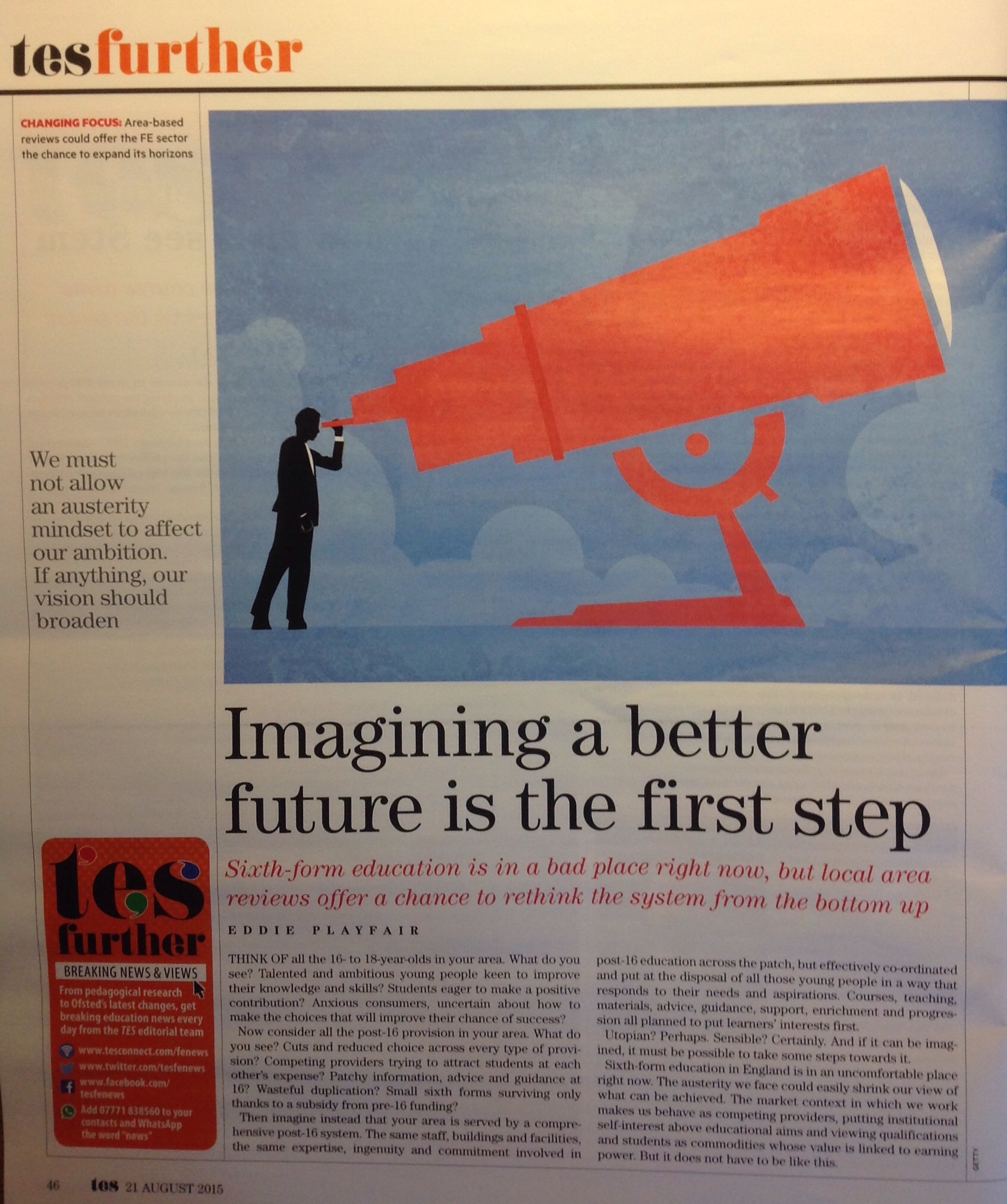
My article on the post-16 area-based reviews from this week’s Times Education Supplement.

Think of all the 16-18 year olds in your area. What do you see? Talented and ambitious young people keen to improve their knowledge and skills? Students eager to make a positive contribution? Anxious consumers, uncertain about how to make the choices which will improve their chance of success?

Now consider all the post-16 provision in your area. What do you see? Cuts and reduced choice across every type of provision? Competing providers trying to attract students at each other’s expense? Patchy information, advice and guidance at 16? Wasteful duplication? Small sixth forms surviving only thanks to a subsidy from pre-16 funding?

Then imagine instead that your area is served by a comprehensive post-16 system. The same staff, buildings and facilities, the same expertise, ingenuity and commitment currently involved in post-16 education across the patch, but effectively co-ordinated and put at the disposal of all those young people in a way that responds to their needs and aspirations. Courses, teaching, materials, advice, guidance, support, challenge, enrichment and progression all planned to put learners’ interests first.

Utopian? Perhaps. Sensible? Certainly. And if it can be imagined it must be possible to take some steps towards it.

Sixth form education in England is in a very uncomfortable place right now. The financial austerity we face could easily shrink our view of what can be achieved and lead to impoverished ambition and limited horizons. It could make us feel powerless as we retrench further and further. The market context we work in makes us behave as competing providers, putting institutional self-interest above educational aims and seeing qualifications and students themselves as commodities whose value is linked to earning power. But it doesn’t have to be like this.

Despite our troubles, we can see the elements of a better system all around us. These signs of hope include the commitment and expertise of our staff, our experience and appetite for collaboration, the possibilities of new types of partnership and governance at national, regional and local level, including hard and soft federations, trusts and Teaching School Alliances and of course our wonderful students, who are so much more than the passive recipients of education.

In Reviewing post-16 Education and Training Institutions published by the government last month, we are being offered the chance to help rethink our system from the bottom up – an opportunity which I believe we should grasp with alacrity.

The document proposes a new programme of Area-based Reviews of post-16 provision. This is very welcome if it means that all the appropriate agencies will work with post-16 providers and their local communities to take an objective view of local provision and agree on the best configuration using a range of criteria including quality, cost-effectiveness, geography and demand.

These reviews will need to draw on the imagination, system leadership and better instincts of all concerned and we will be expected to rise above institutional self-interest in order to build the best possible system for young people in our areas. Because the current pattern of provision is different in each area the outcomes will not be uniform.

One of the suggestions in the document is that we need ‘fewer, often larger, more resilient and efficient providers’. The implication is that larger colleges are better placed to provide high quality, plan strategically and survive austerity in the medium term. If this is so, the point applies not just to colleges but to all 16-19 provision in an area. When the guidance on these reviews is published, it will be essential that school sixth forms are automatically considered as part of the local system. To leave them out would be a colossal missed opportunity. If some colleges are not cost-effective, this must also be true of many small school sixth forms. So if we want to invest cost-effectively in quality we have to review that provision which is most dispersed or least effective as well as that which is already successful or more efficient.

The document also seeks to encourage ‘greater specialisation in genuine centres of expertise’ while at the same time maintaining ‘broad universal access to high quality education and training for students of all abilities’. Squaring this circle may be easier with fewer colleges but doing it well requires the creation of inclusive, comprehensive local systems. Without this, the least qualified and most vulnerable young people are more likely to be overlooked or segregated.

We mustn’t allow an austerity mindset to affect our ambition as well as our spending power. If anything, our vision should broaden just as our financial room for manoeuvre narrows. Can we find the courage and ingenuity to develop effective national, regional and local collaborative systems and release the collaboration dividend? Can we marry our commitment to all learners and to high standards with radically new ways of doing things? Actually, I don’t think we have a choice.

We need to work with new partners, build new coalitions and create new structures. This means networking and federating at various levels, building on our strengths and experience. We also need to work with our stakeholders, elected politicians and the new Regional School Commissioners who are already using their strategic powers in parts of the post-16 system.

So let’s welcome these area reviews and engage with them from the outset. If they are comprehensive in scope and founded on educational criteria they could help us bring about positive and sustainable change. There is much at stake and we cannot afford to fail.

Published in the Times Education Supplement (TES) 21/08/15

See also:

What’s at stake in the new post-16 are-based reviews? (July 2015)

No austerity of the imagination (July 2015)

Snatching hope from the jaws of despair (June 2015)

Posted in Education policy | Tagged , , , , , , , , , | 2 Comments

What is powerful knowledge?

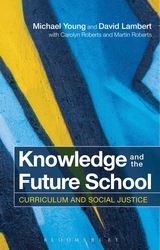
Knoweldge and the future schoolIn Knowledge and the Future School (2014) the sociologist of education Michael Young proposes a ‘return to knowledge’ following what he regards as the ‘turn away from knowledge’ taken by some progressives including Young himself in his earlier work. This book, co-authored with David Lambert, Carolyn Roberts and Martin Roberts, makes a powerful case for a curriculum and a pedagogy based on what the authors call ‘powerful knowledge’. This is part of a kind of ‘third way’ approach; a synthesis of two clashing perspectives on the school curriculum which can be characterised broadly as ‘traditionalist’ and ‘progressive’.

The authors distinguish between three alternative futures or ways of thinking about the school curriculum:

A Future 1 curriculum is the curriculum inherited from the 19th century which assumes that knowledge is a given and is beyond debate. The future is seen as an extension of the past.

A Future 2 approach acknowledges that knowledge has social and historical roots. It is defined in terms of particular needs and interests, often those which are dominant in society. It was a response to the rigidity and elitism of the Future 1 model but it was based on a misguided theory of knowledge. The fact that knowledge is socially constructed does not necessarily mean that it is inherently biased or that some knowledge is not better; more valuable, more truthful or more universally applicable.

Future 3 already exists in parts of the curriculum despite the pressure to lean towards Futures 1 or 2. In contrast to Future 1, it locates knowledge as the creation of specialist communities of researchers rather than simply treating it as given. It acknowledges that knowledge is fallible, contestable, provisional and subject to change. But in contrast to Future 2 it does not see it as an arbitrary response to a particular challenge; it is bound by epistemic rules about what makes things likely to be true.

Future 3 treats subjects as the most reliable tools we have to help students acquire powerful knowledge and make sense of the world. Subjects are a resource to take students beyond their experience, to challenge their existing ideas.

“We want schools to give children access to knowledge that takes them beyond their experience in a way that their parents can trust and value, they they will find challenging and which prepares them for the next step in their education.”

Powerful knowledge starts from the idea of equal citizens with an equal entitlement to knowledge; an entitlement which should not be limited on grounds of assumed ability or motivation, ethnicity, class or gender. The curriculum should be seen as a guarantor of equality based on the best knowledge we have, or at least a staged approach towards acquiring it.

According to Young, skills cannot be an adequate basis for a curriculum:

“Skills have their place in the curriculum but skills on their own limit the student to tackling ‘how’ questions and not ‘what’ questions. It is only ‘what’ questions that take students beyond their experience and enable them to engage with and grasp alternatives.”

The authors propose 3 criteria for defining powerful knowledge:

  1. It is distinct from ‘common sense’ knowledge acquired through everyday experience and therefore context-specific and limited.
  2. It is systematic. Its concepts are related to each as part of a discipline with its specific rules and conventions. It can be the basis for generalisations and predictions beyond specific cases or contexts.
  3. It is specialized; developed by specialists within defined fields of expertise and enquiry.

Powerful knowledge embodies values of objectivity, openness to challenge, rationalism and respect for all humans. These criteria are concerned with truth rather than with valuing different belief systems people may hold to.

What would a shift to a powerful knowledge curriculum mean?

It would require a major reassessment of all curriculum programmes as well as changes to pedagogy. The approach advocated in this book requires schools to see a knowledge-led curriculum as an entitlement for all and as a starting point for a more equal, fair and just society. It would set us on a path of pretty radical pedagogic and curriculum innovation.

“Our approach is not to start by assuming different ‘types’ of children but by wanting to give all children access to the foundations of powerful knowledge.”

“There is no good argument for comprehensive secondary schools if they are not based on a comprehensive curriculum…If we are serious about educational equality we have to be serious about curricular justice.”

The authors have no time for a traditional, old-fashioned, backward-looking view of knowledge but they do agree with a strong emphasis on knowledge:

“Denying access to some in the name of diversity, however linked to a concern for the welfare of students, is not about promoting equality or social justice.”

In conclusion

This is an important contribution to contemporary debates about educational equality and entitlement as well as the central place of knowledge in the curriculum. It is a useful starting point for those of us who support a broad non-elitist knowledge-rich ‘Future 3’ type of curriculum for all young people.

Following on from this, I would want us to have a more thorough discussion of the place of skills and skill-development in the curriculum as well as of the concept of ‘usefulness’. Skill acquisition plays a big part in helping students go beyond their experience and surely those ‘how’ and ‘what’ questions are in constant dialogue with each other, neither of them necessarily more or less challenging than the other.

The book doesn’t explicitly address the idea of ‘useful education’, although at one point, the ‘power’ in ‘powerful knowledge’ is described as referring to ‘what it can do’ for those who have access to it; a fairly major, and welcome, concession to the notion of utility. Question: Is there any difference between what knowledge can do for us and what we can do with it…?

I think there is also a need for more consideration of how academic disciplines change and evolve over time and how they translate into taught subjects. What are the benefits of interdisciplinarity as well as disciplinarity?

And finally, the authors seem to assume that a curriculum entitlement only applies up to 16. I’m not sure that there is any good reason for such an early or sudden cut-off point. I think the idea of a broad liberal studies curriculum with room for specialisation and interdisciplinarity can extend fruitfully into further and higher education.

The book does not claim to be the last word on any of these questions and it should be seen as a solid and clear basis for further exploration. As such it deserves to be widely read and widely discussed.

See also:

Progs and trads: is a synthesis possible? (March 2014)

Gramsci’s grammar and Dewey’s dialectic (December 2014)

Learning to love liberal education (October 2014)

Debating the liberal arts (October 2014)

Posted in Education Futures, Reviews | Tagged , , , , , , , , , | 6 Comments