Educational inequality in France

With a far more cohesive national education system than ours, it is tempting to assume that France is more successful in challenging social inequalities through schooling. In fact, French educators share many of our concerns about the limits of their system’s ability to overcome inequality.

This post draws on this account of a round table on ‘revealing the mechanisms of school inequality’ in the excellent French education website, Café Pedagogique:

Inequality is a constant in French education from infant school to sixth form college (lycee). Children from disadvantaged backgrounds are less successful than their peers. Even if they have comparable results in the Bac they end up on less prestigious pathways.

Sociologist Francois Dubet opened the discussion. “Some countries have great social inequality combined with relatively small educational inequality. Other countries, of which France is one, have fairly small social inequality combined with great educational inequality. How can this paradox be explained?”

His answer is that behind the commitment to give all pupils the same thing, the offer is actually deeply unequal. “This is as a result of the elitist tradition of French schooling. It is good at producing elites but this priority distorts the whole system.” The highest achievers get the most and they generally come from the better off in society. “Our secondary schools are not all equal, they vary a great deal in terms of their social composition and catchment. Some offer Latin and Greek, some have younger teachers, some have more experienced teachers.”

Parental pressure is another source of inequality: “We’ve all had those conversations where the very same people who celebrate the virtues of our egalitarian republican school system are also prepared to admit to gaming the system in quite outrageous ways.” Everyone is chasing the better pathways: “German is better than English, Greek better than Latin, this school is better than that one…”

Research Director Agnes van Zanten from the Sciences Po university spoke about her research on university progression and inequalities in careers guidance based on 30 sixth form colleges (lycees) in the Paris region including more in-depth follow ups in 4 of the colleges with contrasting social profiles.

In the college where most students were from better off backgrounds, one and a half hours out of a two hour presentation about university progression were devoted to the most prestigious destinations (classes preparatoires / grandes ecoles). On the other hand, in the college with more disadvantaged students, students were mostly hearing about technical and sub-degree pathways. Similar inequalities were observed in the type of support and guidance available. The more prestigious institutions started talking to students about their options from year 11, in others this depended much more on teachers’ good will. “Combined with the fact that the better off parents are more informed and can do more to help their children, once again we are giving the most to those who have the most”.

Agnes van Zanten recommends that French colleges need to be given a statutory responsibility to provide careers advice and guidance and to provide specialist trained staff to do this and notes that France is behind many other countries in this respect.

The economist Elise Huillery, also from Sciences Po, spoke about her study of ‘social background and self-limitation’. She wanted to understand the process by which disadvantaged students with the same academic achievements demonstrate lower aspirations than their peers. In other words to what extent do young people internalise their disadvantage when they get careers advice. Her findings were “alarming”. From the start of Year 10, young people with similar achievement levels but from more privileged backgrounds are more likely to opt for the high status pathways (‘voie generale’ and ‘voie technologique’) and the more average their achievements, the wider this gap. Parental influence is also noticeable, with better off parents more likely to reject vocational pathways for their children, to the extent of being prepared for them to retake a year or move to another school. Elise Huillery adds: “In addition to parental resistance, one has to add the fact that teachers’ expectations also tend to be lower for disadvantaged students.”

According to Elise Huillery, this ‘self-limitation’ which disadvantaged students exercise originates from their own perception of the “heavy weight of their social class and the impact it has on their likely future success”. Even when their academic achievements are equal, their self-esteem is lower. She concludes: “these psychological factors are very important and need to be taken into account as part of careers information and guidance.”

Summing up, Marie-Aleth Grard, vice-chair of the ATD Quart Monde charity which works to end poverty and exclusion, referred to a recent report from the Economic Social and Environmental Council (CESE) on ‘Schooling and success for all’ published on 12th May. This clearly shows that the children of poorer families are more likely to experience failure from infant school onwards and to be steered towards special needs provision. 60% of students identified as having learning difficulties originate from the most disadvantaged families, only 6% from the most advantaged. She also pointed out that when students are referred to remedial education, a family report is commissioned, not something which would be needed to refer students to music or international options. This is a practice which the CESE report suggests should end.

The account of this discussion makes depressing reading and the inequalities faced by the French system are all too familiar to us in England. However, it does seem that because they have a more coherent national system, the French may be better placed to take action to address some of the worst inequities. Do we in our own highly atomised and marketised system have the necessary tools to rise to a similar challenge?

More from France:

Inspectors make the case for comprehensive colleges (January 2015)

What is learning? Philippe Meirieu (July 2014)

The digital college: learning from France (April 2014)

le-journaliste-louis-maurin-face-aux-inegalites-nous-avons-besoin-d-une-solidarite-nationale,M23796

Posted in Education | Tagged , , , | Leave a comment

Education or training?

The Conservative manifesto includes a commitment to ‘continue to replace lower-level, classroom based Further Education courses with high-quality apprenticeships that combine training with experience of work and a wage.’ Given that we now have a Conservative-only government, we need to understand what this might mean for colleges and the young people they educate.

As a pledge it sounds OK. Replace something bad with something good, something lower-level with something high-quality, replace boring and unchallenging classroom stuff with real work combined with training – and a wage.

Switch the descriptors and we get: ‘continue to replace high-quality classroom based Further Education courses with low-level apprenticeships…’ Not quite so attractive perhaps.

Depending on how this commitment is interpreted and implemented, either of these 2 versions could become the reality for the many young people who leave school without 5 good GCSE grades, a full English Bacc or whatever the requirements are for advanced level study post-16.

We have yet to see exactly how this promise pans out for 16-19 year olds. For adults, it’s already clear that funding is being diverted from education to apprenticeships with the loss of many high-quality educational opportunities which are much in demand. Is this what’s in store for young people?

The manifesto statement prompts two questions of definition:

1. What are meant by ‘lower-level classroom based further education courses’?

All courses below advanced level (or level 3) can be described as being ‘lower level’ post-16. If they’ve done well at 16, young people can move straight on to an advanced programme. But for those who have not yet fully achieved at level 2 (GCSE equivalent) there need to be some intermediate rungs on the ladder to bridge the gap. Many sixth forms and FE colleges offer full-time courses for 16 and 17 year olds who are not yet ready to progress to level 3. These include GCSEs, level 2 and level 1 vocational programmes which build on students’ vocational aspirations while consolidating their literacy, numeracy and study skills, usually with plenty of work experience. So ‘lower-level’ is not another way of saying ‘lower-quality’, it is a factual description of everything below level 3. Far from being dead-ends, these ‘lower-level’ programmes are real stepping-stones and many students successfully progress from them to advanced level courses and then on to university.

2. What is meant by ‘replace’ ?

Funding has already been withdrawn from a wide range of short vocational courses which were not deemed to be of value and a new generation of more challenging vocational programmes with more external assessment is being introduced. These courses need time to settle down and make an impact. If the government, through the Education Funding Agency (EFA), intends to ‘de-fund’ another whole swathe of ‘lower level’ programmes they could be leaving an awful lot of young learners high and dry at 16. Without the intermediate rungs to bridge the gap, we could in effect be saying: ‘if you haven’t succeeded in education by 16, that’s it’ and it could spell the end of inclusive, comprehensive post-16 education of the sort that is on offer in many sixth form, further education and tertiary colleges.

This may be an excessively pessimistic scenario and let’s hope no one is planning this level of aspiration-crushing. However it brings us to another question: what educational entitlement do we want for all young people aged 16-19?

The apprenticeships which are seen as the alternatives to the ‘low-level’ courses are basically jobs with training. These are highly desirable if they are real jobs with real training. As such they are a vital part of an economic and employment strategy requiring government and employers to work together to create new opportunities for young people in the labour market.

But are they part of an educational offer? An approach which relies on apprenticeships as the favoured ‘vocational’ route needs to address this question. Are apprenticeships for young people simply about jobs and training or should they have an educational content beyond functional literacy and numeracy?

For me, part of the answer can be found in the idea of a National Bacc framework for all young people. An award which would be capable of offering 16-19 year olds a good general education, a degree of specialisation, practical and work based learning and would be available at both level 2 and level 3 and be accessible wherever they are studying or working.

If we believe in offering all young people a rich and broad education to 18, we will need to define what it looks like – before it’s too late.

More on vocational education:

5 vocational myths to avoid (March 2015)

Bacc on the agenda (March 2015)

Vocational education: rejecting the narrative of failure (January 2015)

Guess what? Vocational students go to university too (March 2014)


Posted in Education policy | Tagged , , , , , , , , , , , | 1 Comment

A better future for London?

London City Hall with the London Tower Bridge just after midnight. Only a few people hovers around the area. The stars are peaking out from the skies. Photo by: Jacob Surland, www.caughtinpixels.com

Photo by: Jacob Surland, http://www.caughtinpixels.com

The political parties are currently in the process of choosing their candidates for the 2016 London mayoral and Greater London Assembly elections. For Labour, this means that members in London are pondering who is best placed to help win back the mayoralty of one the world’s greatest cities after 2 Tory terms. They’re doing this at the same time as they consider who to select as national party leader.

Any Labour mayor elected next year would have a full 4 year term to show what their party can achieve in office before their national leader has the chance to implement a single policy on a national scale if elected in 2020. So for Labour this is a real opportunity to show how it can do politics differently and win the confidence of voters, not just in London but across the country. Get it right in the capital and it could set the agenda for a progressive parliamentary majority in 2020.

London will remain a great city whoever is elected, but there are many worrying trends and problems building up which need attention and could benefit from some radical thinking. For starters, we are the most unequal city in the most unequal country in the developed world and those inequalities can be seen in every sphere of life, in terms of housing conditions, income levels, health problems and life chances. At the same time we are an immensely rich city which continues to attract inward investment.

So instead of being known as the city of extremes, what if we aspired to be the most equal, the most sustainable and the most child-friendly city in the world? What if we set out to make London a learning city, a caring city and a healthy city as well as a creative, diverse and dynamic one? What if, for example, the mayor used their influence to mobilise all of London’s educational resources to help meet the needs of all of its citizens by promoting partnership and collaboration rather than competition? And what if that partnership also included all of London’s great cultural assets and biggest employers? The potential is phenomenal.

Inevitably at the moment the focus is on the individual candidates and their likely voter appeal. Choosing an excellent candidate is clearly important but attention also needs to be given to policy development; how it’s done and how Londoners can get involved. The selection of a candidate could simply be a popularity contest followed by a conventional campaign or it could be the opportunity to open up a real debate about how London needs to change and the start of a broad appeal for ideas to help realise that vision of a better city. What if this election was just the start of a process of engaging Londoners in shaping the future of their city? The policies for London which emerge could prefigure those that will be needed on a national scale.

To be effective any mayoral candidate will need to combine a strong sense of direction and a compelling vision of the future city with a genuine openness about the policies which can best nudge our city-region in the right direction. They will need help from everyone who is dissatisfied with the way things are at the moment.

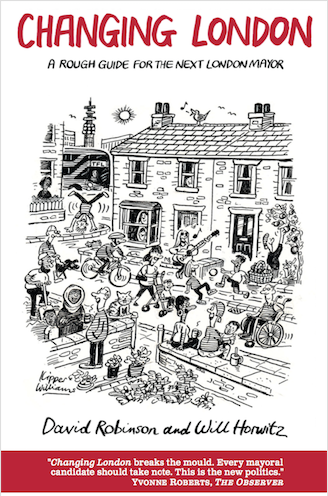
In the search for radical but practical ideas for change, one of the most hopeful developments has been the Changing London process initiated by David Robinson, one of the co-founders of the pioneering Newham-based charity, Community Links. So far this has involved crowd-sourcing a range of good ideas around key themes, including some borrowed from other great cities. There is also a book: Changing London – a rough guide for the next London mayor and open meetings, like the one I attended on 28th May with three of the potential mayoral candidates: Diane Abbott, David Lammy and Christian Wolmar. This hasn’t been about drafting a manifesto but initiating a process which has the potential to reach beyond political insiders and party members.

The Changing London project has so far been organised around 6 broad themes each including a range of ideas:

1. A great place to grow up: including six promises and a ‘cultural guarantee’ for every London child as well as the creation of 10,000 play streets.

2. A city where neighbourhoods thrive and everybody matters: putting thriving neighbourhoods and social space at the heart of planning

3. A fair city: putting power, wealth and opportunity in the hands of the many not the few, using a ‘mayor’s share’ in London’s biggest businesses to promote anti-poverty and affordable housing objectives.

4. A healthy city: which really prioritizes the health of its citizens and tackles health inequalities.

5. A deeper democracy: trying out new processes to involve Londoners in decision-making, for example an ‘Ideas for London’ agency to seek out and develop new ideas and an annual referendum on big issues facing the city.

6. A spirit of can-do: promoting the sense that change is possible and a willingness to listen to, and try out, new ideas.

If initiatives like Changing London can inspire, catch on and grow they have the potential to invigorate our politics and our city. The stakes are high and the early signs are promising.

I will be posting soon on how London could aspire to be a learning city by 2020.

cover_web3

Posted in Politics | Tagged , , , , , , , , , , , , | Leave a comment

Education: the universal human right


6c62dc9f964e6c2d1cfe1707e63d9c20
We should understand our common humanity in order to put our differences in perspective. Values and rights need to apply to all to be effective. Education should be a global human right, provided on the same basis to all.1

Universalism in education means regarding learning, knowledge and skills as part of a universal human inheritance which we have a duty to share as widely as possible. It means rejecting any notion of an education which is for the benefit of a minority, an advantage to be sought or a commodity to be bought with all the restrictive practices and cultural protectionism this implies.

A universalist curriculum would be a curriculum for global citizenship where even the most local and parochial of knowledge is connected to an understanding of the greatest global challenges and vice versa. It would reinforce learners’ growing sense of being part of a wider community; at the global as well as the local scale. It would help learners understand and analyse discriminatory and exclusionary beliefs and practices so as to expose them to scrutiny and judgement on the basis of equality, human rights and respect for all other humans. Such a curriculum would not shy away from fundamental difference or disagreement but would aim to be inclusive rather than exclusive.

There is a school of thought which argues that cultural diversity inevitably leads to a weakening of social solidarity as people are ‘less prepared’ to contribute to supporting people who are culturally or ethnically different to them. We cannot allow its advocates to get away with the claim that cultural diversity or multiculturalism inevitably lead to a weakening of universal values and social solidarity when the real threats come from cultures of excessive individualism, xenophobia and alienation.

Others have argued that the diversity of our big cities requires more diverse educational provision. In other words the comprehensive school may be a good model in more homogeneous communities but does not serve the more heterogeneous urban community with its clamour for diversity of provision. This may seem intuitive, but a very diverse community surely needs the common school as much as any other because it is the very place where young people can experience and understand diversity by learning and working alongside a wide range of others who are different to themselves, while sharing their common human concerns. If we allow young people to be segregated by class, faith or ethnicity how can we hope to build the good society we need to address our shared problems? The social engineering of selection and segregation simply reinforces existing social inequalities and is the very opposite of universalism. The common school is one of the most common-sense expressions of our shared common values.

One of the key functions of education in a good society should be to put into practice agreed universal values. Our schools and colleges should aim to model the good society, to promote solidarity and egalitarian and democratic practices even if the society around them is deficient in these. As Eric Robinson said at the end of his 2009 Caroline Benn lecture: “In evading the cultural, social and moral dimensions of education we are betraying our children and cheapening ourselves”.

We need to ensure that public investment in education reaches learners according to need and is targeted in a way which helps to reduce inequalities and promote learning. This inevitably means allocating greater resources to those who face the greatest barriers to success as well as keeping educational routes and opportunities open for all learners throughout life. In this context, the pupil premium, targeted at children in receipt of free school meals in England, can be an effective mechanism for redistribution and promoting universal access to a good education. However, in the context of reduced public spending per capita overall on education, any such resource is not buying additional provision for the least privileged but simply redistributing the cuts faced by all students.

The best way to guarantee a universal entitlement to high quality education is to maintain and defend a publicly owned and controlled system. Only collective community ownership and involvement can protect the principle of universalism. Such a system need not be uniform, monolithic or unchanging. It must be subject to constant questioning and allow for vigorous debate about its aims, outcomes, structures, standards and methods. It must avoid complacency or sclerosis and allow room for experimentation and innovation and allow people time to make judgements about what works best.

Advocates of the market claim that it is more responsive and innovative than the state. In a market, consumers do not have equal stakes and market innovation requires much market failure along the way. The “choice and diversity” agenda is predicated on the notion that greater choice between diverse providers is more likely to give people what they want from education. Like all market models it requires consumers with unequal ‘purchasing power’, whether of the financial or sharp-elbowed sort, to make market choices between unequal products. Those who already have the most generally benefit the most from such arrangements. In contrast, the idea of the common school is founded on the universalist belief that it is possible to meet the educational needs of all young people within a single common framework; one which acknowledges diversity and responds to individual needs.

Widening our scope to learning throughout life, universal opportunities for lifelong learning have been much reduced in England over recent years as a result of substantial cuts in every kind of adult education. Educational success is mostly measured in age-related milestones and from the first standardised tests in primary school, some children are defined as being below average, a judgement with great predictive value which sticks with them fairly deterministically.  Rather than being regarded simply as late developers, less successful children are faced with a narrowing of their options as they progress. In particular, major choices between ‘academic’ and ‘vocational’ pathways are often determined by a young person’s GCSE grades at age 16 as if young people themselves can be categorised so easily. Those who are able to catch up and achieve success later than their peers often face greater obstacles in seeking to progress to university or to combine employment and part-time study.

A genuinely universal education system needs to acknowledge differences between learners and the various obstacles faced as a result of people’s social and economic context, racism, sexism or other forms of discrimination. It must also recognise their different needs at different phases in their life and create opportunities to move in and out of full or part-time learning. Above all, it should be based on a belief that education is a universal lifelong right rather than a once in a lifetime competition for limited ‘goods’ with many more losers than winners.

On a global scale, an even more pressing case for levelling up is the grossly unequal access to education across the planet. The United Nations’ Education for All targets for schooling rates and literacy are still far from being achieved, with 72 million primary aged children and 71 million teenagers worldwide without school places and global illiteracy standing at 759 million people, two thirds of whom are women2. This is a global scandal which needs to be urgently addressed, but it seems likely that the global economic downturn will make this situation worse. Investing in education is one of the most effective means of combating inequality but it requires long term political commitment at the planetary level.

Education should address the needs of the whole person as well as the whole society. It should be prepared to address any and all areas of human activity, human knowledge and skill and not restrict itself in ways which are circumscribed by current power structures. Education is a lifelong process of deepening and widening understanding which combines the development of each person with that of the society they live in. Learning is fundamental to the human experience and we need to ensure that access to the benefits of learning really is universal.

“The good we secure for ourselves is precarious and uncertain until it is secured for all of us and incorporated into our common life.” Jane Addams

Notes:

The image is a poster designed by Roxanne Dupont for the 100 posters exhibition in 2011/12 sponsored by Human Rights and Peace Centre and shown at the Makerere Arts Gallery, Makerere, Uganda.

1. One of my 10 principles to shape education

2. Education for All Global Monitoring Report, UNESCO/OUP 2010

See also:

Unlimited potential part 1

Unlimited potential part 2

The selection debate

Many colleges in one


Posted in Education | Tagged , , , , , , , , , , | Leave a comment

Listening to our post-16 conscience.

209x288_17747_83Frank Coffield is the conscience of the post-16 sector. When faddishness or instrumentalism threaten, he is there to remind us of our values and our purpose. A decade ago, Coffield was one of the first to question ‘learning styles’ and the sloppy thinking around them and he debunked them with forensic skill. He has systematically exposed successive and simplistic models of improvement in teaching and learning and argued for more profound pedagogic change. He also co-wrote the excellent From Exam Factories to Communities of Discovery (2011) which offers us a vision of an alternative, more democratic education system which could help us confront the serious social and environmental challenges we face.

There’s no doubt that in these difficult times for post-16 education we need Coffield and we need more Coffield-ism.

In his latest contribution Resistance is Fertile (March 2015) he suggests 10 demands FE must make of the new government:

  1. Teacher unions and professional bodies to become equal social partners with government and business in policy development.
  2. Control over professional matters relating to teaching, learning and assessment to be returned to the teaching profession.
  3. Teaching to be carried out solely by fully trained professionals.
  4. Abolish or radically transform Ofsted into a body of professional colleagues dedicated to improving teaching and learning.
  5. Lifelong learning to become a right of citizenship in a democracy.
  6. Create an independent, middle tier of governance between national government and institutions.
  7. Build bipartisan political consensus for a unified 14-19 diploma system which integrates academic and vocational learning.
  8. Ensure that all new initiatives are carefully designed, thoroughly tested and slowly embedded.
  9. End the funding crisis, introduce 3 year budgets and simplify funding streams.
  10. Replace the pressure of permanent revolution with a slower, incremental, evolutionary approach to change.

It’s hard to disagree with these aims. Some of them are urgent and relate to the very existence and survival of our sector, others require long term groundwork and culture change. For this full agenda to be realised, we would have to create a new ‘common sense’ around what post-16 education is for, what professionalism is and how change is brought about. These are not simple targets to be ticked off a list. We’re talking about a major transformational project here and there are no short-cuts.

So what can we do?

Resourcing the post-16 education people need: Demands 5, 7 and 9

The funding crisis is an immediate priority. Full time 16-19 year old students are by far the worst funded in our whole system This strategically vital phase has been excluded from the government’s education spending ring-fence and adult education spending has been slashed. These facts speak volumes about where we are on the agenda and the low regard for our work. We need to make the positive social case for the kind of broad educational programme which all young people need as well as for the benefits of lifelong learning. If it becomes the consensus that post-16 education is a priority, there will necessarily be a consensus about making the choice to resource it properly. In his analysis of the 2015 budget, Mick Fletcher made the simple observation that cutting the price of a pint of beer by a penny could pay for 125,000 adult education places and the £700 cut in spending on all full time 18 year old students was roughly equivalent to the cut of 16p from the price of a bottle of whisky. (Inebriation before education – Policy Consortium). These are matters of political priority and political will.

A more plural and democratic system: Demands 6, 8 and 10

This requires a real shift in the way government thinks about public services and industrial policy. There is some movement towards regionalisation and some recognition that this requires a democratic input. Accountable regional authorities such as the Greater London Authority and other city regions could be given more autonomy to develop distinctive post-16 education strategies and open up space for discussion and debate about what people want from the system, giving themselves time to plan and embed system-wide improvements. Building a more democratically responsive system from the market free-for-all we currently have will not be easy.

Trust and professionalism: Demands 1, 2, 3 and 4

Bringing about this shift is partly in our hands. The more successful, creative and innovative post-16 providers and their staff prove to be, the more we are likely to build the climate of trust and confidence we deserve to work in. We need to take every opportunity, however small, to demonstrate our commitment to learners, to high educational standards and to partnership working. This is how we will win friends, advocates and allies at all levels and create a new context for our work with fewer demands for heavy regulation and policing and more willingness to invest. Another long-term transformational project.

In Resistance is Fertile Frank Coffield reminds us that it will take “collaboration, political nous and the stomach and energy for a prolonged struggle” to turn any of these demands into policy and practice. It will require new coalitions and ways of sharing information and organising, such as ‘Tutors’ Voices’ and other structures we have yet to invent. If we value the work that we do in post-16 education and its vital social contribution we really have no alternative but to listen to our conscience.

More about the post-election landscape:

Welcome back minister

Education 2020

Posted in Education policy | Tagged , , , , , , , , , , , , | 5 Comments

Defending liberal education

FullSizeRender (5)I had the pleasure of attending a talk at the London School of Economics given by the U.S. commentator Fareed Zakaria (18th May 2015). The lecture coincided with the launch of his new book ‘In Defense of a Liberal Education’ which promises to be a stimulating read.

Fareed Zakaria asked what it takes for individuals and countries to succeed in today’s world and concluded that a broad liberal arts education up to university level is part of the answer rather than part of the problem. Yet, in the United States the closure of social science and humanities departments or the withdrawal of subsidies for their courses is very much on the political agenda. Private liberal arts colleges remain part of an elite U.S. tradition while publicly funded programmes are increasingly under threat. Gone are the days when working class Californians could afford to study a degree at Berkeley for $300 per year for instance.

Zakaria reminded us that the idea of a liberal education ‘pertaining to free people in a free society’ dates back to ancient Greece where Pericles decided that the innovation of a democratic form of government required a similar innovation in education. He also made the point that the study of science has always been central to a liberal arts education. Far from being seen as ‘useful’ or ‘applied’ as it is now, it was regarded only a few hundred years ago as being of no practical value; the rather abstract study of the mysteries of the universe. Clearly, what we consider to be ‘practical’ has changed considerably over time.

The issue of defending and advocating a liberal arts education is an urgent one, he argued, because the evidence suggests that this is the best preparation for being innovative; whether in high-level scientific, new patents or business start-ups. The U.S. stresses about its middle ranking in PISA tables but it’s been in a similar position for 50 years; ever since PISA tests started in fact. Despite this, it remains one of the most dynamic and innovative economies, a position it shares with Sweden, another PISA mid-range performer. So it seems that having 15-year olds who are good at solving Maths problems is not the same as being innovative and enterprising. Instead, there seems to be a correlation with characteristics such as a healthy disrespect for hierarchies, irreverence and intellectual ‘disruptiveness’.

In any case, innovation and success is not all about new technologies. These need to be combined with new social processes or business practices. Zakaria drew on the success of Singer sowing machines, Apple computers, Facebook and Amazon to exemplify this point. The real innovations seem to come from people who applied sociological, psychological and aesthetic insights in new ways. It is often the clash and collision of different fields and disciplines which leads to progress and creativity and it is often the liberal arts graduates who can see the big picture, integrate several disciplines and understand that in the world, different things are ‘all happening at once’ rather than behaving as if they are stuck in specialist silos.

According to Zakaria, the two great forces changing our world are globalization and the information revolution. These forces are not new and we already understand them well. We need to embrace them optimistically and critically but there’s no turning back.

In summary, Zakaria made a strong case that young adults in upper secondary and higher education need a broad liberal arts foundation rather than a narrow over-specialised experience to prepare them for the unknowable future. I was inspired by the talk but for me it served to highlight the chasm between this aspiration and most of English education as it is currently organised. How distant the hope of a broad knowledge-based curriculum for all young people still seems. How dominant the instrumentalist case and how much there is still to do.

I look forward to reading and reviewing Zakaria’s book. In the meantime, here are some posts I have written on a similar theme:

Gramsci’s grammar and Dewey’s dialectic (December 2014)

Debating the Liberal Arts (October 2014)

Learning to love liberal education (October 2014)


Posted in Education | Tagged , , , , , , , , | 3 Comments

Aspiration – what’s that all about?

Are you suffering from aspiration fatigue? In a week when Labour leadership contenders were falling over themselves to urge the party to do more to appeal to ‘aspirational’ voters it’s not surprising we’re already tiring of it, especially when it’s described in terms of nothing more than where we shop, or want to shop.

Brian May, speaking on a BBC Question Time panel this week, gave voice to some of this irritation, and expressed concern that politicians seem to be using the term to describe people’s personal desire for more money rather than their wish to achieve great things.

In the context of Labour’s successes and failures in the general election, there’s hardly a clear correlation between aspiration and not voting Labour given that London, the epicentre of aspiration, swung towards the party and it was older voters, whose economic aspirations are more likely to be behind them, who turned away from it.

But what is aspiration and who has it?

In its narrowest sense, aspiration just means aiming high or having high hopes. This can refer to wanting a higher income or standard of living (and which of us doesn’t?) but it can also mean having high hopes of those around us, our community and wider society. A genuinely aspirational person wants everyone to aim high and achieve great things, they understand that for each of us to do well our personal ambition has to be combined with social support and solidarity. None of us will achieve our aspirations without the contribution of lots of other people and the presence of some fairly solid social structures and institutions.

So what are politicians telling us when they praise aspiration? Are they praising greed? Selfishness? Personal ambition? Are they using the term to highlight the deficiencies of the non-aspirational; the lazy feckless ‘underclass’ who make no plans and can’t be bothered to better themselves?

Singling out particular people or demographic groups as ‘aspirational’ feels wrong, and maybe even divisive. Surely, we are all aspirational, both for ourselves and for others. This may look different for different people but we all want a comfortable standard of living and personal security and we all hope for the kind of incremental improvements which will give us a better life. However, the realising of all our aspirations requires a functioning, decent and fair society.

It needs to be said that we are also all capable of being selfish and grasping under certain circumstances. But politicians shouldn’t just aim to hold a mirror up to our individual selfishness. Electing representatives is one of the ways we act together as social agents. Our politicians represent us as a collective and should be helping us to see how to promote wider social aspirations rather than encouraging us to simply look out for number one.

The great joy of working with young people in an educational setting is that our students are full of aspiration and our work is all about helping to nurture and realise those aspirations. And how wonderful that aspiration is not a commodity which needs to be rationed; one person’s high aspirations do not require anyone else’s to be lowered. In a school or college, everyone can aim high and do well.

So we may be a bit fed up with all this talk of aspiration, particularly of the narrow economic kind. But let’s not give up on the full aspirational package, including the wider social kind. It’s what keeps us all going.

See also: Is social mobility enough?

Posted in Politics | Tagged , , , , , | Leave a comment

Why Labour lost: the definitive analysis.

Your personal guide to why Labour lost.

Hoping to explain the election outcome? Insert your own explanations to construct a reassuring account. Satisfaction guaranteed.

1. Why Labour lost.

Labour lost because it failed to appeal to [insert demographic of choice] who shop in [insert retail outlet of choice] and couldn’t persuade them that they would [insert priority of choice]. They should have apologised for [insert past mistake of choice] and talked more about [insert policy area of choice]. They should have taken the threat of [insert rival parties of choice] more seriously and been prepared to take on the vested interests of [insert hate-figure of choice]. Their leader was too [insert characteristic of choice].

Some suggestions in case you can’t come up with your own:

Disaffected working class people / aspirational middle class people / Scottish voters

Alldi / Tesco / Waitrose / John Lewis / the corner shop

Reverse austerity / manage the economy well / make life better / improve the weather

The Iraq war / spending too much / spending too little / not winning the 2006 world cup

Reducing inequality / encouraging enterprise / the environment / immigration / kittens

The SNP / UKIP / the Tories / godzilla

Media proprietors / the banks / the utility companies / the unions / public sector workers

Clever / nice / weird / left-wing / right-wing / clumsy

2. What Labour needs to do to win.

Labour needs a leader who is a brilliant communicator and a credible prime minister. The party needs to establish a strong message long before the next election, this needs to be based on core values of [insert value 1], [insert value 2] and [insert value 3]. The party needs to create new alliances and work more closely with [insert potential allies] and [insert potential allies].

Some suggestions in case you can’t come up with your own:

Equality / solidarity / aspiration / patriotism / wealth creation / selfishness

Greens / Liberal Democrats / progressives / trade unionists / monster raving loonies

Posted in Politics | Tagged , , | Leave a comment

Science in Society: what you need to know.


AS Science in Society (AQA)

A very condensed list of the key science concepts you need to understand well.

SiS_663399-1


Infectious disease, medicines and the germ theory of disease:

All living things (organisms) are composed of cells. Most of the chemical reactions that are needed for organisms to stay alive, grow and reproduce take place in cells. The mechanisms are similar in the cells of all living organisms. Infectious diseases are caused by microbes suchas bacteria, fungi and viruses. How the body defends itself against infections or other foreign tissue with its immune system, the specific immune response and vaccination, exposing the individual to a form of the microbe that has been altered or attenuated so that it is unable to cause disease but will still stimulate the production of antibodies. The processis known as vaccination. Why it is difficult to develop an effective vaccine against some diseases such as the common cold, malaria and HIV. Drugs are chemicals derived from natural or synthetic sources that influence the normal chemical processes in the body. Antibiotics and antibiotic resistance. Cancers occur when cells divide uncontrollably. Mutations in certain genes damage the normal controls on cell division. The dividing cells form a tumour.

Genetics, reproductive choices and ethical issues in medicine:

Instructions for development are found in the form of genes which are part of the chromosomes in the nucleus of every cell in the organism. Each gene is a segment of a very long molecule of DNA. Chromosomes contain a large number of genes. All cells except sex cells, and red blood cells, contain two sets of chromosomes. Both chromosomes in a pair carry the same genes in the same place, but the two chromosomes may carry slightly different versions, called alleles. In sexual reproduction, a single specialised cell from a female merges with another specialised cell from a male. Each of these sex cells contains a randomly selected half of the parent’s genes. The single cell which they form then contains a full set of genetic information, one of each gene pair coming from a different parent. This process means that there is a very large number of possible combinations of the parents’ genes, so offspring can be quite varied in their characteristics. As a new organism grows from a single cell, its full set of genes is replicated in each cell. In any cell only a fraction of all the genes are expressed, that is, determine the functioning of the cell. The genes that are not expressed have no influence on the cell. Each cell contains two genes with the same function, and each gene may occur in two or more different versions called alleles. The way one allele affects cell function may dominate the effects of other alleles. This allele is known as dominant, and the others as recessive alleles. The effects of recessive alleles are only seen if both chromosomes carry the recessive alleles.

Most characteristics are determined by an interaction between several genes as well as by the effect of the environment. The environment can influence gene expression. In addition to the variation which arises through sexual reproduction, change can occasionally happen to a gene itself. This is called mutation. It can be caused by certain chemicals, by ionising radiation (including ultraviolet rays, X-rays or gamma rays). If a mutated gene happens to be in a sex cell, copies of it can be handed on to an offspring, perhaps giving it new characteristics. These may be undesirable or beneficial, or have no effect on the offspring’s ability to survive and reproduce.

Most cells in large organisms are specialised and carry out particular functions. The processes by which this specialisation occurs in the early development of an organism are very complex and are still not fully understood. Once they have become specialised, cells of animals stay specialised so that it is not easy to produce clones. Stem cells are cells that have not specialised. Embryonic stem cells can give rise to any type of specialised cell under the right conditions. Adult stem cells have developed partial specialisation and can only give rise to a limited number of new types of cell. Cloning is a way of making a genetically identical copy of an organism. Because all organisms use the same genetic code to carry units of information, a gene can be taken from the nucleus of one cell and placed in a different cell. This is called genetic modification. The resulting organism will display new characteristics.

Evolution:

The first living organisms are thought to have developed from molecules that could copy themselves. All the Earth’s present species, and the many more species that are now extinct, evolved from the same very simple life forms that first appeared on Earth about 3.5 billion years ago. All species can therefore be linked in a single branching tree structure in which many of the branches are ‘dead ends’. One of the mechanisms central to the explanation of evolution is natural selection. There is usually variation between individuals of the same species. Some have characteristics which give them a better chance of surviving and reproducing in a particular environment. These individuals will pass on their characteristics to the next generation. The genes for the advantageous characteristics will become more common as a result. Natural selection leads, over many generations, to a gradual change in the characteristics of a whole population.

Among the implications of this theory (Darwin’s theory of evolution) are that the process is not driven by any overall direction or aim; and that the path which evolution has actually taken is a result of chance factors at every stage and could, with minor changes in circumstances, have been different. In any given environment, or ecosystem, there is competition between several species for the materials they require to live and reproduce. Species may also be dependent on other species in the ecosystem. As a result of these complex patterns of interdependence and competition for resources, changes which affect one species can have extensive knock-on effects on other species.

Transport:

Atomic structure, elements, bonding, compounds and mixtures. Chemical reactions involve the recombination of atoms to form new and different substances. All changes require a fuel, or some other concentrated source of energy, to make them happen. Fuels are concentrated sources of energy. There is a finite amount of fossil fuel (coal, oil, natural gas) on Earth. Other energy sources (wind, wave, biomass such as wood) are renewable and can be replaced in the same sort of time scale as they are used. Energy can be transferred from one object to another mechanically (by forces acting), thermally (by heat flowing from high to low temperatures), electrically (by an electric current), or by radiation. A system of chemicals (for example, a fuel plus oxygen) can release energy when the chemicals react. When a change happens energy is not destroyed. Instead it is dispersed and ends up in a wider number of places. As a result it is less useful for driving any further changes. The principle of conservation of energy, energy efficiency (the percentage of the energy originally available which ends up where you want it to be). In many processes, energy is wasted and ends up heating parts of the system.

Radiation:

Although all atoms of an element have the same number of protons and electrons they may have different numbers of neutrons. Atoms of the same element with different numbers of neutrons are called isotopes. Most atoms are stable but some of these isotopes have unstable atoms. A substance containing unstable atoms is said to be radioactive. Radioactive atoms decay, emitting radiation. The decays occur randomly but with a definite probability. As they proceed, the number of radioactive atoms left in a sample falls, so the rate of emission drops. The number of emissions per second is called the activity of the source (in becquerel). The time which it takes for the activity of a sample of radioactive isotope to fall from any initial value to half of that value can be measured and is called the half-life of the radioactive isotope. The half-life is characteristic of the isotope.

Radioactive materials emit three types of radiation. Alpha particles are easily absorbed e.g. by a thin layer of paper, or a few centimetres of air. Beta emissions (a stream of electtrons) pass fairly easily through many substances but can be absorbed by a thin sheet of any metal. Gamma radiation (part of the electromagnetic spectrum) are very penetrating and can only be significantly reduced in strength by a thick sheet of a dense metal such as lead or by concrete several metres thick. When radiation is absorbed it ceases to exist as radiation, instead causing heating. Shorter wavelength radiation, ultraviolet, X-rays and gamma rays, can bring about chemical changes by breaking up molecules into fragments. The fragments are often electrically charged particles which we call ions. Radiation that produces ions is called ionising radiation. All three types of emission can cause damage to the molecules in living cells, either killing the cells or causing mutations in the genes. Alpha does most damage (per centimetre of their path), followed by beta, then gamma. The radiation dose equivalent (in sieverts) which a person receives is a measure of the amount of damage caused by the radiation within their body. Effects of radioactivity can be spread in two ways: by irradiation (the emissions from a radioactive substance striking and being absorbed by another object); and by contamination (the transfer of pieces of the radioactive substance itself on to, or into, another object).

The universe:

The solar system was formed about 5 billion years ago. The Sun is a star. Stars originate from clouds of gases drawn together by the force of gravity. In stars hydrogen atoms fuse to form helium atoms releasing energy until most of the hydrogen is used up – another 5 billion years for our Sun. The Sun is one of billions of stars clustered in a group called the Milky Way galaxy. The size of this galaxy is huge, even compared to the distances between our Sun and the nearest stars. Light travelling at 300 million metres per second takes about 100 000 years to get from one side of the galaxy to the other. Most of the galaxy is empty space. There are millions of other galaxies in the Universe. The distances between galaxies are very large compared to the size of the galaxies themselves. The distances between the galaxies are not fixed, but increasing. The Universe is expanding. The further apart galaxies are from each other, the faster they are moving apart. This suggests that all the universe, all of space, matter, energy and time started from a tiny size with a huge explosion (the Big Bang) which occurred 13.7 billion years ago. The rate at which the Universe is expanding seems to be increasing. We do not know what is causing this to happen and this unknown force is called as dark energy. Gravity is the force of attraction between any two masses, including planets, stars and other objects in the universe. The strength of the force is proportional to the masses of the two attracting objects and inversely proportional to the square of the distance between them.

Science in Society Quiz: 100 questions you should be able to answer

Don’t be satisfied with just finding the word, make sure you can explain the concept

  1. A word which means the share of the total amount (a percentage, a fraction or a decimal)
  2. A word which describes the amount of change as a share of the total amount
  3. Diseases caused by microbes
  4. Microbes which cause disease
  5. Diseases which are caused by human behaviours
  6. A very small micro-organism which needs to get into a cell in order to replicate
  7. A substance which is recognised as non-self and triggers an immune response
  8. A protein made by lymphocytes which binds with specific non-self molecules
  9. When one variable changes in the same way as another variable
  10. The relationship between two variables, when one rises, the other rises too
  11. The relationship between two variables, when one variable rises and the other falls
  12. A substance which destroys specific bacteria
  13. When experiments can be repeated and show the same results
  14. When it can be shown how one thing leads to something else
  15. Gradual change over a long period
  16. Sudden change over a short period
  17. The study of development before birth
  18. The study of fossils
  19. The study of the progress of disease
  20. The study of rocks and changes in the Earth over time
  21. Passing characteristics from one generation to the next
  22. When two structures are basically the same thing in different contexts
  23. Comparing two things which have some similarities
  24. Being able to cope better with a particular environment
  25. Having lots of differences within a population
  26. The study of animals
  27. The study of plants
  28. Five-fingered
  29. The man who came up with the theory of evolution by natural selection
  30. An Italian scientist who supported a Sun-centred view of the universe
  31. A Polish astronomer who supported a Sun-centred view of the universe
  32. An ancient scientist who supported an Earth-centred view of the universe
  33. Earth-centred view
  34. Sun-centred view
  35. An unproven proposition
  36. An explanation which has been thoroughly tested and is generally accepted as accurate
  37. ‘Bottom-up’ reasoning which draws general conclusions from specific cases
  38. ‘Top-down’ reasoning which starts from general statement to make predictions
  39. Universally recognised scientific belief system which shapes the work of scientists
  40. A statement about what will happen in the future
  41. A proposed explanation which still needs to be properly tested
  42. The biological process by which energy is released from food
  43. The biological process by which food is produced from carbon dioxide and water
  44. The process of stimulating the production of antibodies in order to protect against disease
  45. The Austrian doctor who promoted antiseptic practice
  46. The French scientist who promoted the germ theory of disease
  47. The overall death rate in young children
  48. The average time people live for
  49. The thing which spreads a disease
  50. Energy producing substances which originate from very ancient living things
  51. The fact that higher levels of certain gases in the atmosphere causes more heat to be retained
  52. A sex cell
  53. A word which means that sex cells have only half the genetic material of body cells
  54. Cell division which produces more body cells
  55. Cell division which produces sex cells
  56. The first cell or ‘fertilised egg’ which can then divide and grow into a full organism
  57. Different genes for the same characteristic
  58. The version of a gene which will be expressed even if it’s the only one present
  59. The version of a gene which will only be expressed if two copies are present
  60. When both versions of a gene are the same for a particular individual
  61. The structure in the cell nucleus on which genes are found
  62. The chemical which genes are made of
  63. The 4 different nucleotides
  64. The molecules which are strung together to form proteins
  65. How many base pairs are needed to code for one amino acid
  66. Ways of producing energy which will not run out
  67. The products of the combustion of a hydrocarbon
  68. A medical treatment which has no active ingredient
  69. A test where the patient does not know whether they are getting an active treatment
  70. A test where neither the patient knows whether they are getting an active treatment
  71. A group in a trial who are not receiving the active treatment
  72. Two particles which are present in the nucleus of an atom
  73. How many electrons can occupy the first and the second shells of an atom
  74. A form of electromagnetic radiation which can kill cells
  75. A form of electromagnetic radiation with a very long wavelength and low frequency
  76. An instrument for measuring radiation
  77. An instrument which uses radiation to ‘see’ inside our bodies
  78. The colour of visible light with the longest wavelength
  79. The colour of visible light with the highest frequency
  80. The nucleus of a Helium atom
  81. A stream of electrons
  82. Different versions of an atom of the same element which have different atomic mass
  83. A substance made of atoms of the same atomic number
  84. A charged atom
  85. The connection between atoms when they share electrons
  86. The connection between atoms which one gives electrons to the other
  87. The unit of energy
  88. The unit of mass
  89. The unit of frequency
  90. The unit of radioactive decay
  91. The unit of radioactive dose
  92. The speed of light
  93. The speed of sound in air
  94. The distance which light travels in a year
  95. The time it takes for the amount of radioactivity emitted by a substance to fall by 50%
  96. When the frequency of a wave changes because the source is travels away from, or towards, us
  97. Our Sun and the planets which orbit it
  98. A massive cluster of stars – the one we are in is called the Milky Way
  99. The American scientist who discovered that the universe is expanding
  100. The event which we think started the universe as we know it

See also:

Science in Society: Course outline and link to resources

Science in Society 1: Is doubt the origin of wisdom?

Science in Society 2: Science and poetry

Science in Society 3: How we do science

Science in Society 4: Paradigm shift

Science in Society 5: Homology, analogy and metaphor

Science in Society 6: The germ theory of disease

Science in Society 7: A few things we know about the universe

Posted in Learning resources, Science in Society | Tagged , | Leave a comment

Welcome back, minister

Dear secretary of state,

Congratulations on your reappointment. You have the advantage of being more familiar with your ministerial in-tray than most. This is only a very short addition to it.

Among the urgent issues for your consideration are some relating to the education of 16-19 year olds in England. Public funding for this age group is by far the lowest in the system. Despite the raising of the participation age, this funding remains outside the government’s spending ‘ring fence’ and has been disproportionately affected by spending reductions. This trend seems set to continue unless drastic action is taken.

On average, full time 16 and 17 year olds are funded at £4,646 per year and 18 year olds at £3,830 compared to £5,620 for 11-16 year olds and £8,500 for 19-21 year olds (including FE loans). This means that 16-17 year olds attract 17% less funding than their 11-16 year old counterparts. For 18 year olds the gap is even wider at 32%.

Sixth form fees in independent schools average over £13,000 and are typically above their 11-16 fees reflecting additional costs required to offer the post-16 curriculum.

It is clear that publicly funded sixth form providers, whether colleges or schools, are already finding it difficult to offer a broad and balanced curriculum to this age group and with further reductions the gap between aspirations and resources will be impossible to bridge.

In addition, this phase of education is now characterised by intense competition between providers, this does not necessarily create successful or cost-effective local systems or serve the interests of young people well.

All of this must be of grave concern to you as you will be aware of how important good full time sixth form education is in preparing young people for progression to university and employment and building on their achievements pre-16.

It is therefore vital that the following urgent questions are addressed:

  1. How do we fund the education of 16-19 year olds adequately and equitably over the next few years to ensure they can benefit from the kind of full time programmes which prepare them well for higher education and employment?
  2. How do we promote successful and cost-effective models of collaboration and partnership between 16-19 providers to ensure that the educational needs of all young people across England can be met?

We look forward to a constructive dialogue on these matters.

Posted in Education policy | Tagged , , , , , | 3 Comments

Gulliver’s levels

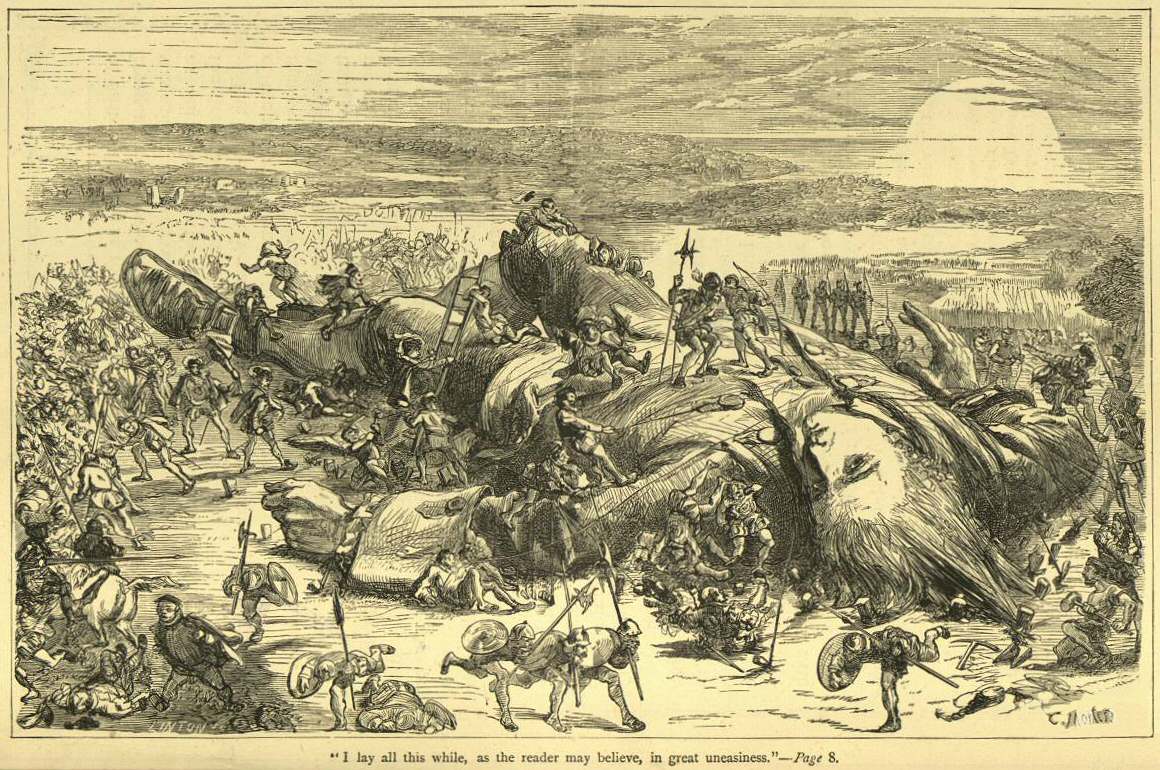
gulliver-morten16Jonathan Swift’s ‘Gulliver’s Travels’, first published in 1726, mocks the travel journals of its day with their increasingly fantastical adventures. It is also brilliant social satire, mercilessly tearing through contemporary conventions and pretentions.


It can also be read as a thought experiment about levels of analysis and explanation; a kind of philosophical enquiry into different perspectives on human society. Each of the worlds Gulliver visits requires us to question some of our assumptions, to look at ourselves with different eyes.

So in Lilliput we ‘see the world small’ with Gulliver. In a world whose people are so much smaller than him and where he could easily harm many of them at once, he is able to view social activity from a distance; to take a more sociological perspective. In Brobdingnag where people are much bigger than him and where even a child could easily harm him, he has a different perspective; getting up close and personal with individuals and understanding their psychological motives; he is ‘seeing the world big’.

In the other adventures, we are asked to imagine dramatically different societies which have enough in common with our own to be recognisable while requiring very different ways of living. What if music and mathematics were the most valued social goods? What if the apparently immutable laws of physics could be reversed and islands could fly (Laputa)? What if immortality was possible (Luggnagg)? What if there are more advanced beings who see us in a similar way as we see ‘lower’ life forms (The country of the Houyhnhnms)?

In each new adventure, Swift radically shifts the assumptions or the level of analysis. We are looking at societies that have something in common with ours but through a different lens each time. By changing our spectacles we are able to see the utopian, dystopian and ridiculous elements of our own society.

All of this serves to remind us that viewing our world from different perspectives helps us to make more sense of it and that complex systems need to be studied both at the level of the parts and their properties; reductionism – as well as at the level of the wholes and their properties; emergence.

In education, ‘seeing the world big’ offers many examples of the parts connecting to wholes: facts or units of knowledge which need to be connected to others into meaningful structures or schemas over time, individual learning ‘moments’ which need to be connected in long-term learning projects or curricula in disciplinary (and interdisciplinary) frameworks, ideas and values which need to be tested and connected to each other to inform real-life actions, individual people with human desires and motivations who need to connect to other people to realise the potential of working collectively to achieve great things.

At the ultimate level of ‘seeing the world small’ we have human civilization as a whole with all the insights and capabilities it offers us and we also have certain enduring cultural and educational practices and institutions which aim to help us pass all this on.

If we add all of this together we get the possibility of becoming educated – an emergent property of all this learning work. We experience it at our own, human, level in the here and now. But we will understand the things we study better if, like Gulliver, we see them from different perspectives and at different levels. All our questioning and all our learning will take place somewhere between the big and the small, the actual and the possible, the known and the unknown. And it’s from there that wiser, better educated individuals and a wiser, better educated society emerges.

See also: Learning is dialectical (April 2015)

Maxine Greene: resisting one-dimensionality (June 2014)


Posted in Culture, Fiction, Philosophy, Reviews | Tagged , , , , , , | Leave a comment

Tribalism or pluralism?

themWith no single party likely to win an overall majority in next week’s general election, they are all finding ways of answering, or not answering, the questions about what they will do in hypothetical post-election scenarios. So we are learning to live with the politics of ‘red-lines’ and various degrees of passionate deal-denialism from ‘over my dead body’ to ‘let’s wait until the electorate give their verdict’.

For the two major parties, it seems to be an act of faith not to countenance anything but outright victory, anything else is regarded as a terrible sign of weakness. But would they not gain more respect from all sides if they could at least acknowledge the possibility that a coalition or deal may be necessary and should be openly discussed? Given that no party will command a majority of votes cast, let alone of the electorate, is this not simply a better response to the diversity of public opinion?

We seem to be stuck with tribalism just when we need pluralism. Tribalism in politics holds parties together and generates loyalty and cohesion. That sense of internal solidarity between its core supporters can be a strength. However, it is less useful when trying to build coalitions with other ‘tribes’ who share some of our beliefs but come from a different tradition. Our sense of moral superiority, exclusive access to truth and hatred of all other parties become obstacles. The stronger the intra-party tribalism the harder it is to build any solidarity across parties and establish common ground. Instead, options are closed down instead of being explored.

A general election is a good example of a complex system operating at different levels. At one level it is about millions of individuals each making a separate decision about who to vote for, shaped by a complex interplay of influences. We all understand that, on its own, our ‘little’ vote makes little difference to the result. At the next level up, the composition of the House of Commons is determined by the first past the post outcomes in each constituency, some MPs being elected with large majorities and others very narrowly and with a minority of the vote. A government with a Commons majority is not put together simply by aggregating the popular vote.

So when commentators try to explain the meta-politics of Westminster in terms of our individual political choices they ask questions like ‘what do voters want?’ or ‘what is Britain thinking?’ and try to construct typical voter archetypes like ‘Mondeo man’, ‘Essex woman’, the ‘grey vote’, the ‘youth vote’ or ‘swing voters’ none of which can do justice to the complexity of the electorate or explain the relationship between our votes and the actual outcome.

Clearly, it is the actual votes cast on polling day which will generate the result, but the arithmetic of the House of Commons operates at a different level. It is at one remove from the popular vote; an unpredictable emergent property affected by the way our votes feed through our electoral system. Differential turnouts and very small geographical or demographic shifts can lead to very different overall results in terms of the number of MPs each party will have.

In our current system we vote for one candidate and therefore one party only. This is often a compromise, given that we probably don’t agree with every one of their policies and in some cases we may be voting tactically. We can’t choose a coalition and we can’t easily tell ‘our’ party who to work with. But once the votes have been counted and the MPs have been elected, we expect them to produce some kind of decent government.

So why not just recognise that single party government is unlikely and make a virtue of being prepared to work with others? Doing some of the advance work, in public, this side of the election would help to give voters a sense of what different coalitions might look like and maybe even to influence their party’s negotiating stance. A party which has a clear set of values and beliefs and can express them confidently should be in a good position to negotiate with others about policies without sacrificing what really matters.

Most parties are themselves coalitions, held together by the glue of common values, and so they are familiar with the process of resolving differences internally. If we allow our tribalism to blind us to the real benefits of working with others we could miss out on those benefits altogether.

See also: Young people and the election


Posted in Politics | Tagged , , , , , , , | 2 Comments

The Big Hairy Bacc

herryThose political metaphors are great aren’t they? When he was an opposition spokesperson on education, Boris Johnson used to speak about the importance of ‘crunchy’ subjects, by which he meant Science and Maths, presumably in contrast to the soggy gruel of English Lit or Philosophy.

Last week, Tristram Hunt told us he wanted to initiate a ‘big hairy conversation’ about the possibility of a single national baccalaureate. I’m not sure what is ‘hairy’ about this conversation but is is a very welcome development. Inevitably, the media reported the proposal in terms of ‘ditching GCSE’ just as a decade ago claim was that the Tomlinson report would be ‘ditching A levels’. This was probably what led prime minister Tony Blair to get cold feet about a 14-19 reform, which could actually have been very popular.

Whether crunchy or hairy, this is a conversation that doesn’t need to be about ditching things. The point of an overarching qualification framework is that it can contain different qualifications within it. The baccalaureate should be an expression of what we think a good curriculum should be. The qualifications inside it can change or disappear as the overarching award evolves. So the ‘hairiest’ issue is actually the least important one.

There is strong support for the idea of an overarching curriculum framework for all young people. The Husbands report commissioned by the Labour Party offered a realistic way forward, a number of successful alternative models already exist, for example in Wales, and the work being done by the Headteachers’ Roundtable demonstrates the appetite for a baccalaureate approach in England.

Tristram Hunt is taking the view that people are fed up with imposed curriculum reform and that there needs to be a national conversation on 14-19 education followed by a period of consensus-building before any major change to the system. He is absolutely right and that conversation needs to include teachers, parents, students and everyone concerned with the future of education.

What he is doing is making it possible to for that conversation to take place and telling us that he understands that politicians don’t have all the answers. This approach  is refreshing – as long as it comes with some guiding principles. Politicians in government should be mindful of government’s role in shaping the education system rather than micromanaging it.

I would offer just two very clean-shaven principles as a starting point for our conversation:

  1. The conversation should start from first principles and should ask some fundamental questions: What do we think 14-19 education is for? What should an educated 19 year old have experienced, learnt and achieved?
  2. The conversation should take a ‘one-nation’ perspective. This means imagining a single framework which is capable of including all learners in this age group. Instead of starting with the creation of a Tech Bacc and envisaging different pathways for different ‘types’ of learner and then working towards equal value, it should start from a single National Bacc and then consider what different options and routes could be included within it. This is the only way to ensure equal value and equal challenge for all learners.

So, Tristram Hunt’s ‘big hairy conversation’ offers us the chance to grow a genuinely popular National Bacc from the bottom up.

Before that, of course, there is the small matter of a general election…

More on the National Bacc:

Bacc on the agenda (March 2015)

Labour’s disappearing National Bacc (December 2014)

Building the Bacc from below (December 2014)

Posted in Education policy | Tagged , , , , , , , | Leave a comment

Young people and the election

Facebook-20150427-120239Are young people turned off politics? Will they vote? Do they care who wins the election? Are all parties the same? Are the candidates just hacks mindlessly parroting their parties’ approved slogans?

This week’s general election hustings at Newham sixth form college (NewVIc) challenged many assumptions about ‘business as usual’ and young people’s alleged lack of engagement with politics.

We welcomed 6 parliamentary candidates, each of whom is standing in one of the 2 Newham constituencies: East Ham or West Ham. They represented the full range of parties standing: Conservative (Festus Akinbusoye), Green (Tamsin Omond), Labour (Stephen Timms), Liberal Democrat (Paul Reynolds), TUSC the Trade Union & Socialist Coalition (Lois Austin) and UKIP (Daniel Oxley).

The meeting was attended by around 100 students in their free time and they were fully engaged for nearly 2 hours. Less than half of these young people will actually be able to vote on May 7th as many are still 16 or 17 years old. But all were eager to hear what the candidates had to say.

As the chair, I had the task of trying to keep the candidates in order and focused on the questions which students were asking. This was actually not a problem, the speakers were reasonably disciplined and kept to the point. On the whole our candidates were refreshingly direct and free of slogans or platitudes and their personal commitment came through pretty strongly. My impression was that they all took our audience seriously, treated them as adults and made no assumptions about what they were interested in.

We didn’t have time to address all the topics which students wanted to raise but we did cover a lot of ground. All the candidates were asked about the impact of austerity on local people in Newham, their positions on university tuition fees, global warming and immigration.  There was plenty of disagreement but each candidate was allowed to make their point so that people could judge for themselves. Based on the strength of the applause, this was an audience strongly opposed to both austerity and tuition fees.

We also had a round of questions aimed specifically at each party; mostly challenging them in some way. Labour was asked how different its spending plans would be compared to the Coalition’s. Stephen pointed to the growth in food banks and gave many examples of Labour’s very different priorities including a much greater emphasis on jobs and poverty reduction.

Tamsin was asked how the Greens would pay for their living wage commitment and she reminded us that Britain is a rich country and that we can shift resources away from Trident for example.

For UKIP, Daniel was challenged to define the ‘British culture’ which his party seems so keen on. His reply that it’s hard to describe but we’d know it if we saw it – “like a sausage” – did rather mystify many in the audience but his case for leaving Europe was more cogently argued.

One student asked Paul how the Liberal Democrats could ever be trusted again after their tuition fee U-turn and the reply was mainly about the reality of coalition politics and the fact that no single party can get its whole manifesto through.

For the Conservatives, Festus was asked whether his party was ‘for the rich’ and he told us a little about his own story of aspiration and achievement from an unpromising start, first as a basketball player and then as an entrepreneur. He wanted policies to encourage enterprise and success and not stifle it.

TUSC was asked a rather supportive question about its plan to reverse austerity and this gave Lois the opportunity to argue against governing in the interests of the rich and big corporations and in favour of expecting them to pay a much greater share.

What we got was a real diversity of opinion and very different visions of the future, argued with passion as well as evidence. Our candidates came across as real people with life experience beyond party politics.  None of them sounded like the Westminster insiders we see so much of in the media and the debate was all the better as a result.

I think most of the students present will have come away with a sense that we face some genuine choices, that politics really matters and that voting can make a difference. I think they also understand that voting once every 5 years is only the start of full citizenship. As most of the candidates emphasised in their different ways, young people need to be well informed, to engage in activism and campaigning and to work with others and fight for what they believe in.

NewVIc students have a proud record of political engagement and this election debate is only one of many activities our college offers to help them develop the knowledge and skills needed for active citizenship, for example through political education and experience of advocacy, debate, community organising and leadership.

No doubt our students will continue to debate the issues and we’re looking forward to our on-line student poll to be held on May 7th. We recently celebrated the highest ever participation rate in our student union elections so we’re hoping for a similarly high turnout for this one.

I want to thank all 6 candidates who made time in their campaign diaries to attend our debate and took it so seriously. They clearly can’t all win but we will follow their progress with interest. A big thank you also to NewVIc teacher Robert Behan and his A level politics students, and to Kate Reed and Steven Kern, our student development team for all the planning and preparation which contributed to the success of the event.

Facebook-20150427-120345 Facebook-20150427-120330

Posted in NewVIc, Politics | Tagged , , , , , , , | Leave a comment

Is social mobility enough?

Analysing the data in the recently published Sutton Trust Social Mobility Index* has made me reflect a bit on ‘social mobility’ as a goal of public policy. My conclusion: it’s a worthy but inadequate response to the many injustices and inequalities in our society, a stepping stone which must not be mistaken for the destination.

We’ve all seen the statistics about the class profile of judges, media professionals, Oxbridge students and so on. Increasing social mobility seems to mean improving the proportion of disadvantaged people who can access the well-paid professional careers where they are currently under-represented. This under-representation clearly needs to be corrected and presumably, in a genuinely meritocratic society we would expect the profile of these professions to be close to that of the population as a whole with many more disadvantaged young people moving ‘up’ to take their share of the well paid and influential roles.

Greater social mobility is clearly preferable to its opposite. Social immobility implies a society where your birth determines your destiny, where there is no movement between classes and where the child of an unskilled worker is doomed to remain unskilled themselves. Also, there can be no doubt that education is a key engine of such mobility.

I have spent my whole career helping disadvantaged young people gain the knowledge and skills to be successful and ‘get on’. Promoting social mobility has been my job for over 30 years and I’m proud to lead the college which sends more disadvantaged young people to university than any other sixth form in England (more on this here).

So is this enough? I don’t think it is.

First of all because education on its own cannot address the unequal distribution of power and influence, the discrimination and the networks of privilege which shore up the many inequalities in our society; whether based on class, ethnicity or gender. Disadvantaged young people with high educational achievement still face more barriers to mobility than their more privileged peers.

Secondly, because the promise of upward mobility in a highly unequal society does nothing to challenge the structure of that inequality. It may even legitimise it by seeming to say: “look, some disadvantaged people have overcome great obstacles to ‘make it’ so it’s your own fault if you can’t too.”

If we focus merely on social mobility as a policy goal, we are settling for an accommodation with the very inequalities we want to overcome. If all we seek is greater mobility (both upwards and downwards) we narrow our ambitions for social change, social justice, greater equality, solidarity and human flourishing for everyone, whether they are moving ‘up’, ‘down’ or ‘sideways’. We miss the bigger goal of a more egalitarian society, a society where every citizen is of equal worth and where the costs of ‘moving down’ and the benefits of ‘moving up’ are not so dramatic.

So, if we want a more equal society, let’s by all means continue to measure, promote and celebrate greater social mobility but let’s not kid ourselves that it’s enough. Goodness knows we still have a long way to go!

*The data and social mobility rankings in this index turn out to be flawed because they don’t include over half of young people who progress to university from colleges rather than schools, but that is another story (here and here).

Posted in Education, Education policy, NewVIc, Politics | Tagged , , , | 2 Comments