The college of the future.

Launch of NewVIc 2020 at The ArcelorMittal Orbit, Stratford.

16th March 2016.

IMG_4780This is both a celebration and a launch. A celebration of what NewVIc has achieved since it opened 24 years ago and also the launch of our vision for the NewVIc of 2020.

We have curated an evening of art, music, song and dance, produced and performed by current and former students and we are delighted to welcome Flux @flux_official as our headline act. Flux are nearly all NewVIc alumni, including Shammi Pithia and Michael Goodey. They have developed a beautiful ethereal fusion style and perform widely internationally, appealing a growing global audience.

We are also very grateful to ArcelorMittal and Ian Louden, their global branding director, for the opportunity to use this amazing venue. Just as this viewing platform offers a 360° view of London, we want to take a 360o view of the college’s world, it’s past, present, and future: taking account of the current challenges we face and the opportunities all around us.

Next time we have a party will be in September when we will be opening our wonderful new building in Plaistow and will have nearly as spectacular a view of Canary Wharf and the City.

We chose Anish Kapoor’s Orbit for several reasons. First, we identify with its scale, ambition and with its contribution to the legacy of transformation in East London. Also, like its cousins, Eiffel’s tower in Paris and Tatlin’s design for a Monument to the Third International, it seems to point to the future, to be ready to launch us into orbit, to propel us towards a better place.

And that is a good metaphor for what we do; helping young people achieve the escape velocity to launch themselves into orbit as successful learners, workers and citizens. Over the last 24 years NewVIc has transformed the life outcomes of thousands of young people in East London:

  • We send more students from disadvantaged backgrounds to university than any other sixth form in England.
  • We sent 770 students to university last year, 91% of applicants – well above the national average for both A level and vocational students.
  • We sent 90 students to Russell group universities, our highest number ever, a number which has more than doubled over the last 5 years.
  • Our vocational results are above the national average.
  • We remain proudly comprehensive, with students at all levels from Entry to Advanced.

Our core values haven’t changed, in fact they have been remarkably constant through the last quarter century – partly perhaps because of staff stability and continuity and the fact that the college has only had one change of principal in that period. After much discussion and consultation we have added to our existing mission; to create a successful learning community, with three further principles: ambition, challenge and equality.

We want to offer the best opportunities for learning and progression and to be an indispensable partner for local schools, universities and employers providing the greatest possible challenge, the highest possible standards and the widest possible progression for everyone, whatever their starting point. We are a good college but our ambition is now to become an outstanding college.

2016 is turning out to be an important year. We’re going to be taking some big decisions. The London mayoral and GLA elections in May will determine the direction of travel for our city and the referendum on European Union membership in June will be critical for our country’s future. In post-16 education, all the colleges in England are being asked to consider their future role and many are already making major changes. In common with all Sixth Form Colleges, NewVIc is being asked to consider converting to 16-19 academy status, joining the school sector and forming new kinds of educational partnerships. My view is that we have to join the mainstream and make the shift from independence to interdependence.

So as we go into this period of change it’s a good time to ask ourselves: what will the successful education providers of 2020 look like? Will they be the ones working in splendid isolation, holding on to every scrap of autonomy they have, competing with everyone around them and trying to do everything? Or will they be the ones which have pooled some of their autonomy, grasped the opportunity for deeper collaboration to share good practice, learn from others and to look at the whole learner and the whole learning journey, at least from 11 to 21, if not from 5 to 95? We all have our different strengths and none of us are expert at everything, so I think we must work more closely with new partners including schools, universities and employers.

Our vision is that by 2020, NewVIc will be part of a successful, comprehensive local education system which will be providing even better opportunities for young people.

Your presence here this evening is important to us and is proof of your commitment to improving the life chances of young people in East London. As organisations, if you choose to work with NewVIc you will be working with confident, talented and resourceful students and staff with the passion and commitment to really make a difference across all areas of human endeavour, in the arts, sciences, humanities, law, sports, business, engineering, healthcare… you name it.

As individuals, if you want to do more, we would like to ask you to consider giving us 360 minutes of your time in 2016 – to lend your knowledge, skills and expertise to inspire, support and nurture students at NewVIc as they navigate progression to higher education and the world of work. You and your colleagues can make a real difference, even in just 6 hours and we value your contribution to supporting and enriching our students’ educational experiences.

You can help make this happen. You can help us propel young people into their professional lives and give them the escape velocity to launch them into orbit.

We look forward to being in orbit with you.

Thank you.

See also:

University progression for the NewVIc class of 2015 (December 2015)

Leadership for partnership (November 2015)

Reviewing post-16 education in London (November 2015)


Posted in Education, Education Futures, NewVIc | Tagged , , , , , , , , , , , , , , , , , | Leave a comment

The limits of social mobility

John GoldthorpeIn his Observer article a couple of weeks ago, the sociologist John Goldthorpe shatters two cherished illusions: first, that social mobility in Britain is in decline and second, that education is a powerful agent for promoting social mobility.

1. Social mobility is not in decline:

Goldthorpe has demonstrated that there has been little change in relative social mobility. The evidence is that “the inherent ‘stickiness’ between the class positions of parents and their children has remained unchanged”. When the economy is growing and opportunities for better paid jobs are increasing there is clearly more ‘room at the top’ and upward mobility increases to take up the growing opportunities. This is what happened in the post-war decades; most people find themselves standing on an ‘up’ escalator. But this process has been in reverse for a while now and more people are at risk of downward mobility. This increases the stakes in the competition to keep up and people find themselves on a ‘down’ escalator trying to run upwards ever faster to avoid being downwardly mobile. But overall, in relative terms, the degree of social mobility across society has not changed much.

2. Education has not improved social mobility:

In the labour market, education can be regarded as a relative positional good. ‘More’ education or the achieving of more, and higher level, qualifications confers benefits to individuals, but these advantages are relative. In other words, beyond a basic level of education, what matters isn’t how ‘much’ education one has but how ‘much’ one has relative to everyone else. Qualifications are more valuable in the labour market if they are more scarce in the population. Goldthorpe says: “If the aim is to increase social mobility by creating a greater equality in relative mobility chances, what can be achieved through education policy alone is limited – far more so than politicians find it convenient to suppose.”

Goldthorpe sums up his case concisely:

“Across successive birth cohorts, the association between individuals’ class origins and their educational attainment does not change, and neither does the association between their educational attainment and their eventual class destinations, or not in any consistent way.”

3. Depressing or liberating?

This may come as a bit of a shock to educators, particularly those of us who are committed to transforming the life chances of students from disadvantaged backgrounds. It also takes the wind out of the sails of those politicians and policy-makers who have made ‘education for social mobility’ their credo. Nevertheless, it seems we need to consign ‘social mobility for all through education’ to the dustbin of edu-myths – together with that other staple ‘qualifications create jobs’

Goldthorpe’s analysis may seem depressing if we take it to mean that all our efforts are in vain. However, it can also free us up to renew our commitment to both equality and education as valuable aims of themselves.

If we accept that education on its own will not make a highly unequal society fairer and more equal, we could then concentrate on what economic and social policies would actually make our society more equal: reducing poverty, redistributing wealth and protecting the poorest from the fear of exclusion and destitution. In a more equal society, the gains and losses involved in moving ‘up’ or ‘down’ are not so great and people can make more of their life decisions based on their actual skills and interests. We could also consider how best to invest in creating more jobs for our young people in order to meet our social needs.

And far from giving up on education as a vitally important transformative process, we could be deciding what we actually mean by a good education: one which helps all young people to flourish, fulfil themselves, live a good life and contribute to society – rather than simply being about accumulating credit to be exchanged for relative advantage in a labour market which offers diminishing returns.

John Goldthorpe’s sobering analysis may challenge some cherished beliefs but we can use it to liberate ourselves from a narrow economic justification for education and to renew our commitment to real education and real equality.

See also:

Is social mobility enough? (April 2015)

Do qualificaions create wealth? (January 2015)

Market madness #5 Qualifications as currency (December 2014)

Martin Allen posting in ‘Education, economy and society’ on Social mobility’s ups and downs (March 2016)


Posted in Education | Tagged , , , , , , | Leave a comment

A-level Drama in London.

Drama masksDrama / Theatre Studies is an important area of study. It enriches the sixth form offer and provides students with opportunities to develop their cultural education, their understanding of the human condition, their confidence and ability to communicate well and work with others. Like the other visual and performing arts subjects, it should  have a place in the sixth form curriculum ‘menu’ we would wish to make available to all young people.

The position in London

A total of 1,841 students were entered for A-level Drama & Theatre Studies in London, 83% of them coming from 219 publicly-funded sixth forms.  This puts the overall entries well above Music, Dance, Philosophy and any single language (French is the highest with 1,642 entries). Average cohort sizes are relatively high at 7.0 in the public sector with lower average cohort sizes in school sixth forms (6.6) and much higher average cohorts in colleges (11.0). Across the 8 sixth form colleges offering the subject, the average cohort size is 17.5.

Although colleges overall are raising the average cohort size by a factor of 2.5, the contribution of colleges to this is very different in different areas. It is clear that local colleges are increasing average cohort size in Barnet, Harrow, Islington, Kensington, Lewisham, Newham and Wandsworth but in other boroughs (Camden, Croydon, Hackney, Havering, Hillingdon and Westminster) the effect is the reverse.

As with so many subjects, provision is patchy across London and the variation in numbers between boroughs is striking. 7 boroughs have less than 25 candidates in publicly funded provision from the whole borough and there is a clear issue with both the availability and viability of the subject in some areas.

A-level Drama and Theatre Studies entries in publicly-funded centres (2015)

London borough Schools Colleges Total
Barking 38/7 0 38/7
Barnet 91/13 26/1 117/14
Bexley 55/7 0 55/7
Brent 24/4 0 24/4
Bromley 125/14 0 125/14
Camden 43/6 1/1 44/7
City of London 0 0 0
Croydon 74/11 10/2 84/13
Ealing 62/9 0 62/9
Enfield 62/10 0 62/10
Greenwich 56/8 0 56/8
Hackney 45/7 3/2 48/9
Hamm. & Fulham 11/3 0 11/3
Haringey 45/5 0 45/5
Harrow 33/6 27/2 60/8
Havering 33/5 1/1 34/6
Hillingdon 51/7 1/1 52/8
Hounslow 25/4 0 25/4
Islington 4/4 35/1 39/5
Ken. & Chelsea 3/1 12/2 15/3
Kingston 64/8 0 64/8
Lambeth 31/6 0 31/6
Lewisham 32/5 42/2 74/7
Merton 15/2 0 15/2
Newham 21/3 14/1 35/4
Redbridge 52/9 0 52/9
Richmond 0 18/1 18/1
Southwark 40/6 0 40/6
Sutton 61/10 0 61/10
Tower Hamlets 36/7 0 36/7
Waltham Forest 23/4 0 23/4
Wandsworth 13/3 24/2 37/5
Westminster 40/5 6/1 46/6
London total: 1,308/199 220/20 1,528/219
Average cohort size: 6.6 11.0 7.0

Conclusion:

As with other subjects examined in this series, the availability and viability of A-level Drama could certainly benefit from a more collaborative approach between London sixth form providers.

See also:

A level minority report: Dance, Music, Philosophy (February 2016)

A level languages in London (February 2016)

Accessing the IB Diploma (February 2016)

More sixth formers doing research projects (February 2016)

Classical Capital (March 2016)

A sixth form profile for the ‘Local London’ area (February 2016)


Posted in Culture, Education, Education policy | Tagged , , , , , , , , , | Leave a comment

Classical Capital.

Greek templeStudying early civilizations helps us understand how people built sustainable ways of living together and made sense of the world many centuries before us. These civilizations have contributed so much to our own that studying them must form part of any broad curriculum. This instalment of the analysis of A-level provision in London takes a look at Classical Civilization, Ancient History, Archaeology, Latin and Greek.

Classical Civilization

A-level Classical Civilization is more popular than one might expect and is strong in publicly-funded sixth forms. A total of 608 students were entered for the subject in London putting it above Music, Dance, Philosophy (in publicly-funded providers), German and all other languages other than French and Spanish. 77% of all entries come from publicly funded sixth forms and average cohort sizes are relatively high at 8.5; larger than for any of the language subjects and with the 11 colleges offering the subject showing average cohort size of 11.5. By comparison, the average cohort size in the private sector is 3.7.

However, as with so many of the smaller entry subjects, provision is patchy across London. 7 boroughs have no provision at all,  a further 5 have no publicly funded provision at all and in 6 boroughs the publicly funded provision is in single figures.

A-level Classical Civilization entries and number of centres: Entries/no. of centres

London borough Schools* Colleges* Private
Barking 0 0 0
Barnet 17/3 28/1 9/4
Bexley 38/4 0 0
Brent 0 0 0
Bromley 36/2 0 0
Camden 38/6 1/1 2/1
City of London 0 0 3/1
Croydon 4/1 0 9/3
Ealing 0 0 0
Enfield 5/1 0 0
Greenwich 0 0 6/1
Hackney 7/3 7/2 0
Hamm. & Fulham 0 0 8/2
Haringey 12/1 0 19/2
Harrow 9/3 21/1 5/2
Havering 36/3 17/2 0
Hillingdon 9/1 0 5/2
Hounslow 19/3 0 0
Islington 0 0 0
Ken. & Chelsea 12/1 0 14/5
Kingston 3/1 0 5/2
Lambeth 0 0 11/2
Lewisham 0 0 0
Merton 0 0 0
Newham 7/1 14/1 0
Redbridge 33/3 0 6/1
Richmond 0 25/1 8/4
Southwark 0 0 14/2
Sutton 41/5 0 2/1
Tower Hamlets 0 0 0
Waltham Forest 0 3/1 7/1
Wandsworth 5/1 11/1 11/2
Westminster 9/1 0 7/3
London total: 340/44 127/11 151/41
Average cohort size: 7.7 11.5 3.7

*Publicly funded

Ancient History

A-level Ancient History is very much a minority subject with only 41 entries spread across 10 centres in the whole of London. All but one of these sixth forms are private fee-charging schools although the publicly funded centre does have a healthy entry of 13 candidates.

Arrchaeology

A-level Archaeology is even more ‘endangered’ with a grand total of 5 entries from 2 sixth forms – 4 of these were from Newham Sixth Form College (NewVIc).

What about Latin and Greek?

The value of studying Latin and Classical Greek at A-level may be debatable but they are attracting entries across London and clearly have currency and recognition. These ‘dead’ languages are obviously a minority choice and provision is more heavily skewed towards private providers.

A-level Latin

330 sixth formers were entered for A-level Latin in London last year, making it the 4th most popular A-level language subject in the city after French, Spanish and German and ahead of Turkish, Italian and Chinese.

Latin entries are far more skewed towards private schools with 69% of all candidates coming from private fee-charging schools – this is quite different from French where the private sector accounts for 36% of candidates. A-level Latin was offered in 72 sixth forms, of which 47 were private fee-charging schools. Average group sizes are reasonably healthy compared to those for some other languages: 4.9 students per group in the private sector and 4.0 in the publicly-funded sector.

7 London boroughs had no Latin entries from any type of sixth form: Barking, Hackney, Havering, Hounslow, Islington, Newham and Tower Hamlets. Overall, 13 boroughs have no publicly-funded providers with Latin entries, a list which also includes the following 6 boroughs: Haringey, Hillingdon, Lambeth, Merton, Richmond and Waltham Forest.

A-level Classical Greek

Across the capital, 72 sixth formers entered the A-level placing it in 13th place out of the total of 21 languages offered (including Latin and Classical Greek) – just above Urdu (64 entries) and just below Persian (83 entries).

If private providers dominate in the provision of A-level Latin, this is even more the case with Classical Greek. 86% of entries come from 19 private fee-charging sixth forms with nearly a quarter of the London total coming from just 2 schools (St. Paul’s and St. Paul’s Girls). Only 5 publicly-funded sixth forms offer the subject at all.

Conclusion:

As with other ‘minority’ subjects examined in this series, the availability and viability of these subjects could certainly benefit from a more collaborative approach between London sixth form providers.

See also:

A level languages in London (February 2016)

Accessing the IB Diploma (February 2016)

A level minority report: Dance, Music, Philosophy (February 2016)

More sixth formers doing research projects (February 2016)

A sixth form profile for the ‘Local London’ area (February 2016)


Posted in Education, Education policy | Tagged , , , , , , , , , , , , , | Leave a comment

A sixth form profile for the ‘Local London’ area.

Local london mapLocal London‘ is one of London’s subregional local authority groupings. It consist of 8 boroughs and corresponds roughly to the East London sub-region for the post-16 area review. School sixth forms will not be part of the reviews but the overall pattern of provision will need to be taken into account when developing recommendations.

This is a first attempt to provide some key data on sixth form provision for the area to help inform the East London area review. This first post outlines the scale and type of provision and some performance data. All data have been derived from the published performance tables for 2015. Further posts will look at other aspects, such as university progression – drawn from earlier years.

The Local London boroughs are: Barking, Enfield, Greenwich, Havering, Newham, Redbridge, Tower Hamlets and Waltham Forest. As a relatively disadvantaged area, one key aim is to promote opportunities for education to help the boroughs converge upwards in all the key measures of success. Among the aspirations of Local London is a wish to play a planning and strategic role in the use of Education Funding Agency spending in the subregion and to develop effective collaborative networks between providers.

Overall summary:

A total of 45,181 sixth formers were studying in the area, not all will have been residents of the 8 boroughs as post-16 students are not limited by borough boundaries when they travel to learn.

48% of these students were studying in 85 school sixth forms and 52% were studying in 12 Further Education or Sixth Form Colleges and 4 16-18 academies or free schools.

Size of sixth forms:

The average size of school sixth forms across the area was 257 students per school with borough averages ranging from 206 per school in Tower Hamlets to 337 per school in Redbridge. 47 of these sixth forms has fewer than 200 students on roll and 17 were below 100. 200 is generally regarded as the minimum size for a viable sixth form. Tower Hamlets has 8 of these smaller school sixth forms, Barking has 6 and Waltham Forest has 5.

The average cohort size of the area’s other sixth form providers (16-18 year olds only) was:

Sixth Form Colleges:                      2,347 each

Further Education Colleges:       1,563 each

16-18 academies / free schools:    369 each

Level of study:

The proportion of learners who are following advanced (level 3) courses varies from borough to borough. The performance tables only provide data on final year students so the number has been doubled to give a rough estimate of the total advanced cohort. This gives an average of 64% of sixth formers across the area studying at advanced level and this ranges from 81% in Redbridge to 48% in Greenwich. This proportion may be related to the proportion of the cohort who complete year 11 with the necessary grades to progress to level 3.

Take-up of vocational courses:

The proportion of these advanced level students who were studying vocational courses also varied considerably, with the area average standing at 37% and borough rates ranging from 22% in Redbridge and Enfield to 58% in Barking. It is hard to know what the right mix should be but it is clear that young people in some boroughs have more diverse and comprehensive vocational options to choose from. The aim should surely be to offer the full range of ‘academic’ and ‘vocational’ options to all sixth form students within reasonable travelling distance.

Borough Total 16-18 % Adv % Voc
Barking 5,253 49.8 58.4
Enfield 4,782 71.4 22.4
Greenwich 4,452 48.4 39.5
Havering 6,636 64.6 34.1
Newham 5,638 62.6 47.3
Redbridge 6,991 81.0 21.5
Tower Hamlets 4,507 62.4 41.9
Waltham Forest 6,922 61.4 46.8

%Adv: estimated proportion of sixth formers on advanced programmes

%Voc: proportion of advanced level students on advanced vocational courses

Size of academic and vocational cohorts:

If school sixth forms are much smaller than colleges, this differential is even more marked when it comes to comparing academic and vocational cohort sizes. The average final year ‘academic’ cohort is 84 in the area’s school sixth form and 433 in the area’s sixth form colleges. For vocational courses, the figures are 28 students per school and 395 per sixth form college. FE college cohort sizes are in the middle at 98 for ‘academic’ courses and 209 for vocational’ ones. In all cases, only those providers offering courses are being counted.

The smallest cohort sizes are to be found in schools with average final year ‘vocational’ cohort sizes of 13 and 14 in Havering and Waltham Forest and average final year ‘academic’ cohort sizes of 51 in Tower Hamlets.

Performance:

Advanced vocational achievement is a big success story in the subregion. For advanced vocational courses, points per student are well above the national average in 5 of the 8 boroughs: Tower Hamlets, Enfield, Greenwich, Newham and Waltham Forest. Raw achievement is below the national average in all 8 boroughs at A-level, ranging from 89% of the national average for academic points per student in Greenwich to 99% in Redbridge. Students in sixth form colleges perform consistently above their local borough averages on vocational courses but not always for academic courses where they are in competition with more selective school sixth forms aiming to attract high achieving school leavers.

Borough Academic PPS Vocational PPS
Barking 94.7 97.6
Enfield 95.0 111.2
Greenwich 88.8 110.4
Havering 91.7 88.8
Newham 95.0 104.3
Redbridge 99.0 88.6
Tower Hamlets 92.5 117.5
Waltham Forest 91.2 103.6

PPS: Points per student (as a percentage of the national average)

Minority / endangered subjects:

As shown in the analysis of minority subjects in previous posts (see below), the range of provision is patchy across this area. A-level Music is healthy in 3 boroughs (Enfield, Havering and Redbridge) but has very low numbers elsewhere, A-level Dance is not offered in 3 of the 8 boroughs and A level Philosophy is not offered in 2. A-level language provision is particularly low in Barking and Tower Hamlets. Extended Project Qualification (EPQ) numbers are in the bottom half of London boroughs, except in Waltham Forest with its 149 entries and the IB Diploma is non-existent in all but 2 boroughs with 2 centres providing barely 19 candidates out of 419 across London.

Conclusion:

This initial case study shows that there is plenty of scope for rationalisation and consolidation across this part of London as long as school sixth forms are considered as part of the pattern of provision.

See also:

A level languages in London (February 2016)

Accessing the IB Diploma (February 2016)

A level minority report: Dance, Music, Philosophy (February 2016)

More sixth formers doing research projects (February 2016)

Posted in Education, Education policy | Tagged , , , , , , , , , | Leave a comment

‘Carthage’ by Joyce Carol Oates.

CarthageJoyce Carol Oates’ brilliant novel ‘Carthage’ carries the reader along on a compelling looping, zig-zag narrative which starts and finishes in the heart of a sympathetic comfortably-off family in the small upstate New York town of Carthage. Along the way, Oates drags us through extraordinary highs and lows in a thorough exploration of the human condition.

This is not a book about 9/11 or the dehumanising effects of combat in the Iraq war, neither is it a dissection of love, jealousy or family dysfunction. All these have their place here but they are the context for what is a powerful story of a young person struggling to find meaning in her life.

Cressida Mayfield belongs to that endlessly fascinating character-type, the ‘gifted misfit’ going off the rails. Examples of the type abound in great American novels, whether explicitly of the ‘coming-of-age’ genre or not. Super-sensitive, highly intelligent, intense, principled, vulnerable, remote and emotionally inaccessible, Cressida finds it difficult to negotiate her place in the world and yet she is as capable as anyone of experiencing emotion.

I’ve selected extracts from the episode in ‘Carthage’ where as a young high school student Cressida decides to volunteer to tutor inner city students struggling with Maths. This is uncharacteristic, as she is more of a loner than a joiner:

“The surprise was, almost immediately Cressida liked ‘tutoring’. She liked her young students – the majority were girls between the ages of ten and twelve – who looked to her for help so openly. Even the boys were somber and serious-seeming. … It was a revelation to Cressida, tutoring her pupils for ninety minutes with scarcely a break that working with others in such a setting could be so pleasurable. Teaching – a way of life?  …she liked it that the young pupils clearly admired her and were eager to learn from her. And even the other Math Squad students – her classmates at Church Street – who ordinarily would have annoyed her with their chatter and laughter on the bus, seemed likeable to her.”

This is a small but significant moment in a big turbulent story and Cressida’s tentative enthusiasm and burgeoning confidence are a joy to behold. Unfortunately, the experience doesn’t end well.

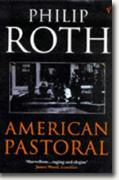
american pastoralCressida Mayfield reminded me of Meredith ‘Merry’ Levov from Philip Roth’s wonderful novel ‘American Pastoral’. Growing up in New Jersey, Merry is Seymour ‘Swede’ Levov’s highly intelligent and much-loved daughter who goes on to commit a terrorist act as part of an anti-Vietnam war protest. The consequences of the young characters’ alienation are far-reaching in both novels but the wider social fracture is woven into the human drama more explicitly In ‘American Pastoral’ set in 1960’s America.

As he subsequently searches for explanations for his daughter’s actions, Swede recalls her reaction, aged 11, to seeing the self-immolation of a Buddhist monk on the TV news:

“Though she had been terrified for weeks afterward, crying about what had appeared on television that night, talking about it, awakened from her sleep by dreaming about it, it hardly stopped her in her tracks…. ‘do you have to m-m-melt yourself down in fire to bring p-p-people to their s-senses? Does anybody care? Does anybody have a conscience? Doesn’t anybody in this w-world have a conscience left?’”

To what extent are the difficulties faced by these gifted and sensitive young characters affected by their environment or upbringing? If the society around them was a little less complacent or materialistic and a little more idealistic or morally consistent, would things have been different? The struggles of these characters make great stories because we can identify both with their alienation and with the dismay of those close to them who are just trying to do the right thing.

I strongly recommend ‘Carthage’ and, of course, ‘American Pastoral’.


Posted in Culture, Fiction, Reviews | Tagged , , , , | Leave a comment

Skill shortage, training shortage or job shortage?

Unpicking the ‘skills gap’ narrative.

“The number of job vacancies unfilled because employers cannot find candidates with the appropriate skills has risen by 130% in 4 years” (UK Commission for Employment and Skills UKCET report, January 2016)

When employers or politicians complain of skills shortages, there is a tendency for the narrative to be about the education system failing to ensure that young people have the required skills. This in turn fits into a related narrative of the weakness, or failure of our vocational education.

“The current environment of skills shortages and high unemployment reflect a clear mismatch between educational output and employment needs.” (NEF The Innovation Institute, October 2012)

Are these perspectives beyond criticism? Clearly employers know what skills they need and have identified gaps between the skills they want their employees to have and those being offered by job applicants. They are then telling us that the education system should do something about it. Who can argue with that?

We need to define our terms and try to understand the various factors in play:

Skills and education

‘Skills’ is a catch-all description of a very broad set of abilities and experiences which people can demonstrate. At one end of the spectrum, good functional literacy and numeracy are skills we would wish the education system to guarantee all school leavers. Employers, should therefore be able to take these for granted in most applicants.

At the other extreme, what about the ability to operate a specialised tool or process which is highly industry-specific and only required by a small number of employers? Is this not the kind of skill for which only the employer themselves can provide the required training as part of employee induction or via an apprenticeship or day-release programme?

So one question is actually about where we draw the line between job-specific training and education, whether general or vocational. Maybe the problem is that there is no consensus about what kind of ‘work-readiness’ general education provision should be aiming for.

Let’s be clear – education is not, anvictorian child labourd should not be, about job-specific training. Its role is to help people acquire the knowledge and skills needed to live a good life not to slot them as quickly as possible into particular roles. But finding worthwhile, rewarding employment is an important part of human flourishing and we do want our students to leave us with a good work ethic and the ability to make an effective economic and social contribution and make sensible work-related decisions for themselves.

Vocational education is not job training. Most of the vocational courses offered to young people aged 16-18 who have a strong interest in a particular sector don’t target a narrow job role. They are an introduction to a sector in its fullest sense, developing a broad knowledge base and some sector-related skills while remaining part of a general education for life, work and citizenship. They provide considerable transferability between sectors, something which is particularly welcomed by those students whose progression isn’t necessarily a smooth trajectory from 16 straight through to 21.

Which skills?

If some school-leavers really aren’t ‘work-ready’, we need to be clear what it is they lack which prevents them being employable or which can’t be provided by any good employer as part of their training or apprenticeship.

When employers are asked, they report that they highly value literacy and numeracy as well as certain generic personal skills and educators should certainly take note. High on the list are: effective communication, interpersonal skills, time management, independent working, initiative, team work, planning and managing projects.

These skills are of use in all spheres of life and should certainly be explicitly developed throughout education and not simply for reasons of employability. They form a valid part of a broad liberal education for all rather than necessarily requiring specific work-related programmes aimed only at certain students.

The labour market

Using the word ‘shortage’ implies a supply problem; not enough STEM specialists for example. If we agree that this is a supply problem, then the answer is presumably to do something to increase the supply by getting the education system to raise its game and turn out more skilled job applicants.

But what if the problem is not as simple as this? What if it is less about a skills deficit and more about an incentives deficit? For instance, skilled STEM graduates choosing to work in finance because the rewards or prospects seem better. The solution to this type of problem won’t be found by reforming the education or qualification system or by simply increasing the number of STEM graduates. Supply side solutions won’t work if the problem is not a supply side problem. Instead, what might be required are measures which make certain jobs more attractive, such as wage or training incentives to attract applicants where there are shortages.

Dr. Thijs van Rens from the Department of Economics at the University of Warwick puts it very succinctly when he sets out just 3 possible reasons for a skills mismatch in the labour market:

  • Workers not adjusting to changes in skills demand (eg: caused by new systems and technologies)
  • Employers not adjusting to changes in skill supply (eg: by not investing in training and selection)
  • Wages not reflecting skills shortages (whether by rising or falling)

He concludes that reform of the education system is not the answer to any of these labour market problems.

The education / training / employment interface is dynamic and fluid and educators must engage with the debate about the nature of work in our economy. But we must never lose our focus on the universal core purpose of education.

Clearly, as educators we share responsibility for the development of tomorrow’s workers. However, the danger of an uncritical acceptance of the ‘skills gap’ narrative is that we can end up blaming ourselves and our students for wider economic and labour market problems such as vacancy rates, unemployment or underemployment. We all want a healthy economy but we must take care that in addressing the ‘skills gap’ we don’t widen the ‘education gap’.

See also:

Is vocational education in England really inadequate? (January 2016)

Let’s celebrate vocational success (January 2016)

Education or training? (May 2015)

5 vocational myths to avoid (March 2015)

Do qualifications create wealth? (January 2015)

Vocational education: rejecting the narrative of failure (January 2015)

Useful further reading:

Low wages not education to blame for skills gap, Thijs van Rens (December 2015)

Employers aren’t just whining – the ‘skills gap’ is real, James Bessen (August 2014)

Jobs and skills and zombies, Paul Krugman (March 2014)

Posted in Education, Education policy | Tagged , , , , , , , , , | Leave a comment

A level languages in London.

What is the condition of A-level language provision in London’s sixth forms?

Data from the 2015 performance tables show that:

  • Over 5,500 London sixth formers entered A-levels in 19 different languages last year.
  • Over two thirds of these were entered for the top 3 most popular languages: French, Spanish and German.
  • In all but the top 4 languages (including Turkish), more than half the sixth forms with entries only entered a single candidate. Even in French and Spanish, around 1 in 5 sixth forms entered only one candidate.
  • Average cohort sizes are small, mostly 2 students or less per group, while colleges achieve some of the largest average group sizes (eg: 12.5 for Spanish and 10.4 for French)
  • Publicly funded sixth forms across London offer more options overall (all 19 languages) with only numbers for Gujarati in single figures. London’s private fee-charging sixth forms offer 16 languages between them with no Dutch, Punjabi or Bengali available at all and single figures only for Turkish, Urdu, Modern Greek, Modern Hebrew and Gujarati.
  • Other notable differences between the public and private sectors include the higher numbers of entries in private sixth forms for Russian and Chinese.

Summary of A-level Language entries in London (2015)

Language Centres Total Public AGS Private AGS
French 309 1,642 1,038 4.4 604 8.3
Spanish 291 1,577 1,132 5.1 445 6.5
German 188 535 391 2.9 144 2.8
Turkish 47 270 266 3.5 4 1.3
Italian 116 257 173 2.1 84 2.6
Chinese 82 203 77 1.3 126 5.5
Portuguese 99 197 179 2.0 18 1.8
Russian 86 188 90 1.7 98 3.1
Arabic 75 156 142 2.0 14 2.0
Polish 106 144 129 1.3 15 1.5
Persian 51 83 67 1.7 16 1.3
Urdu 35 64 61 1.8 3 1.0
Japanese 40 57 35 1.4 22 1.5
Modern Greek 27 41 38 1.6 3 1.0
Dutch 26 31 31 1.2 0
Modern Hebrew 8 21 18 3.6 3 1.0
Punjabi 13 19 19 1.5 0
Bengali 10 17 17 1.7 0
Gujarati 7 8 7 1.0 1 1.0

Centres: number of sixth forms,  Total: total student entries,  AGS: Average Group Size

It seems that there are healthy numbers choosing to study A-level languages across London but that there may be a large number of very small groups as well as many ‘language-free zones’. Language A-levels are not offered by many centres and where they are available, vibrant language learning groups require a certain ‘critical mass’. More could be done to improve sixth formers’ access to a broad offer as well as their experience of language learning.

This is an example of where a collaborative approach between sixth forms could help. For instance, a Language Hub, or hubs, supported by, and belonging to, all its member sixth forms could be created for every London borough or group of boroughs. With some common timetabling, this could offer a good range of languages to all sixth formers in the area regardless of their ‘home’ centre. This might act rather like the existing Music Hubs – offering a broader and richer language learning environment than any single sixth form could, promoting language learning to all sixth formers and making the best use of expert language teachers from across the area as well as supporting excellent language teaching pre-16.

Some of the students in the tables above may already be benefiting from such arrangements without it showing in the data if they are entered at their home centre but taught in a bigger group elsewhere. It may also be that some of the very small groups are not groups at all but simply students who are already confident users of a language and are entering via their sixth form with little or no tuition needed. While it would be interesting to know the extent of these arrangements, they are probably not widespread and the case for collaboration to benefit all those sixth formers who wish to study a language remains very strong.

Top languages by London borough:

This table provides data for A-level entries in publicly funded sixth forms by borough and concentrates on those ‘top 3’ language A-levels which account for over two thirds of all language entries. It also lists the next most popular languages in each borough.

London borough French Spanish German next
Barking 9 6 1 Persian (2)
Barnet 96 92 30 Turkish (26)
Bexley 22 9 36 Italian (10)
Brent 29 21 10 Portuguese (14)
Bromley 57 65 27 Persian (6)
Camden 37 49 6 Portuguese (9)
City of London 0 0 0
Croydon 46 34 20 Turkish (10)
Ealing 38 67 16 Polish (15)
Enfield 41 50 14 Turkish (69)
Greenwich 27 14 4 It/Ja/Tu (5 each)
Hackney 13 33 2 Turkish (29)
Hamm. & Fulham 46 44 9 Arabic (23)
Haringey 13 25 10 Turkish (37)
Harrow 34 23 11 Arabic (11)
Havering 48 21 16 Italian (13)
Hillingdon 20 18 15 Italian (9)
Hounslow 33 29 13 Pol/Port. (14)
Islington 10 36 0 Turkish (44)
Ken. & Chelsea 27 42 1 Portuguese (12)
Kingston 44 33 19 Chinese (5)
Lambeth 19 48 4 Portuguese (19)
Lewisham 43 60 7 Italian (10)
Merton 15 14 9 Polish (9)
Newham 20 18 9 Italian (9)
Redbridge 79 32 35 Russian (20)
Richmond 20 46 8 Polish (7)
Southwark 11 22 1 Turkish (4)
Sutton 61 51 34 Chinese (6)
Tower Hamlets 7 9 5 Bengali (9)
Waltham Forest 23 19 0 Turkish (53)
Wandsworth 45 60 21 Portuguese (19)
Westminster 34 42 7 Arabic (24)

The overall A-level cohorts are of different sizes in each borough so these numbers would need to be seen as a proportion of the appropriate cohort if we want to establish the precise take-up rate of A-level languages in different parts of London. Even without this, some conclusions can be drawn:

A-level languages in general seem to be much less chosen, or less available, in Barking and Tower Hamlets. Of the top 3 languages, German availability is particular patchy, being unavailable in 2 boroughs and falling to single figures in 14 boroughs. German is relatively less popular in around 11 boroughs (Camden, Greenwich, Hackney, Hammersmith, Islington, Kensington, Lambeth, Lewisham, Richmond, Southwark and Westminster) whereas Spanish is relatively less popular in just one borough (Bexley).

It’s also interesting to note that Turkish is the top language A-level in publicly funded sixth forms in 4 London boroughs (Enfield, Haringey, Islington and Waltham Forest) and the second highest in Hackney. Bengali is the joint first choice language in Tower Hamlets and Portuguese is the joint second most popular choice in Lambeth.

This forms part of a series of posts in the run-up to the post-16 Area Reviews, making the case for greater sixth form collaboration in London to benefit students.

More on the pattern of sixth form course availability in London:

More sixth formers doing research projects (Feb 2016)

A-level minority report: Dance, Music, Philosophy (Feb 2016)

Accessing the IB Diploma (Feb 2016)

Language


Posted in Education, Education policy | Tagged , , , , , , , , , | 1 Comment

Accessing the IB diploma

Global educationThe International Baccalaureate (IB) Diploma is a well-established internationally recognised qualification which provides students with an excellent grounding across a broad and balanced curriculum. It is based on a core; theory of knowledge, creativity, activity, service and an extended essay as well as 6 subject groups; language and literature, language acquisition, individuals and societies, sciences, maths and the arts. These offer some opportunity for deeper, additional study in chosen areas as well as interdisciplinary connections. The IB is founded on a strong unifying set of values based on intercultural understanding and respect for others and it encourages inquiry, action and reflection, critical thinking and awareness of the global context.

It’s the kind of curriculum which, while not necessarily being right for every student, we would ideally want to offer as an option to sixth formers in publicly funded education within reasonably easy reach for all.

10 years ago, this is precisely what the then Prime Minister, Tony Blair, was aiming for:

“We believe that there should be at least one sixth form college or school in every local authority offering students the choice of the IB. So we will support up to 100 extra schools and colleges in training staff to offer the qualification by 2010.”

(Tony Blair, 2006)

At that time, there were 46 publicly funded IB providers in England. In 2015, the performance table data show there are 48. So why has the envisaged tripling of publicly funded providers not materialised over the last decade?

The key problem is funding. At a time when the funding rate per 16-18 year old student has shrunk to a level where it can barely support the provision of a 3 A level programme, it is very difficult to resource a broader offer such as the IB Diploma which is equivalent to far more. Achieving the critical mass of students to make the IB Diploma viable is that much more difficult in our under-resourced system.

Also, in a context where market demand is the only driver, there’s no policy ‘push’ to ensure that more students have access to the IB. The idea is that, as with any other qualification which can be offered, if there is demand for it, it will thrive – otherwise it will simply wither.

However, the government has acknowledged the additional cost of running the IB through the ‘large programme uplift’ which includes an additional 20% funding for IB Diploma students, but only if they achieve at least 28 points, worth 348 UCAS points and roughly equivalent to 3.5 grade B’s at A level. This is applied retrospectively, so the high achievement has to precede the funding and it this may not prove attractive enough in itself to prompt much growth.

Nationally in 2015, there were 3,339 IB Diploma entries across 104 centres England. More than half of these (54%) came from private schools. In London, the ratio is reversed with 56% of the total of 419 IB entries coming from publicly funded sixth forms. Overall provision is very patchy however, with 24 London boroughs having no public provision at all and some centres’ entries in single figures.

Nevertheless, there might be enough demand to support viable regional IB centres if sixth forms could partner up to support such provision. For example, the data for London suggest that three or four substantial IB centres could thrive and attract young people from across a wide area of the city if providers could agree to share and consolidate. This is another example of the kind of benefits we could achieve for students by working together and planning more coherently.

10 years on, Tony Blair’s vision of an IB provider in every local authority seems very distant, but creating just a few viable centres serving a group of local authorities would be a big step forward to improve student access to this worthwhile educational opportunity.

IB diploma entries by London borough (2015)

London borough Entries Centres Sector
Barking 0 0
Barnet 16 1 Private
Bexley 68 1 Public
Brent 0 0
Bromley 13 1 Public
Camden 1 1 Public
City of London 0 0
Croydon 34 1 Private
Ealing 15 1 Private
Enfield 0 0
Greenwich 3 1 Public
Hackney 0 0
Hammersmith & Fulham 22 1 Private
Haringey 0 0
Harrow 18 1 Private
Havering 0 0
Hillingdon 0 0
Hounslow 0 0
Islington 58 2 Public
Kensington & Chelsea 0 0
Kingston 0 0
Lambeth 0 0
Lewisham 8 1 Private
Merton 69 1 Private
Newham 0 0
Redbridge 0 0
Richmond 41 1 Public
Southwark 0 0
Sutton 0 0
Tower Hamlets 16 1 Public
Waltham Forest 0 0
Wandsworth 15 1 Public
Westminster 22 1 Public
London total 419 17  

Data drawn from the underlying data in the 2015 performance tables.

See also:

A-level minority report: Dance, Music, Philosophy (February 2016)

More sixth formers doing research projects (February 2016)

More on the IB Diploma here.

Posted in Education | Tagged , , , , , , , , , , , , | Leave a comment

W.E.B. DuBois, black liberation and liberal education for all.

DuBoisThe great African American academic, socialist, peace and civil rights activist William Edward Burghardt DuBois (1868-1963) wrote about philosophy, sociology, history, race equality and education as well as writing fiction. He is best remembered for his The Souls of Black Folk (1903) which is his “most poetic, most philosophical and most prescient analysis of race, education and the American project” (Rodino Anderson). In The Souls of Black Folk, DuBois advocates a liberal arts education as a way to emancipate people and help them understand the meaning of life:

“…simply old time-glorified methods of delving for Truth and searching out the hidden beauties of life and learning the good of living. The riddle of existence is the college curriculum that… formed the trivium and quadrivium and is today laid before the freedmen’s sons by Atlanta University. The true college will ever have one goal – not to earn meat but to know the end and aim of that life which meat nourishes.”

In the early 1900’s, DuBois strongly advocated liberal or classical education as the best means to help Black Americans fully emancipate themselves. He debated this with Booker T. Washington who took the view that Black advancement would come from self-help and the acquisition of practical skills. Both their positions were nuanced responses to the massive challenges facing African Americans; inequality, segregation, racism and the legacy of slavery. It would be wrong to characterise DuBois simply as opposing vocational education for African Americans even in his early phase. This debate wasn’t just about academic versus vocational education but about the best strategy and tactics to achieve the common goal of black advancement in a highly unequal society.

In this period, DuBois advocated the development of a classically educated ‘talented tenth’; a Black leadership cadre who would lead African Americans to emancipation and equality and within which women played a central role. From today’s perspective, this approach seems somewhat elitist but at the time it was a pragmatic response to addressing the vast economic, educational and political inequalities between black Americans and their fellow citizens.

One aspect of this was the importance of African Americans gaining greater control of their public education and shaping the curriculum, wresting it from institutionally racist structures. DuBois strongly opposed segregation wherever it existed and his ideal would be integrated, multi-racial schools with both black and white teachers, adequate funding and a high quality education. However, he was prepared to countenance separate black schools as having a better chance of creating the basis for black empowerment.

By 1930, DuBois had adapted his own view to incorporate the need for technical and vocational education as a component of a broad education for advancement, although he did not want schools to become the hand-maidens of big business and industry. He wanted the education of ‘mind and hand’ which would include the humanities as well as technical and vocational learning. He also revised his notion of the ‘talented tenth’ and in the 1940’s started advocating the education for leadership of a more representative ‘guiding hundredth’ of the black masses.

In the Cold War environment of the 1940’s and 50’s, DuBois advocated an education which developed good basic skills and encouraged all citizens to challenge the social, economic and political status quo that privileged a few and relegated many to poverty. It should be academic and rigorous while also encouraging people to see the connection between the idea of democracy and the practice of democracy.

DuBois had no illusions that education alone could end discrimination, social and racial inequality and injustice. He recognised that laws and institutional structures, racism and market capitalism all played their part in holding people back. He based his educational ideas on a deep understanding of the position of black people in society and always framed them in the wider social and economic context.

DuBois consistently supported independence, anti-imperialist and liberation struggles around the world and believed that education had to be part of a strategy of intellectual as well as political liberation. In The World and Africa (1947) he outlines the contribution of Africans to world history and makes global connections. The black history and black pride movements owe a great deal to DuBois pioneering work.

In 1968, just a few weeks before his assassination, civil rights leader Martin Luther King referred to DuBois’ educational contribution in a speech Honouring Dr DuBois:

“Dr DuBois was not only an intellectual giant exploring the frontiers of knowledge, he was in the first place a teacher. He would have wanted his life to teach us something about our tasks of emancipation.”

In his visionary short story A.D. 2150DuBois imagines a genuinely ‘post-racial’ future where there is no poverty or discrimination and where people can relate to each other on equal terms. We are not there yet, our society and education system are still far from equal and W.E.B. DuBois’ work continues to have much to offer us.

Source material: The Educational Thought of W.E.B. DuBois by Derrick P. Alridge (Teachers College Press, 2008). Any inaccuracies in this post are mine.

Posted in Education, History | Tagged , , , , , , , , , , | Leave a comment

A level minority report: Dance, Music, Philosophy.

I start from a belief that Dance, Music and Philosophy are wonderful A level subjects which should be accessible to sixth form students not too far from where they live as part of a broad educational offer.

The published performance tables provide data on exam entries and results subject by subject at school level. Amongst other things, this allows an analysis of how many candidates are being entered for particular subjects. For this post, I’ve simply picked these 3 ‘minority’ A level subjects which often have small numbers and looked at the distribution of entries across London in 2015 .

What the data reveal is a very patchy offer across London with students in some boroughs having little or no local opportunity to follow one of these A level subjects. Cohort sizes are generally very small and in the current climate this provision must be vulnerable. If most sixth forms operate as market competitors, there is little chance of any rational collaborative planning to ensure good coverage and viable group sizes. For example, there is nothing to prevent every sixth form in a particular area from closing any of these subjects, or any others, reducing choice even further. It may be that some centres are already offering joint provision which doesn’t register in the national tables but it won’t be many.

al_dance2

A level Dance

A level Dance is ‘on its last legs’ in many sixth forms and could become an endangered species if something isn’t done soon. A total of 198 London students were entered from 54 centres, giving an average cohort size of 3.7 students. The overwhelming proportion of candidates came from the state sector (96%) and 26% of those came from 9 sixth form or FE colleges with an average cohort size of 5.4. Only two centres had more than 10 candidates; one of which was the BRIT school which is a specialist performing arts provider. 10 London boroughs had no A level Dance entries at all.

A level Music

A total of 605 students were entered from 184 centres, giving an average cohort size of 3.3. One third of all the A level Music entries in London come from private fee-charging schools. Nevertheless their average cohort size is also small at 3.7. Of the publicly funded sixth forms, 24 candidates came from 3 sixth form colleges with an average cohort size of 8. Across London only 3 centres had over 10 candidates while 49 centres had only 1 candidate each. 15 of the London boroughs have less than 10 A level Music candidates across the whole borough.

A level Philosophy

A total of 584 students were entered from 78 centres, giving an average cohort size of 7.5. The subjects is healthy in those colleges where it is offered. However, geographical coverage is very patchy with students in 9 London boroughs having no local provider in their borough. Publicly funded sixth forms have an 86% share of these entries and, of those, 47% come from 14 sixth form or FE colleges. Average cohort sizes are: 4.2 for the private schools, 7.6 for publicly funded school sixth forms and 17.1 for sixth form or FE colleges. 16 centres have over 10 candidates and 13 have only 1 candidate each.

How collaboration could help

Given the total take-up of these subjects across London, one could envisage a distribution of roughly one viable provider per borough for Music and Philosophy and possibly one for pairs of boroughs for Dance. With a bit of goodwill and some common timetabling, these subjects could be safeguarded and brought within the reach of all London sixth formers while creating vibrant and cost-effective group sizes.

The forthcoming area reviews of post-16 provision don’t include school sixth forms, but they should certainly consider the issue of ‘minority’ subject coverage and the dangers of either ‘extinction’ or non-viability for valuable subjects. If nothing is done about these, young people’s entitlement to a broad course offer could well be further undermined.

A level entries in publicly funded sixth forms by London borough (2015)

London borough Dance Music Philosophy
Barking 0 5 0
Barnet 14 34 52
Bexley 9 13 16
Brent 0 3 8
Bromley 28 27 22
Camden 1 17 43
City of London 0 0 0
Croydon 24 22 3
Ealing 3 13 0
Enfield 4 28 0
Greenwich 4 9 15
Hackney 1 4 11
Hammersmith & Fulham 0 9 4
Haringey 0 10 22
Harrow 10 20 19
Havering 7 26 19
Hillingdon 9 13 0
Hounslow 3 4 0
Islington 15 2 43
Kensington & Chelsea 1 3 11
Kingston 4 9 15
Lambeth 1 12 0
Lewisham 6 20 69
Merton 0 0 0
Newham 3 5 9
Redbridge 2 21 8
Richmond 0 5 16
Southwark 0 10 5
Sutton 20 21 32
Tower Hamlets 0 4 19
Waltham Forest 0 4 21
Wandsworth 13 15 23
Westminster 8 13 0
London total 190 401 505

Data drawn from the underlying data in the 2015 performance tables.

Other A-level subjects, such as in languages clearly merit a similar analysis – to follow.

See also:

More sixth formers doing research projects (February 2016)


Posted in Culture, Education, Education policy, music | Tagged , , , , , , , , , , , | Leave a comment

More sixth formers doing research projects.

epq-course-logoThe continuing growth of Extended Project Qualification (EPQ) entries in England’s sixth forms is a sign that student research is increasingly valued. However, still only 9% of advanced level sixth formers have the opportunity to achieve it and many are studying in sixth forms where it isn’t offered.

The 36,314 EPQ entries in 2015 represent a 4% increase over the previous year and this continues the upward trend of the past 6 years. Nationally, 62% of EPQ entries come from over 1,300 school sixth forms, 28% of entries come from 232 colleges (with 88 sixth form colleges accounting for the great majority: 22% of the total) and 328 private fee-charging schools account for around 10%.

The average number of EPQ entries per sixth form college is 93 – well above the average for any other provider type (17 for state funded schools and 11 for private schools). 15 of the top 20 centres by size are sixth form colleges and for the third year running the list is headed by Hills Road Sixth Form College with 980 EPQ entries. Second is Esher with 412 entries and third is Barton Peveril with 400 entries.

The pass rates for EPQ are generally high with a national average of 90%. The most successful provider type is sixth form colleges with an average pass rate of 95%.

The EPQ is not the only way to accredit student research but it does offer UCAS points and is valued by universities as a sign of students’ academic curiosity as well as their research and presentation skills. A good EPQ allows a young person to investigate a question which interests them critically, analytically and in some depth. Their topic might be a deeper exploration of a theme being studied in one of their subjects, it may arise from the interaction of their subjects or the spaces between them, or it may be something entirely personal and unrelated. At its best, it can be an original contribution which involves some primary research and offers a genuinely new insight.

Like many other baccalaureate qualifications, the Tech Bacc and the proposed new National Bacc both value research skills and working towards an EPQ is an excellent way to demonstrate these. The EPQ is an opportunity for students to produce their version of an apprentice’s ‘masterpiece’ which demonstrates their commitment and their promise and makes a tangible contribution to their community. It should be something they can proudly present to a wide audience and which provokes discussion and reflection.

At a time of continuing squeeze on public funding for sixth form education which makes a ‘4th A level’ less sustainable, an EPQ may well become the most attractive way to broaden students’ programmes and build on their wider academic interests.

At its best, the product of student research projects provides evidence of mastery and skill which can hold its own in the wider world and this could form part of everyone’s sixth form graduation or matriculation. For today’s visual or performing arts students, this evidence could be similar to their current portfolios, artefacts or student devised productions. For students of other disciplines, it might be a student-led community project, social enterprise, publication or the more traditional written essay. Digital platforms offer a great opportunity to share and discuss these products widely and sixth form teachers, university academics, professionals, employers and local residents could all play a part in supporting, assessing and celebrating student research. Universities could extend and deepen their support for developing a research culture – particularly where EPQ entries are low or non-existent. Regional partnerships could provide training and resources for sixth form staff and students across a wide area.

Looking at London in more detail, entries have risen by 5% overall but it is clear that EPQ provision remains very patchy (see table below) so we need broader and more consistent access to it.

At Newham Sixth Form College (NewVIc) the EPQ is still operating at the margins of the curriculum and we are starting from a very low base (9 EPQ entries in 2015 and 15 in 2014) but we aim to increase these numbers and there are plenty of ideas for us to build on:

  • Our ‘Future London’ action research project in partnership with London Citizens. This involves students researching some of the major problems facing our city and coming up with proposals to address them in the run up to the London mayoral and assembly elections this May.
  • The research potential of a range of student volunteering and service learning such as our international projects with Raleigh International.
  • Our student development programme and student involvement in campaigning and community organising.
  • The University of East London’s London Scholars programme of student-led research on East London challenges such as literacy.
  • Queen Mary University of London’s excellent work on developing student ’criticality’.
  • The potential to develop some vocational assignments into fuller research projects.
  • Our programme of Liberal Arts lectures which provides a rich source of additional research topics.

There is probably a tendency for EPQ entries to be targeted at students who have already demonstrated good research skills and initiative and it is a way of recognising and rewarding this. A more inclusive and ambitious approach would also see the EPQ as a way of developing those skills in those students for whom this is a steeper learning curve and we should aim to increase EPQ take up overall. Sixth forms could offer to help Year 11 students in their local schools achieve a Higher Project (GCSE level standard) in order to develop their research skills and prepare for progression to the EPQ.

The possibilities and the benefits of expanding student research are evident but are there enough incentives for more sixth forms to promote this important work?

2014 and 2015 EPQ entries by London borough

London borough 2014 2015
Sutton 443 462
Croydon 296 293
Bromley 280 272
Wandsworth 235 258
Ealing 217 239
Barnet 159 216
Harrow 270 210
Kingston 114 189
Hillingdon 132 168
Lewisham 221 164
Camden 126 163
Waltham Forest 197 149
Hammersmith & Fulham 139 124
Havering 133 124
Richmond 111 123
Redbridge 82 121
Lambeth 88 114
Brent 53 112
Bexley 71 108
Barking 76 107
Greenwich 97 103
Southwark 117 87
Westminster 70 77
Hounslow 46 61
Islington 54 61
Enfield 98 55
Kensington & Chelsea 60 55
Haringey 69 54
Tower Hamlets 29 48
Newham 55 47
Hackney 45 44
Merton 37 35
City of London 11 10
London total 4,231 4,453

Data drawn from the underlying data in the 2014 and 2015 performance tables.

See also:

Promoting a sixth form student research culture (September 2014)

EPQ chief examiner John Taylor wrote an excellent piece in the TES with 8 top success tips for teachers, 4 of which are here

Posted in Education, NewVIc | Tagged , , , , , , , , , , , , , | 2 Comments

Jane Addams and Toynbee Hall.

Toynbee hallToynbee Hall, Commercial street, Whitechapel, 1921. Jane Addams of Chicago (aged 60) is visiting Europe. She is in conversation with a young Whitechapel schoolteacher while preparing for the arrival of four other eminent educators.

If I may ask, Miss Addams, are you a teacher?

In a manner of speaking I am, but not quite in the sense that you are. In fact I nearly became a medical doctor as I had formed a plan of working with the poor by practising medicine. At about your age I enrolled at the Women’s Medical College in Philadelphia but had to abandon my medical studies soon after because of a serious spinal difficulty.

Did you not return to your studies?

No, I could not and I was then all at sea in terms of my life’s purpose. I had a great desire to really live in the world rather than in some shadowy reflection of it but I had no plan of action.

I was one of those cultivated young people who have no recognised outlet for their faculties. They suffer from a sort of ‘shock of inaction’. They know about the great problems of their society; the sickness, suffering, idleness, ignorance and want, but they have no way to bring about change and their uselessness hangs heavily on them.

Indeed, I sometimes wonder myself if I am doing any good with the children in my care.

You are doing one of the most important jobs there is. Believe me, you must not be in any doubt that you are doing good. Tell me, have you read Tolstoy?

No. Well, I know he is a Russian.

If you read nothing else, you must read Tolstoy, he is an inspiration. In one of his writings he describes what he calls “the snare of preparation” by which he means the ways we find of entangling young people with inactivity at the very point when they are most longing to make a better world.

Canon Barnett, who created this settlement here at Toynbee Hall recognised this need of an outlet for the young men of Oxford and Cambridge universities. He built on this impulse to share the lives of the poor, to be of service to others. He understood that man’s action is found in his connection with his fellows.

Have you been in England many times?

A few, but it was my first visit that I remember most vividly – in 1883. One incident in particular; I witnessed the late Saturday night sale of decaying fruit and vegetables by auction down a dingy street off the Mile End road. There was a huge mass of pale ragged people bidding their farthings for one vegetable at a time which the auctioneer would fling scornfully at the successful bidder. I saw a man devour a raw, unwashed cabbage on the kerbside as soon as he had won it.

I don’t believe life has improved that much for those ragged people.

That is how I received an ineradicable impression of the wretchedness of this so called ‘submerged tenth’ of society. Myriads of hands; empty, pathetic and workworn, clutching for food which was already unfit to eat. For the rest of that first visit, all huge London seemed unreal save the poverty of its East End.

Did you visit Toynbee Hall in its early days?

It wasn’t until a later visit in 1888 that I was able to come here. Once I understood what a settlement was, I became confident that although life itself might contain many difficulties, my period of mere passive receptivity had come to an end and I had at last finished with the everlasting ‘preparation for life’.

You decided to take action?

In America we have more democratic instincts and fellowship comes more naturally but our educated young people also felt the need to put theory into practice very keenly. I was one of them. I very much wanted to be useful.

So what did you do?

I returned to Illinois and, together with my friend Ellen Gates Starr, we created a social settlement in a place called Hull House in Chicago. And 30 years later it’s still open.

Inspired by Chapters 3 and 4 of ‘Twenty Years at Hull House’ by Jane Addams (1910)

See also:

Barack Obama community organiser (May 2014)

Posted in Education, History | Tagged , , , , , | Leave a comment

Escher in Corsica.

The Dutch artist M.C.Escher (1898-1972) is well known for his meticulous geometric and ‘impossible’ prints, his optical distortions, his extreme viewpoints and his tessellated patterns which seem to move from two to three dimensions. His early work is perhaps less known and includes some beautiful perspectives inspired by Italian and Corsican mountain villages.

Escher first visited Italy with his parents in 1921 and returned many times. His two early woodcut views of San Gimignano dating from 1922 and 1923 both highlight the dramatic potential of the view of the town with the first one incorporating a lush organic foreground and the second having a dominant architectural geometry. The Bridge from 1930 takes a more extreme perspective, drawn from a vantage point above the steep peaks on which nestle two villages overlooking a valley. The South Italian Landscape of 1929 and the view of Castrovalva from 1930 further develop his interest in perspective. In Castrovalva, the eye is drawn along a steep mountain path with dramatic views of a village above and one below. The gorgeous Ravello and the coast of Amalfi (1931) combines an aerial perspective with the gentle curves of the Amalfi coast.

Bonifacio

Escher and his wife Jetta visited Corsica in 1928 and travelled around the island where he was able to sketch many views, some of which were later worked up into prints. The village of Bonifacio, vertiginously perched on an eroded cliff in the far south of the island, was an ideal subject and Escher renders the view simply and cleanly allowing the wildness of the location to speak for itself.

Escher’s pencil drawing Corte, Corsica (1928) offers a more intimate view of the bridge and entrance to Corsica’s old capital seen from above.

0272138, Maurits Cornelis Escher, Corte Corsica

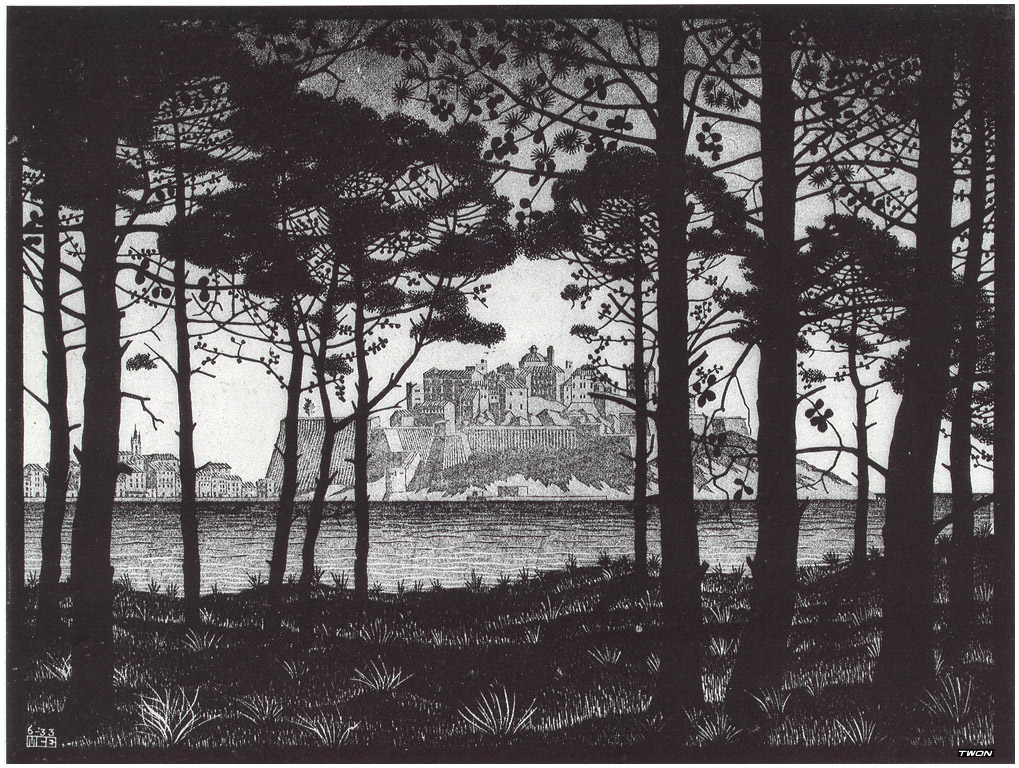
In Pineta de Calvi (1933), the coastal town and citadel are seen through an almost silhouetted pine forest ‘screen’ in the foreground. In this case, Escher doesn’t use aerial perspective to enhance the view. Instead, we seem to be approaching the bay through a dark forest which frames the architecture of the town.

pineta-of-calvi-corsica

Escher’s wood engraving of a view of Calvi’s waterfront seen from its citadel (1933) uses the contrast of growing darkness and lengthening shadow with the white of the fortifications to add to the spectacle to the viewpoint.

Calvi

We can see in these early works the germ of many of Escher’s lifelong preoccupations; with geometry, architecture and perspective. It seems that his visit to Corsica helped him develop his eye for dramatic points of view as well as meticulous detail. However, these wonderful works stand on their own merits as an artistic response to the beauty of the Corsican landscape, both natural and built.

“You have to retain a sense of wonder, that’s what it’s all about” M.C.Escher.


More on Corsica:

Sebald in Corsica (December 2015)

Edward Lear in Corsica (August 2015)

Paoli in London (March 2015)

Conrad in Corsica (August 2014)

Seneca in Corsica (August 2014)

Village wisdom: Corsican proverbs and sayings (August 2014)

Poem: Corsica (July 2015)

Posted in Culture | Tagged , , , , , | Leave a comment

Is vocational education in England really ‘inadequate’?

The case for the prosecution:

Hand with pen and check boxes on white background

“Educational provision for the many children who do not succeed at 16 or who would prefer an alternative to higher education, is inadequate at best and non-existent at worst.”

Michael Wilshaw, Her Majesty’s Chief Inspector 18th January 2016.

Defence Exhibit 1:

Over a quarter of English students progressing to university have a vocational qualification (26%), this is the highest proportion ever and up from 14% in 2008.

UCAS progression pathways report (2008-2015)

Defence Exhibit 2:

Only 3% of General FE colleges were graded ‘inadequate’ in their most recent inspection.

Her Majesty’s Chief Inspector’s most recent annual report (2015)

Supporting evidence for the defence:

Presented by the sixth largest provider of vocational courses to 16-18 year olds in London and based on a cohort of 590 students completing vocational courses in 2015.

89% of these vocational students applied to university and 93% of those applicants progressed to university including 17 to 8 different Russell group universities.

Vocational students progressed to degree courses in Accounting, Animation, Architecture, Biomedical science, Business, Childhood studies, Chinese, Construction, Computer science, Criminology, Dental technology, Design (games, graphics, media, product), Drama, Economics, Education, Engineering (aeronautical, automotive, civil, electronic, mechanical), Fashion, Film, Finance, Hospitality and Tourism, Law, Marketing, Music, Nursing, Nutrition, Osteopathy, Pharmacology, Public health, Radiography, Social work, Sociology, Sports science, Surveying…and many more.

A significant number of these university progressors (130 in 2014) left school with GCSE grades well below 5 A*-C, started at college on level 2 programmes, retook their GCSE English and/or Maths and progressed on to an Advanced vocational course. They fall into the category Michael Wilshaw has described as “children who do not do well at 16 or…who are not academic”. They are skilled, successful and are now at university.

Taken as a whole, this high rate of progression suggests that these students are well prepared for higher level specialist professional study and will have the skills needed to take their place in the workforce across a wide range of sectors.

The verdict:

Does the evidence suggest that vocational provision is “inadequate at best”?

See also:

Policy Consortium open letter to Michael Wilshaw (January 2016)

Let’s celebrate vocational success! (January 2016)

5 vocational myths to avoid (March 2015)

Vocational education: rejecting the narrative of failure (January 2015)

Guess what? Vocational students go to university too (March 2014)

Posted in Education | Tagged , , , , , , , , , | Leave a comment