From free school meals to university

The proportion of key stage 5 (KS5) advanced students eligible for free school meals (FSM) progressing to university is seen as a measure of social mobility. It’s clearly a statistic of interest, even if the data raise more questions than answers about what factors are most significant in promoting social mobility.

There are also deeper questions about the very notion of social mobility as a social policy objective, these can be addressed in a future post.

In a previous post I showed that the Social Mobility Index recently produced by the Sutton Trust seems to miss out the majority of FSM students; those who are attending colleges. This post aims to give a sense of what happens if college students are included. The Sutton Trust measure also includes early years, Key Stage 2 and GCSE performance of disadvantaged pupils as well as their progression rate to professional occupations.

The table below, drawn from base data from the government for 2012/13, ranks the top local authorities by the proportion of advanced FSM students who progress to university. It also provides actual numbers to give a sense of scale. It’s a fairly rough and ready first pass and I’ve only included the top 25 local authority areas (of around 150). It compares the actual ranking with the Sutton Trust rankings to show any difference the college data makes. Although the ranking systems aren’t strictly comparable it’s clear that, as it currently stands, the Sutton Trust table does not rank the areas accurately for this measure; the rankings are jumping around all over the place with many high performing areas under-ranked.

Key points:

1. Colleges are the major providers in educating disadvantaged sixth form students

  • The majority of FSM students at KS5 are studying in colleges: 19,580 or 62% of the total
  • The majority of these FSM students who progress to university also come from colleges: around 7,600 or 54% of the total.

2. The London effect is very marked with higher progression rates than any other region

  • London’s FSM university progression rate is 58% compared to the national rate of 45% and it is the only region with above average FSM university progression.
  • 30% of all FSM KS5 students are from London, this rises to 38% of those who progress to university: 5,449 students
  • 20 out of the top 25 local authorities for progression rates are London boroughs.

3. The progression gap* between FSM and all students varies widely between areas

  • The most successful local authorities often have no progression gap and many have a small positive advantage for FSM students.
  • The least successful local authorities also often have a big progression gap, sometimes numbers are small but Kent stands out with only 140 FSM students progressing to HE out of 500 and a progression gap of 17%.

*The FSM progression rate minus the all student progression rate.

Area: top 25 FSM progression rate FSM students progressing Progression gap Actual rank ST rank
Redbridge 67% 260 1% 1 13
Brent 67% 180 1% 2 16
Ealing 65% 150 1% 3 25
Enfield 65% 150 2% 4 18
Tower Hamlets 64% 360 2% 5 18
Camden 64% 270 12% 6 34
Wandsworth 63% 260 6% 7 81
Harlow 63% 190 1% 8 349
Barking 63% 170 6% 9 18
Hackney 63% 200 3% 10 62
Bexley 63% 50 3% 11 34
Kensington & Chelsea 62% 80 -3% 12 34
Luton 61% 110 2% 13 x
Hillingdon 61% 170 5% 14 8
Islington 59% 290 5% 15 157
Calderdale 58% 70 4% 16 74
Lewisham 58% 180 2% 17 101
Wolverhampton 58% 110 -2% 18 48
Haringey 57% 170 7% 19 34
Waltham Forest 57% 390 2% 20 11
Newham 57% 350 0 21 1
Hamm. & Fulham 56% 190 1% 22 46
Richmond / Thames 55% 110 5% 23 81
Westminster 55% 230 8% 24 25
Coventry 54% 130 -1% 25 48
England 45% 14,252      

Data for Newham Sixth Form College (NewVIc) for the same year shows that our college sent more disadvantaged students to university (270) than any other single sixth form provider in England and many whole local authorities. This represents 10% of all FSM students progressing to HE from Inner London. It also had a much higher than average progression rate for its KS5 cohort – equivalent to one of the top 11 local authority areas and with higher numbers than most of them.

  FSM progression rate to HE FSM students progressing
NewVIc 63% 270
England 45% 14,252

More on that here:

NewVIc: highest number of disadvantaged students going to university

More about where our students progress to:

Where do all our A level students go?

Vocational education: rejecting the narrative of failure.

Investing in East London’s future

College success with disadvantaged students


Posted in Education, NewVIc | Tagged , , , , , , , | Leave a comment

Social Mobility measure ignores 62% of students

There seems to be a major flaw in the Sutton Trust Social Mobility measure which means that the university progression of 62% of disadvantaged advanced sixth formers studying in colleges has been excluded. The data is therefore only based on the progression of 38% of the relevant cohort.

The Social Mobility Index recently produced by the Sutton Trust attempts to rank all 533 constituencies in England using a basket of social mobility indicators based on national data for 2012/13. The measures include early years, Key Stage 2 and GCSE performance of disadvantaged pupils as well as their progression rate to university and to professional occupations. The Index has already got media coverage and generated comment.

This kind of measure is an interesting idea but it seems that at least one of the indicators is flawed in the current version. The data used for the progress of disadvantaged sixth form students to universities is based on that for schools only. This excludes 19,580 advanced sixth form (or KS5) disadvantaged students studying in colleges; around 62% of the total – highly significant if this measure is intended to be meaningful. The degree of distortion this causes will differ greatly from area to area as the proportion of sixth formers studying in colleges rather than school sixth forms varies considerably.

This is probably an unintentional oversight resulting from the way the drop-down menus work in the national statistical tables these data come from. However, if I am right, this error will need to be corrected for this measure to be taken seriously. If I am wrong and have missed something, I apologise for crying wolf.

I discovered this while taking a look at the base data this measure comes from: numbers of Key Stage 5 students eligible for Free School Meals (FSM) and the percentage progressing to university. I only looked at the data for 7 East London boroughs, but they all confirmed the problem (see table below). The Sutton Trust data corresponds exactly to the national data for schools only. Their tables don’t give actual numbers of students, only percentages, making it that much harder to check. I have included the numbers in the table below:

Borough FSM progression rate to HE Number of FSM students
  Sutton Trust Actual Sutton Trust Actual
Barking 67% 62% 200 270
Hackney 62% 62% 130 320
Havering x 46% 10 220
Newham 82% 57% 90 620
Redbridge 70% 66% 340 390
Tower Hamlets 67% 64% 390 560
Waltham Forest 71% 56% 50 690
England 54% 45% 12,090 31,670

Given the large numbers and proportions of KS5 FSM students excluded from the data (91% in Havering, 86% in Waltham Forest and 75% in Newham) it’s understandable that there might be concern about the data being so skewed as to be meaningless.

Any further analysis or critique of the usefulness of such an Index in measuring education’s contribution to social mobility therefore needs to await a reworking of this measure. In the meantime I offer the data for Newham Sixth Form College (NewVIc) for the same year which shows that our college sent more disadvantaged students to university (270) than any other sixth form provider in England and had a much higher than average progression rate for our disadvantaged cohort.

  FSM progression rate to HE Number of FSM students
NewVIc 63% 420
England 45% 31,670

More on that story:  NewVIc: highest number of disadvantaged students going to university

More about where our students progress to:

Where do all our A level students go?

Vocational education: rejecting the narrative of failure.

Investing in East London’s future

College success with disadvantaged students

Posted in Education, NewVIc | Tagged , , , , | Leave a comment

Many colleges in one

IMG_0165[1]

A science college, an engineering technical college, a media technical college, a music industry college and several super-selective A-level providers offering a narrow range of subjects to high-achieving students. These are just some of the new sixth forms which have opened recently within travelling distance of our college, encouraged by the trend to institutional specialization and selection post-16. This is happening all over England. It seems that selection or curriculum specialization are seen as a prerequisite of quality; another way of saying that comprehensive schools and colleges which offer a broad range post-16 are rather out of date ‘one size fits all’ institutions.

Fresh new institutions full of promise and with a narrow focus clearly have their attractions. They can be seen to address a specific need and their novelty and specialisation are part of the appeal. However, the rationale for setting them up usually includes ignoring or rubbishing the good work of existing providers. Comprehensive providers in particular are often dismissed as ‘one size fits all’ implying a grey uniformity and lack of curriculum diversity, with all students being shoe-horned into a monolithic curriculum without having their individual aspirations met.

This is, of course, a gross misrepresentation. Comprehensive providers offer highly differentiated programmes and play to students’ strengths allowing them to specialise as well as keep their options and progression routes open. By being more inclusive, they are better placed to celebrate and fully represent the diversity and dynamism of their communities and make productive connections between education, the wider society and the economy.

In our case, everything that is being offered by new local specialist or selective providers is already on offer in our comprehensive setting plus a great deal more. Our diverse offer can be described in many ways, including using the language of the specialist or selective sixth forms themselves.

The specialist parts:

All of the following can be found within Newham Sixth Form College (NewVIc):

A high performing A level college:

A high performing college of 300-400 A level students (just under half the total A-level cohort) who would meet the entry requirements of other selective sixth forms. Many are studying facilitating subjects while also selecting from a wider range of subjects than is available elsewhere. These students achieve well above the national average, progress to university and between a third and a half go on to highly selective Russell group universities.

A STEM college:

A science, engineering and IT college of around 550 students over and above the many students studying for A levels in sciences, computing, maths and further maths. Achievement is high with around 130 progressing to university per year.

An early years and social care college:

A high achieving college of 220 students specializing in health, social and child care studies. Over 40 progress to university per year and many will go straight into work in childcare or social care.

A business school:

Around 600 students following specialist business programmes, including an accounting and finance pathway and a leisure, tourism and sport college of around 120 students. High achievement overall with around 150 students progressing to university per year.

An arts and media school:

An excellent specialist art, performing arts and media school of around 210 students with over 40 progressing to universities, art schools, drama schools and conservatoires per year.

A second chance ‘progression’ college:

This includes the 220 students on Entry and Foundation programmes who need to develop their knowledge and skills further before progressing onto a specialist pathway, nearly 50 students on a one year GCSE, pre-advanced programme and also over 500 students on other programmes who need to retake GCSE English and 400 who need to retake GCSE Maths because they didn’t achieve a grade C in the subjects at school. One could add around 350 level 2 vocational students who are already counted within the ‘specialist’ numbers above who need to follow a 3-year programme before progressing to university. One could also broaden this definition out to the 400 to 500 A level students who met our entry criteria but are not regarded as ‘high achievers’ and none of whom would have been considered by the more selective providers but many of whom do well and progress within the college and then on to university.

The comprehensive whole:

There are many ways of slicing the whole up into specialist parts. The point is that these are all elements of a single coherent whole which aims to meet the needs and aspirations of every young person who enrols with us; needs which are constantly changing and aspirations which are constantly rising.

When this all comes together in one college, is the whole greater than the parts? We think so. There is a strong bond which binds us all together. This is our sense of being a single college community; one that we all belong to. There is also the fact that students who are on a longer educational journey can work alongside those who are further along on that journey. And going beyond the curriculum specialisation we are able to offer a uniquely broad student development programme to all our students including sports, health advocacy, language and writing, cultural and social activities, university lectures, leadership, international links and a great deal more. All of this in a setting which welcomes all young people who are committed to their learning and progression regardless of their prior achievement – a setting where everyone is valued as well as challenged.

And it works.

See also:

Where do all our A level students go? (January)

Vocational education: rejecting the narrative of failure (January)

Investing in East London’s future (December 2014)

Comparing like with like (August 2014)

College success with disadvantaged students (June 2014)

The comprehensive college (February 2014)


Posted in Education policy, NewVIc | Tagged , , , , , , , , , , | Leave a comment

Roberto Unger on school as the ‘voice of the future’

0,,15871367,00

In his excellent book ‘The Left Alternative’ the Brazilian philosopher and politician Roberto Unger proposes a new way for progressives to think about the future and start creating the good society.

Unger suggests we should not give up on the central promise of democracy which is that people’s ‘constructive genius’ can be applied to the task of achieving greater equality and a better life. According to him, today’s two main lefts have not achieved this. The ‘recalcitrant’ left seeks to halt markets and globalisation without having a practical alternative, the ‘surrendering’ left has accepted markets and globalisation and merely seeks to humanize their impacts. In Unger’s view we need a third type of left which aims to democratise the market and deepen democracy itself.

This book is about how we could overcome what Unger calls the ‘dictatorship of no alternatives’ which can paralyse those who want to make real change. It gives examples of how we could apply our social imagination through small practical steps in each realm of social practice within the framework of big ideas about the direction of travel. The task of the imagination is to do the work of crisis, ie: radical change, without precipitating crisis:

“The possible that counts is not the fanciful horizon but the adjacent possible deployed in the pursuit of movement in the desired direction.”

Unger suggests that the left should always prefer solidaristic and reconstructive approaches and one of his 5 institutional ideas to define its direction today is to ensure that social policy is about empowerment and capacity building. Education can contribute to anchoring social inclusion as well as individual empowerment by developing people’s conceptual and practical capacities. Unger proposes a system of public education that equips, informs and frees the mind by a method of teaching at once analytic, dialectical and co-operative.

In Unger’s view, education should prepare young people to engage in an ‘experimentalist’ culture, it should be analytic and problem-based rather than simply informational. It should encourage co-operation rather than isolation or authoritarianism. It should proceed dialectically; exploring contrasting methods and views rather than appealing to a closed canon of doctrine. He prefers exemplary, selective deepening rather than attempt at encyclopaedic coverage.

For Unger, the school must be the voice of the future, ‘rescuing’ its students from their specific contexts and experience and consequently it should not be the passive tool of either the local community or the government of the day. It must compensate for inequalities rather than reinforcing them – but the authorities must intervene when basic standards are not being met.

Unger is arguing for a form of lifelong education which develops people’s practical and conceptual capabilities, allowing them to move from job to job and participate in collective production, care, learning and innovation:

“The school must not only equip the child with the tools of effective action. It must also endow them with the skills and habits of perpetual, piecemeal experimentation. In every domain of thought and practice it must teach people how to probe and take the next steps.”

For Unger, building solidarity is also vital and informing and inspiring the practical organisation of the responsibility to care for others is one of the greatest concerns of education.

This is a book which inspires. It is filled with hope that society can recognise and nourish everyone’s constructive genius in order to reduce human subjugation and increase our opportunities to revise and improve things. It provides us with a good basis to question our education systems and curricula and to imagine better ones.

Unger reminds us that after the experience of the 20th century, people are right to be wary of proposals to reorganise society. But it would be wrong if this caution created a sense of closure or of an ‘end of history’. This would be an illusion fuelled by a lack of imagination. Today, powerful messages about alternatives can rapidly resonate around the world and once tried out, some will seem inevitable.

This is not a book about education policy with detailed prescriptions for change and Unger’s visionary gradualism is not a blueprint for a better world. However it offers encouragement to those who sense that if we really want a better world, things need to be done very differently and who want to make a start right here, right now.

See also:

Learning is dialectical

Gramsci’s grammar and Dewey’s dialectic

Education as a whole and in its parts

Education without metaphors

Martin Robinson has also written about Unger here.

9781844673704-frontcover-max_221-e2eb2fea40275d7f8c43aa066c2e2833

Posted in Education, Education policy, Philosophy, Politics, Reviews, Teaching and learning | Tagged , , , , , , | Leave a comment

Which public service?

All 3 major parties are trying to outbid each other in pledging to increase spending on a key public service.

They clearly recognise the vital importance of investing in this service for our future economic and social well-being. They also know how much people value it.

I think I heard them saying things like:

“We are confident we can invest further in post-16 and adult education. The economy has been turned round and we will generate above inflation increases in funding and at least the £billions needed.”

“We are promising extra £billions per year to be paid for by a new tax. We have a funded plan for more teachers, lecturers and course hours.”

“We have said how we will plug the funding gap identified by the sector and prevent services being cut. The other parties must come clean about how they would do this.”

I might not have been concentrating properly so I added the words in italics based on what I thought was most likely given the dire state of funding for post-16, further and adult education and the vital contribution of this work – alongside other public services.

That was right wasn’t it?

Posted in Education, Politics | Tagged , , , | 1 Comment

Nazim Hikmet: Hiroshima and Strontium 90

549add46ebf1185f35d633de


I Come and Stand at Every Door (Hiroshima)

I come and stand at every door

But no one hears my silent tread

I knock and yet remain unseen

For I am dead, for I am dead.


I’m only seven although I died

In Hiroshima long ago

I’m seven now as I was then

When children die they do not grow.


My hair was scorched by swirling flame

My eyes grew dim, my eyes grew blind

Death came and turned my bones to dust

And that was scattered by the wind.


I need no fruit, I need no rice

I need no sweet, nor even bread

I ask for nothing for myself

For I am dead, for I am dead.


All that I ask is that for peace

You fight today, you fight today

So that the children of this world

May live and grow and laugh and play

Nazim Hikmet (1902-1963)


Strontium 90

We are having very strange weather,

sun, rain, snow.

They say it’s as a result of the nuclear tests.

It’s been raining Strontium 90

on the grass, the milk, the meat,

on hope, on freedom:

on the great longing

whose door we knocked at.

We are in a race against each other, my darling.

Either we’ll take life to the dead stars,

or death will descend on our world.

Nazim Hikmet, 6 March 1958, Warsaw.

More poems by Nazim Hikmet available here.

Posted in Poetry | Tagged , | 1 Comment

Learning is dialectical

lineandcompass_lgAn attempt to start from first principles…

There is now, there is before and there is after. Whatever time is, our awareness of it helps us distinguish between past and future. Within our own lived experience we understand the difference between what has been and what will be and the relationship between them.

The future doesn’t yet exist and is full of alternative possibilities while also being shaped by the past. We have seen in our own lives how prior events shape future ones. While these events are all in the past they teach us important lessons about the processes of change; causality, sequence, randomness, predictability and purpose. Our understanding of the past gives us some experience that things can be changed both for better and for worse for ourselves and for others. We know that by understanding how change has happened in the past we are able to plan for change in the future.

Thanks to memory, language, the written word and other cultural activity we are able to extend this understanding of change beyond our lifespan. We can conceive of a past, including a distant past, before we became conscious. We can conceive of a future, including a distant future, after our own life.

Learning takes place at the point where our knowledge of the past interacts with our wish to act in the future. Our past is filled with learning experiences whose effects accumulate over time. We are shaped by the sum of these learning experiences and they may inspire joy and hope or fear and dread. They change us, our relationship with the past and our view of the future.

*

There is the self, there are others and there is the relationship between them. Whatever consciousness is, it helps us to distinguish between self and others. Within our own lived experience we understand the difference between our thoughts and actions, those of others and the relationship between them.

Our actions exist in the outer world and our thoughts exist only in our inner world. We have seen for ourselves the actions of others. Our experience shows us that the actions and reflections of others can influence ours and that theirs can be shaped by ours. While these are not our own, we can ourselves reflect on the thoughts and actions of others in ways that give us a better understanding of the world we inhabit.

Thanks to memory, language, the written word and other cultural activity we are able to extend this understanding of others beyond our selves. We can conceive of the inner world of others and the link between their action and thought.

Learning takes place at the point where our knowledge of others interacts with our knowledge of ourselves. Our past is filled with learning experiences which arise from some interaction with others. We are shaped by these learning experiences, they change us and our relationship with others.

*

There is the whole and there are the parts and there is the relationship between them. Whatever wholeness is, it cannot be fully grasped simply by knowing the parts. Within our own lived experience we understand the difference between parts and wholes and the relationship between them.

Things exist in the world both as parts and wholes and we can understand them as both. For example; cells as parts of organs, our heart as part of our circulatory system, itself part of our whole body; ourselves as part of a local and a global ecosystem and social community; our locality as a part of planet Earth, itself part of our solar system and our galaxy.

Thanks to memory, language, the written word and other cultural activity we are able to study the parts separately as well as linked to the whole. We can conceive of different levels of organisation and the translations between them.

Learning takes place at the point where our understanding of wholes and their parts comes together and we can translate this understanding between different levels. Such learning helps us to deepen our understanding of what we can know about the world.

*

Learning is a dialectical process of constantly testing the unknown against the known and broadening the sphere of the known, connecting our learning with that of other people and testing our understanding against theirs. This requires time, human thought and action in a social context. The dialectical relationships are between the past and the future, action and reflection and the individual and society.

From learning to education

The sequence of learning events in our life so far has shaped who we are in more or less welcome ways. Much of this learning may be outside our control but some can be regarded as part of a number of life projects which give purpose and meaning to our lives. Such life projects are necessarily learning projects which require some planning of future learning experiences and reflection on past ones. Any learning project, whether self-defined or defined by others is an educational one.

Education implies a conscious programme of learning experiences or opportunities which are likely to improve the chances of desired outcomes for those who experience it. If it is designed, it may be part of an education system or a formal curriculum.

A programme of education creates a framework for learning experiences and provides some kind of structure, coherence, meaning and purpose for them, for the individual learner and for others around them.

A civilised society has a duty to take collective responsibility for nurturing learning in ways which promote the values and interests of the society as well as the flourishing of the individual as a free and active contributor to society. This requires societal educational programmes which reach all citizens and whose aims are widely discussed and contested and subject to democratic scrutiny and consent. These programmes will only ever include a fraction of what people learn but give value and authority to particular forms of knowledge and skill.

So it starts with a self-conscious person travelling through history in society with other people and trying to make sense of it all. First there is learning and then there is education.

Line drawing A.Rodchenko (1915)


Posted in Culture, Education, Philosophy | Tagged , , , , , , , | Leave a comment

Democratic emotions in the face of barbarism – Philippe Meirieu

196030284_B974991685Z.1_20150311180409_000_GK144RHUF.1-0In the aftermath of the massacre of 147 people at Garissa University College in Kenya on 2 April it is difficult to find any positive emotions to draw on. The slaughter of young people in their place of learning shocks us all to our core. For their communities and families, this place which symbolises hope and reason seems now to represent nothing but despair and barbarism. What can we possibly say?

Soon after the Charlie Hebdo killings in Paris on January 7th, French educationalist Philippe Meirieu wrote an important piece for the French education site Café Pedagogique. I provide a brief summary here as some of it has a wider relevance.

“The intense collective emotion which has been expressed following these killings was broadly seen as a massive and positive humanitarian reaction. We firmly and calmly demonstrated our common attachment to democratic values – a strong and necessary political act which must remain in our memories. However, it does not exonerate us from the task of taking stock or making a difference; quite the opposite. Without indulging in the tearful guilt of “we should have…” we need to stare “we must…” in the face.”

Beyond this stock-taking, educators, for whom the future is their profession, need to take on the task of political, social and pedagogical creation. We cannot avoid asking ourselves “what comes after the emotions?” or even “how can we use these emotions?”.

Meirieu then draws specifically on the work of the US philosopher Martha Nussbaum, in particular in her Political emotions: why love matters for justice where she defines the primary purpose of education as the development of young peoples’ capacity for democratic life through peace, respect for others and a search for the common good. Young people, Nussbaum argues, need to see the world through the eyes of others and to imagine their experience, including their suffering. This is the only way that distant or different people can be thought of as equal. Meirieu feels that Nussbaum’s analysis allows us to escape the dichotomy between theory and practice and to define education in terms of both ends and means.

In order to build on Nussbaum’s thinking, Meirieu develops her views on the importance of empathy by adding that in order to have an authentic meeting with the ‘other’ we need to enter into their frame of reference without ‘getting lost’ in it. In other words we must never take anything for granted, always check our sources of knowledge and get as close as possible to what is really happening.

It also seems to Meirieu that we need to give everyone the opportunity to find a place and take some responsibility in the collective construction of our shared society. It is in this shared world that we can experience legitimate authority; acting on behalf of the common interest. Finally, he insists on the vital need to describe and formalise what young people learn through action and see it as part of establishing a strong social framework.

Meirieu goes on to provide evidence of what he regards as the ‘continental drift’ affecting schools in France, including a lack of commitment to genuine civic, philosophical and artistic education and various other tendencies in government policy. In doing so, he in no way absolves terrorists or the extremists who encourage them from their terrible responsibility.

“We must clearly take stock of how we have let our institutions drift to the extent of having lost much of their credibility. We must listen to those who remind us that our education system is not keeping its promise and that “the right to a quality education for all” remains largely a pious hope.”

He also argues for some teaching of law as a subject within the French system as law is after all what holds us together, protects and liberates us. He asks: if no-one can ignore the law, how can we omit to teach about it?

Ultimately, Meirieu is optimistic that teachers need not be powerless in the face of barbarism. They may not be all-powerful and neither education nor democracy will guarantee success. It is their very fragility which is so precious and which we need to defend against dogmatism, totalitarianism and violence.

Adapted and translated from Pour que nos emotions soient vraiment democratiques, Cafe Pedagogique 19/01/15. (any errors and misunderstandings are mine)

See also my posts on  Learning and xenophilia and Colleges and violent extremism

Posted in Education | Tagged , , , , , , , , | Leave a comment

L’autonomie: pourquoi?

IMG_0165[1]

J’ai participé récemment au colloque organisé par l’AFAE (Association Française des Acteurs de l’Education) sur le thème de « l’autonomie pourquoi faire ? ». J’y ai présenté ma perspective en tant que chef d’établissement d’un lycée anglais:

Avant 1992, les lycées anglais (les sixth form colleges qui scolarisent les jeunes de 1ere et de terminale) étaient gérés par leurs municipalités comme les collèges et les écoles. Depuis une loi du gouvernement Conservateur qui a ‘incorporé’ tous les lycées, nous sommes entièrement indépendants des collectivités. Nous sommes donc très autonomes ; quasiment des entreprises privées quoique financées par le gouvernement. En revanche, il nous faut subir des audits et des inspections très sévères et faire preuve assez constamment de notre performance par rapport aux moyennes nationales.

Effectivement, je suis un chef d’entreprise, sélectionné par un conseil d’établissement auquel je réponds. Nous sommes entièrement responsables du projet d’établissement, des priorités budgétaires, la gestion du budget, l’immobilier, les investissements financiers, y compris les prêts commerciaux,  le maintien, la rénovation et la reconstruction de l’immobilier, du nombre, des structures et du recrutement de tous les employés y compris leurs contrats, leurs salaires, leurs conditions de travail et leur formation continue.

Nous sommes aussi responsables du choix des programmes, du recrutement et de la sélection des étudiants, leurs heures de cours, la politique générale éducative de l’établissement y compris nos programmes de soutien et d’encadrement et nos programmes d’enrichissement éducatif. Nous décidons aussi notre orientation envers nos concurrents, notre politique de marketing et nos choix de partenariats régionaux, nationaux et internationaux. Au niveau stratégique je réponds directement au conseil d’établissement et je suis soutenu par une équipe de gestion de 8 autres cadres supérieurs. Au niveau juridique et financier je réponds à un organisme semi-autonome (the Education Funding Agency) qui nous finance et qui fait partie du ministère de l’éducation.

Cette large marge d’autonomie n’est limitée que par un financement public de plus en plus étroit. Nous sommes financés essentiellement en fonction du nombre d’étudiants recrutés l’année précédente. Pour recevoir un financement maximal chaque étudiant doit suivre un programme assez proscrit. Ces dernières années, nous avons subi des réductions très importantes du tarif étudiant et notre marge de manœuvre a été bien réduite. Néanmoins, chaque lycée choisit de créer un équilibre particulier des investissements qui lui sont possibles. L’autonomie que nous avons nous permet de d’innover et de répondre aux besoins particuliers de nos étudiants et de notre quartier.

Par exemple, mon établissement a besoin d’un nouveau centre de documentation et nos espaces sociaux sont insuffisants. Nous allons donc construire un nouveau bâtiment avec une nouvelle entrée, un nouveau théâtre et un nouveau centre de documentation 3 fois plus grand que celui d’aujourd’hui. C’est un investissement qui va nous couter £8 Millions, dont £4 Millions sont déjà en réserve et £4 Millions seront fournis par le moyen d’un prêt commercial qu’il faudra financer nous-mêmes sur plusieurs années.

Cette autonomie existe dans un contexte très marchandisé. A 16 ans, les jeunes ont le choix d’étudier ou ils veulent et il n’y a aucune carte scolaire ; aucun planning. Le gouvernement a voulu encourager la concurrence et la création de nouveaux établissements, par exemple les ‘free schools’ (espèce de charter schools a l’Américaine) ou les collèges qui peuvent ‘ajouter’ des classes de 1ere et de terminale. Dans mon quartier par exemple, nous sommes allés de 3 établissements concurrents en 2008 à 9 en 2015.  En conséquence, il nous faut faire face à ces nouveaux concurrents et dans ce cadre notre budget de marketing devient de plus en plus important.

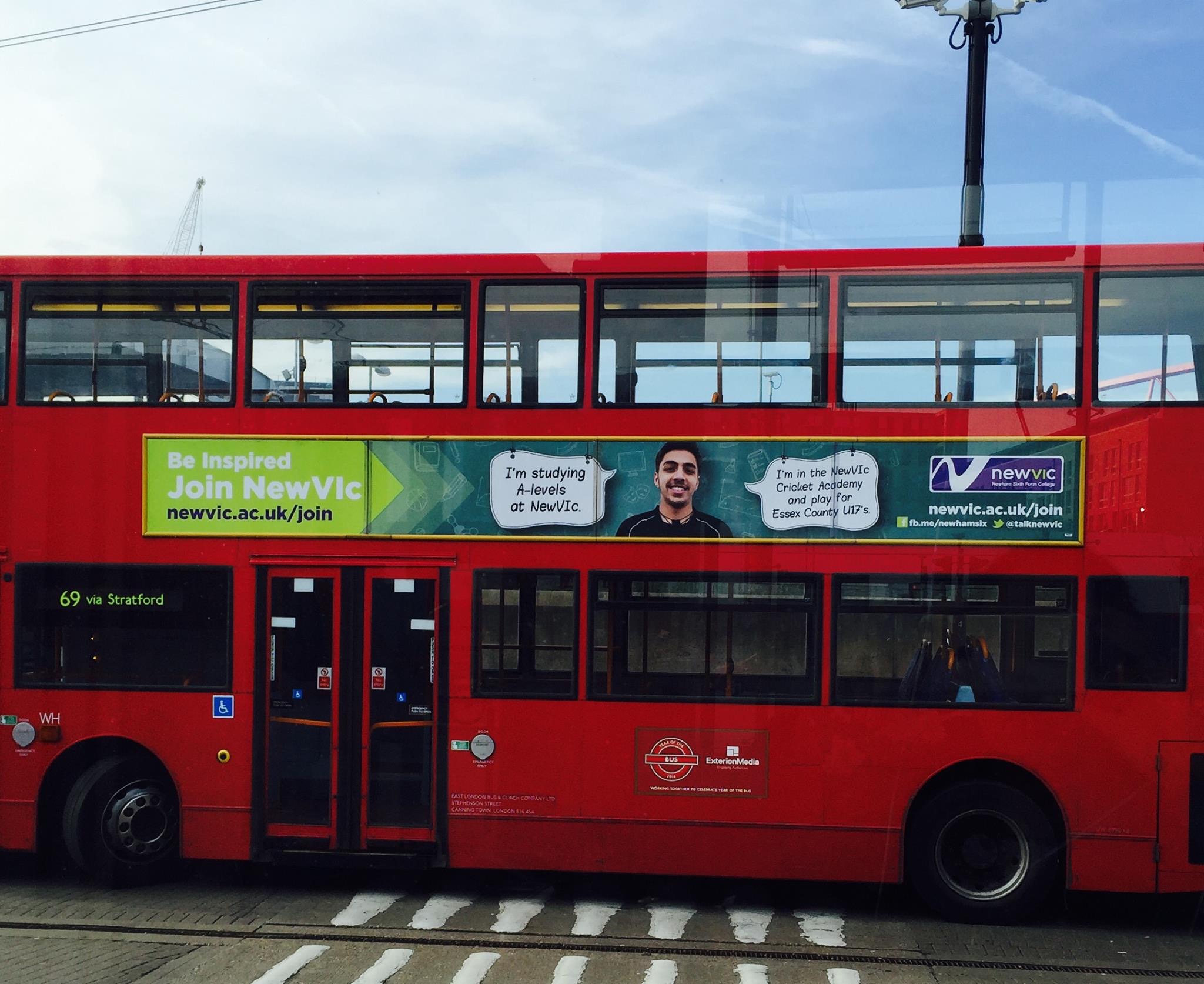
Cette année dans notre quartier, vous verrez affichées sur plusieurs arrêts de bus et sur les bus eux-mêmes des publicités avec des belles photos de nos étudiants les plus performants de l’année dernière. Nous en sommes très fiers bien sûr, mais je préférerai dépenser ce budget pour nos programmes éducatifs. Tout cela est fait pour attirer des étudiants, ou pour éviter que nos concurrents en attirent trop !

Nous avons plus de 2,600 étudiants et un budget annuel de plus de £15 Millions. Nous pouvons faire de la publicité et des économies d’échelle. Dans une grande ville comme Londres, nous pouvons aller recruter dans les quartiers voisins. Dans le contexte d’une concurrence croissante tous les lycées n’ont pas cette marge d’action s’ils sont moins grands ou situés en province.

Les 93 lycées anglais ont choisi de se fédérer dans une association (SFCA : Sixth Form Colleges Association, dont je suis président) ce qui nous permet d’offrir du soutien à chaque membre, d’être en rapport avec le ministère d’une façon plus unie et de négocier collectivement avec nos syndicats. Heureusement que la marchandisation n’a pas pu rompre cette solidarité entre établissements du même type.

Pour conclure, j’apprécie l’autonomie. Il faut bien responsabiliser les responsables et leur permettre de gérer leurs établissements sans trop de lourdes intrusions. Notre autonomie nous donne la flexibilité de pouvoir répondre rapidement aux besoins de nos étudiants. Le fait que nos employés et nos étudiants ont tous choisi de faire partie de notre communauté éducative nous permet de créer une ambiance particulière et un attachement unique à chaque établissement.

Mais il faut aussi demander de cette autonomie : « dans quel contexte ? ». Les établissements ne sont pas des particules détachées indépendants de la société ou sans rapport les uns aux autres.  Ce qui nous manque en Angleterre c’est un système, un cadre rationnel qui permettrait un projet vraiment national pour l’éducation des jeunes de 16 à 19 ans. Dans ce vide, il n’y a que le marché, et il est bien évident que dans un marché concurrentiel il y a toujours des gagnants et des perdants. Incontestablement, ceux qui sont déjà les moins favorisés de la société seront les perdants.

Donc, j’accepte d’être responsable et je revendique l’autonomie. Mais l’autonomie dans un vide n’est que l’ombre de l’autonomie réelle. Je préfèrerai pouvoir l’exercer dans le cadre d’un système national avec des valeurs nationales et un plan national susceptible d’être interprété et traduit au niveau de la région et du quartier d’une façon qui encouragerait les établissements à travailler en coopération plutôt qu’en concurrence. Tous les étudiants en seraient les gagnants.

Eddie Playfair est chef d’établissement de Newham Sixth Form College (NewVIc) un lycée polyvalent inclusif de 2,600 étudiants dans un quartier défavorisé de l’Est de Londres.

Voir aussi mon billet sur l’inspection en Angleterre.

Vous trouverez mes autres billets en Français ici.

IMG_0164

Posted in en Francais | Tagged , , , | Leave a comment

The selection debate

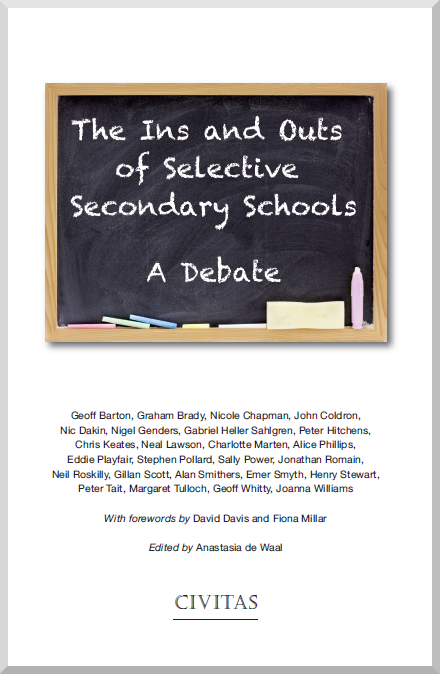
The launch of ‘The Ins and Outs of Selective Secondary Schools’ a collection of essays on selection published by Civitas was an opportunity for advocates and opponents of selection to revisit familiar arguments. The debate was mostly good natured but we heard little that was new. The chasm which separates us is still pretty wide.

My own contribution, ‘Unlimited Potential’ can be read in two parts here and here. It is an attempt to summarize the moral, philosophical, political and pragmatic case against selective practices in education from an egalitarian standpoint.

On the pro-selection side, David Davies MP mounted a stout defence of grammar schools arguing that the fall in social mobility is directly attributable to the death of the selective system in much of the country. Other advocates of selection from both grammar schools, faith schools and fee-paying selective schools chimed in with accounts of their successes and suggestions for new ways to extend selection or make it more ‘efficient’, such as providing more opportunities to select at different ages.

Fiona Millar, Margaret Tulloch, Henry Stewart and others made a robust case for a comprehensive approach and offered evidence that this is both fairer and more successful in providing opportunities and meeting the needs of all students.

Shadow Education Secretary Tristram Hunt MP came across as something of a fence-sitter on this issue. He did not feel that the extension of grammar schools was the best way to extend opportunities but made no commitment to end selection at 11 where it exists. His most constructive point was that schools should work in partnership and be judged more by their aggregate achievements, for example with students who receive free meals. However, he was clearly open to the idea of selection at 14 and his ‘technical colleges’ sounded very much like a form of segregated provision resulting from a selective mind-set which labels students as ‘vocational’ or ‘academic’. This was far from the unambiguous defence of the comprehensive principle which his natural supporters would have liked.

I think the problem with this debate is that it is fixated on the institutional level and the success or otherwise of particular institutions, notably grammar schools. As some speakers pointed out, this fails to recognise the bigger question about what we want from the whole system. Grammar schools don’t exist in a vacuum, their existence requires the existence of secondary moderns, however you dress them up or rebrand them. Every other form of institutional selection also has consequences which reverberate throughout the system.

The debate should therefore be located at the level of the system. We should be asking ourselves what we want from the system and how it can ensure the best opportunities for all young people. Once we shift our focus to this level, it becomes obvious that policy, planning, resource allocation, quality improvement, accountability and inspection all need to take more account of the experience and opportunities of every young person in every school, locally, regionally and nationally.

So, rather than our current worst-case coupling of ‘hands-off’ at the macro-level and excessive interference at the micro-level, Government policy and interventions should be designed to promote whole-system thinking, to incentivise area collaboration, to develop system leadership and accountability and to reward whole cohort improvement.

However, shifting our gaze towards the whole system would also require us to call into question the prevailing market philosophy which regards schools as atomised providers, or chains of providers, competing in a (far from perfect) market where the success of the few is predicated on the failure of the many.

We can argue about all the selective practices used to label, classify and segregate young people and skew the market. But perhaps we should move beyond the debates about different types of school and consider instead what our shared aims and values are for the whole? This might give us some chance of creating an education system in which all schools can thrive and every young person flourish.


Posted in Education policy | Tagged , , , , , , , | Leave a comment

The case for sixth form colleges

From ‘What’s next for education?’ (New Visions Group, 2015)

By any objective standard, England’s 93 sixth form colleges are among this country’s great educational success stories. They offer more opportunities, higher standards and a broader experience for students aged 16-19 than school sixth forms, and they do it in a more cost-effective way.

Wherever they exist – their avFullSizeRender (4)ailability is unfortunately patchy with many cities and counties having none at all and only one in three young people living within five miles of one – sixth form colleges are popular. The break at 16 offers students the opportunity to work in a stimulating new environment which allows for some specialisation and feels like a real step towards university or employment. Because the colleges have a critical mass of 16 to 19-year-olds, students can choose from a wide range of study options, working with many others who share similar interests and aspirations within a wider academic community while developing greater independence and broadening their horizons. This is why many countries organise a distinct institutional phase of upper secondary education.

In the government’s performance tables, sixth form colleges achieve better average results than other non-selective state-funded providers. A London Economics report (commissioned by the Sixth Form Colleges Association) in 2014 shows that college students score an average of 773 points each in ‘academic’ exams, mainly A-levels. Local authority school sixth formers get an average of 707 points, academy sixth formers 688 points.

This success comes at a lower cost to the public purse. The London Economics report calculates that each point in sixth form colleges comes at a cost of £5.86, against £7.95 in school sixth forms and £8.63 in academy sixth forms. This ‘efficiency’ premium of at least 25% is surely enough to make even the most demanding bean-counter happy in these austere times.

Moreover, Department for Education data from 2012 shows that 67% of college students progress to university compared to 63% from school sixth forms and 53% from academy sixth forms. The figures for the most selective universities, such as Russell Group members, are also higher: 19% for sixth form colleges compared to 17% and 9% for school and academy sixth forms respectively.

Sixth form colleges achieve these results despite having proportionately more disadvantaged students than other providers. Despite having a 14% share of the total number of young people progressing to university they account for more than 31% of the most disadvantaged students progressing.

Yet the colleges remain the worst funded sector in education. They are starved of resources and sidelined by education policy. Why?

The government’s spending protection for education does not extend beyond 16 and colleges were hit hard: first by cuts to programmes that don’t lead directly to qualifications (tutorials and extra-curricular activities for example) and then later by a ‘programme cap’ which penalises colleges where some students aim for more than the usual three A-levels.

In addition, colleges have to pay VAT while their competitor schools and academies are exempt. This costs the average sixth form college over £300,000 per year, an inequity which we describe as the ‘learning tax’. Those colleges which enrol 18 year olds have also seen funding for this age group cut by 17.5% this year; this could be called an  ‘aspiration tax’ because it hits colleges which offer the most second chance opportunities to students who did least well at school. On top of all this, the London Economics report estimates that secondary schools subsidise their sixth form provision from pre-16 funding by an average of between £680 and £1,307 per student.

The result is that by 2016/17 the average sixth form college student will have only £4,128 spent on his or her education each year. That is 82% of the funding for a school or academy sixth form student, 74% of the funding for an 11-16 year old, 49% of the funding for a university student and 16% of the sixth form day fees at a private school such as Westminster. In the private sector, it is quite usual for sixth form fees to be higher than for the rest of the school, presumably reflecting relative cost. At Westminster this is a +8% premium compared to the -16% discount we see in public funding.

Sixth-form colleges also face a growing systemic problem. In many ways they were the pioneers of academy type freedoms. Mostly established in the 1970s and 1980s, as part of school reorganisations led by local authorities, they, along with further education colleges, were taken out of local authority control in 1992 and given wide autonomy and direct national funding. But to operate most effectively, they need some degree of local planning and collaboration. The coalition government, however, emphasizing the merits of greater choice and competition, has allowed academies and free schools to open new sixth-forms.

Because of their history, the colleges – which are in effect super-academies with a record of super-autonomy – should be in a good position to compete in today’s super-market. But choice and diversity can be self-defeating. Paradoxically, a system of more, smaller providers tends to reduce choice because each sixth form can only afford the same narrow range of courses, and ‘minority’ subjects become unviable across the patch. New sixth forms also tend to be more selective, limiting access to students who have already achieved the most success pre-16. And there is much evidence that once a school opens a sixth form it is tempted to cut corners and limit its range of pre-16 advice in order to keep higher achieving students in their school.

In short, we really can’t expect to have both universal school sixth forms and successful sixth form colleges all in the same area without some costs or casualties. We find ourselves without a coherent system of any kind, subject to the interplay of history and market forces, none of which necessarily serves young people’s interests well.

The former education minister Andrew Adonis, in his book recalling an account of his role in developing the academies programme between 1998 and 2008 (Education, Education, Education. Reforming England’s Schools) says he believes “a successful school almost always has a sixth form”. He acknowledges that some sixth-form colleges are “academic powerhouses” and says “I was attracted to setting up lots more”. He adds: “it would not have been possible to establish many new sixth forms in the half of comprehensives which lacked them if new sixth form colleges were being set up to serve the same teenagers”. The big challenge, as he saw it, was to improve underperforming schools – the “secondary modern comprehensives”, as he called them – and sixth-form colleges just got in the way.

There was an alternative: to encourage existing sixth forms, whether in schools or colleges, to start working together area-wide. But despite the evidence that this was the better solution, he and his successors have encouraged a post-16 free-for-all.

The result is that some colleges are questioning whether they can survive much longer. But if they have to compete, they can still do so effectively if they have a genuine level playing field. There needs to be a clearer context for planning, possibly at a regional level, which listens to the young people themselves and values success, inclusiveness and value for money.

Sixth form colleges up and down the country are daily demonstrating their deep commitment to their local area and to working with schools, universities and employers. If collaboration was encouraged, they could play a leading role in creating local networks of 16-19 provision which could promote excellence and good practice.

Action for the next government:

  • Invest in the crucial 16-19 phase at a similar level to 5-16 education and address the iniquitous ‘learning tax’ and ‘aspiration tax’.
  • Encourage local area collaboration in 16-19 provision to ensure a comprehensive range of courses is available to all young people
  • Ensure that all under-16s are well informed about all the post-16 options in their area.
  • Encourage the development of new sixth form colleges where this is a logical step forward.

Eddie Playfair has been principal of Newham Sixth Form College (NewVIc) in east London since 2008, and chair of the Sixth Form Colleges Association (SFCA) since 2014. He blogs about education at eddieplayfair.com

Posted in Education policy | Tagged , , , , , , , , , , | Leave a comment

Laïcité, égalité, diversité

Mon article du 15 Mars 2015 pour le site Globaliz Now

Le principe de laïcité doit permettre de faire disparaitre le risque extrémiste et permettre le « vivre-ensemble » en France. L’éducation en Angleterre ne partage pas la tradition laïque et républicaine de l’Education Nationale Française. Comment réagissons-nous aux mêmes défis et enjeux sociaux dans les établissements Anglais ?

Je ne peux que citer l’exemple de mon lycée, un Sixth Form College anglais avec 2,600 étudiants de Première et de Terminale dans un arrondissement socio-économique défavorisé de l’Est de Londres où le chômage et la pauvreté sont à des niveaux bien plus élevés que la moyenne.

Nous sommes une communauté diverse, riche en ressources humaines, pleine de jeunes très ambitieux qui obtiennent de bons résultats, progressent à l’université en grand nombre et dont des centaines sont volontaires et bénévoles dans la vie associative de leur communauté.

Le contexte dans lequel vivent et sont éduqués nos étudiants n’est peut-être pas promettant au niveau économique mais ils sont soutenus par une communauté riche au niveau social, y compris dans leurs écoles, leurs collèges et leurs lycées. C’est là que nos étudiants  développent leurs relations sociales entre amis, voisins, camarades de classe et modèles adultes. C’est dans ce contexte qu’ils partagent leurs joies et leurs peines, leurs espoirs et leurs craintes et qu’ils font l’apprentissage de l’identité et de la différence. Ce réseau de relations et de confiance se construit petit à petit au fil du temps. A l’échelle sociale tout cela contribue à ce qu’on peut appeler «cohésion communautaire» ou «résilience».

A mon avis, ce sont ces relations sociales qui nous protègent le plus contre l’extrémisme violent. Ce sont ces relations que nous œuvrons constamment à renforcer et il y a bien sûr aussi un travail important d’entretien.

Et pourtant…nous avons tout de même connu quelques jeunes qui ont adopté des idéologies dangereuses, qui justifient et même qui glorifient la violence à des fins politiques ou religieuses. Ils sont très peu nombreux et nous pensons, sans aucune complaisance, que nous les avons bien abordés.

Comme tous les établissements anglais, nous sommes partenaires dans une stratégie gouvernementale pour lutter contre l’extrémisme violent. Avant d’évoquer ce que cela implique je voudrais d’abord aborder la question de la colère, l’extrémisme, le ‘radicalisme’ et la ‘radicalisation’ dans le cadre éducatif.

Je commence par dire que, comme beaucoup d’autres, j’ai soutenu des causes politiques, j’ai manifesté dans les rues de Londres, j’ai été en colère quand j’ai perçu des injustices et je me suis fait entendre.

Nous qui avons milité, qui avons été en colère, somme nous «radicaux»? Sommes-nous «extrêmes»? Sommes-nous «vulnérables»? Sommes-nous montés sur une sorte de voie sens unique qui pourrait nous conduire d’une façon inexorable vers l’extrémisme violent?

Pour ma part, je me considère comme un bon citoyen qui choisit d’exercer son droit de libre expression de temps en temps et je ne pense pas avoir fait quoi que ce soit pour me rendre susceptible de prôner la violence.

Comment tout cela se traduit-il dans un cadre éducatif?

Il faut commencer par nos objectifs éducatifs. Dans notre cas, notre mission est d’être une «communauté d’apprentissage réussie». La réussite, l’apprentissage et la communauté sont chacun important et nous voulons que nos étudiants:

  • Deviennent des citoyens actifs, critiques, réfléchis, qui sont capables de prendre des mesures dans le cadre de la loi pour mener au changement. Capables donc d’être militants et de faire preuve de civisme.
  • Sont assez conscients de l’histoire et la politique globale pour être en mesure de situer les conflits et les controverses d’aujourd’hui dans un contexte plus large et d’apprécier les perspectives différentes qui existent.
  • Remettent en cause les idées reçues autour d’eux et développent leurs propres opinions qu’ils peuvent soutenir rationnellement.
  • Sachent comment exprimer l’insatisfaction et même la colère avec le statut quo, et même comment être «radical».
  • Puissent examiner et mettre en question leur propre système de croyances et voir la religion et autres systèmes de croyances ou d’idéologie dans le contexte d’une société plurielle.

Notre établissement a lui-même un ensemble de valeurs. Dans notre cas, il s’agit explicitement de valeurs laïques, de « valeurs Britanniques » si l’on veut, mais certainement de valeurs qui sont capables d’application universelle.

Nous avons aussi un code du comportement étudiant, une déclaration sur la liberté d’expression, une déclaration sur la religion au lycée et une déclaration sur la sécurité numérique. Nous avons aussi certaines responsabilités légales dans le cadre de la loi contre le terrorisme.

Nous voulons  protéger nos étudiants contre l’influence de l’extrémisme violent quelle que soit sa source. Nous sommes engagés à fond et nous appliquons un code qui est bien compris par tous. Nos employés ont reçu une formation qui les sensibilise à l’égard des risques. Cela nous conduit à discuter les questions importantes, les confronter ouvertement et aider tout le personnel à reconnaître et confronter les discours ou les comportements qui peuvent être des signes précurseurs de l’extrémisme violent.

Nous ne nous attendons pas que nos collègues adoptent un point de vue particulier sur la politique étrangère Britannique, ou qu’ils soient experts en théologie ou géopolitique ou qu’ils reconnaissent tous les divers groupes extrémistes. Pas plus qu’ils n’ont besoin de connaître les noms et les activités des bandes criminelles de notre quartier. Mais ils doivent comprendre les risques, reconnaître et contester tout discours extrémiste qu’ils peuvent entendre et être prêts à défendre nos valeurs communes et de savoir comment signaler tout ce qui semble être un risque possible pour la sécurité des jeunes ou de leur lycée. Ce n’est pas une question de conscience personnelle, l’établissement l’exige.

En ce qui concerne les étudiants, nous souhaitons que personne ne se sente soupçonné ou persécuté en raison de leurs croyances religieuses ou de leur appartenance politique. Mais rien ne justifie des propos ou des comportements discriminatoires ou la glorification de la violence. Nous avons le devoir de contester, d’être clair à propos des risques, de rappeler ce qui est inadmissible et de protéger notre communauté.

Il nous faut fixer des limites très claires, bien les expliquer et être prêts à tenir la ligne. Dans notre établissement, nous n’admettons pas de sociétés uniconfessionnelles ou de prêcheurs externes. Tous nos conférenciers sont approuvés par la direction du lycée et nous n’acceptons pas d’orateurs qui risquent de prôner des opinions en conflit avec notre engagement envers l’égalité et le respect mutuel.

Nous ne voulons aucunement circonscrire le droit à la liberté d’expression ou décider ce qui nous est «acceptable» au niveau personnel. Nous ne devons pas, décrire les individus comme «bons» ou «modérés». Mais dans toute communauté la liberté a ses limites et il nous faut expliquer clairement les nôtres. Nos représentants étudiants ont voulu un dialogue à cet égard et nous avons participé à une discussion très ouverte à propos de la liberté d’expression, la laïcité et les droits politiques des jeunes.

Nous sommes avant tout une communauté éducative, notre projet est d’éduquer dans un contexte égalitaire et nous sommes persuadés que chaque jeune personne peut apprendre à respecter les autres et à exprimer son désaccord avec les autres dans un cadre de citoyenneté plurielle et démocratique. Nos valeurs doivent être vécues et pratiquées au quotidien par tous les membres de notre communauté et nous ne cessons de le rappeler. Il nous faut croire que ceux qui pourraient mettre en péril les valeurs de notre communauté peuvent aussi se reformer. Mais il nous faut également reconnaître les limites du projet éducatif et le fait que l’extrémisme violent peut attirer et séduire certains jeunes. Nos interventions ne réussissent pas toujours. Les éducateurs ne peuvent pas tout faire et il y a un moment où d’autres organismes doivent prendre le relai.

Notre établissement n’est pas typique, mais nous sommes prêts à partager nos expériences avec d’autres lycées ou collèges en Angleterre ou à l’étranger si cela peut les aider à s’engager en toute confiance avec ces questions difficiles.

Publié sur le site Globaliz Now le 15 Mars 2015.

Version anglaise ici.

 Liberte_egalite_fraternite

Posted in en Francais | Tagged , , , , , | 7 Comments

The multilingual citizen in a multicultural society

I want to speak about the experience of being bilingual and bicultural and its educational benefits. I am not an expert or an academic and I have no research findings to share. I have worked in diverse communities for over 30 years and my only evidence is my professional and personal experience. This experience is not unique, in fact it’s probably the majority experience in all the schools and colleges I’ve worked in.

My story is not particularly remarkable. It starts with the fact that I have a French mother and an English father. This sounds simple, but in fact my mother is from Corsica and my father’s family was from Scotland on one side and Huguenot from France on the other. And so we move from the mainstream to the periphery; Corsicans, Scots and Huguenots are often viewing things from the margins. They are minorities from the ‘wrong’ side of the border, minorities who have had to fight to find a voice and work hard to learn the language of power.

I grew up in London, one of the world’s most powerful centres of human gravity. London, the great metropolitan melting pot where everyone is a stranger and where we can all lose ourselves and find ourselves. But I also spent my long summer holidays in our small Corsican village where I felt just as much at home. This is a place where you are never lost, where everyone knows everyone, where your house is open to all and where your business is almost certainly known to all.

I was genuinely bilingual, both languages were my indispensable tools; necessary for me to get by in my home city, to communicate with family, friends and teachers. I moved smoothly between the two different languages and learnt the different codes of meaning and emotion in each of them. There was never any question of consciously translating, just of expressing things as well as possible in one or both of these two languages. When people asked ‘what language do you think in?’ the only sensible answer was: ‘neither’ or ‘either’.

I was aware of culture and of the connection between language and culture. Certain ways of seeing things and doing things seemed to be French, Corsican or English. I read different types of text in each language. Amongst others, Tintin and Asterix in French, E.Nesbit and Richmal Crompton’s William stories in English. Because my parents had a very diverse range of friends from around the world, I was reminded daily that people see things, do things and express things in very different ways and that each perspective is equally valid.

No one ever lectured me about respecting others, it was just an obvious part of normal social interaction. No one ever suggested to me that there was something suspicious or threatening about difference, it was just obvious that difference was a stimulus, something interesting, something to explore. Xenophilia was the norm. So when I first encountered xenophobia, racism and prejudice I was quite shocked and it took me a while to understand where it was coming from and the harm it could do.

I may have been bi-cultural and bi-lingual but because of my parents’ very broad interests; for example in African, Indian and Japanese art, music and literature, our house was always multi-cultural and multi-lingual. So I grew up in an environment of stable values which was also rich in difference, both safe and challenging, a strong basis on which to reach out and explore the world.

All this felt normal to me but I realise now how lucky I was.

I think it is this combination of the known and the unknown which is the basis of all learning. Learning is a constant encounter with the unknown. We use what we know to try to make sense of what we don’t yet know; building connections, constructing metaphors and analogies, testing our hypotheses against the reality in front of us, telling our stories and seeing if others recognise them. To really learn we have to seek out the challenge, the different, the other, the unknown. We have to stand in a different place and see things from a different perspective. Not always easy, but always educational.

As an adult I’ve not nurtured my bilingualism as much as I would like. But recently I’ve had the pleasure of working with French colleagues and speaking at educational conferences in France and I’ve tried to discuss education and describe learning more fluently in French. The process of translation has been an opportunity for learning forcing me to reflect on the meanings of our words and what I’m actually trying to say.

So for example ‘apprendre’ is to learn and ‘l’apprentissage’ is learning, but it also conjures up ‘apprenticeship’ which has other meanings. Vocational training is ‘formation professionelle’ which implies a shaping process rather than simple practice. We have no easy adjective for human fellowship to translate ‘solidaire’ (solidaristic? in solidarity?). Can we speak of ‘valeurs republicaines’ (republican values) in England without making the Queen a little uncomfortable? Are these values anything like our own ‘British values’?

The French have a phrase ‘projet de societe’. How would we translate this vision of a better world into English without sounding ridiculously utopian? And above all, there is the wonderful French institution of ‘l’Education Nationale’ around which the nation can unite while also debating it passionately. We are proud of our National Health Service but sadly have little hope at the moment of building any kind of National Education Service – more’s the pity.

So when we translate, we’re not just translating words, we’re translating ideas, perceptions, feelings, a whole culturally shaped perspective. Saying something in another language gives it a whole new meaning and sharpens our grasp of our purpose.

And where is identity in all this? Each one of us is constructing our identity throughout our life. It is fluid, shaped by our changing relationships with others, always provisional, a work in progress, full of tensions and questions. It is dialectical; a conversation with ourselves and with the world.

We need to learn to keep our own identities open and in question and to distrust the intransigent identity politics of those who are so convinced that their particular combination of beliefs, values and perspectives is a fixed and superior identity that they have lost the ability to step aside and see the world from anyone else’s perspective.

This is not a theoretical concern. The leader of a British political party told us last year he ‘feels uncomfortable’ hearing foreign languages being spoken on a train and more recently that children of immigrants should not be allowed to be state educated until they have lived in the UK for 5 years. This betrays a suspicion of the other and a wish to hide them away and to exclude them from the benefits of education and our common life. It is fairly clear what sentiments are being encouraged here.

The reality is that when we meet someone new, instead of turning difference into the problem, we often start by finding what we have in common, however tenuous, a language, a geographical origin, a shared interest, some shared history, a mutual acquaintance. At the most basic level we are all human and we can all share our common humanity, the experience of living, loving and losing and all the associated emotions.

In contrast, I would quote the Indian poet Rabindranath Tagore, describing where we might aim to be in his poem Gitanjali:

‘where the mind is without fear and the head is held high, where knowledge is free. Where the world has not been broken up into fragments by narrow domestic walls. Where the clear stream of reason has not lost its way in the dreary desert sand of dead habit. Where the mind is led forward into ever-widening thought and action’

To experience being multilingual and multicultural is to go beyond the differences between people. The multicultural learner experiences difference within themselves and has a different understanding of the other because the other is within them. They have a plural identity.

But this is not an experience unique to multi-lingual people. In fact every one of us can be multi-lingual and multi-cultural. We speak in different registers with different people and on different occasions, we have different roles in different contexts. We connect and move between different settings and traditions. We are all capable of seeking out the other and taking a different perspective because we each contain our own plural identities and our own different perspectives.

We just need to refuse to be imprisoned by a single perspective, a single identity or a single voice. And we need to reject narrow, suffocating categories and labels as these foster ignorance, mistrust, hatred and division.

So, let’s not allow ourselves to be afraid. Let’s celebrate our diversity, our multilingualism and our multiculturalism both collective and individual. It is the basis of our learning and it is what binds us together as human beings.

Speech given on the occasion of the presentation of the Palmes Academiques at NewVIc, 18th March 2015. Original in French available here.

Posted in Culture, Education, Teaching and learning | Tagged , , , , , , , , , | Leave a comment

Citoyens multilingues, société multiculturelle

Quelques réflexions sur le vécu bilingue et biculturel et ses avantages éducatifs.

Je ne suis ni expert ni chercheur et je ne vous propose pas de résultats d’une recherche scientifique. J’enseigne depuis 30 ans dans des communautés diverses et je vous propose ma perspective personnelle et professionnelle. Mon vécu bilingue et biculturel n’est pas unique, en fait c’est l’expérience majoritaire dans tous les établissements ou j’ai travaillé.

Mon récit personnel n’a rien de remarquable. Il commence avec le fait que j’ai une mère française et un père anglais. Cela parait simple, mais cette mère française est Corse et ce père anglais est d’origine écossaise d’un coté et huguenot français de l’autre. Déjà, la perspective se déplace du centre vers la périphérie. Corses, écossais et huguenots partagent une perspective minoritaire. Ils sont d’outre frontière, ils ont lutté pour se faire entendre et pour avoir accès au langage du pouvoir.

J’ai été éduqué à Londres, un des plus puissants centres de gravité humains du monde. Londres, ce grand creuset métropolitain ou tout le monde est un étranger, ou chacun peut a la fois se perdre et se trouver. Mais j’étais tout aussi à l’aise au village en Corse ou je passais les grandes vacances. Un village ou l’on ne peut pas se perdre, ou les maisons sont ouvertes à tous, ou tout le monde se connait et connait les affaires des autres.

J’étais donc bilingue, avec comme outils deux langues indispensables qui me permettaient de me débrouiller dans ma ville, Londres, dans mon école, un lycée français et de pouvoir communiquer avec mes amis et tous les membres de ma famille. Je faisais la transition entre ces langues sans effort, me servant des ressources lexiques pour m’exprimer. Il n’était jamais question de traduction, seulement de choix d’expression dans une ou l’autre de ces langues. Si on m’avait demandé : ‘tu penses en Anglais ou en Français ?’ je ne pourrais que répondre : ‘les deux’ ou ‘ni l’un ni l’autre’.

J’étais conscient de la culture et du rapport entre langue et culture. Certaines façons de voir les choses ou de faire les choses s’annonçaient clairement : français, anglais, corse…Mes lectures étaient différentes : Tintin et Astérix en Français, E.Nesbit et Richmal Crompton en anglais entre-autres. Mes parents avaient un cercle d’amis du monde entier, ce qui me démontrait au quotidien que les gens voient les choses, font les choses, expriment les choses de façon très différente et que chaque perspective a de valeur égale.

On ne m’a jamais sermonné sur le besoin de respecter les autres. Le respect des autres était la norme dans la cadre de toutes les relations sociales. Il m’était évident que la différence était toujours intéressante et méritait toujours notre attention. Une perspective xénophile si vous voulez. J’ai eu très peu de contact avec des propos xénophobes et quand cela m’est arrivé j’étais assez choqué. J’ai compris éventuellement d’où cela provient et à quoi cela peut mener.

Je suis donc bi-culturel et bi-lingue mais les passions de mes parents pour les cultures africaines et asiatiques ont créé chez nous un environnement multi-culturel et multi-lingue. J’ai été élevé dans un contexte stable mais riche en différence, à la fois très sûr et aussi très stimulant ; une bonne base pour s’ouvrir à tout ce que le monde peut offrir.

Tout cela m’a semblé très normal mais je suis bien conscient d’avoir eu de la chance.

Il me semble que la base de tout apprentissage est l’association du connu et de l’inconnu. Pour apprendre il faut aller vers l’inconnu, ce qu’on ignore. Nous nous servons de nos connaissances pour appréhender ce nous ne connaissons pas encore, pour construire des hypothèses et pour les évaluer contre la réalité qui nous confronte. Pour vraiment apprendre il faut aller chercher la différence, changer de position et voir les choses autrement, prendre une nouvelle perspective. Pas toujours facile, mais toujours educatif.

Devenu adulte, je n’ai pas bien maintenu mon bilinguisme, mais récemment j’ai eu le plaisir de rencontrer de nombreux collègues français et j’ai été intervenant et conférencier en France sur l’éducation. Il m’a fallu faire l’effort de communiquer mes idées plus aisément en français. L’effort de traduction a été lui-même un apprentissage. Cela m’a permis de réfléchir, et m’a obligé à questionner de que je veux dire et la precision de notre vocabulaire, autant en anglais qu’en français.

Donc, par exemple, apprendre c’est ‘to learn’ et l’apprentissage c’est ‘learning’ mais en Anglais ‘apprenticeship’ s’applique plutôt à la formation. La ‘formation professionnelle’ c’est ‘vocational training’ qui signifie un processus plutôt répétitif. Nous n’avons pas d’adjectif ‘solidaire’ en Anglais ; ‘solidaristic’ nous semble un peu maladroit. Pourrions-nous parler de ‘valeurs républicaines’ en Angleterre sans être accusés de haute trahison? Et ces valeurs ressemblent-elles à nos ‘British values’?

Et les Français ont une expression: ‘projet de société’. Comment traduire en anglais ce sentiment de vouloir un monde meilleur sans sembler utopique? Et surtout, il y a l’idée de l’Education Nationale autour de laquelle la nation se rassemble et qui se débat passionnément. Nous sommes bien fiers de notre ‘National Health Service’ mais malheureusement nous avons peu d’espoir de pouvoir créer un National Education Service.

Toutes ces traductions ne s’appliquent pas seulement aux mots, ce sont des traductions d’idées, de perspectives et d’émotions dans le cadre d’une culture. Se prononcer dans une autre langue c’est changer la pensée et repenser les objectifs.

Ou se situe l’identité la dedans? Nous construisons notre identité chacun le long de notre vie. Elle est fluide et elle est formée pas nos relations avec les autres, toujours provisoire, une œuvre en progrès, pleine de conflits et de dialectique. C’est un dialogue avec nous-mêmes et avec le monde.

Il nous faut préserver une identité ouverte et mutable. Il faut se méfier de la politique intransigeante de l’identité fixe et de ceux qui sont convaincus que leur assemblage particulier de valeurs et de perspectives est supérieure aux autres et qui ont perdu la capacité de prendre un pas a côté pour voir le monde d’un autre point de vue.

Ce n’est pas un souci théorique. Le chef du quatrième parti Britannique s’est plaint l’année dernière de se trouver mal à l’aise quand il n’entend que des langues étrangères dans les transports publics. Plus récemment il a proposé que les enfants d’immigrés perdent leurs droits de scolarité pendant 5 ans. Cela témoigne d’une méfiance envers l’autre et d’un désir qu’il ne se montre pas, qu’il soit exclu de l’éducation et de la vie en commun. Pas besoin d’aller chercher très loin pour comprendre les sentiments qu’il espère encourager.

En réalité, quand nous rencontrons l’autre, plutôt que de s’obséder sur les différences nous cherchons d’abord ce que nous avons en commun; une langue, une passion, un rapport historique, des intérêts communs. A la base nous sommes tout d’abord des très humains et nous pouvons partager notre humanité commune. Nous savons tous ce qu’est la vie, le désir, la tristesse.

Je citerai le poète Indien Rabindranath Tagore qui décrit si bien ce que nous désirons peut-être dans son poème Gitanjali : « Là où l’esprit est sans crainte et où la tête est haut portée ; Là où la connaissance est libre ; Là où le monde n’a pas été morcelé entre d’étroites parois mitoyennes ; Là où les mots émanent des profondeurs de la sincérité ; Là où l’effort infatigué tend les bras vers la perfection ; Là où le clair courant de la raison ne s’est pas mortellement égaré dans l’aride et morne désert de la coutume ; Là où l’esprit s’avance dans l’élargissement continu de la pensée et de l’action » (traduction d’André Gide)

Je citerai aussi en exemple le projet Ponte-Cultura qu’anime ma sœur et qui organise des stages de musique ou les jeunes Corses et Anglais se rencontrent et partagent leur apprentissage musical et culturel.

Vivre le multilinguisme et le multiculturalisme c’est dépasser nos différences. L’étudiant multiculturel et xénophile est conscient de son identité plurielle, il reconnait la différence en soi-même et comprend l’autre par ce qu’après tout l’autre c’est aussi lui.

Mais ce vécu n’est pas unique aux multilingues. Chacun peut être multilingue et multiculturel. Nous pratiquons des lexiques différents et nous jouons des rôles différents dans des contextes différents. Nous sommes tous capables d’aller vers l’autre et d’adopter une nouvelle perspective parce que nous avons tous nos identités uniques, différentes et plurielles.

Il nous faut simplement refuser d’être prisonniers d’une seule perspective, une seule identité ou une seule voix. Il nous faut simplement rejeter les catégories étroites et les stéréotypes culturels. Ils seront suivis par l’ignorance, le mépris, la haine et la division.

N’ayons pas peur, célébrons notre diversité, notre multilinguisme et notre multiculturalisme, en commun et en tant qu’individus. C’est le que trouverons notre apprentissage de la vie en commun.

Discours à l’ occasion de la présentation des Palmes Académiques, à NewVIc, Londres le 18 Mars 2015.

Posted in Culture, Education, en Francais | Tagged , | 4 Comments

Unlimited potential (part 2)

Unlimited potential (part 2)

Part 2 of my chapter from The ins and outs of selective secondary schools (Civitas, March 2015)

5. Selection at 16 and beyond

There is a strong case for extending the comprehensive ideal beyond 16, even to university.

We persist in describing our sixth form college as comprehensive when the term has been unfashionable for some time and there is no requirement to have inclusive admissions policies. We are proud to be comprehensive and, for us, using the “c-word” is the clearest way of defining one of our core values; the fact that we aim to provide for the educational needs of all young people in the age group we cater for, ie: 16-19 year olds.

However, this is not the norm. The case for a comprehensive post-16 college still needs to be made given that there is such a wide range of potential courses available at different levels for this age group and also that 16 year olds have complete freedom of choice about where they study. Sixth form education has become the new frontier for selection with a plethora of new providers, whether 11-18 academies or 16-18 free schools trying to outdo each other in setting ever more exclusive entry requirements. Post-16 performance table measures and cheer-leading from the media and politicians encourage this selective bubble.

Those schools and colleges which aren’t trying to be comprehensive should be asked: Why segregate? What is the case for exclusion? After all, a comprehensive intake is the norm for primary schools, why should things change after 11 or 16? Faced with a proliferation of selective post-16 providers, we should be asking: Why is it OK for a school to be comprehensive from 11-16 and become selective in the sixth form, thereby excluding most of its former students? Why don’t you provide the non-facilitating A-level subjects many students want? Why don’t you offer the vocational courses which help so many students progress to university? Why don’t you offer the foundation and intermediate courses which provide vital stepping stones to advanced study for so many students who did less well at 16?

The range of courses and specialisation available post-16 do require a larger system or network of providers to provide them cost-effectively but there is no reason why all these courses can’t be offered within a single institution or even under one roof. Because they operate in a market where students choose where to study, this doesn’t mean that the post-16 providers have to be either ‘niche’ or selective.

Beyond this, the case for the comprehensive university has yet to be fully articulated. Why set a 50% ceiling on the proportion of the population who can benefit from a university education and tell some young people that university is not for them? Why shouldn’t publicly funded universities be tasked with leading a renaissance in lifelong learning with the aim of engaging all adults in some form of tertiary education, whether at postgraduate, degree or pre-degree level?

6. The politics of selection

The modern Conservative party has moved away from a full political endorsement of selection at 11 while nevertheless tolerating existing selective systems and practices where they exist. The right-wing populists of the UK Independence Party (UKIP) seem to have taken on the mantle of champions of selection, advocating ‘a grammar school in every town’ and therefore ‘3 or 4 secondary moderns in every town’.

If academic selection and the 11+ are back on the political agenda then they should certainly be vigorously challenged. Many of us will want to defend the comprehensive principle because we believe that the common school, college and university, like the NHS, are part of the foundations of the good society.

New Labour was squeamish about the ‘e-word’ preferring to substitute ‘fairness’ or ‘equity’, perfectly good concepts in themselves but the change of language appeared to signal a dilution of Labour’s commitment to actually challenging inequalities even of the grossest kind. Perhaps it is time for the party to give English education its ‘NHS moment’ and apply an egalitarian litmus test to its thinking about publicly funded schools and colleges. Labour might even find that this plays well with an electorate fed up with the 57 varieties of segregation we are currently experiencing.

The comprehensive school is a successful and popular expression of solidarity which transcends all social differences. The idea that children and young people should be educated with their neighbours and their peers in a learning community which reflects the composition of the geographical community they live in is still valid, even if some have abandoned it. A comprehensive system discourages competition for positional advantage by school, and seeks to ensure that every school and every student can flourish.

7. The evidence

There is a considerable body of research into the performance of selective systems compared to comprehensive ones. Chris Cook’s analysis7 of GCSE achievement for 2011 in selective and non-selective areas in England demonstrated that students from poorer backgrounds and the bottom 50% did significantly worse in selective areas while the wealthiest 5% did better. The Sutton Trust report Degrees of Success8 suggested that given their intake “grammar schools would appear to be under-represented among the most successful schools for Oxbridge entry.” An OECD report has shown that the top 5 education systems as measured by the Programme for International Student Assessment (PISA) are non selective9 and comments that “early differentiation of students by school is associated with wider than average socio-economic disparities and not with better results overall”. Recent research by Matt Dickson, Lindsey Macmillan and Simon Burgess10 also demonstrates that selective systems increase inequality; lowering incomes at the bottom as well as raising them at the top.

Students can and do achieve outstanding results in comprehensive settings and there is no evidence that selection increases most students’ chances of success. Quite the opposite, selection restricts opportunities for achievement and increases social segregation.

8. Conclusion: making the case for universal comprehensive public education

We still live in a class-ridden society and this is reflected in the classification, hierarchy and competition between providers in education as in so many other areas of our life. Our understandable desire for an education which helps us or our children ‘get on’ is translated into a striving to find the ‘best’ school or college, often with diminishing returns. We are obsessed with the pecking order rather than being obsessed with education and flourishing.

So what does a genuinely egalitarian approach look like in relation to education?

It means rediscovering and proudly championing the virtues and achievements of universal public services. The comprehensive school or college is a place where citizens experience equality. People are treated with equal respect, meet and work with others on equal terms and have their individual needs met regardless of their starting point or ability to pay. It’s time we saw our successful comprehensive schools and colleges as the benchmark even if they don’t top the performance tables for raw exam scores. By doing a great job for all students, they pose a daily challenge to more selective providers to justify segregation. It is the advocates of more selection who need to explain what their proposals are for the education of all those students they keep out. Surely they should be raising their game rather than simply picking the low-hanging fruit?

Like other public services at their best, state-funded education providers model the social relationships of a more equal society. As Basil Bernstein rather depressingly reminded us: “education cannot compensate for society” 11 nevertheless the fact that people’s experience of equality in one sphere is not mirrored in every other aspect of their day to day experience should be a source of anger and action rather than a reason for giving up on the egalitarian ideal. People clearly do not all engage with education from the same starting point and many face enormous barriers. However, the right kind of public education can challenge injustice and give people a lived experience of more equal social relations and practices so it is worth trying to compensate for society.

I absolutely agree with Anthony Seldon that “schools should be places of delight, challenge and deep stimulation where all the faculties that a student possesses can be identified, nurtured and developed” and this is precisely why people oppose selection. We need a broad liberal and practical curriculum for all young people, one which offers challenge, choice, depth, breadth, stretch and progression for all, which values both knowledge and skill and provides something to build on throughout life.

This is not a theoretical argument. When parents and potential students experience what being comprehensive means, in all its diversity and ambition, they respond very positively and continue to support the practice.

English education has yet to have its NHS moment but the founding principles of a single universal health service which meets the full range of people’s needs can be applied just as well to a national education system.

Schools, colleges and universities for everyone are better placed to promote excellence for everyone. The challenge is to renew and reshape the comprehensive system rather than abandoning it.

Eddie Playfair

Eddie is the principal of Newham Sixth Form College (NewVIc) in East London. He has taught in comprehensive schools and colleges for over 30 years and all 4 of his children attended state comprehensive schools and sixth form colleges. He blogs at eddieplayfair.com and tweets @eddieplayfair

Notes:

  1. blogs.ft.com, Chris Cook, 28th January 2013
  2. Degrees of Success, Sutton Trust, July 2011
  3. PISA 2012 Results snapshot, http://www.oecd.org/pisa/keyfindings/PISA-2012
  4. Selective schooling systems increase inequality, Simon Burgess, Matt Dickson and Lindsey Macmillan, Institute of Education working paper, May 2014.
  5. Basil Bernstein, New Society 15 (387), 1970.

Part 1 of this chapter can be read hereTIAOOSSS

Posted in Education policy | Tagged , , , , , , , , , | Leave a comment