Careers guidance: failing to inspire

This month has seen the publication of new guidance to FE and sixth form colleges on careers. This aims to help us implement the requirement to provide independent careers guidance. There’s nothing in here which good colleges aren’t already doing. In fact, most of us will be doing much more than the document suggests as it seems to assume a rather low base.

The word inspire is used repeatedly in the document and inspiration seems to sum up the government’s view of the purpose of careers advice (see the Inspiration vision statement: careers). Like aspiration, inspiration is often seen as a magic wand to raise achievement. In my experience of working in inner city colleges, most young people are not lacking either. What they often lack are the tools and practical strategies to turn aspiration to reality and that requires planning, consistent teaching and support for skills development throughout their education. A great role-model, workplace visit or inspirational speaker can contribute, but these do not substitute for a well planned careers education programme with support for personal development.

Given the labour market advantage which a university degree offers, there is surprisingly little about supporting realistic HE choices and preparing for successful progression. For most advanced level students this is still quite rightly their most likely next step to realising their aspirations. This is covered very superficially. If all we are expected to do is to support “access to open days” and “help…for example in completing UCAS applications” this doesn’t amount to a comprehensive HE-progression strategy. Fortunately, most of us are delivering well beyond these very basic expectations.

There’s also a heavy reliance on employer links to…you guessed it: “inspire” young people. So for example “Colleges are encouraged to connect with the wider business community to identify speakers from business, student mentors and relevant work experience placements. Governors are well placed to facilitate such engagement.” Clearly, governors are sometimes able to steer their college towards great new business links but any college which relied on their governors to broker these would get only very partial coverage and in any case, it is not a governor’s responsibility to find such contacts.

The guidance emphasises the need for students to make well informed decisions and raise their ambitions but does not suggest minimum acceptable standards. For example, having mentioned the Matrix Standard, why not expect all colleges to achieve this or a similar kitemark? There’s also a remarkable reluctance to mention professional careers advisors and their key role in delivering high quality independent information advice and guidance in a way which no individual employer can. Why not require colleges to employ qualified careers professionals?

There are widespread concerns about the variable quality of careers education and the protectionist practices of some schools which choose not to give high quality advice for reasons of self-interest. The Education Select Committee reported that “the quantity and quality of guidance is deteriorating just when it is most needed” (Jan 2013). Given this context, we might have expected this document and its equivalent for schools to have more teeth or at least some strong incentives to raise quality.

The paper concludes with some interesting case studies and useful links to further sources of information and resources.

Overall, this is a rather disappointing document which probably won’t do any harm or much good either. Despite its great emphasis on ‘inspiration’, it failed to inspire me.

A good way to keep up to date with news, advice and best practice in Careers Education is to follow Janet Colledge’s excellent Careers Defender blog and Outstanding Careers website.

Posted in Education | Tagged , , , , , | Leave a comment

Comparing like with like

There’s been a lot of hype about the A-level results of our neighbouring 16-18 free school and there’s no doubt that their students have achieved some very good outcomes. But their claim to have the “best ever results by a sixth form college in the UK” is hard to believe and prompted a very rapid rebuttal from the Sixth Form Colleges Association (SFCA) which can be read here.

The fact is that this sixth form is very selective; setting a high bar for entry and the trouble with making crude comparisons between providers is that we are not comparing like with like.

The best predictor of achievement at 18 is achievement at 16; there is a strong correlation between individual students’ GCSE scores and their subsequent A-level scores. Different sixth forms apply different entry requirements and can therefore be working with a very different cohort mix which generates a very different set of likely outcomes.

For example, Newham sixth form college (NewVIc), which has a very broad and comprehensive intake, could easily generate very high crude A level scores simply be being more exclusive. By keeping more students out we could obtain similar scores to those achieved by selective providers. Nevertheless, more students progressed to Russell group universities from NewVIc than from any other sixth form in the borough.

Much of the success claimed by selective providers is therefore a function of who they keep out rather than who they let in. So if we are searching for measures of the value added or contribution to achievement of a sixth form we need to use those which compare like with like.

Our current national post-16 performance tables don’t help much with this as groups of students are not profiled in the way they are at key stage 4, showing the number of students in each ‘band’ of prior achievement for each school (low, middle and high attainers).

So, how could one start to compare like with like between very different sixth forms?

The key is to know more about the characteristics of each provider’s cohort, in particular their students’ prior achievement. If all the students in a selective provider have at least 5 GCSE grade A’s, or 5 grade B’s or a particular GCSE point score average on entry they can only be sensibly compared to the subset of students with the same prior achievement drawn from the more inclusive provider. Students’ outcomes should also only really be compared with those of other students on similar programmes (eg: at least 3 A levels).

Another factor which needs to be taken into account is retention; what proportion of starters actually finished the courses they started and then also achieved? A sixth form which does a big ‘clear-out’ of medium to low-achieving students after the first year is skewing its results compared to one which retains most of its students.

Here’s a proposal: why don’t we simply share the following data for our cohort of students enrolled on at least 3 AS/A levels with either: (a) 5+ GCSE grade A’s or (b) 5+ GCSE grade B’s or (c) Average GCSE point score of 6.0+ or any other appropriate measure.

  • Number of starters:
  • Number of completers entered for at least 3 A levels:
  • Average points per student and per entry:
  • Number progressing to HE / Russell group:

There are plenty of other interesting questions which could follow and value added measures could also be calculated for the comparable cohorts.

NewVIc would be happy to submit such performance data for objective and independent analysis and comparison with other providers on this basis. This would at least allow us all to evaluate the claims made by different types of provider and move us beyond the use of decontextualised data to make claims of unique excellence.

We are all doing a fairly similar job in similar circumstances and my hunch is that we are probably all doing a pretty good job overall. If this type of analysis shows up significant differences in performance, we could then try to understand what factors might be contributing and to share whatever good practice is making a difference. If any of us really do have some educational ‘magic dust’ then rather than guard it jealously I think we have a responsibility to share it with each other in the interests of all students.

So, can Newham’s post-16 providers rise to this challenge or will we remain locked in a dialogue of the deaf, each making only those claims which suit our case?

See also:

Can we celebrate success without rewriting history?

Russell group offers: hype and reality.

Celebrating success or manipulating data?

Posted in Education, NewVIc | Tagged , , , , , , , , , | Leave a comment

Finding Labour’s Education Mojo

Less than a year before the general election, has the Labour Party developed winning education policies? Tristram Hunt’s latest speech ‘The Choice in Education’ was a bit like a pre-tour band rehearsal. A range of material was tried out, some of it was good, some of it was weak but some of the best stuff was left out.

So, given that both the tour and the album need to go well, here is my personal advice about each of the tracks, starting with the worst:

The Forgotten 50 Percent: This one really needs to be dropped quickly. It assumes that young people who don’t go to university are ‘forgotten’. The chorus of “a bewildering array of options that are difficult to navigate” suggests a lack of understanding of the many good quality and perfectly clear vocational routes on offer and it fails to acknowledge that students on vocational courses progress to university in large numbers. If they don’t always get good jobs, it’s not because of their qualifications but despite them. This track makes the band sound seriously out of touch.

Institutes of Technical Education: Your nostalgia for the technical schools that never were following 1944 is no better than the “grammar school nostalgia” you criticise. Re-branding some FE colleges and not others sounds like a two-nation ‘structural impulse’ of the very kind you criticise. Tell people that you will make sure that all schools and all colleges aim to be excellent.

Race to the Top: Be careful about promising that education will solve our economic problems and create “a high-wage, high-tech, high innovation economy”. At the moment, unemployment and underemployment are more real than an alleged “40 million shortage of high skilled workers”. The fact is “the ever changing, ever more competitive market place” is nothing new and the best way for young people to prepare for it is to have a broad, rounded education.

Human Capital: Do people like being described as economic resources or assets? Why can’t we just talk about educating people…as full and active members of society?

Gold Standard and…

World Class Teaching: The lyrics are fine, these ones just need better titles in plain English.

Generation Citizen: Great sentiment, but drop this one. The next one does the job better.

The Promise of Britain: “Young people who are confident, determined and resilient…bursting with ideas about how they can contribute and make a difference” This is good but you need to say more about what more a new government will actually do to nurture young people’s determination to make a difference: invest in jobs perhaps?

The National Baccalaureate: This should be a real hit, especially if it is “broad and balanced”. The lyrics need to spell out how it “binds all routes together” in case people hear two tunes rather than one and assume the Tech Bacc. and GCE routes will be completely separate.

Comprehensive: Not on the list, presumably because some people feel this is not one of your best tunes. These people are not your real fans. This classic speaks to all those who share your values and love your work. In one word it tells a story about schools for all offering the best possible opportunities for everyone with no limits on achievement. A contemporary arrangement will make it popular again and it can knock that “1950s grammar school nostalgia” right out of the charts.

Democracy and Equality: More inexplicable omissions from the set. “Community-focused education system” sounds good but it needs more democratic and egalitarian ballast. Let’s have a good rousing NHS-style anthem about how our education system belongs to all of us, should serve all of us and be accountable to all of us.


The concept

Two concepts are proposed, that’s one too many. The tour and album need a single signature concept to capture the imagination:

The Beautiful Ambition of 1944: This isn’t your winning concept. Universal secondary education was a great achievement, but the 1944 ‘Butler’ Act also gave us a divided system with selection. Do we really want to hark back to that? Leave this one to the historians.

One Nation: This has been around for longer and is a far stronger idea with plenty of opportunity for examples and elaboration. It builds on your critique of the “aggressively free-market experiment” and binds together all the other tracks; helping everyone achieve their promise, ending the obsession with structures and the hierarchy of schools, promoting high standards in the common school and a broad and balanced common curriculum leading to a common qualification framework for all.

Good luck with the tour and we look forward to buying your CD next spring.


See also: Labour’s vocational vision and Election 2015


Posted in Education, Education policy, Politics | Tagged , , , , , , , , | Leave a comment

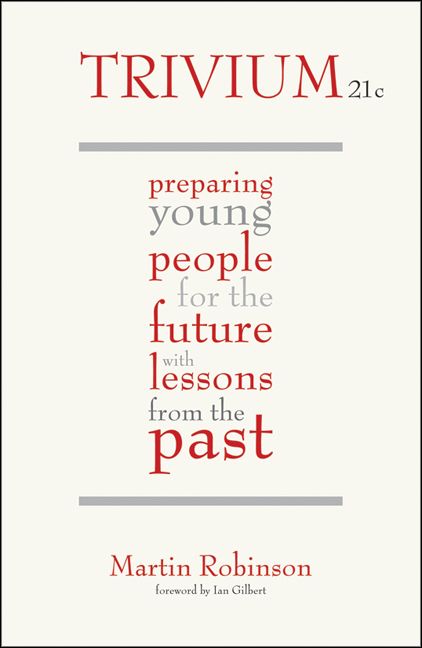
Trivium 21c by Martin Robinson

I am so glad to have finally got round to reading Trivium 21c. I was expecting a treat and I wasn’t disappointed.

This is an important book which should be read by anyone interested in the purpose and practice of education. I hope it prompts a great debate across all phases of education and contributes to a renaissance of liberal education. It should also open up many areas for further debate.

Martin Robinson starts from his own experience as a drama teacher and his desire as a father for the best possible education for his young daughter Lotte. He invites us to join him on a journey to explore his idea that a good education in the 21st century should be based on the 3 ancient arts of the Trivium: grammar, rhetoric and the dialectic.

Grammar is about foundational knowledge and skills, how things are. Grammarians emphasise authority and rules and want to pass on core and canonical knowledge.

Rhetoric is about communicating persuasively and expressing how things could be. Rhetoricians value the building of community, citizenship and character

The dialectic is about testing and challenging knowledge through questioning and argument, Dialecticians value debate and dialogue as a way of creating new knowledge.

My default state is dialectical. I think that some of the most interesting debates in education are built on creative tensions; between the known and the unknown, the self and the social, thinking and doing, knowledge and skill for example. These tensions can be contained in oxymoronic phrases or dissoi logoi such as ‘progressive traditionalism’ or ‘practical idealism’ which require us to start thinking about the synthesis of apparently contradictory terms.

But Trivium 21c reminds us of the equal value of all three arts of the Trivium. So, for instance, we can’t proceed dialectically if we haven’t got some solid foundations of knowledge to think with (grammar) and such knowledge has no real meaning and is of no real use in changing our world if we can’t express it well and share it with others (rhetoric).

The book weaves in and out of the historical and the philosophical and we are introduced to a wide range of key thinkers as the author circles around his central question, expanding and deepening our understanding bit by bit: what might a Trivium-based education for the 21st century actually look like? Every chapter is packed with stimulating ideas and provocations; too many to do justice to in a review.

I really enjoyed Robinson’s account of his own development as a drama teacher, building students’ work from fragments of movement and text, looking for connections, arguments, threads and interrogating them. He consolidated this for his students into the idea of a mantra and a sequence: movement, emotion, intellect, performance. Instead of thinking of creativity as free-flowing and unconstrained, Robinson emphasises the discipline required to be creative and quotes Ken Campbell, with whom he worked: “Creativity is about constraints”. This chimes with the idea that the greatest modernists or revolutionaries such as Joyce, Picasso or Schoenberg start with considerable mastery of traditional knowledge and technique before they can effectively challenge and subvert it. Robinson returns to pedagogy towards the end of the book with useful checklists of activities and teaching methods mapped to the Trivium.

Robinson draws on an eclectic mix of thinkers, both dead and alive, and includes transcripts of conversations he has had with some contemporary educationalists and commentators in which he seeks to elicit their response to the challenge of the Trivium. I was fascinated to discover that the crime writer Dorothy L. Sayers had spoken passionately about the Trivium as part of independent lifelong learning in 1947 and also to learn more about the work of Marshall MacLuhan and Daniel Willingham. It was also good to rediscover some familiar figures such as Michel de Montaigne, Antonio Gramsci and Richard Sennett but I was surprised there was no reference to the work of John Dewey, Michael Oakeshott, Maxine Greene or Martha Nussbaum, clearly one can’t include everyone.

Robinson uses the terms meme and cultural capital quite a bit. The concept of a meme was coined by Richard Dawkins to describe a unit of culture and the notion of cultural capital was developed by Pierre Bourdieu to describe a set of valued knowledge and skills which provides access to power and status. These ideas have some explanatory use but they suggest that culture is made up of static particles detached from any of the structures of power or dominance in human societies. I think any metaphor for culture should reflect the fact that it is constantly being re-made by social beings living in highly unequal societies subject to powerful historical and political forces and therefore is contingent and constantly changing. I agree with Robinson that all young people should have access to the ‘cultural capital’ of the elite but do we believe that this is enough to really challenge their economic dominance? [and does Sam Freedman really believe that lower exam performance means that white children, Afro-Caribbean boys and Pakistanis “don’t have cultural capital in their societies whereas your middle class Ghanaian, Indian and Chinese do have that cultural capital”? p.192].

A great strength of the book is that is opens up the possibility of a genuinely universal approach to how we should teach and what we should teach all young people and doesn’t seek to label and classify learners or provide a rationale for a different education for different ‘kinds’ of students. Rather than trying to describe a liberal education for some, it is genuinely searching for a liberal education for all.

Many contributors to our current lively education debate in England feel a need to identify themselves as part of a ‘camp’; traditionalist or progressive, advocates of the primacy of either knowledge or skill. This often leads to the lobbing of missiles rather than the promotion of debate. Martin Robinson’s contribution cuts through all of this and builds on what each tradition can contribute to a full education in being human. The traditionalists love grammar because it’s about passing on important knowledge and the progressives love the dialectic because it’s about challenging tradition and thinking for yourself. Taken together with rhetoric; the art of expressing your ideas and communicating with other humans these are the essential elements of an education in being a full member of human society. But each on its own is inadequate to the task.

In summary, Martin Robinson is proposing a ‘progressive traditionalist’ curriculum which aims to develop ‘philosopher kids’ and nurture respect for the best that humans have thought, said and done, to develop character, virtue and moral purpose and which values both the traditional and the progressive and the need to cultivate curiosity, dialogue and mastery.

Like all the best books, Trivium 21c prompts many questions. So for example:

  • How do we decide when students know enough ‘grammar’ to usefully engage in the dialectic? Is there a whole phase of education which should be devoted to consolidating ‘grammar’ before embarking on the development of dialectical skills. Is the transition from one to the other part of human development or should we see them developing hand in hand? This is related to the question of learning to let go, which Robinson addressed in his own practice as a drama teacher.
  • How much space should there be in the curriculum to ‘discover our genius’ and pursue personal passions and interests and is this something which needs an increasing proportion of our time as we move through our education?
  • In a highly connected culture where ‘horizontal’ communication is now so rapid and easy, how do we both prepare young people to be effective in cyberspace while also reinventing the ‘vertical’ structures which give authority to our knowledge and skills? Truth is neither democratic nor is it a market commodity and the ‘wisdom of the crowd’ is not an adequate basis to build deeper personal wisdom. What is the role of schools in setting norms and challenging popular ignorance and prejudice?
  • How could we develop a liberal arts curriculum for all 16-18 year olds in the context of our current post-16 offer which has no common core curriculum requirements other than the expectation that all students should aim to achieve level 2 Maths and English?

In Martin Robinson’s own words: “I want my daughter to explore a whole range of truths, not just scientific or analytical ones. I want her to develop the ability to reason, to be reasonable and to develop and trust her intuition. I want her to have a sense of wonder and not to be hoodwinked by charlatans. There is also a place for responding to the beauty or ugliness of the world with a developed sense of outrage or love.”

We can all hope that Lotte together with everyone else in her cohort can access this kind of education. To help bring this about, Martin Robinson is working to establish a network of educators and whole schools which could develop the idea of the Trivium as an organising principle for a good education. Anyone who is interested in finding out more and possibly getting involved should consider following Martin’s blog and attending the Trivium  conference at King’s College in October.

Martin Robinson can also be followed on twitter and facebook.

In my view the perfect companion volume to Trivium 21c is Learning to Flourish by Daniel DeNicola (Continuum, 2012) another philosophical exploration of liberal learning which I will review separately.

Trivium 21c by Martin Robinson (Independent Thinking Press, 2013)

0a9305e63cf3f6f3d7b682151ee8cb54


Posted in Education, Reviews | Tagged , , , , , , , , | Leave a comment

How to choose a sixth form

During year 11 you are free to apply to any sixth form you want, whether it’s a sixth form college, further education college or school sixth form. If your own school has a sixth form, there is absolutely no requirement for you to continue there. You can apply to more than one sixth form although you should decide where you actually want to go well before the summer holidays.

This is a big decision which will shape your life. You need to take it seriously and take your future into your hands. Here are 10 tips to help you make a well-informed decision.

  1. Think about what you’ve enjoyed studying

You know what subjects and what type of learning you’ve enjoyed. A good starting point is to think about what you’d most like to study further.

  1. Think about what you’re interested in and good at

Which subjects are you passionate about and which ones have you already excelled in? These might be a good basis for further study.

  1. Think about your future

Don’t worry if you don’t have a definite career ambition yet. See a careers adviser for a careers interview. Combined with your thoughts on (1) and (2) this will help you to explore a range of options you might want to pursue and will also help with your choice of subjects. It’s also a good idea to look at university websites and check what specific subjects, if any, are required by possible future degree courses. For some of the more selective universities, make sure you understand their approach to ‘facilitating subjects’.

  1. Decide what you think you want to study

Draw up a list of potential courses and subjects which might be right for you.

  1. Find what courses and combinations are on offer

Now you’re ready to look at what’s on offer in sixth forms within travelling distance. Research any subjects and courses which you know less about but which seem interesting. Don’t compromise on the subjects or courses that are important to you. Remember also that you might change your mind so it’s helpful to have a range of alternatives and fallback options.

  1. Decide what kind of environment you want to be in

You’re going to be spending a lot of time in the sixth form you choose. Imagine yourself being there every day, what are you absolutely essential requirements? You obviously want an environment which suits you but don’t make any assumptions about  whether a particular sixth will appeal to you until you’ve been to visit.

  1. Find out about different providers

Research all the sixth forms you are considering; look at their course offer and their results and read what they say about themselves in their prospectus and on their website. Remember that they will tend to publish positive information and don’t make assumptions based purely on statistics eg: 30% A* grades in a small college could be far fewer students that 5% A* grades in a larger one. More selective sixth forms will have higher average scores overall but that doesn’t mean that an individual student necessarily has a better chance of success there. This is about choosing what’s right for you and you are an individual not an ‘average’. Prepare the questions you want to ask on your visit.

  1. Shop around, visit and ask plenty of questions

You really need to get a feel for any sixth form you’re seriously considering. You can only get this by actually visiting. Attend open days and other opportunities to look around. Is there a purposeful working atmosphere focused on academic success? Do the staff and students seem friendly, respectful and supportive? Will your teachers have high expectations of you? Do you think you’d be happy there? Meet the teachers who teach your subject(s) and find out how you will be supported and assessed. Ask about university and employer links, the enrichment offer such as sports, music, arts, debating, lectures, student council, leadership, volunteering, student magazine etc. Look at the library and IT facilities and ask about careers advice, opportunities for work placements and the support available for any specific learning needs you may have. Remember, there are no stupid questions. If it’s on your mind, just ask!

  1. Find out about the entry requirements and application process

Make sure you understand what is expected. What is the application deadline? What grades, average point scores or subject results will you need to get on to the courses you want to study? These will be different for different sixth forms. If you don’t quite make the entry requirements will they be able to offer you alternatives or stepping stones?

10. Talk to others but make your own decision

Talk to current or former sixth formers to get their views but take all second-hand opinions or anecdotes with a pinch of salt. One person is a very small sample, so you need to ask more people if you can. Even better: judge for yourself. Don’t just follow, or avoid, what your friends are doing because you can’t make your mind up. Make sure you’re well enough informed to make your own choice. After all, it’s your future.

See also:

How to make a strong college application

Your college interview

Posted in Education, Learning resources, NewVIc, Parents, Students | Tagged , , , , | Leave a comment

Can we celebrate success without rewriting history?

The headteacher of the Newham-based 16-18 free school; London Academy of Excellence (LAE) in commenting on their A-level results to the Guardian last Thursday was quoted as saying:

“In Newham, there were hundreds and thousands of young people who wanted to do traditional A-levels. In the past they couldn’t do them because there was no one to provide them. Either they were having to go to school in the surrounding boroughs or – if they couldn’t afford to do that – they were having to take places at colleges here that didn’t provide biology, maths and history. They were having to do BTecs, GNVQs and that type of thing.”

This is a complete untruth. Newham Sixth Form College (NewVIc) has been offering a very wide range of A-levels (all those available at LAE and many more) for over 20 years. The many thousands of students who have taken A-level subjects at NewVIc over the last 20 years and progressed to competitive degree courses in selective universities will be surprised to hear that they’ve been airbrushed out of the history of education in Newham.

Just for the record, this summer 101 NewVIc students took A-level Maths, 79 took A-level Biology and 48 took A-level History.

NewVIc’s university progression rates are very high: 767 students progressed overall in 2013, 99% of all A level applicants to HE progressed and we regularly get students into Russell group institutions (60 in 2013, possibly more this year) including Oxbridge (2 this year).

NewVIc is comprehensive so our overall scores will not be as high as those of more selective providers but our A-level results will certainly bear a like-for-like comparison.

We also have a wide and comprehensive vocational offer which is extremely successful and attracts learners in its own right. We recruit with integrity and have never pushed applicants towards vocational courses if they want to do A-levels and meet the entry requirements, why on earth would we?

Sadly, this is not the first outing for this “there was nothing here before we came along” narrative. It’s been trotted out before and reverberates around the media and the Westminster village whenever LAE is discussed.

For example: “Newham where there are strikingly few academic sixth form courses available” (Attain magazine, October 2011) “Where in Newham can you get that unabashed approach to academic work, leading to a top university?” (Tony Little, Sunday Times 29/04/2012) “…talented children, many of whom had to go outside Newham to study for A-levels.” (Independent 15/07/2013)

Free school founders may find this narrative convenient. The problem is it isn’t true.

It’s quite natural for institutions to promote the successes of their students but we need to ensure that the truth does not become the victim when we celebrate our students’ achievements. We need to agree not to perpetrate myths and untruths about other providers just because they suit our case. We all need to tell our own story but this should not involve rewriting history.

I have blogged here and here about previous claims made and my tale of two boroughs also provides a little more context. I will blog separately about what we know of the respective performance of comprehensive and selective sixth forms and the importance of comparing like with like.

Posted in Education, Education policy, NewVIc | Tagged , , , , , , , | 2 Comments

Market madness #4 A good system can help schools improve

A series of short posts about the marketisation of public education: #4 A good system can help schools improve.

Whenever I am asked to explain English secondary education to foreign visitors I usually start by saying that there is no English ‘system’. I then try to describe the rather random pattern of overlapping provision which cannot be dignified by the term ‘system’. Different areas have different permutations of 11-16 schools, 11-18 schools, sixth form and FE colleges with overlapping catchments, degrees of selection and market behaviours and a frightening lack of coherence or planning. The whole is so clearly less than the sum of the parts that I’m not surprised when my visitors look at me with pity.

In his excellent post ‘Teacher quality and education structures’, David Pavett tells the  story of visitors to the room-sized early computers who were given wire cutters and encouraged to snip wires at random to show that the system could cope with such broken connections thanks to its built-in redundancy. David uses this example to show how system redundancy can compensate for parts failure and to argue that it is quite wrong to assume that the performance of a system cannot be greater than that of its component parts or that a school or education system cannot be better than its teachers.

In fact the very opposite is the case. A strong system with plenty of opportunities for partnership, sharing and support can be greater than the sum of its parts because it has lots of redundant ‘wiring’ which shores up performance when necessary. So inter-institutional ‘wiring’ can help to improve schools.

David goes on to contrast a market system with a more ‘connection-rich system’. The former has hardly any inter-institutional ‘wiring’ as each school has to behave as a competitor and avoid sharing anything. In the latter, schools see each other as partners and can support each other by sharing a lot.

For example, if a group of schools in an area routinely share their expertise, this can come into its own when one school suddenly faces a dip in performance, staff shortages or long term absence. Staff can be part-seconded to help out and colleagues will already know how to offer, or ask for, help.  If departments in several schools share resources and teaching methods and build up a store of good practice and strong support networks, this will be a great help with changes to curriculum or assessment methods or shifts in student numbers. Also, relating jointly to external partners such as universities, employers or cultural organisations can lead to a stronger, richer and more cost-effective input from those organisations.

A strong system also promotes system leadership as opposed to purely institutional leadership. Groups of schools can think of their students as part of a wider community of learners and the development of strong distinctive or specialist offers driven by demand can be made available to all rather than being exclusive to one school as part of a search for competitive advantage.

However, all of this requires a culture of openness and trust between schools and an investment in the ‘wiring’ and the process of partnership. Schools need to accept some loss of autonomy while the benefits for everyone clearly outweigh the disadvantages. But clearly in the short term collaboration requires more effort than isolationism.

So, a good education system needs more ‘wiring’ but this does not mean more costly bureaucracy or layers of coordination. New technologies can facilitate communication and resource sharing between the practitioners who know best what they need without needing much top-down control.

The market won’t help the system function better. It rips out much of the ‘wiring’ and forces different sections to function without any support from others. This makes them more likely to break down, sometimes beyond repair.

For the time-being we are stuck with the logic of competition and incoherent markets in education. Should we simply settle for being prisoners of this logic or could we start to subvert it by putting in our own wiring piece by piece? Slow and painstaking though it may be, it might be the only way to start creating the real education system we need bit by bit from the parts to a better whole.

All the Market Madness posts:

Market madness #1 Oversubscribed?

Market madness #2 “Choice and diversity”

Market madness #3 The well-informed educational consumer

Market madness #4 A good system can help schools improve

Market madness #5 Qualifications as currency

Market madness #6 Students as commodities: premium, discount and remaindered

Market madness #7 What markets do to us

Posted in Education, Education policy | Tagged , , , , , , | Leave a comment

Village wisdom: Corsican proverbs and sayings

Every Corsican comes from a village and Corsican wisdom is the wisdom of village life. Such village wisdom looks inwards for its universal insights into human frailty and mortality, luck and jealousy. Its laconic sayings find truth in food and wine, saucepans and barrels. Eggs, bread, soup, ripe figs and pears feed the imagery as do the essential functions of eating and sleeping. Darker, more surreal tones come from foxes pissing on old dogs or the nightmare world of people born without heads to spite the hatmaker. Our ambiguous relationships with money, beauty, love and the passage of time are never far. This is the wisdom of the granite fountain stone, well worn by a steady stream of fresh water from deep within the mountain.

Corsican proverbs and sayings selected from: Pruverbii e’ detti Corsi, Paul Dalmas-Alfonsi (Rivages 2004) English translations: Eddie Playfair (2012).

1. U mondu ghje un mare di lacrime.

The world is an ocean of tears.


2. U mondu he bellu basta a sapellu piglia.

The world is beautiful if  you know how to look at it.


3. Un’ ci he pesciu/carne/rosula senza lische/osse/spina.

There’s no fish/meat/rose without bones/bones/thorns.


4. Un’ si po fa frittata senza rompe l’ove.

You can’t make an omelette without breaking eggs.


5. I soldi, induve vanu? Induve ellu ci n’he di piu!

Where does money go? Where there’s the most!


6. Quandu facciu eiu I cappelli nascenu l’omi scapati.

When I make hats, the men are born without heads.

Or: If I was a hatmaker, people would be born without heads.


7. Quandu u cane he vechju a volpe li piscia addossu.

When the dog is old, the fox pisses on him.


8. A botte vechja fa bon vinu.

An old barrel gives good wine.


9. A bellezza passa prestu.

Beauty fades quickly.


10. Giuventu ! Giuventu! Una volta e po nun piu!

Youth! Youth! Once and never again!


11. Indu e pignattte vechje si face a bona suppa.

Old saucepans make good soup.

(There’s no substitute for experience).


12. Nimu un po risponde di esseci dumane.

No one can claim they’ll be here tomorrow.


13. Tuttu natu deve more,

All that is born must die,


14. Finu a a morte camperemu,

Until death we live.


15. Quandu a pera he matura si ne casca.

When the pear is ripe it will drop.


16. U mortu allarga u vivu.

The dead make room for the living.


17. A’ more ci he sempre tempu.

We’re always on time for death.


18. Un diavule caccia l’astru.

One devil (misfortune) replaces another.


19. Un’ ci vole mica a fassi croce prima di vede u Diavule.

Don’t cross yourself before seeing the Devil.

(Don’t worry about misfortunes that haven’t happened).


20. A speranza, prima chi nasce, ultima chi more.

Hope is first- born and last to die.


21. A’ chi troppu ride u venneri, pienghjera a dumenica.

Laugh too much on Friday, cry on Sunday.


22. I so panni brutti si lavanu in famiglia.

Wash your dirty laundry in the family.


23. A’ chi ti tene caru ti face pienghje, a’ chi un ti tene caru ti face ride

Who loves you makes you cry, who doesn’t makes you laugh.


24. In ogni lettu ci he puci.

Every bed has fleas.


25. Spazza a piazza e u portacu chi, s’ellu ghjunghje calchissia, ch’ellu pensi ch’e ghje pulitu dapertuttu.

Sweep the lobby so that visitors will think the rest is also clean.


26. Chi vole sta un’ esci da a so casa.

If you want to stay at home, don’t go out.


27. Quandu tuttu u mondu cumanda, l’affari vanu male.

Things go badly when everyone’s in charge.


28. Quandu un ci he gattu in casa, i topi ballanu.

When the cat’s away, the rats dance.


29. Ghje un gattivu canta quandu i strumenti un so mica d’accordu.

The song is bad if the instruments are out of tune.


30. Figlioli chjuchi, penseri chjuchi. Figlioli grandi, penseri grandi.

Little children, little worries. Big children, big worries.


31. Quandu era giovanu eiu, cumandavanu i gentori, ma ava cumandanu i zitelli.

When I was young, the parents were in change, but now the children are in charge.


32. Ognonu trova scarpu a so pede.

Each finds a shoe for their foot.


33. Nun ci he amore senza ghjelusia.

There is no love without jealousy.


34. L’amore he cecu.

Love is blind.


35. Patti chjari, amici cari.

Clear contracts make dear friends.


36. A’ ch’ha piu bellu filu face piu bella tela.

Who has the finest thread makes the finest fabric.


37. A’ ch’ha danaru face tuttu.

Who has money can do everything.


38. Di nasce riccu, quess’un he una virtue soia.

There’s no virtue in being born rich.


39. A puverta un face vergogna.

There’s no shame in being poor.


40. He megliu poveri e onorati ch’e ricchi e in vergogna.

Better to be poor and honourable than rich and shameful.


41. Ancu u pocu he assai per quellu ch’ha bisognu.

A little is quite a lot for those who need it.


42. Sangue di e petre un si ne po caccia.

You can’t squeeze blood from stones (one can’t give what one hasn’t got).


43. A’ ch’un ha dinari un’ ha piu voglie.

Who has no money has no desires.


44. Fin ch’e dura fa figura.

Flaunt it while it lasts.


45. A’ forza di caccia e d’un mette a botte canta.

The more you take and don’t replace the more the barrel will sing.


46. Un fa mica u passu piu grande ch’e l’infurcatoghja.

Don’t step beyond your stride (don’t spend more than you have).


47. Un’ he mica a guazza chi empie u fossu.

The dew won’t fill the tank (small economies can be false economies).


48. For a u dente for a u pena.

Tooth gone, pain gone (pay your debts and rid yourself of worries).


49. A’ alberu caduto, acceta! Acceta !

Once the tree has fallen everyone gets their axe out.


50. A’ un fica chi ghjimba tuttu u mondu s’arremba.

Everyone leans on the leaning fig tree.


51. A bocca si trova ancu a bughju.

You can find your mouth even in the dark (if you’re hungry).


52. Di manghja a di gratta tuttu he a principia.

Whether eating or scratching, the main thing is to start.


53. So chi si manghja un he ghjittatu.

What is eaten is not wasted.


54. Manghja a minestra o salta la finestra.

Eat your soup or jump out of the window (take what you’re given).


55. U techju un crede u famitu.

The full don’t believe the hungry.


56. Cun l’annata di a divizia pensa a l’annata di a dicetta.

In the good years think of the bad years (plan ahead).


57. Pane biancu a fichi mature – e’ ch’ela duri !

White bread and ripe figs – long may it last !


58. Si manghja e si beie e’ alegri si sta.

Eat, drink and be merry.


59. Un’ he micca l’abitu chi face u prete.

The habit doesn’t make the priest.


60. Manghja a gustu toiu e’ vestiti a gustu di l’astri.

Eat to your taste but dress to others’ taste.


Posted in Culture | Tagged , , , | 1 Comment

Conrad in Corsica

Joseph Conrad“My task is…by the power of the written word, to make you hear, to make you feel – it is, above all, to make you see”

Joseph Conrad


The writer Joseph Conrad visited Corsica with his wife Jessie in February 1921. He was hoping to complete a novel about Napoleon, Suspense, but he was also in search of a connection with his long-dead friend and fellow merchant seaman Dominique Cervoni, who originated from the village of Luri in the Cap Corse.

Joseph and Jessie Conrad stayed in Ajaccio where Conrad visited Napoleon’s house several times. They then travelled via Corte to Bastia where he was able to see the island of Elba from a distance. It seems he was struggling with the Napoleon book and was much preoccupied with the memory of his friend Cervoni.

On their return to Kent, Conrad wrote his final novel The Rover about a sailor in Napoleonic France who is retired from the republican navy but is drawn into a final dangerous and heroic mission away from his quiet life on the Giens peninsula near Toulon. Suspense, however, remained unfinished at Conrad’s death but has been subsequently edited and published. Set in Genoa in 1815 during Napoleon’s first exile and before his escape from Elba, the title refers to this uneasy pause between major historic upheavals in Europe.

In 1874, aged 16 and orphaned, Conrad arrived in Marseille to learn his trade as a merchant sailor. He met the 42 year old Dominique Cervoni two years later when they were both crew members of the barque Saint Antoine travelling to the West Indies. Cervoni was the first mate and became the inspiration for Conrad characters such as Nostromo. They may have later been involved in arms smuggling in Central America, as described in Conrad’s The Arrow of Gold, or his accounts may be second hand and based on Cervoni’s tales. After their return to Marseille they went their separate ways and Conrad joined the British merchant navy and eventually published his first novel in 1895.

dominique_cervoniDominique Cervoni memorial in Luri

This episode has been written about by the historian and artist Maddalena Rodriguez-Antoniotti in Bleu Conrad, le destin mediterraneen de Joseph Conrad (Albiana 2007) and more recently made into a documentary film by Francois Rossini.


Conrad’s time in Corsica was also the subject of a presentation by the writer and poet Kenneth White in Ajaccio in March 2011. White is the author of Corsica – l’itineraire des rives et des monts (La Marge 1998)

I have drawn on “Bleu Conrad” en avant-premiere a Bastia (March 2014) from the Corse Net Infos website.

Posted in Culture, History | Tagged , | 1 Comment

Seneca in Corsica


Seneca (Lucius Annaeus Seneca: 4 BCE – 65 C.E.) the Roman senator and philosopher, was exiled to Corsica from 41-49 AD by the emperor Claudius having been accused of adultery with Julia Livilla, one of the sisters of the former emperor Caligula. The accusation came from the emperor’s wife Messalina who was suspicious of Caligula’s sisters and felt they represented a threat.
Julia was also sent to exile, in her case to the Pontine Islands, having already accompanied her sister Agrippina there in a previous exile following an unsuccessful attempt to overthrow their brother, the emperor Caligula.
Legend has it that Seneca spent his exile in an isolated tower above the village of Luri in the Cap Corse. But this Torre di Seneca in fact dates from the 16th century and it seems likely that he stayed at Mariana or Aleria.
Seneca seems not to be have been very impressed. He describes his surroundings as rocky, unproductive and unhealthy and the people as the worse kind of vengeful, thieving, lying heathen.
In De Consolatione ad Helviam Matrem written during this exile Seneca consoles his mother and draws on Stoic philosophy. He tells his mother he does not feel grief, therefore she should not mourn his absence. He reassures her that his exile has not brought him feelings of disgrace. He comments on his mother’s strong character as a virtue that will allow her to bear his absence:
“I am joyous and cheerful, as if under the best of circumstances. And indeed, now they are the best, since my spirit, devoid of all other preoccupations, has room for its own activities and either delights in easier studies or rises up eager for the truth, to the consideration of its own nature as well as that of the universe”
In Corsica, Seneca also wrote De Consolatione ad Polybium. This addresses Polybius, who works for the emperor Claudius, following the death of his brother. Rather than personal condolences, Seneca offers a general essay on grief and bereavement without even mentioning Polybius’ deceased brother by name.
“As many tears as are left to me by my own fortune I do not refuse to shed lamenting yours. For I will manage to find in my eyes, exhausted as they are by my private crying, some that still may pour out, if this will do you any good.”
Seneca then makes a point of extravagantly flattering the emperor Claudius, seeking to draw empathy for himself. Robert Graves in his novel Claudius the God has the emperor Claudius describe his feelings about Seneca on reading this consolation:
“There was a lot more about my wonderful loving-kindness and mercy and a passage putting into my mouth the most extravagant sentiments about the noblest way of bearing the loss of a brother. I was supposed to cite my grandfather Mark Antony’s grief for his brother Gaius, my uncle Tiberius’s grief for my father, Gaius Caesar’s grief for young Lucius, my own grief for my brother Germanicus, and then relate how valiantly we had each in turn borne these calamities. The only effect that this slime and honey had on me was to make me quite satisfied in my mind; that I had not wronged anyone by his banishment except perhaps the island of Corsica.”
Seneca was recalled from exile in c.49 C.E. by Julia’s sister Agrippina and became tutor to her son, the future Emperor Nero. When Claudius died in 54 C.E. Seneca became one of Nero’s most important advisers increasing his wealth and influence.
Although Seneca portrays himself as a Stoic philosopher, indifferent to wealth and fame, his actions did not live up to his professed ideals and his admiration of Claudius may not have been entirely sincere. Did his time in Corsica, so far from the good life in Rome, cause him to reflect and become more generous and constant? Hardly. He remained ready to switch sides and turn from flattery to ridicule when it suited him. Following the death of Claudius, Seneca wrote The Apocolocyntosis of the Divine Claudius, a vicious satire of the deification of the recently deceased emperor. Apocolocyntosis means to transform into a gourd ie: a cabbage-head or idiot. In Claudius the God, Robert Graves translates this as The Pumpkinification of Claudius giving a modern twist to the insult.
The satire is about Claudius’ attempts to be accepted as a god by the other gods in heaven. Seneca begins by flattering Nero and then mocks Claudius’ death:
“His last words heard on earth came after he’d let off a louder noise from his easiest channel of communication: ‘Oh my! I think I’ve shit myself’ For all I know, he did. He certainly shat on everything else.”
He then imagines a debate among the gods about Claudius’ qualifications to become a god. Just when it seems that Claudius might prevail, former emperor Augustus intervenes and opposes the motion. After accusing Claudius of murdering many of Augustus’ descendants he mocks his physical and speech impairments:
“Do you now want to make this man a god? Look at his body – the gods were angry when it came into the world. In short, let him say three words one after the other and he can drag me off as his slave. Who’s going to worship him as a god? Who’ll believe in him?”
Claudius is sent to Hades, where he is greeted by the spirits of those he had killed and is then sent before a tribunal to be tried for his numerous murders.

Seneca eventually fell out of favour with the emperor Nero. He retired and was a few years later forced to commit suicide after being accused of plotting to kill the emperor.
Seneca’s time in Corsica was the subject of a New York University doctoral thesis by Eli Edward Buriss published in 1922, available here
Torre di Seneca Luri, Haute Corse

Posted in Culture, History | Tagged , | 3 Comments

Socrate et le numerique

Il y a 2,400 ans en Grèce antique quand le principal moyen de transmission culturelle et d’apprentissage était la langue parlée, le philosophe Socrate avait prevenu que la parole écrite posait de graves risques pour la société. Dans une culture orale, l’écriture était une nouvelle technologie et Socrate avait plusieurs soucis quant à son impact possible:

  1. Il considérait que la parole écrite était inflexible: le discours « vivant » est dynamique et prêt à être découvert et interrogé par le dialogue. Dans le discours « mort » de la parole écrite, les mots semblent nous parler comme s’ils étaient eux-mêmes intelligents. Une fois écrits, ils continuent à raconter la même chose pour toujours, quoique nous en pensons. Les mots écrits sont susceptibles d’êtres confondus avec la réalité et les lecteurs peuvent obtenir la fausse impression de bien comprendre quelque chose quand ils ne font que commencer à le comprendre.
  2. Il considérait que l’écriture détruirait la mémoire: l’effort de memoire permet la transmission orale et préserve une mémoire culturelle tout en améliorant la compréhension personnelle de chacun. Le lecteur ne peut pas s’approprier le texte sur une page comme il le peut avec celui qu’il a mémorisé.
  3. Il considérait que nous perdrions la maîtrise de la langue: la lecture représente une perte de contrôle de nos connaissances. On ne peut pas savoir qui va lire notre texte et comment cette lecture sera interprétée. Une fois qu’une chose est écrite elle peut tomber dans les mains de ceux qui la comprennent tout aussi bien que de ceux qui n’en comprennent rien. Le texte ne peut pas s’adapter pour répondre aux différents besoins des differents publics et quand il est maltraité, il ne peut pas se défendre. Les dérives sont possibles de tous les côtés.

Socrate ne nous a pas laissé d’écrits, mais heureusement que son disciple Platon avait moins de scrupules, ce qui nous permet d’avoir un compte-rendu des meilleurs arguments Socratiques.

Plus de deux mille ans plus tard, sommes nous en mesure de répondre aux préoccupations de Socrate? L’écrit est devenu un élément essentiel de la transmission culturelle et nous dépendons tellement de la parole écrite qu’il est impossible d’imaginer notre monde sans elle. Face à un Socrate du 21eme siecle, nous pourrions commencer par rapeller qu’il est inconcevable aujourd’hui qu’un individu ou même un groupe puisse acquerir toutes les connaissances humaines. Nous pourrions lui expliquer la nécessité absolue d’avoir des textes écrits pour pouvoir rassembler la totalité de nos connaissances contemporaines dans une forme capable d’être partagée et comprise par nos concitoyens de la république humaine des connaissances. Nous pourrions également lui démontrer que l’avancée de l’écrit n’a étouffé ni le dialogue ni le débat, il en est en fait le principal moyen. C’est generalement en langue ecrite que nous proposons, que nous partageons et que nous contestons nos idées nouvelles. On pourrait convenir que l’écrit est sujet aux abus, y compris ceux que l’auteur n’aurait pas pu prévoir, mais on pourrait aussi montrer que le développement de l’alphabétisation généralisée et la lecture critique peuvent protéger contre ces abus.

Bien que la mémoire n’a pas été détruite, nous apprenons beaucoup moins par coeur qu’autrefois et la pratique routine de la mémoire est bien moins valorisée hormis à des fins très spécifiques. Nous avons remplacé la memoire par une gamme de compétences de recherche sophistiquée qui nous aide à sélectionner precisement ce dont nous avons besoin parmi la masse des sources écrites disponibles et à en évaluer la validité. Le plaisir d’apprendre un poème, une chanson ou une citation préférée par cœur est toujours à notre disposition et même si nous ne récitons plus les grands poèmes épiques notre memoire nous sert quotidiennement dans toutes sortes de situations complexes.

L’inquiétude de Socrate au sujet de l’impact négatif d’une nouvelle technologie de communications a été réitéré à chaque cycle suivant de révolution en communication. L’imprimerie encouragerait-elle une propagation de l’hérésie et appauvrirait-elle la culture? La photographie et puis le cinéma entraîneraient-ils la fin de la peinture et du théâtre? Le téléphone et l’email détruirait-ils l’art d’écrire? A chaque étape certains craignent que les pertes l’emporteraient sur les gains, mais une fois qu’une nouvelle technologie de communication s’implante et mûrit, nous trouvons eventuallement qu’elle renforce les interactions humaines et qu’elle permet aux anciennes technologies de s’adapter et de trouver un nouveau rôle.

Nous sommes aujourd’hui en pleine révolution de la communication. La connectivité mondiale à grande vitesse entre les individus, la creation de ressources accessibles, interrogeables et interactives intégrant l’image, le son et l’écrit ; tout cela nous offre de merveilleuses possibilités éducatives. Les enseignants ont toujours été soucieux d’appliquer les nouvelles techniques pour renforcer l’apprentissage, mais il faut du temps pour percevoir leurs avantages. Ceux d’entre nous qui ont vécu l’introduction des premiers ordinateurs en classe se souviendront qu’ils nous offraient très peu de valeur educative. L’incorporation technologique nécessite un temps de scepticisme, d’experimentation et de reflexion. En tant qu’enseignants, nous devons incorporer ces nouvelles technologies dans notre boîte à outils tout en posant le même genre de questions que poserait Socrate : Que risque t’on de perdre? Quels aspects des anciennes technologies faudrait-il préserver?

Dans leur essai Questions for a Reader dans la collection Stop what you’re doing and read this (Vintage 2011) Maryanne Wolf et Mirit Barzillai décrivent certains des défis du numérique pour le lecteur contemporain :

« Les lecteurs de demain apprendront-ils à ne reclamer que la simplicité, la rapidité et l’expliquation par un autre? Ou seront-ils plongés dans l’innovation technologique, devenus habiles à faire le triage et l’évaluation critique de différents types de lecture en fonction de leurs intérets et de leur but ; recherche, comprehension? …La souplesse du texte numérique…pourrait-elle améliorer l’expérience de la lecture pour les lecteurs, les propulsant vers un engagement plus profond avec le texte, ou est ce que tout cela ne fera que multiplier les distractions? »

Selon Wolf et Barzillaï, pour reussir leur apprentissage, les étudiants auront besoin de: 

« connecter des compétences de lecture profonde aux compétences de traitement de l’information afin d’être en mesure d’utiliser les ressources et les plates-formes du 21ème siècle judicieusement. La tâche est de comprendre comment le faire. »

Le numérique n’est pas une mode passagère ou une tentative de pertinence. Nous ne voulons pas niveller vers le bas pour atteindre une génération en-ligne avec leur prétendue courte durée d’attention. Les enseignants qui connaissent bien leur sujet, qui ont des objectifs clairs et qui comprennent l’apprentissage doivent developper et sélectionner les meilleurs matériaux possibles et s’en servir intelligemment pour renforcer l’acquisition des connaissances et de la compréhension approfondie. Ils doivent également se servir du numérique pour partager leurs bonnes pratiques pédagogiques et éviter de réinventer la roue.

Tout en faisant cela, nous devons rapeller que pour un apprentissage reussi il faut pouvoir se concentrer, penser, parler, écouter, lire et écrire en profondeur. Par conséquent, nos objectifs pour le numérique doivent êtres ambitieux. Nous voulons que nos étudiants puissent naviguer l’internet pour les commentaires et les sommaires de livres mais aussi qu’ils puissent lire des livres entiers et et en former leur propres opinions. Nous voulons qu’ils puissent tweeter mais aussi qu’ils puissent écrire une bonne rédaction, qu’ils puissent critiquer leurs etudes avec leurs camarades tout en s’engageant dans un effort personnel soutenu. Bref, nous devons développer des étudiants qui peuvent maitriser tous les moyens à leur disposition pour enrichir leur apprentissage et leur vie.

Il se pourrait bien que l’exploitation du numérique par des enseignants experts et créatifs puisse les libérer et leur permettre d’engager leurs etudiants de plus en plus en dialogue « Socratique ». Le grand philosophe approverait certainement.


Adapté de mon blog post en Anglais : Socrates on e-learning.

Ma traduction laisse certainement beaucoup à desirer et je serais heureux de recevoir vos commentaires et corrections.

Posted in Education, en Francais, Teaching and learning | Tagged , , , | 7 Comments

What is learning? Philippe Meirieu

Philippe Meirieu is a French academic and Green party politician. His educational thinking starts from an ethical and egalitarian position and a commitment to emancipation through learning. He is actively involved in both educational and political debate and engages readily in constructive dialogue with his critics, often modifying his positions as a result. Criticised by some as an advocate of lower standards, he is passionately in favour of giving all young people access to a demanding universal cultural curriculum. He is a former member of the French Socialist party and is currently active in the Europe Ecologie Les Verts (EELV) Green Party and has been an elected councillor and parliamentary candidate. He has written extensively about education including the 1987 best seller “Apprendre…oui, mais comment?”(“to learn…yes but how?”) and most recently “Le plaisir d’apprendre” (“The pleasure of learning”) published this year.

I’m offering his “fundamental principles to approach the question of learning” as a brief introduction to Meirieu’s work:

Learning: some fundamental principles

  1. Learning cannot be decreed or imposed.
  2. People initiate their own learning and starting to learn requires some confidence.
  3. Each person learns in a distinctive but not fixed way which can be modified and developed through experience.
  4. Learning is difficult and so it is important to provide learners with the environment and the support which are likely to make it easier.
  5. Research on teaching methods, the psychology of learning and the observation of optimal conditions for learning can help us create contexts for effective learning. Such methods and contexts can make personal and social learning situations more likely to be successful but cannot substitute for the autonomy of the learner.
  6. It is impossible to separate process and content in learning: no process operates in a vacuum and no content can be learnt without process.
  7. It is impossible to separate the cognitive and the affective aspects of learning: the acquisition of knowledge requires the learner to reconsider their self identity.
  8. It is impossible to separate the personal and the social in learning: no one learns entirely on their own and ways of learning always involve an idea of society and the relationship of knowledge and power.
  9. To learn is to be enriched and to advance and therefore to go beyond what is given and to subvert any social order where each has a fixed place.
  10. Everyone can learn and no one can decide that learning is not possible for any individual.
  11. Learning builds humanity within people and offers them access to the universal culture which can emerge when people refuse to be subject to others but decide to subject themselves with others to peaceful exchanges.

This, rather free, translation is mine and I am happy to accept suggested improvements which readers feel better reflect Meirieu’s intention.

Philippe Meirieu: “Quelques principes fondamentaux pour approcher la question de l’apprentissage” is available in French here.

Meirieu’s excellent blog (in French) is well worth a visit. It has details of all his publications and some excellent historical and philosophical summaries.

See also my own 11 suggested points for agreement between educational progressives and traditionalists in my earlier post: Progs and trads: is a synthesis possible?

Posted in Education, Teaching and learning | Tagged , , , , | 7 Comments

Post-16: education’s wild frontier

Sixth form education in England has become the wild frontier for selection and marketisation with a plethora of new providers, whether 11-18 academies or 16-18 free schools trying to outdo each other in setting ever more exclusive entry requirements and competing for the most qualified students. Post-16 performance tables value high average grades in a narrow range of subjects and encourage the ‘weeding out’ of less successful students mid-course. Cheerleading from politicians and the media simply serves to puff up the selective bubble.

So, your local comprehensive sixth form has a year group of 400 A level students admitting them with 5 C’s or above at GCSE and their average point scores are below the national average? Don’t worry, a new selective sixth form will open with a year group of 250 requiring at least 5 grade B’s at GCSE. Not good enough for you?  There’ll be another one along soon which only has a year group of 150 and expects 5 grade A’s at GCSE. Each turn of the screw inevitably rewards the most selective institutions with ‘better’ results even if their students do worse that the top 150 or top 250 students in the comprehensive provider, which meanwhile may find it more difficult to actually remain comprehensive.

And all of this is sanctioned by government and funded with public money.

Markets and selection advancing hand in hand

Post-16 selection and marketization are advancing hand in hand. Selection is a way of rationing choice within a system which worships choice. It encourages hierarchies, reproduces inequalities and introduces unnecessary scarcity and elitism. Market selection puts greater power in the hands of the institution doing the choosing rather than the individual ‘consumer’ who thinks they’re doing the choosing. Decisions about the basis of selection are taken by people in power; a highly conservative process where judgements about what skills or knowledge are valued and what are good measures of ‘potential’ reproduce those already valued by the current system. In effect, the decision about where and what you can study is taken by others and the existing power structures remain unchallenged.

Instead, the super-selective schools and colleges should be asked: “Why segregate? What is the case for exclusion?” After all, a comprehensive intake is the norm for primary schools, why should things change at 16? Faced with a proliferation of selective post-16 providers, we should be asking: “Why is it OK for a school to be comprehensive from 11-16 and then become selective in the sixth form, thereby excluding most of its former students? Why don’t you provide the non-facilitating A-level subjects many students want? Why don’t you offer the vocational courses which help so many students progress to university? Why don’t you offer the foundation and intermediate courses which provide vital stepping stones to advanced study for so many students who did less well at 16?”

Playing to young people’s strengths?

This is the argument that academic selection simply supports the institutional specialisation needed to help everyone flourish. Being academically selective is: “just like being a ballet school or a football academy; we need to identify those who have demonstrated the potential to benefit from a specialist education. We are simply playing to people’s different strengths.”

This is the flip side of the ‘one size fits all’ charge which implies that advocates of comprehensive education seek forced uniformity rather than universalism and collective standardisation rather than individual flourishing. It ignores the opportunity for specialisation, diversity and pluralism present and practised in comprehensive schools and colleges. Young people can and do develop as expert dancers and footballers within a comprehensive system and without being segregated from their peers or having other doors closed to them.

When Richard Cairns, headmaster of fee-charging and selective Brighton College, said “we must get away from the idea that we can successfully deliver both vocational and academic courses in the same school”  he offered no evidence for this assertion. The achievements of thousands of students every year in the many successful colleges which offer both types of course make the eloquent case to the contrary. The desire to segregate is strong but once we start to draw such arbitrary lines, why stop there? What about the idea that we can successfully deliver science and art courses in the same school? Or history and engineering in the same university?

Older students need selection?

Another argument is that selection becomes more acceptable as students get older. The case for specialist and differentiated offers becomes stronger the further along the educational journey one travels. Different students obviously need a range of different experiences based on the educational and career journey they’ve chosen. Clearly everyone is not the same and increasing differentiation is needed.

But we need to distinguish between differentiation and selection. The range of needs is wide and overlapping and therefore the range of educational offers to meet these needs should be made available within a common system rather than requiring us to invent a new type of provider for every need. The arbitrary divisions in a binary or tripartite system are simply too crude to reflect the diversity of student needs.

Trickle-down selection?

The fact that in England academic selection is permitted and resurgent post-16 makes it more likely that advocates of selection at 14 or 11 will reason in reverse; making the case that: “If it’s OK to select at 16, why not do so at an earlier age? If there’s no principle at stake, what difference does a few years make?”

The range of courses and specialisation available post-16 does require a larger system or network of providers to provide them cost-effectively but there is no reason why all these courses can’t be offered within a single institution or even under one roof. Because they operate in a market where students choose where to study, this doesn’t require post-16 providers to be either ‘niche’ or selective.

It’s time we saw our successful comprehensive sixth forms, whether in schools or colleges as the benchmark even if they don’t top the performance tables for raw exam scores. By doing a great job for all students, they pose a daily challenge to more selective providers to justify segregation. It is the advocates of more selection who need to explain what their proposals are for the education of all those students they keep out. Surely they should be raising their game rather than simply picking the low-hanging fruit?

Meritocratic or parasitic?

Another argument for post-16 selection, and selection in general, is that it is meritocratic, allowing poor bright students to be rescued from mediocrity and to become upwardly mobile.

The promise of greater social mobility within a meritocracy is a distortion of the egalitarian impulse. This essentially offers opportunity to a few to ‘get on’ within a stratified and unequal society while failing to address the needs of the many or to do anything about existing profound inequalities. While ‘getting on’ is a valid aspiration such approaches can actually function as palliatives; justifying inequalities and polarising society.

When a new selective sixth form college was created in our area, championed by Richard Cairns (see above), it was described by its founders as a ‘lifeboat’, presumably because it was going to save poor bright students from drowning in mediocrity. Sticking with the analogy; by setting high entry requirements and offering a narrow curriculum the lifeboat in question was cherry-picking the saved very carefully, leaving most to ‘drown’ and even subsequently pushing quite a few of the chosen back into the water if their grades were not high enough half way through their course. Only a very close reading of the new retention measures will reveal the extent of such ‘selective exclusion’ and these data are not yet publicly available.

Surely, a genuine lifeboat would aim to save everyone by providing appropriate routes for all students, including those who have achieved less well at school. The reality is that such selective practices depend on the existence of more inclusive, comprehensive providers nearby to act as the real lifeboats, picking up the rejected.

Rediscovering comprehensiveness

Our understandable desire for an education which helps us or our children ‘get on’ is translated into a striving to find the ‘best’ school or college, often with diminishing returns. We are obsessed with the pecking order rather than being obsessed with education and flourishing.

If we could agree that we can achieve more as a society if all students ‘get on’, we would be able to champion the virtues of our best universal public services and seek to extend the comprehensive principle. The comprehensive school or college sixth form keeps students’ options open, allowing movement between different pathways and from different starting points while also promoting social cohesion by creating a single community where everyone’s aspiration can be nurtured and everyone’s contribution valued. It is a place where citizens can experience equality, can be treated with equal respect, can meet and work with others on equal terms and can have their individual needs met regardless of their starting point. Like other public services at their best, comprehensive sixth form providers model the social relationships of a more equal society.

This is not a theoretical argument. When parents and potential students experience what being comprehensive means in all its diversity and ambition, they respond very positively and continue to support the practice.

English education has yet to have its ‘NHS moment’ but the founding principles of a single universal health service which meets the full range of people’s needs could just as well be applied to our education system. A system designed for everyone is better placed to promote excellence for everyone. The challenge, both post-16 and pre-16, is to revive the comprehensive system rather than to abandon it.

Posted in Education, Education policy | Tagged , , , , , , , , , , , | Leave a comment

Labour’s vocational vision: two-nation thinking wrapped in one-nation talk?

The Labour party wants to position itself as the party of skills and vocational education. Party leader Ed Miliband and shadow minister Liam Byrne have both made recent major speeches on this issue. Clearly, any party standing on a ‘one nation’ platform needs to develop an inclusive message on education. But does Labour understand vocational education and does it have a clear vision of the place of vocationalism within its wider ‘one nation’ vision?

These speeches place the ‘skills’ agenda almost entirely in an economic context rather than as part of a broad conception of education. A genuinely inclusive one nation programme for education needs to embrace all types of learning for all types of purpose and avoid  ‘two nation’ policies even if they are wrapped in ‘one nation’ talk.

4 key messages emerge from these speeches:

1. “For young people following the traditional academic route there has for many years been a clear path from age 14 through GCSEs to A levels and on to university. But not enough attention has been paid to the options available to young people that do not currently go to university.”

The suggestion is that the A level high road to university ain’t broken while the vocational route is not about going to university and is much neglected. While this may be true in some schools, it is absolutely not the case in colleges. Many vocational students progress to university where there is a wide range of vocational degrees on offer (see also this post)

2. “The ‘forgotten 50 per cent’ of young people face a confusing mix of vocational courses, many of which are low quality, and no clear progression from one stage of vocational education to the next.

This is to conflate the 50% who don’t go to university with those who study vocational courses, two very different groups. There is no “forgotten 50%” and the more this mantra is repeated the more silly it seems. It is not the case that “many” vocational qualifications are of low quality; the current government has addressed the issue of vocational courses of questionable value and reformed those that they are prepared to fund. The BTEC route for example is popular, successful and recognised by employers and universities. It consists of substantial qualifications at levels 1, 2 and 3 with clear and coherent progression routes. It’s really not confusing at all if one takes the trouble to find out about it.

3. “This situation is failing young people and holding back businesses that can’t get the skills they need to succeed.”

The underlying assumption is that young people’s lack of skills, rather than lack of investment, is a cause of economic stagnation and that somehow vocational education can create jobs, even in a recession. Clearly, a successful economy needs people who have a good level of education and skill and all economies experience skills shortages but is there any evidence that we can train our way out of recession? In any case, employers are generally in a better position than educators to identify and address the skills development needs of their own staff.

4. “The next Labour Government will end the culture that says the academic route is always best and vocational skills are second best, with radical reforms to our education and skills system to create a clear route for the forgotten 50 per cent of young people that do not currently go to university.”

A “clear route for the forgotten 50%” sounds dangerously like binary thinking; more ‘two nation’ than ‘one nation’. Does Labour really want to perpetuate a polar approach which treats learners as either academic or vocational?* Many of the 50% who don’t go to university will or could go later and many of the 50% who do are on a vocational route. Labour’s National Baccalaureate could become the inclusive ‘one nation’ qualification framework we need (see also here), but this will mean giving real parity to the vocational and academic elements within a single common framework for all. The shortcomings of the current two tier system will not be solved by another two tier system. This means talking up a National Bacc. for all rather than a Tech Bacc. for some.

The idea of a comprehensive post-14 curriculum for all young people could be a strong card for Labour but the party has to be careful not to fall back onto stereotypes or platitudes. Labour also needs to show some humility about the rhetoric here given that it’s own previous effort, the diploma, did not fulfil its educational or economic aims.

We need a good broad educational offer for all young people which includes practical and theoretical elements and prepares students for progression. The BIS / DfE divide in government has not been helpful, so it’s particularly important that before the next election we hear a strong joined-up message about the relationship between education for life and education for work which does justice to both the knowledge and the skills which are integral to human learning for social and economic progress.

See also here for more on Labour’s education draft manifesto for 2015

*It’s paradoxical that much of the running on the benefits of a broad liberal education for all has come from the political right while many on the left often seem content to offer vocationalism as a more ‘relevant’ response to the education needs of lower achieving students. I believe the left should settle for nothing less than an expansive, popular and democratic conception of liberal education for all which includes vocational learning and I will be writing about this further in a future post.

Posted in Education, Education policy, Politics | Tagged , , , , , , , | Leave a comment

Meeting the widening participation challenge

My contribution to the Westminster Higher Education Forum seminar on 1st July 2014.

Thank you very much for inviting me and I’m going to keep it short.

I think my take home message is probably the same as Les Ebdon’s actually, which is that if we want to increase access to HE by disadvantaged groups, we need more collaboration. More controversially perhaps, my take home message for policy makers would be that if you really want to widen participation in HE in England, we actually need more colleges, rather than more grammar schools, which is what the Daily Telegraph was advocating today.

So, Newham Sixth Form College: we’re a very large sixth form college with a very high progression rate to HE; 91% of applicants get places. And, when you break it down into vocational and academic, 99% of all A level applicants get places. I would add that an increasing number are progressing to Russell Group universities, so we went from 42 successful Russell Group placements in 2012, to 60 in 2013, and that looks to increase again this year. However, that increase in Russell Group numbers has not been reflected in any increase in Oxbridge numbers, which are very spiky and very low.  So, in recent years: two, three, one, zero, and this year we’re hoping for two. Incidentally, of these two Rumana is of Pakistani heritage, and Gerda moved from Lithuania with no experience of the UK education system until she came to sixth form college.

Also, we’ve seen a big increase in numbers overall; 767 students progressing to university, which puts us in the top 20 of sixth form providers in the whole country.  And we are, in fact, the highest provider of former free school meal students to HE, based on the data that’s just been released for 2011. We didn’t know this until we saw the data, because of course colleges won’t have the free school meal system, until next year. So, one of my points really is that if you want to look for success in actually getting high numbers of disadvantaged students into university, colleges are where it’s happening. So, we have to start mentioning colleges and not just ‘schools’. More free school students progressed to university from 54 colleges in England, than from all the schools in the country. So, that’s our record.

We do have a very London-centric spread. Our students are very reluctant to leave London, there’s all sorts of barriers and all sorts of issues there. I think Oxbridge does suffer from the fact of not being in London, so perhaps one recommendation would be to move to London!  I have told them this.

So how do we do it?  I think the first point is that this is not about raising aspirations.  Certainly our students in East London do not lack aspiration, and I’m sure Ed Durbin would confirm that for Brooke House College in Hackney. The work we have to do is about realising those aspirations; giving students the tools to realise those aspirations. They don’t lack ambition, they completely understand, they completely get the value of education, and they and their families are absolutely committed to success and progression. Whether they always have the tools to achieve that is another matter, and that’s where we have to help with well-informed support, information, advice and guidance. We have to stay ahead of all the changes in HE, all the subtleties and nuances of admissions. We have to prepare them well for selection processes, they are more and more complex: it’s not just about getting good A level results, it’s also about preparing for the BMATs, and LNATs, and UKCATs, and interviews, and all the rest.

Our partnership with universities is critical and is based on academic engagement.  It’s not just about, “go to visit universities, go and look at Oxford, go and look at Cambridge” but it’s about academic engagement, and this is where the partnerships are the most productive. So, we have universities curating our liberal arts lecture programme and we have universities leading on projects. Queen Mary University of London, for example, is leading on a project on critical reading, “what is criticality?”  Those are the most fruitful partnerships, and they help students in all sorts of practical academic ways.

We also have a mentoring culture. We use our alumni, we use university undergraduates and postgrads as mentors and our students are also mentoring school students, so that there’s a whole chain of mentoring. Ideally everyone is both a mentee and a mentor. And finally, as a comprehensive college we have embraced the need for a special programme for high achieving students, who should be aiming to make strong applications to the most selective universities if they want to.

I could say a lot more about the honours programme, but I’m going to skip that and get back to the take-home message. I think we have a real gap where Aim Higher used to be. Some of you will remember Aim Higher. Les Ebdon talked about the need for coherence and collaboration, but from our point of view, we don’t see coherence in terms of our relationships with universities. It’s all very bilateral, and in the case of collegiate universities, like Oxbridge, it’s not even a relationship with the university, it’s a relationship with a complex patchwork of colleges which is very variable.

So, I think we need networks, we need hubs. We have music hubs, in fact we host Newham’s music hub at NewVIc. I think we need to reinvent, to create some ‘wiring’, if you like, for the system, so that universities can engage with colleges and schools.  And, I would suggest that colleges, given the size of the cohort we’re talking about and the success in widening participation, are the right place to mediate that. We are in a world now where there are an increasing number of post-16 providers competing with each other. And, sadly we are all using our university links as part of our marketing strategy in a competitive way, and we’re as guilty as anyone else. That will not stop unless we can create some kind of wiring for the system, and I’d suggest some kind of regional hubs. They could develop the academic support and the academic engagement that I’ve mentioned. Whether it’s support for extended projects, for research skills, lectures, mentoring, online materials, there’s all sorts of potential initiatives that we could build on in a more regional way.

I think we also need a culture change. Because of this competitive market approach we have, both in HE and in FE, we’re in a world where it’s all about who you keep out.  It’s about keeping people out and creating barriers to progression, rather than starting from a comprehensive perspective, which is to say “well actually we want you to come in, we want to make it possible for you to come in to experience this wonderful thing called higher education, which will change your life.” I don’t think there’s enough of that.

I also think there needs to be another look at entry requirements. Entry requirements seem to me to be too driven by market judgements, market considerations, rather than saying “Actually what do you need for this course? What should the entry requirements be for this course?  What skills do you need?”  It’s not just about grades, and I’m certainly not suggesting any lowering of standards, quite the opposite. I also regret the damaging impact of the notion of facilitating subjects. As soon as we start to develop this hierarchy of subjects: facilitating, non-facilitating, hard, soft, all these words:  “top, elite, best . . .” It all gets in the way of widening access. I think there’s an enormous culture shift in England that needs to happen if we really want to commit to widening access.

It seems to me that we also need targets. I was at a college in Cambridge last week and we imagined all sorts of really exciting projects, which everyone was up for. The one thing people didn’t want to do is to set targets, and these geographical partnerships that Oxbridge colleges have, have never developed any targets.  Let’s actually aim to get three, five, ten, students from this region, from this area, from this local authority patch into our college, and let’s do everything we can do to achieve that without in any way compromising standards.

So, I leave you with that fact again, because it’s quite important isn’t it? Just 54 colleges in the country are responsible for as many free school meal students progressing to HE as all the state school sixth forms in the country. So, if there’s anyone you need to work with, start with those 54.  So this is the message to universities: if there’s anyone you need to work with it’s colleges, and we’re ready, our door is open.  So, I’m going to skip my motivational quotes because,

I think I’ve probably overrun, so that’s it, thank you very much.

Paul Uppal MP (chair): Thank you very much, Eddie, quite an interesting stat at the end.  I’ll take the message back to David about moving Oxbridge universities to London, I’m not sure how that’s going to go down, I think it will be a tough gig but let’s see what reception we get on that.

Later questions from the floor:

Dr Peter Claus, Pembroke College, Oxford: I was interested in Eddie’s comments.  I just want to lighten down on the regional hubs idea, which I think is an excellent idea.  I’m an access fellow, which is the first of the beasts that’s emerging very quickly in Oxford, across the collegiate university and I’m an historian by trade. When I came to Oxford I very much wanted to lighten down on a hub type of model, and we worked with Eddie for a while in NewVic, and continue to do so through something called a Classics Centre.  My question really is, how do we join together universities in a more productive way to create the kind of network that we need?  But not actually returning to an Aim Higher type model, which I actually sat on in the Thames Gateway and which really wasn’t very evidence based.  And, neither did it do the real problem, as Eddie admitted, of promoting geographical mobility really, it tended to keep the young people within the partnership of the universities who were working in that particular area.   Because, before we do anything else, we’ve got to surely allow for geographical mobility, so students are choosing the subjects they want to do, in the universities they want to go to, regardless of where those universities are.

Paul Uppal MP: Eddie do you want to come back on that?

Eddie Playfair:Yes, I want to pay tribute to Peter’s work, because it was pioneering, and really perhaps he should be on this platform, rather than some of us. He helped to pioneer this academic engagement which I spoke about. I certainly don’t want to go back to Aim Higher and I certainly don’t want a bureaucratic expensive approach, but I do think that there’s a case for universities to share, to offer a coherent package of academic support to schools and colleges in their region, in their area, simply because bilateral relationships, particularly in the world that we’re in now, where there are so many providers, bilateral relationships are intrinsically unfair, because not everyone benefits. And what you need to be able to say to young people in an area like London, or East London or East Anglia, or whatever, is that there’s a menu of options, there’s a range of programmes available to you, wherever you’re studying, and these are the best possible academic programmes available.

On the issue of geographical mobility, I’m not sure I entirely agree, because I think there are very good reasons why students like ours in East London find it difficult to leave home. There are all sorts of barriers to leaving home; financial, in terms of support networks, and so on, and I’m not sure, given that students are already taking a big step, investing in their future by going to university, that we need to put more big steps in their way. However, what that means is there is a problem for Oxbridge.  If Oxbridge are national, or global institutions and we want to encourage more working class youngsters, more East Londoners to get into them, they would have to engage somehow through the college system or through some better, more coherent approach, with these hubs.  So, I’m not that bothered, in a sense, that 91% of our students, want to stay in London. Because, actually London has a wonderful range of universities on offer. There’s not really much need to leave London in a sense as everything’s on your doorstep. But, if we want to get them to Oxbridge there is this extra barrier of geography. And, as one of the admissions tutors at Fitzwilliam, Cambridge, pointed out to me last week, when they get to Oxbridge, the pastoral care and the kind of wrap around cocoon of support is actually really good.  So, in a sense, there are lots of good reasons to choose that in terms of support.  So, I absolutely agree, we need a new architecture, we need some new wiring, but it needs to be light touch, but very, coherent and, like Tessa Stone, I don’t see enough of the willingness for that. It’s partly because of this very marketised system, we’re all competing with each other at FE, we’re all competing with each other at HE, and it’s all about market position.  I pay tribute also to the Linking London Partnership which is an embryonic regional hub which could go much further. This is where FE and HE actually sit down and talk about some of the problems, you know, “Why do students drop out?  How do vocational students do when they progress?” All these really nitty gritty issues, and there’s that sense of trust and sharing that we can build on. So, certainly in London there’s a possible hub. But, we don’t want bureaucracy, we don’t need large central budgets, we just want people to share the work out and get on with it.

Angela Nartey, University and College Union: This question is on a slightly different track to what we’ve heard this morning. I was just interested in each of your thoughts on UCAS data that shows that there’s an impending crisis in male participation in higher education. So, that their data predicts that within ten years the gap between male and female participation in higher education could be greater than the current gap between, low and high socioeconomic groups.  And I just wondered if, and how, each of you in your roles have seen this, and what methods you’ve employed to tackle this.

Eddie Playfair:I certainly don’t have the answer, but we don’t see a big differential actually.  And, it may be about the fact that, as was said, a high proportion of our students are from Black and Minority Ethnic groups. This gender imbalance may not be such an issue there.  What is noticeable is that when we recruit academic mentors from former NewVIc students who have graduated from university and come back and work for a year to mentor our students, the applicants are overwhelmingly female. It’s very hard to recruit young male mentors. And if you have a disproportionate, unbalanced, mentor group that sends a message to our students about who knows about progression, who can help you academically with your skills and so on. So, that is a challenge, finding male mentors, and of course the way to encourage that is to have parity among our students who choose to be mentors in schools, so that they’re sending a message to young men, young boys, that supporting each other through education is cool, is fine. So, I don’t have the answer, these are deep socio-cultural problems.

Dr. Samina Khan, University of Oxford: We’ve talked about the curriculum reforms, and the qualification reforms, my question really is about the change to funding for sixth forms and what sort of impact that may have on widening participation.

Eddie Playfair:Well, there’s not enough money to pay for the kind of full time 16 to 19 curriculum that I think a modern European country should offer its young people.  I mean, if you compare the number of full time contact hours that we can afford for 16 to 18 year olds with France, Germany, the US or any developed country, we simply can’t afford to offer that kind of experience. So that is one issue. However, the Government has taken some steps to equalise funding. So, for example, we’ve moved away from qualification based funding and towards an entitlement to funding per student as long as they follow full programme of study, including English and maths, and that is welcome.

In FE historically we’ve always had a kind of pupil premium, to provide extra funding for disadvantaged students, and that’s welcome too and it’s been maintained.  So there are steps in the right direction and there’s been a lot of work by this Government to equalise funding and equalise support. So, for example, it took this Government, at a difficult time in a recession, to introduce free school meals for college students, where that was a big disparity. We still have to pay VAT in the college sector, whereas schools and academies don’t, and that’s worth hundreds of thousands of pounds to a typical college. So, there are serious issues with funding.  My problem really is that whatever the size of the cake is, the Government has chosen to ring-fence, to protect, funding from 5 to 16. So we fall into this kind of gap, our students fall in this gap between that ring-fence, that protection, and the loan system post-18. So they are rather stuck, on the one hand we don’t have loans but we’re also seeing massive reductions, particularly for 18 year olds and we face the most outrageous cut, I think, the most irrational cut next year, a  17.5% cut to funding for 18 years olds. These are young people who might be in the middle of their course, moving from the first year to the second year of an advanced course, and suddenly the funding drops by 17.5%. These are young people who are sitting alongside their peers in the same classes. We can’t, target that cut at those students.  It’s simply a cut for the college. And the more 18 year olds you have, the bigger the cut, it’s really irrational.  So, there are clearly funding problems. So, I think this country needs to decide whether, with the raising of the participation age, are we are prepared to invest. Do we believe that a decent full time educational experience for 16 to 18 year olds should be supported by the state, and the level of that funding, of course, has got to be a political decision. I think we have to take a decision about how important 16 to 18 education is, and clearly it’s critical for HE and for widening participation in HE as well.

Hannah Uzor, University of West London: I work in a university, but I’m also a school governor, and Chris you have alluded a lot to we should be doing a lot more at that stage.  I just wondered what are the thoughts of the panel on exactly what should be done in primary schools to really increase the widening participation agenda? I think primary schools are focused right now a lot on just the maths and the English achievement, and there’s not really much focus on, you could say, the widening participation, if we had to progress it through.

Eddie Playfair:I think this links with the question about what we should do in schools, links to white working class under achievement and investing in younger students, which I agree with.  I’ve just recently become a grandfather. I hadn’t completely forgotten, but watching afresh a young child, a baby, learning with this kind of passion, this passion for enquiry which they have, even before they can speak, even before they can walk. Somehow we need to nurture that don’t we? We need to nurture that passion, so young people can find their genius, find their passion. Of course develop the skills to access the best of what human civilisation has to offer them.  But I think we need to switch them on to the joy of learning and then never switch them off it.  We’ve got to avoid doing anything that switches them off it, so that by the time they get to the threshold of applying to university, they still have that passion.  It may be a different passion, the passion may be for understanding mitochondrial DNA or something, rather than how to hold a block of wood, but the point is the same, you know, that passion, that thirst to find out more, to enquire and to delve deeper and to question everything.  And, somehow, for some of our young people, we knock it out of them don’t we?  Somehow, the net effect of what we do between us, can be to knock it out of them, and we really can’t afford that.

Eddie Playfair, Principal of Newham Sixth Form College (NewVIc)

Posted in Education, Education policy, NewVIc | Tagged , , , , , , , , , , , , , , , , | Leave a comment