Unlimited potential (part 1)

Unlimited potential (part 1)

Part 1 of my chapter from The ins and outs of selective secondary schools (Civitas, March 2015)

Summary:

In this brief chapter I have tried to make a moral, philosophical, political and pragmatic case against educational selection. I first outline the scale of selective practices in education and summarize the egalitarian position I am adopting in contrast to notions of fixed ‘potential’. I then examine 3 key arguments made in favour of selection and the curriculum and structural implications of selection and the way that selection and marketization reinforce each others’ divisive impact. I touch on the issue of selection at 16 which is widespread and increasing, the politics of selection and some of the most recent research evidence available about the performance of selective systems in England and internationally. I conclude by making the case for a revitalised and modernised comprehensive national education system as the best way to promote excellence for all.

1. The context

Education in England is riddled with selective assumptions and practices from top to bottom. Learners are routinely selected and segregated into different provision, particularly at secondary and tertiary level; by prior academic achievement, by faith group, by gender, by wealth, class and ability. We have never had a national education system, let alone a fully comprehensive one. What we have is the result of a tension between comprehensive and selective tendencies operating in a context of market competition between unequal schools in an unequal society.

In this context, I want to question our acceptance of selective practices and ask: why support institutional segregation? If we take the perspective of the rejected, the question becomes: why support education practices which exclude them? From this standpoint, advocates of grammar schools also become advocates of secondary moderns. They are not championing opportunity but shutting it down. This perspective can be applied elsewhere in education and I will argue that academic selection at 11 is not the only type of selection which needs to be challenged.

If we agree that the state should shape the kind of education system we have, then we can also probably agree that such a system should broadly value the things we value and reflect the type of society we want. Do our current arrangements reflect this? Do they serve all young people well? If we want a cohesive and open society where everyone can develop and flourish as citizens, workers and community members and an education system that works well for everyone then I think we need to start by consigning academic selection to the dustbin of history.

“Education is the protest against present forms that they may be reformed and transformed.” Dwayne Huebner.

2. Key ideas

The case against selection is based on an egalitarian outlook:

“We want no excellence that is not for all.” Elbert Hubbard

If you had the choice before birth of the type of society to be born into but didn’t know your status in advance – what type of society would you choose? No doubt most of us would choose a more egalitarian society if only to minimise the risk that we might face insurmountable odds against living a good life.

The American philosopher John Rawls in his Theory of Justice1 invites us to adopt this ‘original position’ and imagine ourselves behind a ‘veil of ignorance’ about the personal, social and historical circumstances we might find ourselves in. He argues that the most rational choice of society for anyone in the original position includes the basic rights and liberties needed to secure our interests as free and equal citizens, equality of educational and employment opportunities and a guaranteed minimum income to pursue our interests and maintain our self-respect.

To many of us already born, the moral and political case for a more equal society is very strong. A large and enduring majority of people; 73 per cent in 2004, agree that the gap between rich and poor is too large2. If we need convincing evidence that more equal societies are better for everyone, this can be found in Richard Wilkinson and Kate Pickett’s The Spirit Level 3. Amongst many other benefits of more egalitarian societies, they argue that “it looks as if the achievement of higher national standards of educational performance may depend on reducing the social gradient in educational achievement.”

“The good we secure for ourselves is precarious and uncertain until it is secured for all of us and incorporated into our common life.” Jane Addams.

The case for selection is based on notions of fixed, measurable potential

“One of the great tragedies of the last 100 years has been our failure as a nation to take on the essential concept of human educability and thereby challenge the idea that children are born with a given quota of ‘intelligence’ which remains constant both during childhood and adult life.” Clyde Chitty.

The idea that ‘intelligence’ is a single attribute which is fixed and measurable has been widely discredited despite its regular revival, most recently in genetic or neuro-psychological forms. However, even when advocates of academic selection don’t rely on IQ tests or fixed measures of ability, they replace the idea of measurable and fixed ‘ability’ with something equally fixed called ‘potential’. Both these concepts start from a deterministic approach to learning which implies that an individual’s ability to learn and to achieve academically is substantially pre-determined and unchanging. This view leads to practices which gradually close the doors to certain opportunities for human flourishing to certain people rather than keeping all doors open. 

“Not knowing when the dawn will come, I open every door” Emily Dickinson.

3. Some arguments for selection

“Selection plays to people’s strengths”

This is the argument that academic selection simply supports the institutional specialisation needed to help everyone flourish. Being academically selective is: “just like being the Royal Ballet school or a football academy – we need to identify those who have demonstrated the potential to benefit from a specialist education. We are simply playing to people’s different strengths.”

This is the flip side of the ‘one size fits all’ charge which implies that advocates of comprehensive education seek forced uniformity rather than universalism and collective standardisation rather than individual flourishing. It ignores the opportunity for specialisation, diversity and pluralism present and practised in comprehensive schools and colleges. Young people can and do develop as expert dancers and footballers within a comprehensive system and without being segregated from their peers or having other doors left open to them.

When Richard Cairns, headmaster of fee-charging and selective Brighton College, said “we must get away from the idea that we can successfully deliver both vocational and academic courses in the same school”4 he offered no evidence for this assertion. The achievements of thousands of students every year in the many successful colleges which offer both types of course make the eloquent case to the contrary. The desire to segregate is strong but once we start to draw such arbitrary lines, why stop there? What about the idea that we can successfully deliver science and art courses in the same school? Or history and engineering in the same university?

“Selection becomes more acceptable as students get older”

“It is never too late to be what you might have been.” George Eliot

The case for specialist and differentiated offers becomes stronger the further along the educational journey one travels. Different students clearly need a range of different experiences based on the educational and career journey they’ve chosen. Clearly everyone is not the same and increasing differentiation is needed.

We need to distinguish between differentiation and selection. The range of needs is wide and overlapping and therefore the range of educational offers to meet these needs should be made available within a common system rather than requiring us to invent a new type of provider for every need. The arbitrary divisions in a binary or tripartite system are simply too crude to reflect the diversity of student needs.

The fact that in England academic selection is permitted and resurgent post-16 makes it more likely that advocates of selection at 14 or 11 will reason in reverse; making the case that if it’s fine to select at 16, why not do so at an earlier age. If there’s no principle at stake, what difference does a few years make?

“Selection is meritocratic, allowing poor bright students to be rescued from mediocrity and become upwardly mobile”

The promise of greater social mobility within a meritocracy is a distortion of the egalitarian impulse. This essentially offers equality of opportunity to get on within a stratified and unequal society while failing to question existing profound inequalities. While ‘getting on’ is a valid aspiration such approaches can actually function as palliatives; justifying inequalities by providing high achievers with the sense that they deserve their place at the top of what remains a grotesquely unequal society.

When a new selective sixth form college was created in our area, it was described by its founders as a ‘lifeboat’, presumably because it was going to save poor bright students from drowning in mediocrity. Sticking with the analogy; by setting high entry requirements and offering a narrow curriculum the lifeboat in question was cherry-picking the saved very carefully, leaving most to ‘drown’ and subsequently pushing quite a few of the chosen back into the water if their grades were not high enough half way through their course. Surely, a genuine lifeboat would aim to save everyone by providing appropriate routes for all students, including those who have achieved less well at school. The reality is that such selective practices depend on the existence of more inclusive, comprehensive providers to act as the real lifeboats, picking up the rejected.

The comprehensive school or college improves social mobility by keeping students’ options open, allowing movement between different pathways and at different rates while also promoting social cohesion by creating a single community where everyone’s aspiration can be nurtured and everyone’s contribution valued.

4. Systemic selection and chaotic selection

Separate but equal: a divided curriculum for a divided society

The existence of selection by performance implies the need for a different curriculum for different ‘types’ of student. These different curricula reflect fixed assumptions about the different aspirations and trajectories of different groups of students as sorted by ability. This division generally boils down to some variant of the academic / vocational divide which sees young people belonging to one of two basic types; those with academic ‘potential’ and who can cope with abstract and theoretical concepts and those who can’t and need more applied, practical learning. This gross simplification of knowledge, skills, learning and motivation does everyone a great disservice.

We need an egalitarian vision of the content of education as well as its organisation. In the same way as the Nuffield 14-19 Review5 set out to define the educated 19 year old we need to ask as a society what should we wish for in an educated young member of this society. Our egalitarianism should not restrict choices or promote uniformity of ambition or talent but should aim to offer the best to everyone. We might even take a tip from what the elite choose to pay for in the fee-charging private sector. If a broad and enriched liberal education is good enough for those privileged young people whose parents pay for their education then surely it’s good enough for everyone. A popular version of that curriculum could be a good starting point for what we could offer all young people. Shorn of the trappings of snobbery and exclusivity it could be described as elite culture without the elitism. Our version of egalitarian education should not be based on ‘dumbing down’ for some, but on ‘wising up’ for all.

A new tripartism?

In December 2010, Wellington school headmaster Anthony Seldon in his Sir John Cass lecture6 advocated a return to selection and the tripartite system. In this attempt to reignite the debate on selection Seldon told his audience:

“let me tell you straight – our schools and universities no longer know what they are doing.”

Ignoring all the success, good practice and innovation taking place across the system, he went on:

“…government should divide schools into three streams at 14, an academic, technical and vocational stream, each roughly a third in size: the academic stream would ensure that all pupils who have genuine academic ability and interest could be again stretched at school. The technical stream in the middle would offer a blend of an academic and vocational curriculum. The third element, the vocational stream, would consist predominantly of practical-based learning.”

Seldon also proposed an equivalent tripartite split for universities. He wanted the state to withdraw from the running of education, but he also wanted it to impose new rigid and hierarchical institutional divisions, a very contradictory position for a libertarian to take. Seldon was proposing the re-creation of a discredited mid-20th century model as a solution to 21st century challenges. It is difficult to see how a return to selection would achieve his aim that schools should “open minds and hearts” and “educate for 21st century life in all its unknowable dimensions”. The system he proposed makes unfounded assumptions about the innate ability and aptitudes of young people, the roles they might play in society and the proportions of various strata. How did he conclude that only a third of young people have “genuine academic ability and interest”? This closing of options is the very opposite of the liberating and stretching experience which he claims to want for all.

When Seldon came to outline who would oversee the content of the education offered by each stream, the stratification becomes clearer. Universities (presumably not the technical or vocational ones) would look after the academic stream, the professions the technical stream and the employers the vocational stream: a classic vision of social reproduction where every 14 year old will be clear where they are heading. Seldon made no comment about the means for selecting young people for these streams but claimed that this would not lead to the recreation of secondary modern schools as a “dumping zone for children of low ability”. Would the academic stream engage with any practical learning beyond playing sport or music? How would he ensure that the vocational stream is seen as a “flourishing option”? The plan was riddled with contradictions and elitist assumptions but would nevertheless appeal to the independent sector, the grammar school lobby and those promoting separate vocational studio schools or ‘university’ technical colleges from age 14.

While he claimed not to be attacking the state sector he was clearly attacking the comprehensive principle upon which much of the sector is based. In parts of the speech he was inclusive: “all children should have the chance to learn musical instruments” and “students in all three streams would have to pass a diploma in which they showed proficiency in physical activity, the arts, volunteering and personal skills”. However, the core proposals were highly exclusive and Seldon was adamant that “nothing less than the tripartite division beginning at 14 will provide the solutions that Britain needs.” Confronted with the challenges of 21st century education, Seldon has provided some good diagnosis but offered us a highly toxic prescription.

This embracing of selection goes well beyond anything that Michael Gove has said. In fact, the Secretary of State has been at pains to say that introducing selection where it does not already exist is not on his agenda and he has framed his market reforms in a non-selective context. Neither academies nor free schools are allowed to overtly select on ability pre-16.

Bi- or tri-partism and selection still have a strong following. Anthony Seldon’s speech was just one salvo in a fresh attempt to reintroduce it in public education and the ideology of selection is alive and well in more recent proposals from bodies such as Policy Exchange and the Sutton Trust.

Selection operates within a market system

Selection and marketisation go hand in hand. Selection is a way of rationing choice within a system which worships choice. It encourages hierarchies, reproduces inequalities and creates scarcity and elitism where they are not needed. In a market, schools and colleges feel obliged to say: “we’re better because we have something others don’t” and the selective ones need to add: “apply to us because we might not let you in”.

Market selection puts greater power in the hands of the institution doing the choosing rather than the individual ‘consumer’ who thinks they’re doing the choosing. Decisions about the basis of selection are taken by people in power; a highly conservative process where judgements about what skills or knowledge are valued and what are good measures of ‘potential’ reproduce those already valued by the current system. In effect, the decision about where and what you can study is taken by others and the existing power structures remain unchallenged.

Even if selection operated without a market system, it would still be reproducing inequalities. If the basis for selection was regarded as fair and legitimate and people were given second chances to get in to selective providers (eg: at 11, 14 and 16) there might be fewer ‘errors’ or ‘wastage’ but the effect is still the same.

Some Conservative politicians, including Michael Gove, claim to want a more equal society. In discussion with Richard Wilkinson on Radio 4’s Today programme (1st Feb 2010) he praised The Spirit Level saying its analysis was “fantastic”.

“More equal societies do do better…we need to make opportunities more equal in this country and….action to deal with inequality throughout life.”

Gove is convinced that more market choice and diversity of educational providers will promote this policy aim. All the evidence is that markets have a poor record of promoting equality. Unless purchasing power is heavily weighted towards the poorest, the better off will always have a head start in any market system. Does the government have the courage to regulate the market they have created to prevent it from widening the educational opportunity gap between rich and poor or will they continue to tolerate a divided system with unequal outcomes?

We need to reverse the marketisation and commodification of social goods such as educational opportunities. Public service values are undermined when public services are treated more and more as commodities with a commercial value and in some cases subject to outright market forces and privatisation. For instance, young people are encouraged to value educational qualifications in terms of the alleged additional earning power they attract and to equate higher level skills to labour market advantage. The individual student is increasingly regarded as a consumer making individual choices based on calculations of personal advantage and in effect competing against fellow students for the limited opportunities the labour market has to offer.

Notes:

  1. A Theory of Justice, John Rawls, Harvard University Press 1971
  2. Public Attitudes to Economic Inequality, Joseph Rowntree Foundation, July 2007
  3. The Spirit Level by Richard Wilkinson and Kate Pickett, Penguin, 2010
  4. Richard Cairns, Daily Telegraph, 19th August 2011
  5. Education for All: The Future of Education and Training for 14-19 year olds, Routledge, 2009
  6. Fourth Cass lecture, Anthony Seldon, 8th December 2010

Part 2 available here

Posted in Education policy | Tagged , , , , , , , , , , , | 2 Comments

Market madness #7: What markets do to us

The creeping marketization of education has many aspects, each of which changes the way we see ourselves and the way we relate to others.

Commodification:

If education is seen as a commodity; something which can be consumed and traded, then schools, colleges, universities and the courses they offer all enter the market and can be exchanged. What were previously thought of as life-long social interactions and developmental processes become tradeable things. This inevitably changes the relationship between students, teachers and institutions. Students become both consumers; demanding that education ‘delivers’ for them and also commodities; being selected by providers based on their likelihood of success. Teachers ‘deliver’ and institutions ‘perform’.

Valuing and ranking:

To be tradeable, every aspect of learning needs to quantified and given a value. Grades, points, qualifications, measures of progress and added-value all reduce the complex processes of education to numbers. This promotes a hierarchy of worth with ‘outstanding’ schools, ‘top’ universities and ‘facilitating’ subjects at the top of finely graduated hierarchies. The human beings themselves become ‘grade 1 teachers’ or ‘top decile’ students at one end or ‘marginal performers’ and ‘failures’ at the other. This inevitably changes people’s perceptions of their own worth and that of others.

Choice:

If we exist in a market where everything has a value, we want to seek out the best and there is always something better to aspire to. We need the second-rate or ‘sink’ option to exist in order to scare us into scrambling ahead to escape it. We worship choice and we hope that making the right choice will help us get on. We want to benefit from the inequality, or ‘diversity’, of what is on offer by grabbing something valuable which not everyone can have. However, the market limits the options open to us and only allows us to strive for certain things. It leaves inequalities unchallenged and tends to widen them.

Competition:

Whether it’s the global economic ‘race to the top’ which can never be won or PISA scores which most governments use to beat up their national education systems, we all seem to be running up an accelerating down escalator and never quite reaching our destination. At the individual level this leads to a general dissatisfaction with ourselves and increasing pressure to make the best choices and achieve the highest grades. If only a clutch of high grade GCSEs at 16 and in facilitating A-level subjects with a place in a Russell Group university are good enough then most students will be ‘losers’.

Is this so bad?

Is the effect of the market really so bad? Surely, striving, dissatisfaction and a hunger for more are great motivators of learning. Are these not classic consumer behaviours?

Dissatisfaction and striving are certainly pre-requisites for learning but they need to be combined with curiosity, a desire to understand and a sense of human fellowship if they are to foster a genuine hunger for learning. To be real learners, we need to be inquisitive rather than acquisitive.

What does this do to us?

The danger of assimilating a market view of education is that in our rush to accumulate its goods and get ahead we lose sight of the fact that learning is a social and developmental process involving human relationships and requiring human solidarity. Certainly, we learn in order to advance ourselves but we are learning from others in the hope of achieving something with others. We will never see other people as our equals or our partners in progress if we believe that their educational advancement is at the expense of ours. Our educational relationships with others should not be economic transactions but human ones; threads in a social fabric which is our only hope of a better world.

Previous Market madness posts:

#1 Oversubscribed?

#2 ‘Choice and diversity’

#3 The well-informed educational consumer

#4 A good system can help schools improve

#5 Qualifications as currency

#6 Students as commodities: premium, discount and remaindered

Posted in Education policy | Tagged , , , , , , , | Leave a comment

5 vocational myths to avoid

A checklist for politicians who want to talk about vocational education and apprenticeships during the election campaign:

Myth 1. The vocational route is a practical alternative to university

Many students on advanced vocational courses progress to university and these courses are a good preparation for a range of degrees. They include theoretical and practical content.

Myth 2. We have youth unemployment because our vocational education is not good

Youth unemployment is not caused by a lack of education. Our vocational qualifications mostly do not train people for specific jobs, they are a good general preparation for employment or further study.

Myth 3. Skill shortages are a failure of the education system

If employers in some sectors are finding it hard to recruit staff with the specific skills they need, they should invest in training or offer higher wages. The education system cannot anticipate specific skills needs in every sector.

Myth 4. Better vocational courses will help to reduce youth unemployment

Education does not create jobs, it can prepare people to be strong candidates for jobs when they are available.

Myth 5. More apprenticeships are the answer to youth unemployment

Apprenticeships are jobs. Creating more apprenticeships requires the creation of more entry-level jobs. This is a good idea but it is an economic policy, not an education policy.

Conclusion:

Education is a good thing in itself. Skilled and knowledgeable young people are more likely to make a positive economic and social contribution. We should not blame unemployment or economic stagnation on the education system or the young people who come through it. We should ensure that everyone has access to a good broad, stretching curriculum which gives people the best foundations of knowledge and skill to progress to a wide range of employment, training or higher education opportunities. Sorting young people into narrow ‘vocational’ or ‘academic’ categories does not serve them or the economy well.

See also:

Bacc on the agenda (March 2015)

Vocational education: rejecting the narrative of failure (Jan 2015)

Guess what? Vocational students go to university too (March 2014)


Posted in Education policy | Tagged , , , , , , , , | Leave a comment

Bacc on the agenda

If England is to have a post-16 education system fit for an advanced modern democracy we need to move towards a single national baccalaureate capable of meeting the aspirations of all young people and founded on shared values and a common vision of what it means to be an educated young person today.

This was the view which emerged from the excellent New Visions and Compass joint seminar ‘Towards a National Baccalaureate framework’ held at the UCL Institute of Education on 4th March.

First, Professor Richard Pring reminded us of the frenzy of policy change which has bedevilled post-14 education since the 1980’s with a succession of half-baked government initiatives, none of which were given a chance to bed-down: DoVE, CPVE, TVEI, GNVQ, the Diploma and many more. Richard is in favour of an overarching National Bacc but warned of the dangers of partial or poorly thought-through initiatives which don’t amount to sustained reform; turbulence without change.

We then heard from Professor Ken Spours, who has been developing and advocating the idea of an overarching curriculum framework for some time. Ken is used to false dawns, having been involved in the Tomlinson committee, but he believes that the National Bacc is an idea whose time has come and that we can have change without turbulence.

Ken shared his 10 reform propositions with us:

  1. The case or reform is strong: the future calls for broader capacities than are offered in our current narrow and inequitable curriculum.
  2. We need policy memory to avoid repeating past mistakes and whole system thinking. Reforming vocational qualifications on their own will not work.
  3. We need a unified baccalaureate system to broaden general education and enrich vocational education and apprenticeships.
  4. We need to build a broad consensus around values and purposes. This should not be the property of one political party.
  5. We need ‘and’ rather than ‘or’ thinking: skills and knowledge, breadth and specialisation, choice and prescription…
  6. Keep it simple.
  7. Reform should start at the top (advanced level) and work down, with the possibility of a 3-year post-16 experience as in many other countries.
  8. A new government may emphasise the Tech Bacc route but should also support a single overarching framework.
  9. We need a gradual and consensual approach to change, maybe using the proposed National Baccalaureate Trust to build on existing good practice from the bottom.
  10. We need other reforms to support this: stronger local collaboration, new ways of engaging employers etc.

It’s clearly sensible to try to establish a consensus from shared aims and values and to build from the elements of a system which we already have. The Husbands review proposal for a common National Bacc for all is a promising starting point with its simple design principles and flexible structure. However, the Labour Party which commissioned the review has not taken it up. Instead, they seem stuck in a Tech Bacc groove where vocational reform is seen as the answer to youth unemployment, skills shortages and economic stagnation. This feels like tweaking one half of our ‘two-nation’ system rather than an holistic approach.

A ‘civil society’ approach which relies on practitioners building a new framework from the bottom-up is very attractive. The best prospect for this at the moment is emerging from the Headteachers’ Roundtable and their proposed National Baccalaureate Trust. But we must not let government off the hook. They should be expected to establish national aims and values for the education of 16-19 year old’s and to support the development of an ambitious national curriculum framework and high quality institutional and accountability arrangements capable of meeting the needs of this whole age group.

We need to recognise that 16-19 year old’s in sixth form education are now by far the least well-funded learners in English public education, with 18/19 year old’s the poorest relations of all. While most developed countries provide 25-30h per week in upper secondary education, most young people in England get around 16h a week contact time on a shrinking 2 year programme with less and less curriculum enhancement. If the thin gruel which we currently offer this age group is to be enriched, this will need to be funded and parity with 11-16 education funding should be a realistic objective. Perhaps a small fraction of the billions which Labour has identified to fund their proposed reduction in university fees could be invested in the kind of 16-19 provision which would better prepare young people for success at university as well as in employment.

See also:

Labour’s disappearing National Bacc (Dec 2014)

Building the Bacc from below (Dec 2014)

Labour’s vocational vision: two-nation thinking wrapped in one-nation talk? (July 2014)

One nation education (Jan 2014)

Ken-Spours01


Prof. Ken Spours (UCL Institute of Education)

Posted in Education policy | Tagged , , , , , , , , , , , , | Leave a comment

Paoli in London

270px-PaoliHe’s been called the Che Guevara of the 18th century. He was a freedom fighter, a democrat and an intellectual. He was celebrated by Voltaire and Rousseau for producing one of the first republican constitutions of the enlightenment era; one which subsequently influenced the constitution of the United States.

The Corsican leader Pasquale Paoli (1725-1807) was an inspiration for liberation struggles everywhere, having succeeded in liberating his homeland from Genovese rule. He also inspired a bestselling biography by the young Scottish writer James Boswell which put him on the literary map before he wrote about Dr Johnson.

Paoli and his army successfully ejected the Genoese but his fledgling democracy was soon destroyed by France. After the French took Corsica, Paoli was welcomed in England as a hero. He met the King, was granted a state pension and was feted by London intellectual society. Later, for two years in the 1790s, an Anglo-Corsican Kingdom saw Paoli leading Corsica for a second time, supported by the British. He died in exile in London in February 1807.

London’s Corsicans and friends of Corsica gather every year in February to lay a wreath to ‘u babbu di a patria’ (the father of the nation) at Paoli’s memorial in Westminster Abbey and there have also been occasional gatherings at Old St.Pancras church where he was first buried and at the site of his home in South Audley street which is marked by a City of Westminster plaque.

So, what’s the Paoli story?

Corsica had been part of the republic of Genoa almost continuously since 1284 and in 1729 there was a significant Corsican rebellion against the Genovese occupiers who then repressed them. In 1741 the young Paoli joined the Corsican regiment of the royal Neapolitan army and served in Calabria under his father. Corsican exiles in Italy were seeking leadership and assistance for a revolution. In 1736 they had chosen Theodor von Neuhoff, a German adventurer and soldier of fortune, to be their king, but he left Corsica  for the last time in 1749 seeking foreign support and ending up in a London debtor’s prison 1754. The young Pasquale attracted attention by devising a plan for a democratic native Corsican government. With von Neuhoff off the scene, Paoli was elected General-in-Chief of Corsica and sole commander of the resistance in the subsequent election.

Corsica at that time was still under the influence of groups of feuding clans only one of which had voted in the election. The others now held an alternative election of their own and chose Mario Matra as commander, and they promptly attacked the Paolists. Matra called on the Genovese for assistance but was killed in battle, putting an end to the rivalry.

Paoli’s first task was to confine the Genovese to their coastal strongholds. His second was to draft a constitution for his new state and this was ratified in November 1755. This proclaimed Corsica a sovereign nation, independent from the Republic of Genoa. This was the first constitution in the world written under Enlightenment principles. Paoli was elected president and set about building a modern state; founding a university in Corte.

The Corsican constitution was inspired by enlightenment thinking and in particular the ideas of Jean Jacques Rousseau who wrote in The Social Contract of 1762:

“There is still in Europe one country capable of legislation, and that is the island of Corsica. The valour and constancy with which this brave people has known how to recover and defend its liberty well merits that some wise man teaches them how to preserve it. I have some presentiment that one day this little island will astonish Europe.”*

Recognising that they had effectively lost control of Corsica, the Genovese decided to secretly sell the island to the French in 1764. Once French soldiers had replaced Genovese troops in 1768 the French announced the union of Corsica with France and attempted a reconquest. Paoli and his men fought a guerilla war from the mountains but they were outnumbered and defeated in the battle of Ponte Novu in 1769. Paoli took refuge in England and Corsica became a French province in 1770.

In London, Paoli was treated as a celebrity and attracted the attention of Dr. Johnson’s circle. Paoli’s memoirs were recorded by James Boswell in his book, An Account of Corsica. After a series of interviews with King George III, Paoli was given a pension by the crown on the understanding that if he ever returned to Corsica in a position of authority he would support British interests against the French. Paoli was sincerely pro-British and had a genuine affection for his new friends, including the King.

By the time of the French revolution of 1798, the name of Paoli had become a symbol of liberty and democracy. In 1790, the revolutionary National Assembly in Paris passed a decree incorporating Corsica into France, reaffirming the 1770 decision but under a new authority. Corsican exiles were granted amnesty so Paoli immediately left London for Corsica. He arrived in time for the election of departmental officers, ran for President and was elected unanimously. The young Napoleon Bonaparte, who organized the elections, was a great admirer of Paoli at this point.

In 1791, the National Assembly ordered elections for the officers of the Corsican National Guard, which Napoleon had created. Three lieutenant-colonel posts were available, one senior. Going on leave again, Napoleon ran in Corsica and won the senior position after kidnapping one candidate to keep him ‘safe’ (ie: out of the public eye) and having the other one beaten up. The ‘Terror’ was beginning and, like many others, Napoleon acted outside the law in arbitrary and high-handed ways.

Paoli parted ways with the French Revolution over the issue of the execution of the king and he threw in his lot with the royalists while not making this widely known at first. When the revolutionary government ordered him to take Sardinia he put his nephew in charge of the expedition with secret orders to lose the conflict. He was effectively acting as a British agent, as the British had an interest in Sardinia.

Napoleon realising what was happening, assumed command but the attack failed and he barely escaped. Having been a strong supporter and admirer of Paoli, he was enraged and denounced Paoli as a traitor at the French National Convention. Thanks to Napoleon, arrest warrants were issued and a force sent to Corsica to storm the citadels from the royalists. The Paolists and royalists, working together, defeated Napoleon and drove him from the island in fear of his life.

Paoli then summoned a consulta (assembly) at Corte in 1793, with himself as president and formally seceded from France. He requested the protection of the British government, then at war with revolutionary France. In 1794, the British sent a fleet under Admiral Hood. This fleet had just been ejected from the French port of Toulon by a revolutionary army following Napoleon Bonaparte’s plan.

For a short time, Corsica was a British protectorate under George III. This was the period of the ‘Anglo-Corsican Kingdom’. George III was accepted as sovereign and head of state but Corsica was not incorporated into the British Empire. The relationship between Paoli’s government and the British was never clearly defined, and as a result of tensions between him and the viceroy, Sir Gilbert Elliot, Paoli was ‘invited’ to resign and he returned to exile in Britain with a pension. Referring to Paoli’s views, Elliot had complained in dispatches that:

“The ideas expressed in the General’s speeches on all political matters are absurd and crude…they are in direct contradiction to the system of government established here…Paoli seems to me to have strong tendencies to democracy”

As Dorothy Carrington noted in the ‘Fallen Capitals’ chapter of her brilliant ‘Granite Island’:

“’Democracy’ was not at that time a sacred word in Britain. For the nation’s rulers it meant government by the ignorant masses, the atrocities of Jacobinism, the end of civilisation.”

Soon after, the French reconquered the island and any question of Corsican sovereignty came to an end until the 20th century.

Paoli set sail for England in October 1795 and lived out his final years in London. He died on 5 February 1807 and was buried in Old St. Pancras Churchyard in London. A bust was placed in Westminster Abbey. In 1889 his bones were brought to Corsica in a British frigate and interred at the Paoli family home in the village of Morosaglia in the Castagniccia region of North-Eastern Corsica.

Pasquale never married and as far as is known had no heirs. There is little information about his personal life although he may have had an affair with Maria Cosway the Anglo-Italian artist, musician, and society hostess who was also romantically involved with the American statesman Thomas Jefferson.

Pasquale Paoli’s story twists and turns, lurching from principle to compromise and from success to failure in his search for democracy and self-determination. He is a complex figure worth celebrating for his important contribution both to his native island and to the world.

“O saremo liberi o non saremo niente”

(“we shall be free or we shall be nothing”)

Pasquale Paoli (letters, 1768)

*A fuller account of the history of the Corsican constitution can be found in: Carrington, Dorothy (July 1973). “The Corsican constitution of Pasquale Paoli (1755–1769)”. The English Historical Review 88 (348): 481-503. JSTOR 564654.

The text of Rousseau’s Project for a Corsican constitution can be found here: http://www.constitution.org/jjr/corsica.htm

Previous posts on Corsican themes: Village wisdom: Corsican proverbs and sayings, Conrad in Corsica, Seneca in Corsica.

Posted in Culture, History | Tagged , , , , , , , , , , | Leave a comment

Valuing student research

The continuing growth of the Extended Project Qualification (EPQ) in England’s sixth forms is a sign that students, teachers, universities and employers value what it offers. However, less than 10% of advanced level sixth formers have the opportunity to achieve it and many are in sixth forms where it isn’t offered.

The 35,000 EPQ entries in 2014 represent a 6% increase over the previous year and there has been a seven-fold increase over the past 5 years. Nationally, 57% of EPQ entries come from over 1,200 school sixth forms, 33% of entries come from around 200 colleges (with sixth form colleges accounting for the great majority) and 300 private fee-charging schools accounting for around 11%.

The top 10 centres by size are all sixth form colleges and for the second year running, the list is headed by Hills Road Sixth Form College with 958 EPQ entries. 86 sixth form colleges entered nearly 3 times more EPQ candidates than all the 300 or so private schools who had candidates.

The EPQ is not the only way to accredit student research but it does offer UCAS points and is valued by universities as a sign that students have some academic curiosity as well as well-developed research and presentation skills. A good EPQ allows a young person to investigate a question which interests them critically, analytically and in some depth. Their topic might be a deeper exploration of a theme being studied in one of their subjects, it may arise from the interaction of their subjects or the spaces between them, or it may be something entirely personal and unrelated. At its best, it can be an original contribution which involves some primary research and offers a genuinely new insight.

Like many other baccalaureate qualifications, the Tech Bacc and the proposed new National Bacc both value research skills and working towards an EPQ is an excellent way to demonstrate these. The EPQ is an opportunity for students to produce their version of the apprentices ‘masterpiece’ which demonstrates their commitment and their promise and makes a tangible contribution to their community. It should be something they can proudly present to a wide audience and which provokes discussion and reflection.

At a time when A-level reforms promoting ‘linearity’ and the continuing squeeze on publicly funded sixth forms seem likely to spell the end of the ‘4AS down to 3A level’ route, the EPQ may well become the most attractive way to broaden students’ programmes and develop their interests.

Looking at London in more detail, it is clear that EPQ provision is patchy (see table below). Overall, just over 7% of all final year advanced sixth form students are entered for an EPQ, but this percentage ranges widely from 22% in Sutton, 13% in Ealing and Lambeth, 11% in Harrow and Southwark down to 4% in Brent, Hackney, Islington, Newham and Westminster, 3% in Hounslow and Redbridge and only 2% in Tower Hamlets. Advanced level students in Tower Hamlets are therefore 10 times less likely to be entered for an EPQ than those in Sutton. Given EPQ’s educational value, we need broader and more consistent access to it.

In London, the breakdown of entries between types of provider is: school sixth forms: 65%, colleges: 21% (of which sixth form colleges: 16%), private schools: 14%.

The pass rates for EPQ are generally high with the majority of London borough’s scoring 90% or above and the lowest pass rate of 73% in Merton as an outlier (the next lowest is Kensington & Chelsea with 85%).

There is probably a tendency for EPQ entries to be targeted at students who have already demonstrated good research skills and initiative and it is a way of recognising and rewarding this. A more inclusive and ambitious approach would also see the EPQ as a way of developing those skills in those students for whom this is a steeper learning curve. That is why I think we should have more ambitious targets for EPQ take up.

I have made the case for a stronger student research culture in all sixth forms in a previous post here and suggested that universities could extend and deepen their support for developing a research culture – particularly where EPQ entries are low or non-existent. At a time when sixth forms are struggling, regional partnerships involving universities could provide training and resources for sixth form staff and students across a wide area. University academics could also get involved in assessing and celebrating the resulting research.

In the NewVIc context, we are starting from a low base (15 EPQ entries in 2014) but there is plenty for us to build on:

  • Queen Mary University of London’s excellent work on developing ’criticality’
  • University of East London’s London Scholars programme of student-led research on East London challenges such as literacy
  • University College London’s ‘more than mentors’ research into young people’s health advocacy
  • The potential to develop some vocational assignments into fuller research projects as part of the Tech Bacc
  • The research potential of the wide range of student volunteering and service learning and our students’ involvement in campaigning and community organising, with London Citizens for example.

The possibilities and the benefits of expanding student research are evident, but will we have the resources and support to be able to resource this important work?

EPQ chief examiner John Taylor wrote an excellent piece in the TES with 8 top success  tips for teachers, 4 of which are here

See also my post from September 2014: Promoting a sixth form student research culture

2014 EPQ entries by London borough and as a proportion of the advanced leavers’ cohort

London borough EPQ entries % advanced completers
Barking 76 5.5
Barnet 159 4.6
Bexley 71 4.7
Brent 53 3.5
Bromley 280 9.4
Camden 126 5.9
City of London 11 5.2
Croydon 296 9.2
Ealing 217 13.0
Enfield 98 5.6
Greenwich 97 10.0
Hackney 45 3.6
Hammersmith & Fulham 139 8.1
Haringey 69 5.2
Harrow 270 10.9
Havering 133 5.7
Hillingdon 132 5.5
Hounslow 46 2.8
Islington 54 4.2
Kensington & Chelsea 60 5.0
Kingston 114 5.9
Lambeth 88 12.9
Lewisham 221 10.3
Merton 37 5.8
Newham 55 3.6
Redbridge 82 2.9
Richmond 111 7.0
Southwark 117 10.9
Sutton 443 22.2
Tower Hamlets 29 2.2
Waltham Forest 197 8.6
Wandsworth 235 10.5
Westminster 70 3.9
London total 4,231 7.2

Data drawn from the 2014 performance tables (underlying data).

Posted in Education, NewVIc, Teaching and learning | Tagged , , , , , , , , , , , , , , | Leave a comment

Time for a new Great Education Reform Act

REBill27 years ago, Kenneth Baker’s 1988 Education Reform Act changed the direction of travel of English education. It introduced an element of school choice and Local Management of Schools, established more autonomous City Technology Colleges and Grant Maintained Schools as well as the national curriculum and abolished the Inner London Education Authority. It started the move towards a more marketized education system.

27 years later,  it’s time to recognise that marketization is not the answer and that we need a new Education Reform Act to set a new direction of travel and establish a public education system in England which is truly egalitarian and comprehensive and serves the interests of all.

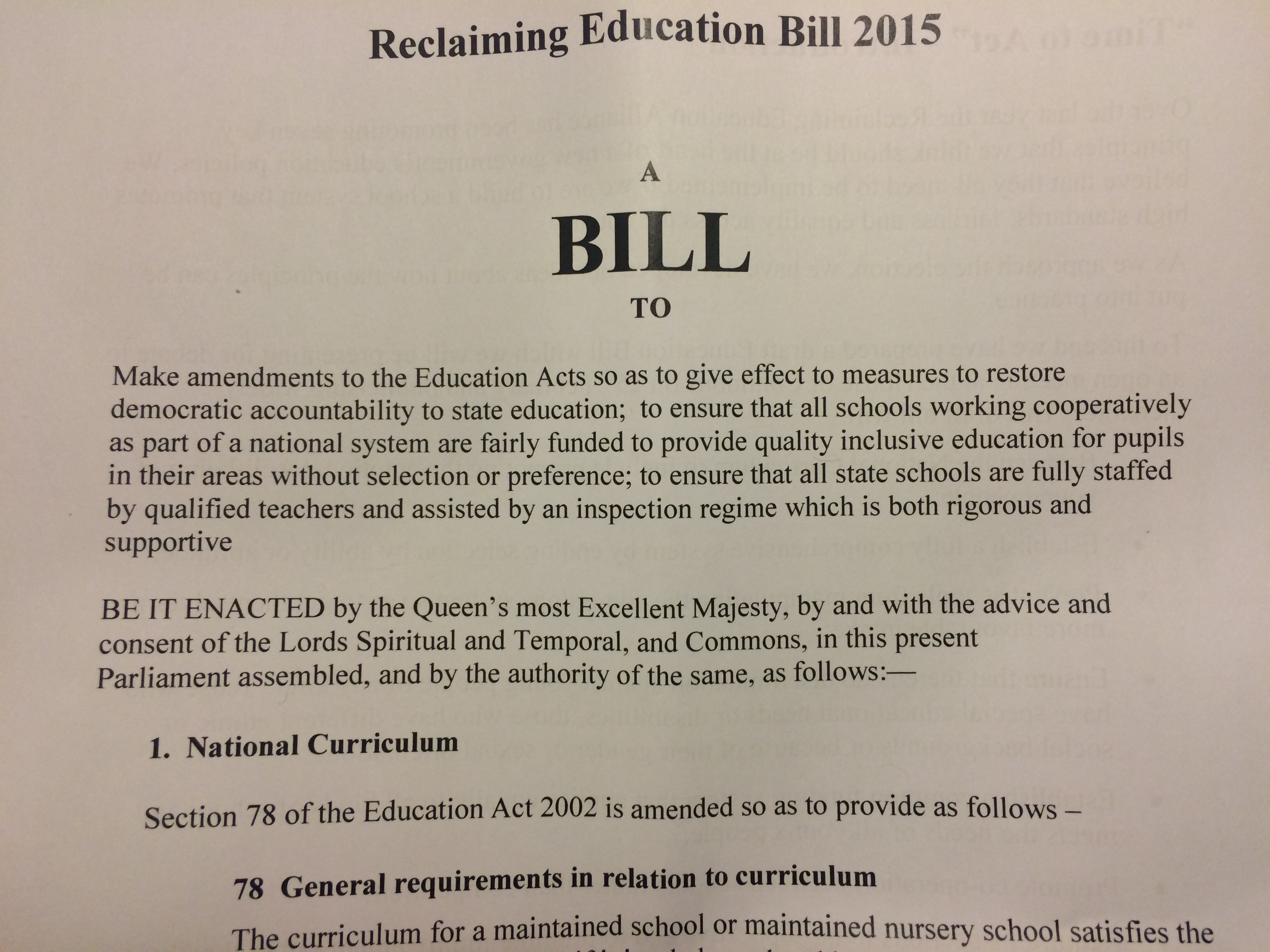
The outlines of such legislation are laid out in the Reclaiming Education Bill 2015 drawn up by Graham Clayton on behalf of an alliance of seven organisations: The Alliance for Inclusive Education, Comprehensive Future, Information for School and College Governors, Socialist Education Association, Campaign for State Education, Forum, New Visions for Education.

The Bill was presented at an open meeting on 25th February and received strong support from all those present. The key aims of the draft bill are to establish a fully comprehensive system by ending selection by ability or aptitude, restoring democratic accountability to state education, ensuring that all schools work co-operatively as part of a national system, are fairly funded to provide quality inclusive education for pupils without selection and that all schools are fully staffed by qualified teachers assisted by an inspection regime which is both rigorous and supportive.

The draft Reclaiming Education Bill represents a vision of a very different future for education. No one at the meeting was in any doubt that such reform cannot be achieved through legislation alone or that it won’t be hard fought. But by providing a concise set of reasonable and potentially very popular demands, the draft bill provides a useful single focus for campaigning by all those concerned about the fragmentation, marketization and inequities of our current ‘non-system’ in the run up to the election.

Agreeing such a bill isn’t a destination, it is the start of a process. Now that we have a single overarching document to work for, the campaigning needs to begin. Clearly, we need to achieve a political majority in favour of such a change of direction. We also need to work through all the important details and this will require a high level of involvement by all those committed to education as a public service; communities, parents, students, education workers and their unions.

So let’s celebrate the bill, disseminate the bill and use the bill to set the terms of debate. This bill represents the hope that many people have that we can at last break away from the market consensus in education and start building a public service consensus. It’s not too late for education to have its NHS moment.

The Reclaiming Education Bill 2015

Posted in Education policy, Politics | Tagged , , , , , , , | Leave a comment

Your college interview

How should you approach your sixth form college interview and get the most from the experience?

Following my previous posts How to choose a sixth form and How to make a strong college application, here is some advice about getting the most from your college interview. This relates to Newham Sixth Form College (NewVIc) interviews as other colleges may have different processes.

Your interview is the most important stage in your application so far. It isn’t a test where you have to get the right answers. It is an in-depth conversation about your future, a conversation between two experts; you are the authority on what you want to do and your interviewer is an expert on what the college has to offer and what is needed for different careers and university courses.

By now, you’ve visited the college, studied our prospectus, researched your options and made your application. You’ve told us about your ambitions, your interests and your achievements in and out of school. We also have your school reference in front of us, which tells us about your attendance, punctuality, behaviour, achievements and of course your predicted grades based on your GCSE mocks. So we know a lot about you on paper but we haven’t yet talked to you about what you want.

The conversation will cover what you’ve said about your future plans, what you hope to study and your wider interests. If you’ve brought a record of achievement or a portfolio of work we are always very interested to look at this and discuss it with you. We often ask about your extra-curricular interests and what you enjoy reading and why. We might discuss particular aspects of our student development offer which might interest you, such as the sports academy, music academy or leadership programmes.

We expect you to be able to justify your course choices, to be realistic about what you need to do to get where you want to be and to be open minded about alternatives which we might suggest. This is a great opportunity to ask questions about any aspect of college life and to check anything you might be unclear about. There are no stupid questions, it is quite natural that there will be many things you’re not sure about and we are here to help explain things to you. We might even look up some university entry requirements online with you to check that you are choosing a programme which keeps the options you are considering open.

Throughout the conversation, your interviewer will be filling in the interview record sheet and you will be given a copy of this to take home and discuss with your family. This gives you some feedback on your application, highlights particular interests or talents you have and outlines the programme which has been agreed and any particular issues or conditions attached. It also shows how we’ve timetabled the courses in your programme as we always offer course combinations which are possible. Although we hope that the outcome is the right one for you, there is still scope for changes and amendments.

By the end of the interview you should have a conditional offer. This means that we are offering you a place on the specific programme agreed on condition that you meet the entry requirements, these are in the prospectus and will be explained to you, they are often a combination of an overall minimum average GCSE point score (eg: a minimum of 4.9 points to do 3 A levels) and minimum grades in specific subjects (eg: a minimum of grade B in Maths to do A level Maths). This offer will be confirmed by letter to your home address.

Your conditional offer is not a guaranteed place at NewVIc. If we do not hear from you again, we will assume you are not planning to join the college. To ensure that you have a guaranteed place, you need to do 3 things:

  • Formally accept the offer by signing and returning the offer letter to us (can also be done online)
  • Agree to attend summer induction* (unless you are going to be abroad)
  • Pay the deposit.

You should only accept your offer if you are serious about coming to NewVIc. Once you have a guaranteed place, we assume you will join us, we keep in touch with you and we book you in for priority early enrolment on GCSE results day and the 2 days immediately following it in August

We don’t expect you to make your final decision at your interview. We understand that you may be applying to other places and can’t make that decision until you’ve had all your interviews and offers. However many places you’ve applied to, in the end you can only enrol at one and you need to make this decision in good time. So don’t leave this too late or you might find that the programme you want is full.

Deciding where to study post-16 is a major life-changing decision. This is your future and deserves to be taken seriously. We will be delighted if you choose to study at NewVIc, but you must only do so if you feel that this is where you will be happy and successful. If you do join us I’m sure you will be – like thousands of successful students before you. But it’s your decision and our role is to inform and advise you, not to try to persuade you.

So we hope that you enjoy your interview and that it is a helpful part of your decision-making process. You should feel that your questions have been answered, your options are clearer, you are even more focused on your future and one step closer to making the important decision about where and what you want to study.

See also: How to choose a sixth form and How to make a strong college application

Coming soon: Induction and enrolment

*at NewVIc, summer induction is an opportunity to start working on your chosen programme and to get to know your teachers and fellow students and experience college life. We will set you reading and tasks over the summer which will help you to prepare for college level study.


Posted in Education, Learning resources, NewVIc | Tagged , , , , , , , | Leave a comment

Education 2020: market or system?

What will education in England be like in 2020? As the 2015 general election approaches, what are the possible futures for education in England? An election is a democratic moment where we are offered a choice of futures and we hope to recognise our own hopes in some of those futures. Education may not be a decisive issue in the 2015 general election but we can still imagine different futures for it by the time of the next general election in 2020. Here are the outlines of two possible futures:

1. An education market:

Following the 2015 election, the political majority at Westminster remained committed to our current direction of travel. Continuing public austerity meant less public spending on education while the rhetoric was even more strident about ‘UK plc’ needing to become ever more globally competitive and ‘win the race to the top’ both economically and educationally in the PISA tables. Politicians’ response to Britain’s continued economic decline was to become even more uncompromising about demanding personal responsibility for high standards and ‘no excuses’ from individual students, teachers, schools and colleges if they achieve anything less than average in various national measures.

We now talk routinely of the ‘education market’ just like the ‘energy market’. As with other utilities, the landscape is dominated by a small number of competing national chains, now known as companies, with national contracts. These are the ‘big six’, each of which operates across all regions and in primary, secondary and post-16. Each company has a strong brand identity and has the capacity to innovate at company level, it supports its own teacher training and development and its own research capacity. Many of them also produce teaching and assessment materials commercially and offer a range of paid-for services to students and parents. They have massive budgets and are not subject to any local scrutiny or accountability and most are quoted on the stock exchange. They maintain close relationships with the national commissioners and politicians who sign off their contracts, regulate their activities and decide the performance measures they will be judged by. They are generally regarded as ‘too big to fail’.

The various national companies offer a range of unique selling points and distinctive strengths to their customers. Some of the chains are a little more focused on inclusion and some on elitism, some emphasise sports or the arts a bit more while others have a slightly more technological bias. These ‘flavours’ are often linked to particular commercial partnerships.

In order to stimulate competition, the government has allowed the trend towards greater selection and stratification of schools to permit companies to offer ‘different types of school for different types of learner’. So although each company aims to cater for all types of learner, their size allows them to engage in ‘cherry picking’ and segregation of students with particular aptitudes and talents at a younger and younger age. Specialist technical schools are common as are highly selective ‘super-grammars’. One company’s initiative to create a hyper-selective national residential sixth form college aiming to get all every one of its students into Oxbridge soon led to the other companies following suit and selection for some of these colleges now starts at age 14.

All the companies market themselves vigorously and their slick TV commercials tell inspiring personal stories of student growth, fulfilment and success within the company system. At the local level, schools are described in terms of their parent company rather than their school name and the company is the brand that really counts. Students generally study within a single company throughout their schooling, benefiting from continuity of staffing and ethos and this is seen as a strength. People even claim to be able to identify which company a student was schooled in based on their behaviour and attitudes.

The school curriculum is increasingly driven by the perceived needs of the economy, concentrating on the ‘core’ subjects or vocational tracks which, it is claimed, will help students find their place in the workforce and beat the global competition.

As public funding has continued to fall, companies are charging for more and more of the ‘extras’, including company-franchised mentoring and tutoring, sports, music, arts and outward bound activities.

University fees have been uncapped and there is real competition on price and companies have negotiated bulk deals with university groups offering preferential loans and bursaries to high achieving students. Adult education is purely about investing in one’s marketable skills and people have to borrow to pay a private provider for it, or persuade an employer to pay.

The national companies’ dominance of the market has led to some spectacular scandals and market failures, the solution to which is always seen as better regulation or changes in company management. Public campaigning is mainly focused on local difficulties rather than offering any coherent critique of the system, and when it is proposed, system reform is seen as unrealistic. Education debates or industrial disputes tend to be about the ineffectiveness or monopolistic excesses of a national company and the barriers to new entrants.

Many parents and students are satisfied customers of the company they have chosen, they buy into its ethos and feel loyalty to it. This education market is diverse and seems to offer something for everyone, although the ‘top’ companies seem to find ways to move low-performing students out of their provision. Nationally, the achievement gap is widening but somehow this is glossed over as the spectacular results of the highest performing students are highlighted.

As the 2020 election campaign gets going, one of the major parties is advocating a single guaranteed ‘national lifelong learning fund’ which the state will make available to the national companies to fund their students’ education from 14 onwards to be repaid by the individuals to their company once they get a job. The politics of education is consumer politics and we hear very little advocacy of a democratically accountable public education, let alone the neighbourhood comprehensive school.

2. An Education Service:

Following the 2015 election, the new political majority at Westminster didn’t have a particularly coherent vision of what they wanted to do about education but they did agree that the solutions did not all lie in Westminster or the unfettered market. During the campaign, they had been struck by the level of popular dissatisfaction with the incoherence and chaos people were experiencing and impressed by the desire for change. Continuing with the reforms of the previous 5 years was clearly not an option.

In the absence of a strong ideological agenda, the politicians asked themselves whether the answers might perhaps be found in the imagination and daily practice of the people actually concerned with education. So within a few weeks of the election they launched a national Great Debate about the purpose and organisation of education in England. This willingness to listen to people turned out to be their most radical decision.

The Great Debate aimed to involve everyone in discussing a few simple questions:

  • What do we want from education?
  • What is an educated person?
  • How do we ensure that everyone gets the best possible education?

The initial Great Debate was given a month in order to focus everyone’s minds and instil a sense of urgency. It was conducted on-line, using social media, in public meetings large and small, inside and outside school classrooms and in outreach activity to ensure that everyone, including children and young people, had the opportunity to express their views. Public involvement in the process was very high, different opinions were respected and the views of ‘experts’ and education professionals were given equal weight to those of everyone else.

As the Great Debate got going, people got excited. They were being listened to and they were setting the agenda. Having voted to hand power to politicians, they were now being asked how that power should be used. The discussions generated many brilliant ideas and the deliberation and aggregation process throughout the month meant that the most popular themes started to emerge and people could return to the debate at different stages.

It became clear quite early on that there was a real consensus that England needs a common national education system with both social and personal objectives to meet the needs of all its people.

One of the most popular emerging themes was “education needs to be like the NHS” and that was actually one of the key outcomes: a groundswell of support for a comprehensive national education system based on agreed common aims, cooperation and universalism rather than competition and selection.

Another outcome was a real celebration of the work of teachers and pride in the work of students. Many participants said that learning directly about what happens in our schools and universities had surprised and impressed them and inspired them to get more involved themselves.

Following this Great Debate, the school curriculum was redefined in terms of human flourishing as well as the fundamental knowledge and skills that everyone needs to build on to be a successful contributor to society. There was support for both breadth and specialisation at upper secondary level with no options being closed off at any age.

Once the national aims were agreed, the new system needed to be built from the existing one with collaboration around the nationally agreed shared aims, core entitlements and funding as givens. The English regions were given the right to elect education councils to oversee the development of the system in their region using all the educational resources available. These elections gave the new councils a strong mandate to develop a distinctive approach for their area within the national aims. The limited funding available was boosted by releasing the ‘partnership premium’, spending previously tied up in competition and duplication. There was room for specialisation as well as regional and local innovation and some regions are now leading on different themes and sharing their work nationally and they have created new forums for action research, evaluation, curriculum and professional development.

The talents and skills of the nation’s young people were increasingly recognised and celebrated including their contribution to community and cultural life and the impact of their research. These are all valued within the school leavers’ National Baccalaureate.

We are starting to see a renaissance of adult education in various forms as universities work with other parts of the education service to reach out more and respond to the needs and interests of all adults in their region. Reading groups, current affairs groups, cultural activity and community organising and volunteering feed in to university extramural programmes with a consequential strengthening of both local and virtual community solidarity.

In fact, the Great Debate which started in the summer of 2015 has never really stopped. People found that they wanted to contribute to education and to help shape the new system. The momentum of 2015 was built on through local education forums across the country which informed the work of the new education councils and helped hold them to account between elections. People’s attachment to their education service and the idea of public service generally was strengthened by this activity.

By 2020 educational inequality has not been abolished but there is some evidence that the gaps are narrowing. Not everyone is satisfied with the rate of progress and funding remains tight. People are proud of the ‘new’ system, positive about its contribution to society and optimistic about its future. There does seem to be a consensus around the aims and values established through the Great Debate. By the time of the 2020 election, all the major parties are committed to the system and the policy differences are mostly about resource allocation and curriculum priorities. One of the parties is advocating another Great Debate about how the banking and finance system can help meet human needs.

There is choice and diversity within this comprehensive system and we hear very little advocacy of greater competition or market incentives. There is friendly rivalry between different parts of the service as they strive to offer the best to their communities but this is combined with a commitment to sharing what they do best to help the whole service improve.

In conclusion: making our path

These are just two of many possible alternative futures for education. If we want a future shaped by us rather than by the market, then voting in the general election is only the start. We need to use democratic means to decide where we want to go and also to help get us there. In one of his poems, the Spanish poet Antonio Machado says:

“there is no path, the path is made by walking.”

So let’s get up and start walking…

Based on a talk given at the Society for Educational Studies annual seminar, Cambridge, 20th February 2015.

f98e7158328c5209366429b96636df23

Posted in Education policy, Politics | Tagged , , , , , , , , , , | Leave a comment

Resisting selection

Thanks to the prime minister, it seems that educational selection is back on the agenda again. The grammar school issue in Kent and elsewhere is one aspect of the debate but it’s worth remembering that the segregation of learners by ‘aptitude’, ‘potential’, test or exam score is widespread with the 11+ being only one of a broad spectrum of selective practices.

Education in England is riddled with selective assumptions and practices from top to bottom. Learners are routinely selected and segregated into different provision, particularly at secondary and tertiary level. We have never had a national education system, let alone a fully comprehensive one. What we have is the result of a tension between comprehensive and selective tendencies operating in a context of market competition between unequal schools in an unequal society.

The case for selection is generally based on notions of fixed, measurable potential. Despite its regular revival, most recently in genetic or neuro-psychological forms, the idea that ‘intelligence’ is a single heritable attribute which is fixed and measurable has no scientific basis. Even when advocates of academic selection don’t rely on IQ tests or similar measures, they replace the idea of measurable and fixed ‘ability’ with something called ‘potential’ which is just as fixed. Both these concepts start from a deterministic approach to learning which implies that an individual’s ability to learn and to achieve academically is substantially pre-determined and unchanging. This view often leads to practices which progressively close the doors to certain opportunities for human flourishing to certain people rather than keeping all doors open.

Selection can operate at a whole-system level, providing different types of school for different ‘types’ of student as determined by some kind of assessment of their ability, aptitude or potential. It can also operate at the intra-institutional level with such practices as rigid streaming or limiting curriculum options to particular ‘types’ of student.

The prime minister has expressed his support for grammar school expansion in Kent. He says this is because ‘good’ schools should be able to expand. However, this fails to recognise that grammar schools are not isolated ‘good’ schools, but part of a system which has selection at its core. If you think a system of selection at 11 is wrong, then you cannot really argue that it is OK to keep, let alone expand, grammar schools. If you think it is right…well, then you would be arguing for it everywhere else too, like UKIP.

If academic selection and the 11+ are back on the political agenda then many of us will want to defend the comprehensive principle because we believe that the common school, college and university, like the NHS, are part of the foundations of the good society.

The comprehensive school is a successful and popular expression of equality of opportunity which transcends all social differences. The idea that children and young people should be educated with their neighbours and their peers in a learning community which reflects the composition of the geographical community they live in is still valid, even if some have abandoned it. A comprehensive system discourages competition for positional advantage by school, and seeks to ensure that every school and every student can flourish.

If we agree that the state should shape the kind of education system we have, then we can probably agree that such a system should broadly value the things we value, reflect the type of society we want and offer the best available to everyone. Do our current arrangements reflect this? Do they serve all young people well? If we want a cohesive and open society where everyone can develop and flourish as citizens, workers and community members and an education system that works well for everyone, perhaps we should consign academic selection to the dustbin of history.

“The good we secure for ourselves is precarious and uncertain until it is secured for all of us and incorporated into our common life.”  Jane Addams.

“One of the great tragedies of the last 100 years has been our failure as a nation to take on the essential concept of human educability and thereby challenge the idea that children are born with a given quota of ‘intelligence’ which remains constant both during childhood and adult life.” Clyde Chitty.

Posted in Education policy, Politics | Tagged , , , , , , , | 1 Comment

Investing in 16-19 education

Labour’s promise to maintain education spending from nursery to 19 year olds and increase it at least by inflation is very welcome. No such protection is on offer from the Conservatives who are promising ‘flat cash’ for pre-16’s and apparently no guarantees of any kind for 16-19. So Labour’s move suggests there may be some education spending ‘blue water’ finding its way between the two major parties.

But before we start cheering in the streets, 16-19 providers will be asking: what does this actually mean for us? Is this really a commitment to adequate levels of funding for the education of this age group?

As outlined so far, this spending guarantee does not protect the rate per learner, so we might still see most of it being used to cater for rising primary rolls and so far we haven’t had any promise of a ring-fence around any part of the education budget, so one sector may need to be raided to pay for growth in others.

The current position is that England’s 16-19 students are the worst funded in education with 18 year-old sixth formers in particular falling off a funding cliff-edge.

To be fair, under this government there has been some progress in levelling the playing field between different 16-19 providers. The post-16 funding system and rate have now been standardised across schools and colleges and college students from low income families are now eligible for free meals on the same basis as their peers in school sixth forms.

But overall, 16-19 learners have been battered by a ‘perfect storm’ of policy and spending decisions which have hit them disproportionately. The coalition government’s spending protection for education does not extend beyond 16 and we have been hit hard; first by cuts to the funding for non-qualification aspects of students’ programmes such as tutorial, enrichment and key skills and then later by the cap on programme size which penalised colleges whose students study larger programmes, such as 4 A-levels.

This year, those colleges which enrol 18 year olds have also seen funding for this age group cut by 17.5% this year; a cruel cut which I call the ‘aspiration tax’ because it hits colleges which offer the most 3-year and second chance opportunities to students who did least well at school and are committed to their success. As well as the ‘aspiration tax’, incorporated colleges have to pay VAT while their competitor schools and academies are exempt. This costs the average sixth form college over £300,000 per year, an inequity which we describe as the ‘learning tax’.

The convergence of a number of all these spending reductions has ended up hitting colleges far more than other sectors and the result is that by 2016/17 the average sixth form college student will attract only £4,128 which is 82% of the average funding for a school or academy sixth form student, 74% of the average funding for an 11-16 year old and 49% of the average funding for a university student. It also represents a mere 16% of the sixth form day fees at a ‘top’ private school such as Westminster. Incidentally, in the private sector it is quite usual for sixth form fees to be higher than for the rest of the school, presumably reflecting the relative cost of the provision. At Westminster there is a +8% sixth form premium compared to the -26% sixth form discount we see in public funding.

So, for Labour’s announcement to be good news for 16-19 year olds, we need to know which of the following possible variants of their plan is most likely for this age group:

1. No protection for 16-19 year olds: This could be very bad news indeed unless the new government also initiates a review of funding rates based on what it expects from each sector. This could lead us towards option 4.

2. No further cuts in the cash rate per learner: This is essentially what we are experiencing this year after a period of unprecedented cuts. Once all these cuts have worked through and inflation takes its toll, it is difficult to see how sixth form providers would be able to provide the minimum programme of study required for 16-19 year olds, let alone the broad and enriching education they need.

3. An inflation-linked increase in the cash rate per learner: This would at least stabilise funding at the current levels and allow providers to survive. There would still be serious inequities in the system, such as massive underfunding of programmes for 18 year olds.

4. Start to move towards greater parity between 16-19 and pre-16 funding: Any new government committed to equitable investment in all young people from nursery to 19 should consider scrapping both the ‘learning tax’ (the VAT inequity between colleges and schools) and the ‘aspiration tax’ (the funding inequity between 18 year-olds and 16/17 year-olds on the same programmes), establish what a fair funding rate would be and start to move towards it.

The same question can also be put to the other parties.

This is a critical phase in the educational and social development of our young citizens and future workers. Good post-16 education should be recognised as a key component of our country’s overall investment strategy for the future. It’s therefore high time that 16-19 education was on the political agenda and we need to see more detail from each major party. The funding, educational opportunities and institutional arrangements which our 16-19 year-olds need should be an election issue and all parties should be put on the spot about how much they intend to invest and what their direction of travel will be.drop_the_learning_tax(1)


Posted in Education policy | Tagged , , , , , , , , , | Leave a comment

Re-imagining the university

A celebration of Birkbeck’s latest innovation in higher education in London.

FullSizeRender (2)Anish Kapoor’s amazing Orbit here in East London’s Olympic quarter calls to mind previous sculptural structures built on a monumental scale. Together with Gustave Eiffel’s tower in Paris and Vladimir Tatlin’s Monument to the Third International designed for Petrograd and never built, these structures seem to reach out towards a better future, willing it into being and propelling us into a new world. In keeping with the age, Anish Kapoor’s Orbit suggests a future which is more uncertain, more challenging, more complex and, of course, more exciting than any of these other futures. Walking onto the site, we passed underneath the opening of a colossal funnel which seemed ready to suck us up and literally propel us into orbit.

I think this is what we are doing in education, we want to propel people into the future, to prepare them for that complex, exciting and wonderful unknown which beckons and to give them some of the tools they will need to navigate with on the journey. Education is about helping people to re-imagine themselves and to re-imagine their world.

Newham sixth form college, NewVIc, just a few miles down the road, is London’s largest sixth form college. Our students are full of ambition and talent, most aspire to go on to university and most do; our progression rate is higher than average. In fact more young people from disadvantaged backgrounds progress to university from NewVIc than from any other further education or sixth form provider in the country. We have also increased the number getting in to the most selective universities. Our A-level results are improving more rapidly than nationally and our vocational results are already well above the national average.

Even in these times where austerity and pessimism seem to prevail, when I see the energy, the personal and social commitment of our students I feel nothing but optimism about our shared future. We are very proud of our students’ achievements and Birkbeck has played its part in this success. The number of NewVIc students progressing to Birkbeck has doubled…from 1 to 2. We are, of course, aiming for even more spectacular increases in future.

I have to disagree when people, usually politicians, make a distinction between ‘wealth creators’ on the one hand and public services which are presumably just ‘wealth spenders’ on the other. They usually also tell us that we have to wait for the wealth to be created before we can have adequate resources allocated to public services. But surely, we are wealth creators too. We are investing in the greatest resource there is; human beings. Our schools, colleges and universities are powerful engines of wealth creation – particularly in a place like East London.

So what does it mean to re-invent the university? I think today’s university has to go beyond running courses or doing research. We need universities to continue being powerhouses of intellectual, cultural, social and economic life; locally and globally. Universities are places where knowledge is created, ideas debated and perspectives shared. They should face outwards and seek to involve everyone in the task of re-imagining themselves and their world.

Birkbeck has a tremendous record of doing precisely this. Finding new ways to reach people and involve them, marrying widening participation with academic and research excellence. Birkbeck shows us what it might mean to go beyond a target of 50% participation in higher education. It seems to me that it symbolises the goal of 100% participation; whether on-line, full-time, day or evening, undergraduate or postgraduate.

So I commend the brilliant 3 year evening degrees which Birkbeck offers and I am confident that we will see an increasing number of young people opting for this mode of attendance and I look forward to continuing to work closely with Birkbeck to help propel more and more of our ambitious young people into a better future.

Adapted from a speech at the AcelorMittal Orbit in Stratford, East London on 12th February 2015.

Posted in Education, NewVIc | Tagged , , , , , , , | Leave a comment

How to make a strong college application

IMG_3448How can students make sure that their sixth form application is as strong as possible and does justice to their achievements, interests and aspirations?

If you are in Year 11, you need to be thinking about where you want to continue your education after 16. You are free to choose where to apply, whether it’s a sixth form college, FE college, school sixth form or training provider. You can make several applications and each college or school will consider your application independently and decide separately whether to make you an offer. So applying to a sixth form is not the end of the process of choosing, it’s very much a part of it.

So here are my 10 top tips:

  1. Make sure you have researched the sixth form you are applying to. Do they offer the programme you are interested in and do you have a reasonable chance of meeting their entry requirements? If you need more help, see my post about choosing a sixth form.
  2. Check you understand the application process and deadlines. Read the application form carefully to see what is expected from you, fill in the easy bits such as personal information. Do a first draft of any section which requires longer responses or choices.
  3. Tell us about your ambition; where you see yourself in 5 or 10 years – we’re not going to hold you to this. Don’t worry if you have more than one option or if you’re genuinely not sure.
  4. Justify your choice of programme in terms of your ambition and your interests. Tell us what you’ve most enjoyed studying at school, including coursework or research projects you found particularly interesting. Have you researched what degree course you might want to progress to at university and what their requirements are – subjects and grades? If you’re not sure where you are heading, have you made sure that your choices keep your options open?
  5. Tell us about yourself, give us a sense of what you are interested in, what you are passionate about, what you enjoy doing and why. We are really interested to know about the achievements and skills you are most proud of; a sporting achievement, playing a musical instrument, performing on stage, designing games, writing a story on Wattpad or in the school magazine, organising an event, coaching, volunteering, some kind of leadership activity, things you learned on work experience etc.
  6. We are interested in what you have learnt from your involvement in any extra-curricular activities such as Duke of Edinburgh, Prince’s Drawing school, Woodcraft Folk, Scouts, Guides or church or mosque youth groups. All of these are opportunities to demonstrate your commitment to helping others and contributing to society. Give us an idea about what activities you might want to take up or continue with at college.
  7. Tell us about something you’ve read or a lecture you attended and why you enjoyed it. What appeals to you about a particular writer or genre such as science-fiction, horror, historical fiction etc.
  8. Don’t forget to tell us about all the languages you speak. Being multilingual is a real asset and will help you throughout your studies and in employment.
  9. Be concise in your writing style. You don’t need to tell us your whole life story! Don’t rush into the final copy, show your draft to a teacher or careers advisor and take account of their feedback. Before sending anything off, double check that you’ve filled in everything you need to complete, and of course…
  10. Send it off in good time!

Over the years I have read thousands of college applications from year 11 students and the best ones are those which are complete, legible, well considered and which give us a strong sense of the real person behind the form.

Together with a good school reference, a strong application sets the scene for a really helpful interview. And that will be the subject of the next post in this series.

Previous post: How to choose a sixth form

See also: Your college interview

Posted in Education, Learning resources, NewVIc, Parents, Students | Tagged , , , , , | 2 Comments

Russell Group university progression: dispelling the myths

Since the Russell group of universities started publishing their ‘Informed Choices’ guide and launched the concept of facilitating A-level subjects, their advice has often been misrepresented or misunderstood. ‘Informed choices’ is a helpful contribution to advising and guiding students about sensible subject choices at 16 which keep their university options open. However, having dispelled some myths about what Russell group universities value, it has given rise to other myths which this post tries to address.

Newham sixth form college (NewVIc) had the highest number of Russell group progressors in its history last year. 71* of our students progressed to Russell group institutions in 2014 compared to 60 in the previous year. This was a higher number than any other Newham sixth form.

[*Not counting the 6 students who progressed to the Institute of Education which is now part of University College London (UCL) – a Russell group member. The merger took place after the admissions process.]

Because NewVIc is a comprehensive college, the range of students was broad and diverse in terms of their subject and degree choices. This gives us a good data set to look at the characteristics of successful Russell group applicants. An analysis of NewVIc’s Russell group class of 2014 provides some useful pointers to help dispel some of the common myths:

Myth 1. Only facilitating subjects really count. Fact: 65% of all exam entries for students progressing to Russell group universities were in non-facilitating subjects. Of the 268 advanced exam entries for these students, 174 were in non-facilitating subjects. Even if we only consider the A-level candidates (as no vocational course is facilitating), the percentage of non-facilitating subject entries is 54% (111 out of 205). If only A2 subjects are considered, the percentage of non-facilitating subject entries is still 54%. The most popular non-facilitating A-level subjects among this cohort are: Psychology and Sociology (8 entries each), Economics and Politics (7 each), Anthropology, Computing and World Development (4 each), Business and ICT (3 each), Law and Media (2 each), Music, Drama and Religious Studies also featured and some A-level students also took a Subsidiary Diploma in Forensic Science or Engineering.

Myth 2. You need to achieve at least AAB in at least 2 facilitating subjects to get into a Russell group university. Fact: 69% of our ‘straight A-level’ students progressing to Russell group universities did not hit this threshold. This was either because they were taking less than 2 facilitating subjects or because they didn’t achieved a minimum of AAB. The 16 ‘straight vocational’ students couldn’t achieve this measure by definition although most achieved triple distinctions or starred distinctions, the highest possible grade. If they are included, the proportion of Russell group progressors who didn’t achieved the ‘AAB in 2FS’ measure becomes 76%. The rather odd ‘AAB in 2FS’ measure is used in the performance tables to represent high achievement implying that facilitating subjects are somehow worth more than other A-levels. But if at least two thirds of those who progress to Russell group universities do not reach this particular threshold, it suggests that it is not a very meaningful benchmark. Perhaps the ‘facilitating’ component should be dropped and the measure could become a more objective measure of high achievement. Progression to Russell group universities is also published so there’s no need for this hybrid measure.

Myth 3. You have to study at least 2 facilitating subjects to get into a Russell group university. Fact: 38% of students progressing to Russell group universities took less than 2 facilitating subjects. 27 out of our 71 Russell group progressors took fewer than 2 facilitating subjects. This included 18 students who took vocational courses. Even if these vocational students are discounted, 17% of ‘straight A-level’ Russell group progressors studied less than 2 facilitating subjects.

Myth 4. You won’t get in to a Russell group university without any facilitating subjects. Fact: 25% of students progressing to Russell group universities had no facilitating subjects at all. Most, but not all, were vocational students; 2 of the ‘straight A-level’ students and 16 vocational students.

To conclude, we do not promote Russell group universities above any others and do not describe them as ‘top’ or ‘best’. Neither do we promote facilitating subjects as ‘harder’ or ‘better’. We give students the best possible advice based on what they are aiming for and where they might want to study and point them to a range of useful sources of information.

The evidence from our successful students is that there is not one simple formula for progressing to Russell group universities and that it is essential to be well informed about entry requirements course by course and university by university. Above all, the message is: you don’t have to limit yourself to facilitating subjects and you should always seriously consider subjects you’re going to enjoy studying.

See also: ‘Hindering’ subjects and ‘bad’ universities from October 2014.

Posted in Education, NewVIc | Tagged , , , , , , , , , | Leave a comment

Demonstrating high achievement in comprehensive settings

Comprehensive schools and colleges can face a challenge when trying to show how well their highest achieving students do and how many of them there are. They can suffer from ‘bog standard’ syndrome and the assumption that all their students achieve roughly the same, fairly modest outcomes. Institutional averages will always show selective providers in a better light precisely because they have selected students on the basis of their likelihood of achieving high scores. Based on such averages, providers with a comprehensive intake across the full range of prior achievement will always seem ‘middling’ or even below average if their cohort is ‘bottom heavy’. This might suggest that very few of their students achieve outstanding results.

One solution to this is to pick out subgroups of students and describe their achievement. This could be students who started with high scores at entry, ie: those who might have qualified for admission to a more selective provider; the ‘grammar school’ cohort perhaps. Or it could simply be those students who achieved above the national average, highlighting how many there were.

Newham sixth form college (NewVIc) has well above national average vocational achievement across the board, but our average A level point scores, although improving rapidly, are still below the national average. This can be explained by the fact that we are not super-selective and that we have a higher than average proportion of students with an average of GCSE grade C at entry. Many school sixth forms or selective post-16 providers set a minimum entry requirement of an average of GCSE grade B or above.

Nevertheless, as a college with a fairly large cohort we can demonstrate that we have a very substantial number of students who achieve well above the national averages and that this high achieving cohort is much larger than many whole sixth forms. This means that within a large comprehensive college there is a large high-achieving cohort whose achievements are equal to or above those of more selective providers. Parents can understand this and it is a good antidote to the narrative which equates selectiveness with success or overall ‘average-ness’ with a lack of success.

So, for example:

A level 2014 No. of students Points per student Points per entry
England average 772.7 211.2
NewVIc 361 655.9 193.8
NewVIc top 200 200 796.2 226.5
NewVIc top 100 100 875.4 237.5

This table shows that the sub-cohort of the top 100 and top 200 are achieving above the national average and they represent groups of students which are larger than many whole cohorts from more selective providers. This allows for a more informed comparison based on detail which crude averages would miss.

Posted in Education, NewVIc | Tagged , , , , , | Leave a comment