No austerity of the imagination

What’s the mood in sixth form and further education 10 weeks after the election?

Following the May general election there’s no question that post-16 education wherever it takes place faces greater austerity than any other phase of education. 16-18 year olds are funded at a lower rate on average that 5-16 year olds or university students. Funding for tutorial and enrichment and for the broadest programmes has been cut and funding for 18 year olds, whatever their programme, has been further hit by the arbitrary and irrational 17.5% ‘aspiration tax’ which punishes second chance providers.

More colleges are experiencing financial challenges and their very survival may be in question. Competition is eroding trust and collaboration between post-16 providers and narrowing opportunities for students. Our poorest students have already seen big reductions in financial support combined with a growing future debt burden from university fees and now also maintenance loans.

This is clearly a deeply depressing scenario but we need to find ways to ‘snatch hope from the jaws of despair’ and develop a ‘pragmatic idealism’ as I have proposed in recent speeches and posts. Our response should include both judicious opposition and constructive proposition.

Before suggesting positive ways forward, it’s worth trying to understand how our context can affect us.

What can financial austerity do to us?

It can shrink our view of what can be achieved collectively, encourage us to see reduced public funding as reduced value for what we do. It can lead to impoverished ambition and limited horizons. It can make us feel powerless as we sink lower and lower. But it doesn’t have to.

What can marketization do to us?

It can force us to think as competing providers, to put institutional self-interest above educational aims and values, to see qualifications, learning and students themselves as market commodities with a price linked mainly to status and earning power. But it doesn’t have to.

A thought experiment

Think of your area and all the young people who live there with all the challenges they face and all the potential they represent. Think of all the post-16 providers with all the challenges they face, many of them to do with financial austerity and competition. What do you see? Do you see competing providers saying negative things about each other? Wasteful duplication? Inadequate information, advice and guidance? Big marketing budgets and overhyped claims of success? Courses closing because they are not attracting enough learners? Small sixth forms that can only survive if they are subsidised by pre-16 funding? Is any of this familiar?

Just imagine…

Now imagine that the area you’re thinking of being served by a system; a comprehensive post-16 education system. The same resources; staff, buildings and facilities, the same experience, expertise, ingenuity, commitment of everyone currently involved in post-16 education in the area, are effectively co-ordinated and put at the disposal of all the young people in a way which responds to their educational needs and aspirations. Courses, progression, advice, guidance, support, challenge and enrichment are planned putting the interests of all learners first. The potential of those learners is realised through education and applied in their community as they learn. People’s jobs; our jobs, my job, may have to change, we might have to share some of our precious territory and professionalism with others, but the system is serving students and society better. And we discover that system leadership can be so much more productive than institutional leadership.

Utopian? Perhaps. Sensible? Evidently. And if it’s possible to imagine a better way of doing things then it must be possible to start taking steps towards building it. But we won’t begin to conceive of a better system if we can’t imagine new kinds of partnership.

Reasons for optimism: building blocks and signs of hope

Despite the gloom, we can identify many of the fragments of a genuine system, plenty of signs of hope. Here are just a few:

  • The commitment and skill of our staff: Teachers want to teach and to contribute to an education system and teaching must be at the heart of what we do. Those of us who do anything other than teaching must make sure that what we do supports, encourages and develops teaching and creates the best possible conditions for success.
  • Our national organisations and our experience of working together: The lived experience and long standing habits of collaboration, often between competitors, within the Sixth Form College Association (SFCA) and the Association of Colleges (AoC) for example.
  • Hard and soft Federations and Trusts: new forms of governance and collaboration at national, regional and local level guided by a wish to meet the educational needs of a whole cohort.
  • Teaching School Alliances (TSA): we have just joined a local TSA and Maths Hub led by a primary school. TSAs can bring teachers together across all phases to do some really useful ‘vertical’ work on how we support learning from early childhood to university level. Imagine the potential of getting primary, secondary and post-16 teachers together to really tackle people’s numeracy and literacy challenges throughout the life-cycle.
  • The existence of elected regional authorities such as the Greater London Authority and proposed Greater Manchester city region: these offer the possibility of regional leadership and advocacy for a joined-up post-16 education strategy which can command the support of our communities and be accountable to them.
  • Our partner universities: which have the reach and capacity to help connect post-16 and adult education and support career-long teacher development. Networks like Linking London and their new Single Point of Contact (SPOC) can support more successful FE to HE progression.
  • The National Bacc: led by schools and colleges and driven by the perceived need for a challenging, inclusive, overarching 14-19 curriculum framework which driven by a definition of what the educated 19 year old should have learned and be able to do.
  • Teacher networks, Tutor Voice, Teach Meets and Action Research Communities: bringing teachers together to learn from each other and from research.
  • Social networks and new technologies: new kinds of virtual communities of practice and opportunities to blend face to face and on-line learning are also transforming the way teachers produce and share excellent ideas, materials and methods.
  • Our students themselves: who should not be seen as economically inactive recipients of education, sitting in adult society’s waiting room but as active learners and workers, making a positive contribution through their community organising, service learning and research.

What many of these signs of hope have in common is that they are bottom-up, horizontal, networked approaches which do not require centralised structures or the approval of politicians to develop. They can spread like rhizomes joining up different parts of our ecosystem. But, to overstretch the organic metaphor we do also need some system ‘gardening’ based on shared values and common organising principles if we want to see the strawberries ripen.

In summary

My main point is that I don’t think we should allow an austerity mindset to affect our imagination and our ambition as well as our spending power. If anything, our vision should expand just as our financial room for manoeuvre narrows. Have we got the courage and ingenuity to develop effective national, regional and local collaborative education systems which could help to realise the collaboration dividend? Can we marry our commitment to all learners and to high standards with radically new ways of doing things? I don’t think we have a choice.

So let’s reject the austerity of the imagination and the tyranny of the market and embrace the challenge of constructing a system from the bottom up.

Presentation to the UCL Institute of Education Post-compulsory Teacher Education Partnership Seminar on Wednesday 15th July 2015 organised by Jay Derrick.

Other related posts:

Snatching hope from the jaws of despair

For a pragmatic idealism

FullSizeRender (7)

Posted in Education policy | Tagged , , , , , , , , , , | 1 Comment

Reading dystopias

Reading dystopias

Utopia: an imagined society or state of things in which everything is perfect or close to perfect.

Dystopia: an imagined society or state of things in which things are very far from perfect to a frightening extent.

An introduction to the genre of dystopian fiction through reading a classic dystopian novel.

We by Yevgeny Zamyatin (1920) [203 pages]

we_zamyatin

I am merely copying, word for word, what was printed in the State Gazette today:

In 120 days, the construction of the Integral will be complete. The great, historic hour when the first Integral will soar through outer space is nigh. Some thousand years ago, your heroic ancestors subjugated the entire earthly sphere to the power of the One State. Today, you are confronting an even greater conquest: the integration of the infinite equation of the universe with the electrified and fire-breathing Integral. You are confronting unknown creatures on alien planets, who may still be living in the savage state of freedom, and subjugating them to the beneficial yoke of reason…

As I write this, I feel something: my cheeks are burning….I am D-503. I am the builder of the Integral.

We was initially banned in the Soviet Union and first published in English translation in 1924 inspiring the next two dystopian novels in this short list: Brave New World and 1984. In the One State, the inhabitants are known by their numbers, live to a strict routine and have virtually no privacy. D-503’s life is disrupted when he falls in love with the attractive E-330 who is involved in a dissident group. What are they up to and can they take on the One State before it eradicates the human imagination?

Brave New World by Aldous Huxley (1932) [229 pages]

download

A squat grey building of only thirty-four storeys. Over the main entrance the words, CENTRAL LONDON HATCHERY AND CONDITIONING CENTRE, and, in a shield, the World State’s motto, COMMUNITY, IDENTITY, STABILITY.

Far in the future, the World Controllers have created the ideal society. Through clever use of genetic engineering, genuine ‘test tube babies’,  brainwashing and recreational sex and drugs, all its members seem to be happy consumers. Bernard Marx seems to be alone in his longing to break free. A visit to one of the few remaining Savage Reservations where the old, imperfect life still continues, may be the cure for his distress. This fantasy of the future draws on Huxley’s concerns about where he felt a society of mass consumption and lowest common denominator culture might be going.

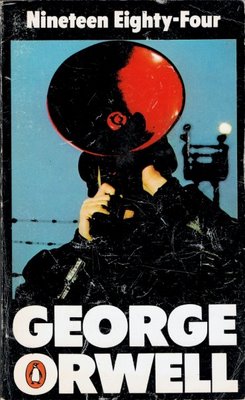
1984 by George Orwell (1949) [355 pages]

1984_2

It was a bright cold day in April, and the clocks were striking thirteen. Winston Smith, his chin nuzzled into his breast in an effort to escape the vile wind, slipped quickly through the glass doors of Victory Mansions, though not quickly enough to prevent a swirl of gritty dust from entering along with him.

The hallway smelt of boiled cabbage and old rag mats. At one end of it a coloured poster, too large for indoor display, had been tacked to the wall. It depicted simply an enormous face, more than a metre wide…

1984 is set in a society ruled by a totalitarian Party. Winston Smith works for the Ministry of Truth in London, the main city in Airstrip One. Big Brother stares out from every poster, the Thought Police uncover every act of betrayal. When Winston falls in love with Julia, he discovers that life does not have to be dreary and dull. Winston and Julia begin to question the Party and are drawn towards conspiracy. But Big Brother will not tolerate dissent – even in the mind. This is a terrifying vision of a future in which everything and everyone is enslaved to a tyrannical regime. The book coined many new words and phrases which are in common usage, such as ‘Big Brother’, ‘thoughtcrime’, ‘doublethink’ and ‘Newspeak’.

Never Let Me Go by Kazuo Ishiguro (2005) [282 pages]

never let me go

My name is Kathy H. I’m thirty-one years old and I’ve been a carer now for over eleven years. That sounds long enough, I know, but actually they want me to go on for another eight months, until the end of this year. That’ll make it almost exactly twelve years.

A group of friends, Kathy, Tommy and Ruth grow up together in a tranquil but rather strange boarding school. They gradually piece together what is going on in the adult world and what they are being prepared for. A highly atmospheric, psychological novel of growing up, love and loss. The book uses its setting it in a world very similar to ours but with a chilling difference to raise questions about the meaning and the quality of human life.

Assignment:

Choose one of these 4 dystopian novels to read and prepare a brief review to discuss with others.

You might want to use the 20 questions to ask about a book you’ve read to get you started and in addition consider the following 5 questions:

  1. If every dystopia is someone’s idea of utopia, describe what motives the architect of the fictional society you’ve read about might have had. What features of this society might have been seen as good and why?
  2. Why do you think this society can be seen as a dystopia rather than a utopia? Does this depend on your point of view or did something go wrong?
  3. Can you suggest a few changes which would make the fictional society you’ve read about better to live in?
  4. If you were designing a fictional utopia for humans to flourish, what principles would you base it on and what rules would you implement?
  5. Can you suggest just 3 possible changes which would make our actual society much better?

More fictional dystopias:

Top 12 dystopian novels

20 best dystopian novels

Gulliver’s levels (May 2015)

Posted in Culture, Fiction, Learning resources, Reviews, Science in Society | Tagged , , , , , , , , , , , , , | Leave a comment

20 questions to ask about a book you’ve read

A starting point for discussion in reading groups or for students doing reading assignments (fiction).

  1. Explain the title.
  2. What category or genre do you think it fits into?
  3. What do you think the author’s purpose was?
  4. Something you liked about it.
  5. Something you disliked about it.
  6. Describe the setting.
  7. Which character did you like most?
  8. Which character did you like least?
  9. Describe one of the main characters.
  10. What changes does a main character go through?
  11. Describe one significant episode.
  12. What techniques does the author use to tell the story?
  13. How did reading it change you, or your views?
  14. What would you say to persuade a friend to read it or not to read it?
  15. Summarise it in one written sentence or a one minute speech.
  16. What feedback would you give the author?
  17. How might you have written it differently?
  18. What do you think of the ending?
  19. What happens, or should happen, after the ending?
  20. What would you want to read about in a sequel or prequel?

Students can be asked to select which 5 questions to prepare answers for, to ask each other in turn or to be ready to answer any of these in a class discussion.

The idea is to encourage students to engage with a text from different perspectives and to share their responses to it without simply re-telling the story.

IMG_3934

Posted in Learning resources | Tagged , , , | 20 Comments

From Bamako to Timbuktu

The brilliant director Abderrahmane Sissakou grew up in Mali and has named two of his films after Malian cities: Bamako and Timbuktu. Watching these two remarkable films recently over one weekend in the sequence they were made was a moving and memorable experience.

In Bamako (2006) we spend most of our time in a busy traditional open courtyard in Mali’s capital where the World Bank is on trial. Judges preside, lawyers give impassioned speeches and witnesses testify in a setting where people are also following their daily routines, collecting water from a well, caring for children, dyeing fabric, buying and selling and trying to hold relationships together.

This fantastical trial is presented as the most natural thing in the world. A powerful case is made against the conditions of World Bank and IMF loans and the devastating consequences of these on basic public infrastructure and services such as education and health. The speeches made by the activists, intellectuals and lawyers might seem rather didactic but their proximity to everyday life serves to integrate this great global drama of debt and economic injustice into the individual human dramas without any sense that we are being lectured. Disruption and tragedy are mainly second-hand, referenced via the trial but they are not completely absent from the very touching human story of the singer Mele and her husband Chaka.

Nothing is dramatized, romanticised or exaggerated. A major political debate about how best to promote human development in Africa is simply being held in one of the places where the failure of the current world order to achieve this is felt most acutely. There is no rush and Sissakou allows his characters the time to be themselves and occupy the screen with their lives and feelings. The juxtapositions of global and local are handled lightly and without excessive signposting.

The coverage of the trial makes no attempt to be even-handed. The case against the World Bank is compelling and we assume the verdict will be damning. However, without anger or rancour, the Bank’s victims ask simply that it should honour its mission to benefit humanity and do the job it set out to do. We see Africa seeking justice rather than vengeance.

Some of the speakers refer briefly in their evidence to the fact that among the consequences of undermining the social infrastructure are alienation, violence and extremism, in one case referring to the terrorist ‘fireballs’ of Al-Quaeda (AQ).

By the time we get to Timbuktu (2014), the residents of the historic city in North-Eastern Mali are experiencing at first hand these consequences. Their city is occupied by Ansar Dine, an AQ-style group. This beautiful film has the same matter of fact documentary feel as Timbuktu but the human impact of oppression is more explicit and the expression of resistance is more subdued.

The history of this occupation and any conflict which led to it are not explained. People’s daily acts of resistance, from the imam to the fish-sellers are shown for what they are, expressions of frustration pushing at boundaries rather than grand heroic gestures. Faced with a totalitarian system, the people are stoical and long-suffering but are not prepared to give total submission. The occupiers operate in a brutal and dehumanising way but are not themselves shown as dehumanised or one-dimensional. We are able to see them as victims themselves of an imposed and alien absolutism.

The film offers scenes of great power and beauty but doesn’t manipulate or pull at our heartstrings. For example the fine, defiant, balletic game of football played by a group of young men without a ball, because football is forbidden, avoids excessive sentiment and feels completely realistic. There is terrible and graphic violence as well as a deep insight into the life of the nomadic Tuareg herdsman Kidane and his family.

The trajectory of these two films can be seen as a distinctly depressing one. Faced with injustice, we seem to move from the possibility of loud and articulate public defiance rooted in popular debate to the constrained and limited acts of personal defiance within an oppressive totalitarian regime. But throughout, the strength of the human spirit shines through in both films and even Timbuktu can be read as a message of hope.

These are two films that will leave an indelible mark on everyone who sees them.

Bamako

mediaSee also:

Film review: Berkeley and the promise of the public university (January 2015)

Posted in Culture, Reviews | Tagged , , , , , , , , | 1 Comment

Teachers create wealth too!

It’s become a commonplace to say that wealth has to be created before it can be spent and the received wisdom in mainstream political discourse is that the private sector does the wealth creating which then allows the public sector to use it up. In a recession, we are told, we have to wait until more wealth is created before being able to improve public services.

Common sense, no?

Well, the problem is that this narrative doesn’t do justice to the economic contribution of our public services.

On my daily 30 minute journey to work, I see at least 6 school crossing supervisors at work. They are probably among the lowest paid and least secure of part-time public servants but they make a vital contribution to child safety, public reassurance and social cohesion. Each interaction with a child or carer is brief but taken together over time these interactions add up to an important web of social support which benefits children and society as a whole. We only need to see what happens to the school run without a crossing supervisor to imagine the social cost of not having any at all.

Once I get to my own workplace, a sixth form college, I then see the work of hundreds of other public servants interacting with young people over extended periods of time, building understanding and confidence, exchanging interpretations of the world, challenging them to think and to learn, embodying and living our shared values and creating the web of social relationships which are the fabric of a good society. Just like the crossing supervisors really. As it happens, although we are entirely publicly funded, our work is now classified as being in the private sector. Nevertheless, what we do is public service wealth creation.

Real wealth creation is about innovation and the application of new ideas and processes which expand and improve human lives in some way. Part of this is about making stuff; the economy of things, new ways to extract, process and organise matter sustainably and efficiently but it is also crucially about knowledge; the economy of ideas, new ways to think about and organise our lives. It’s also important to invest in the work which helps to maintain and repair our social fabric – call it community cohesion or building resilience if you wish. These are all highly interrelated, highly social and often contested processes, shaped by forces which can seem out of our control but which we can influence and change.

Public services are a key part of the wealth of a society; absolutely integrated into our economy and their success is essential to the progress of our society as a whole. So the contribution of teachers to developing tomorrow’s workers, citizens and carers can and should be regarded as a kind of wealth creation. It can of course be more or less successful, but that is another debate.

US senator Elizabeth Warren has expressed this in a beautifully simple way:

You built a factory, good for you. You moved your goods to market on roads the rest of us paid for. You hired workers the rest of us paid to educate. You were safe because of police forces and fire forces the rest of us paid for…Keep a hunk of it. But part of the underlying social contract is you take a hunk of that and pay forward for the next kid who comes along.

The austerity currently being imposed on our public services is not the result of some iron law of economics but a political choice which threatens to impoverish us all. Of course, collectively we need to live within our means and we need to avoid being wasteful, ineffective or inefficient. But this shouldn’t require us to have to choose between public services or waiting until the ‘wealth creating’ part of the economy decides it is ready to invest in them adequately.

Every collective economic decision, whether taken within the private or the public sector, is an investment choice which will has some social impact and some opportunity costs. The job of accountable elected governments should be to ensure that the interaction of these choices; of the free play of human ingenuity and creativity with the need to plan and distribute equitably works as well as possible for the whole of human society. Privileging any one type of wealth creation over others does not move us forward.

So, politicians, by all means let’s debate how we share out the wealth there is and what we need to do to create a better society, but let’s stop assuming that teachers, nurses, doctors, social workers, crossing supervisors and refuse collectors are simply gobbling up the wealth which others produce. It’s both divisive and economically illiterate.

Let’s say it loud and proud: ‘Teachers create wealth too!’

See also: Do qualifications create wealth? (January 2015)

Posted in Politics | Tagged , , , , , , , , , , , | 2 Comments

London: a global learning city

Next May, London will elect a new mayor and Greater London Authority (GLA). The mayor has no statutory education powers but the fact that they are directly elected by the people of London gives them a legitimacy and convening power which could be used to make a real impact.

Given that there are many other challenges to address in housing, transport and the environment where the mayor does have real powers, why would they want to spend any time meddling in education?

If there is one single overarching issue for a London mayor to address it surely has to be inequality. One of the richest and most dynamic cities in the world is also one of the most unequal. Apart from those who have an ideological commitment to the idea of inequality as a necessary condition for economic success, we can surely all agree that the inequality question must be at the heart of this mayoral campaign.

Child poverty, homelessness, unemployment, underemployment, low pay, insecurity, exploitative working conditions and the outrageous cost of housing all mean that for many Londoners there is a wide gulf between their aspirations for a better life and their actual chances of realising those aspirations. The presence among us of the super-rich, the 0.1% who are immune from the impact of austerity or public spending cuts reveals another gulf, that between the ‘can’t make ends meet’ and the ‘can’t spend it fast enough’.

To make an impact on inequality, our new mayor will need to develop policies which redistribute while also strengthening solidarity. In other words, if Londoners want a city at ease with itself where everyone has a stake in the future, resources, wealth, power and influence will need to be shared more equally. This is not about hampering entrepreneurship or innovation but giving everyone a chance to contribute and to benefit.

Such a strategy of ‘redistributive solidarity’ can touch all aspects of policy, including education. So what might a progressive education policy for a mayor with no education powers actually look like?

A new London mayor could choose to use their convening power to the full to get schools, universities, employers and local authorities together around the table and expect them to work together to tackle the challenges. This would build on people’s strong wish to collaborate on shared priorities and galvanize all those who wish to help provide those educational opportunities which are most lacking. The vision would be of a learning city where everyone is a lifelong learner with all the benefits that brings to individuals, the economy and society.

Here are just a few ideas an ‘education mayor’ could argue for:

  • The creation of a single Regional Schools Commissioner (RSC) reporting to the mayor and with a brief extending to all schools. At the moment there are 3 RSC’s who each have a slice of London as part of a much wider territory, trying to address issues of quality, supply and demand for schools in their patch.
  • A single London Education Authority which would aim to put all the city’s educational resources at the disposal of London’s people. It could require all education providers to make their buildings and facilities available to Londoners for use out of hours. It could broker relationships between sixth forms and universities which could benefit everyone. It could organise the best possible sports, cultural and development opportunities and make these available to all young Londoners.
  • A London curriculum which helps people of all ages understand their city, its history, its economy, its diversity and its global context and see this as a starting point for volunteering, service learning, community research and development work by young people across the capital. An army of students working on local projects could transform our city and build new relationships between people from different traditions and generations.
  • A London Youth Service which understands what young people need and reaches out to all young people to provide year-round opportunities which build their confidence and skills and help them to take their place in society.
  • A ‘London education promise’ which spells out what the city-wide education system would guarantee every citizen from early years to the third age and what the city would expect from them in return.
  • Post-16, the mayor could establish a common application process for all post-16 opportunities including apprenticeships. This would be independent of any provider and be supported by professional and impartial city-wide information, advice and guidance. Post-16 providers could also collaborate to offer outstanding specialist programmes and support to meet the fullest range of needs whether in the visual and performing arts, health, science and engineering, enterprise or the humanities.

Much of this could be achieved by reallocating some of the wasted or duplicated resources in our current chaotic ‘non-system’. But if necessary, a small wealth tax or financial transaction tax could be introduced; an ‘education levy’ as a dedicated fund to stimulate the creation of a London-wide education system.

These are just the outlines of a possible manifesto for any mayoral candidate who wants to tap the massive educational potential of what we have in London and be an education mayor amongst other things. A thought-through programme based on this idea could see London become the greatest learning city in the world.

See also:

A better future for London (May 2015)

Map_HumanShapeOfLondon

Posted in Politics | Tagged , , , , , , , , , | Leave a comment

Glasto-Bacc

At last week’s National Baccalaureate convention, the ‘Glastonbury analogy’ was used to describe the way we’re choosing to develop this new curriculum framework. I don’t know if this is its first outing, but the idea is that lots of different people who have a shared purpose are coming to the same large festival which has common organising principles but they will be in different fields or tents. I’ve never attended Glastonbury so I may have got this wrong but you probably get the idea without any need to extend the analogy to headline acts, leaky tents, muddy fields or non-functioning toilets.

Thanks to Highbury Grove School headteacher Tom Sherrington we now have our ‘festival’; a National Baccalaureate Trust with a public identity supported by a broad range of schools and organisations. At the convention, Tom shared the simple framework which his school has adopted for the 14-19 curriculum for all students. He also expressed a sense of urgency because he wants to ensure that all his students start to benefit straight away. The idea is that other existing Bacc models can fit within this framework and can sit within the overarching National Bacc model; hence the Glasto-metaphor.

screen-shot-2014-12-31-at-01-31-07

Many of us share that impatience to get started. Over time, the schools and colleges which have signed up to this framework can develop and share their practice and refine the model as it is built from the ground up. The important thing is that it is a coherent response to a genuine perceived need for a broader, more balanced and inclusive curriculum for this age group based on a clear sense of what the educated 19 year old should aim for. We are not waiting for government to define the purpose of 14-19 education but getting on with it ourselves. The politicians can catch up later!

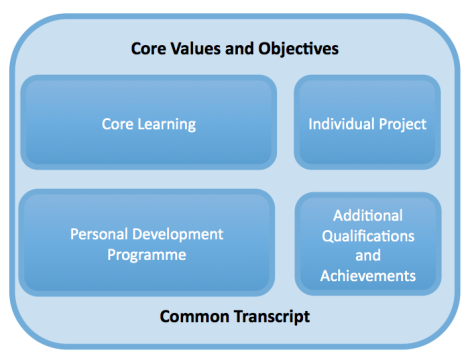
At Newham Sixth Form College (NewVIc), we are using the Sixth Form Bacc developed by sixth form colleges a few years ago as a useful way to value depth and breadth of learning as well as students’ personal development. It’s been very motivating but it is only offered in 12 of England’s 93 sixth form colleges. The two frameworks clearly overlap and I will be suggesting that we should become early adopters of the Nat Bacc and we could soon find ourselves offering something which has much greater recognition and currency.

SFBaclogo_0

At the convention, we also heard from professors Ann Hodgson and Ken Spours who gave us a historical perspective and some conceptual scaffolding to understand where we’re coming from and what we’re doing. It’s important to understand where similar initiatives have failed so that we can go with the grain of our system while also embracing reform.

In their discussion paper Developing a national baccalaureate system in England: a policy learning approach Ann and Ken argue for 4 levels of understanding: international, national, systemic and professional and a clear typology of the various approaches.

Looking at international models of upper secondary education, the paper outlines the tensions between internal and external logics; diversity of student needs versus the demands of globalisation, a common curriculum versus greater specialization leading to choices between unified or divided systems and early versus deferred specialization. The World Bank for example suggests 3 scenarios:

  • early tracking + early specialization, selection and streaming
  • deferred specialization until the end of the lower secondary phase
  • deferred specialization until the end of the upper secondary phase

They go on to examine the history of baccalaureate frameworks in the British context. These fit broadly into 3 types:

  1. Track-based reforms which have either sought to broaden general education or to diversify vocational education.
  2. Linkage strategies which preserve tracks while building bridges between them.
  3. Unified approaches of which the Welsh Bacc is the only current example in the UK. The English National Bacc project falls into this category. These can include overarching frameworks, open modular / unitised systems and grouped baccalaureate awards.

Their conclusion is that we need ‘policy learning’ for an English context; an English translation of the Bacc concept which can build on our existing qualifications system while both modernizing and enriching both our academic and vocational traditions. Hodgson and Spours are making the case for a unified framework as an ‘organizer’ of the different curriculum traditions we need to build on.

Such a development could broaden general education, enrich vocational education and reinforce the linkages between them by promoting a common core of learning beyond the taught curriculum.

Such a framework needs to be based on underpinning values and purposes and they suggest:

“A commitment to universal learner participation, attainment and progression, to the qualities of enquiry, creativity and perseverance and to nurturing partnership to support the economy and society, particularly at the local level.”

This is a good place to start and it feels good that we have started.

More on the National Baccalaureate:

Bacc on the agenda (March 2015)

Building the Bacc from below (December 2014)

Posted in Education | Tagged , , , , , , , , | 2 Comments

For a pragmatic idealism

We all have a range of perspectives on education arising from our various roles: professional, personal and political. In those roles, whether as teachers, learners, parents, governors or trade unionists we need to find ways of dealing with the world as it is and ways of keeping alive the idea of the world as we would wish it to be.

Whatever our perspectives, as progressives we share the same values; a commitment to equality, democracy, solidarity and education for personal flourishing and social progress.

Acknowledging the world as it is means recognising that in the general election on May 7th there was no ‘progressive majority’ either in votes or in seats. As individuals we are pretty powerless to make much of a difference to the world as it is. But when we act collectively in organisations, partnerships and campaigns there is some hope that we can make a difference.

If we really want to build a new progressive consensus on education, we will need to create the conditions for a new common sense. This is not something one does through an election campaign, the political and cultural advance work needs to be done well before. Only when a set of values and ideas is widely accepted as sensible and possible will politicians follow with their support. We need to do our advance work now.

I was asked to speak about the phase of education I know best, so what is happening in post-16 education?

Every phase of education is important and distinctive and none should make any claim to primacy. 16-19 education is characterised by the transition to adulthood. It is a time when young people raise their sights above their immediate concerns and relationships and start to think about how they can make a difference in the world, as workers, citizens and agents of change. It is a time of developing intellectual, social and emotional awareness.

Clearly it is a crucial phase and as a society we need to agree what our aims are for young people at this stage. To put the question as Richard Pring did in the Nuffield 14-19 review: ‘what do we mean by an educated 19 year old?’ What combinations of breadth and specialisation, knowledge, experiences and skills development will achieve this?

But instead of trying to answer these crucial questions, we have a system based on testing, labelling, sorting and segregating.

Some of the challenges we face at the moment:

  • Funding: education for 16-19 year olds is the lowest funded of all sectors of education with roughly £4,000 of public funding annually per full time student compared to roughly £5,000 in schools and £9,000 in universities. Despite the raising of the participation age to 18, funding for this age group is in the unprotected part of the Department for Education’s budget and is therefore the most vulnerable to further cuts. Our best guess is that these cuts could amount to a further 20% in cash terms over the next 3 years. This inevitably means that an increasing number of school sixth forms and colleges will become fragile and vulnerable.
  • Further marketization which leads to intense competition, selection and segregation – this works against the development of a fair and equitable system by pitting provider against provider, narrowing options and reducing efficiency. Our phase is a hyper-competitive ‘wild west’ – an object lesson for anyone who wants to see where further marketization leads.
  • Continuing tension between the educational and the economic with a likely shift from investment in education towards investment in training and apprenticeships.
  • A general lack of national purpose or confidence in the system and those of us who work in it as demonstrated by reduced funding and our inspection and audit regimes. Our high levels of autonomy don’t seem to translate into high levels of trust.

So how do we begin to respond? What political strategy is appropriate?

In my view we need to:

  • Take every opportunity to show our commitment to students and to high standards and expectations.
  • Defend education to 18 against narrow job training while also developing an economic policy which can deliver work and high quality training for more young people.
  • Work with what we have and find new, even unlikely, partners, build new coalitions and create new structures. Roberto Unger talks in terms of democratic experimentalism. We need to question many of our assumptions and ask a lot more ‘what if…?’ questions about the way we do things and be prepared to do them differently.
  • Support the development of the National Baccalaureate which is being built from the bottom by practitioners. This should include all students and offer the broadest possible combination of general and practical learning for 14-19 year olds.
  • Demonstrate how we could reinvent a system. Rather than being anti-academy we need to be pro-system. We need to encourage the creation of comprehensive local systems involving all providers working in new kinds of partnership; national, regional and local.
  • Encourage the creation of new democratic structures such as education forums at both local and regional levels, involving all our stakeholders.

These demands for educational content, for a genuinely comprehensive post-16 curriculum as well as for training opportunities, for a living wage for apprenticeships, for partnership between our institutions, for a democratic voice in education decision-making could also become the ingredients of collective bargaining by post-16 education workers.

Beyond that, what kind of wider organisation do we need? Is it time for the various groups with similar agendas to federate? To build a single network for public education; an alliance built around shared values with different parts playing different roles: Reclaim Education has made a start in bringing different campaigns together. Perhaps it needs to become something like the Network for Public Education in the US; a loose federation of organisations which have different priorities and knowledge but share some key basic principles and aims. Each brings something different; research, advocacy, campaigning, representation, political links and the network itself is able to achieve more than the sum of its parts.

We need to create the conditions and the opportunities to start building a new common sense; a national education system which can actually meet our needs as individuals and as a society. We need to identify the building blocks of that project even if our margin of action is somewhat limited at the moment. This is both a practical and a visionary approach – something we might call pragmatic idealism.

If we do this work, it can only be a positive contribution to building the new progressive majority this country needs.

Speech to the conference of the Socialist Educational Association (SEA), 27th June 2015.

See also:

Snatching hope from the jaws of despair (on professional strategy).

Posted in Education policy | Tagged , , , , , , , | 2 Comments

The skilled learner DOES

FullSizeRender (6)Our mission at Newham Sixth Form College is ‘to create a successful learning community’. Each of the three ideas; success, learning and community are important to us and we make sure we define what each one means for all our new students at the start of every academic year.

We know that our students come to us with some prior experience of educational success and that they have already demonstrated some effective learning. We believe that one of our educational tasks is to prepare them to be even more effective learners and this will serve them throughout life. One of our aims is that every student should leave us as a more skilled learner than when they joined us.

So we have a Skilled Learner framework: DOES. The idea is to remind everyone of some key attributes which we think everyone should be developing whatever they are studying. These are common to effective learners and can be developed further by everyone. Whatever your starting point, whatever your course, you should be working on all of these in a way which is natural and embedded in your acquisition of subject specific knowledge, skills and understanding.

We’ve chosen a simple and memorable framework which allows for a high level of awareness and regular use across the college. The DOES framework describes the skilled learner under 4 headings: Determined, Organised, Enquiring and Social.

Determined:

“I am ambitious and keen to learn and I take responsibility for my learning.”

The starting point is intrinsic motivation or aspiration: “I want to do well… I love Maths… I want to know more about History… I want to progress to university…” This is combined with a recognition that learning is hard work and effort will be needed. This builds on previous experience that effort brings rewards but the commitment and stamina will be stretched further than ever before. Advocates of ‘grit’ and ‘resilience’ will recognise the value of this. Above all, we want students to ‘own’ both their ambition and their learning so that neither crumbles after they leave us.

Organised:

“I am well organised and make good use of my study time, knowledge and skills.”

All the resources we need to learn are finite, so we need to find ways to make the most of them. We are not born organised but by 16 we have learnt that planning can help things to happen the way you want them to. Turning up to classes on time, well equipped and well prepared, being up to date and managing time well are all a good start. Being organised and structured in our thinking, even if our minds wander off all over the place, can also help us make the most of our ideas and the connections we are making between them.

Enquiring:

“I am questioning and creative and I respond positively to new challenges.”

We are questioning animals; the greatest living learners on the planet. From day 1 we are testing our world and asking question upon question. We need to hold on to the curiosity that leads young children to ask those irritating “but why? but how?” questions. Doubting, critiquing, digging further and deeper into things…these are all vital to learning. This means being prepared to take a different perspective, see things from a different angle, to challenge and be challenged.  Don’t be satisfied with knowing only the minimum required. To be confident about the subject content you need in order to do well you really need to have gone well beyond it.

Social:

“I work well with others, respecting them and learning from them.”

Learning is highly social. We are always standing on the shoulders of others and building on their experience and understanding. Even when we are studying alone at the computer or with a book, this is an interaction with others. Anything we do with our learning will be aiming ultimately to have some impact on others. We need to test our ideas out on others and get feedback from them. We need to learn from and with others; students and teachers. This means being good at listening and learning from what others say as well as being good at communicating our own ideas to others. Your learning may be personal to you but bouncing ideas around with others in a group can enhance it.

What DOES isn’t and how it can help

This framework is not an attempt to describe how learning takes place, of the ‘action / reflection / action’ type, or to prescribe a particular pedagogical approach or set the balance between content and skills, such as ‘grammar / rhetoric / dialectic’. The descriptors have no levels or progressive steps, simply a recognition that all of us can develop further in each of the 4 dimensions. It doesn’t refer to the development of literacy or numeracy which we regard as central to our work; this is described elsewhere.

We know that many other factors come into play to help learning happen. This is simply one handy way to help us remind all our learners about some of the ingredients of that somewhat mysterious process called learning and to make sure we can consciously work with them on those areas throughout their time at college. The DOES posters can be found in every classroom and the framework has become part of our language in talking about learning – one shared tool among many.

We make no claim of originality or impact for the DOES framework but please feel free to use the whole thing or borrow selectively from it if you feel it can be of some use in helping students become skilled learners.

Posted in Education, Students, Teaching and learning | Tagged , , , , , | Leave a comment

Market madness: condition critical

IMG_3878Market madness: condition critical

From Forum vol.57, no.2, 2015

The condition of English education is critical. It has been weakened by pathological marketization and is in desperate need of treatment to restore it to health. In this article, I try to diagnose the disease, describe some of its symptoms and effects on various parts of the system and finally I offer two possible prognoses for the patient; a turn for the worse and the start of a recovery.

1. Key processes of marketisation

Commodification

If education is seen as a commodity; something which can be consumed and traded, then schools, colleges, universities and the courses they offer all enter the market. What were previously thought of as life-long social interactions and developmental processes become tradeable things with tangible exchange value. Thinking this way inevitably changes the relationship between students, teachers and institutions. Students become consumers, demanding that education ‘delivers’ outcomes for them and they also themselves become commodities, to be selected by providers based on their likelihood of success. Teachers become the agents of ‘delivery’ and the institutions they work in ‘perform’ better or worse on a numerical scale.

Valuing and ranking

To be tradeable, every aspect of learning needs to quantified and given a value. Grades, points, qualifications, measures of progress and added-value all reduce the complex processes of education to numbers. This promotes a hierarchy of worth with ‘outstanding’ schools, ‘top’ universities and ‘facilitating’ subjects at the peaks of finely graduated hierarchies. In such rankings, human beings themselves become ‘grade 1 teachers’ or ‘top decile’ students at one end or ‘marginal performers’ and ‘failures’ at the other. This inevitably changes people’s perceptions of their own worth and that of others.

Choice

In order to survive in a market where everything has a value, we are driven to seek out the best which is available. As consumers we sense that there is always something better to aspire to. The market needs its ‘second-rate’ or ‘sink’ options in order to scare us into scrambling to escape them and get ahead of those who have no choice. We worship choice and we assume that making the right choice will help us get on. We seek to benefit from the inequality, or ‘diversity’, of what is on offer by grasping something distinctive and valuable which not everyone can have. However, the market actually limits our options and only allows us to strive for certain things. It leaves inequalities unchallenged and in fact tends to widen them.

Competition

Whether it’s the global economic ‘race to the top’ which can never be won, the international PISA scores which governments use to bash their own education systems or national league tables of various kinds, we all seem to be running up an accelerating down escalator and never quite reaching our destination. At the individual level this promotes a general sense of dissatisfaction and increasing pressure on us to make better choices and achieve higher grades. If the only outcomes that are worth something are a clutch of high grade GCSEs at 16, at least AAB grades in 2 or 3 facilitating A-levels at 18 and a place in a Russell Group university then most students will inevitably be ‘losers’.

2. How do these processes play out in our current context?

Choice and diversity

“Choice and diversity” was the last government’s euphemism for marketisation in public services, putting a positive spin on something which was not particularly popular with public service users. In education, it meant promoting new providers and encouraging competition between them. This was sometimes also described as “contestability”.

Looking back to those pre-2010 days, this version of marketisation seems pretty tame, but it paved the way for the current government’s market strategy for education.

The idea is that good schools will attract more students and less good schools will be motivated to improve by the competition for students from the good schools. The less popular schools might get some support to improve or be rebranded and relaunched with new leadership. The possibility of decline, failure or closure sharpens everyone’s focus on doing better.

And we all like choice don’t we? When we’re shopping we like to be able to choose between different products, check prices and value for money and make our own judgement about what’s best for us. Choice is a good thing, yes? Well, up to a point.

Do we really want to shop around and choose between different educational offers for ourselves or our children?  Can education be both a public service and a commodity? Isn’t it too important to be placed in the hands of competing providers based on what they are prepared to offer within the local market? We’re paying for it anyway so surely we want the best possible public education for ourselves as well as for others as a civic right.

As with our other public services, we want education to respond to our needs and aspirations and ultimately to be accountable to us; all of us. Any choice and diversity in what is available; specialist programmes or facilities, experimental or innovative approaches, should be available to all within a system of public education and not be the result of luck eg: “I can develop my musical skills because I happen to attend an excellent specialist music school”.

When the market is combined with the lack of any coherent institutional framework, the absence of local whole-system leadership or planning, the result is actually a loss of choice and a lack of diversity. In post-16 education for example, providers or systems need to be of a certain size to offer the full range of courses to students including minority subjects like A-level German or Classical Civilisation. Encouraging new smaller competing providers can give the impression of more choice – of provider, but lead to less choice – of course. Where there are many competing sixth forms there may be enough demand overall but no single provider can run a viable A level German or Classical Civilisation group, thereby restricting choice for everyone.

So we should be very cautious about the panacea of more choice and diversity in education as we could find ourselves losing more than we gain.

The providers

Schools or colleges will often claim to be “heavily oversubscribed” to establish how popular, and by implication how successful they are. These claims should be taken with a heavy dose of salt.

Being able to measure demand is very important in a market system. Many providers want to show that what they offer has some scarcity value; that more people want it than can actually get it. Saying “we are oversubscribed” is a neat shorthand way of letting consumers know the scarcity value of the commodity you’re offering.

But choosing a school or college is generally a single-outcome decision; each consumer will only choose one at a time. Both the school application system and the post-16 free-for-all allow for multiple applications. Consumers make several applications but will ultimately choose only one. So a high number of applications is a very inadequate measure of demand. Only the final number of students actually enrolling is a true indication of choices made. Schools and colleges have target numbers and each either does or doesn’t achieve this.

A comprehensive college can easily have more applicants than places and therefore be described as “oversubscribed”. This is not because they are selective but because they understand that many applicants make multiple applications. In a competitive environment with new post-16 providers opening up every year, this will intensify, so what matters is the proportion of applicants who actually enrol; the conversion rate.

Selective post-16 providers have no problem turning people away as they think it contributes to an impression of success. Comprehensive post-16 providers operating in a market have to understand the dynamic of that market if they want to plan to be full without wishing to turn students away. That’s quite a challenge!

The consumers

An ideal market requires well informed consumers who are in a position to make choices between products based on accurate information about the things that matter to them; for example quality and price.

If public services like education are really to operate in a market, consumers, whether parents or students, need to be well informed about the alternatives available before they exercise their choice. It is after all a very important choice with longer term consequences that most consumer purchases.

This means having access to good information, advice and guidance from disinterested and well informed experts. It means trusting and understanding the data in league tables, their value and limitations. It also means being able to evaluate a wide range of other ‘objective’ published data and statistical claims.

In reality, the market in education as in other areas is far from perfect and it tends to reinforce the prior advantages of some consumers. Providers with good reputations will tend to attract the kinds of students who are most likely to further enhance their attractiveness in an upward spiral of positive feedback. Other providers can easily fall into a downward spiral.

In post-16 education, it is widely known that many secondary schools with sixth forms work hard to ensure that their most promising students ‘stay on’ at 16 and as a result such schools fall short of the ideal of providing independent advice and guidance about the full range of options open to their students. They often cannot resist describing these options in their own words rather than allowing alternative providers to do so themselves. These tendencies are a natural product of the market system and all its various incentives and pressures.

On top of this, markets lead to marketing. Glossy brochures, prospectuses, press releases and advertising campaigns boosted via social media are now key elements of many providers’ strategy. They aim to boost recruitment and manage reputation and are seen as essential for survival. Besides, if everyone else around us is doing it how can we avoid doing it?

Those of us who work in education enjoy celebrating educational achievement, so we like to see the benefits of learning promoted in the public sphere and we can applaud the best and most imaginative campaigns of colleges and universities. While being delighted by the giant images of our successful former students smiling at us from so many buses in our area, we do wonder, at a time of spending cuts, whether our marketing expenditure could have been better applied to a more educational purpose.

I am always impressed by the way that the French election authorities give equal national billboard space to each presidential candidate however small their party or poorly funded their campaign; the argument is that the state should underwrite some parity of exposure if citizens are to have a real choice in the democratic ‘marketplace’. If we want to promote education, perhaps a similar level playing field might be possible for educational marketing here?

At the moment it seems that in the Hobbesian “war of all against all” where every educational provider is clamouring for attention and favour in the marketplace there is no way of stopping us all from spending public money on campaigns which portray us in the best light and which tell our best story.  Let’s just hope that we all have enough integrity to ensure that the stories we tell are reasonably accurate and that our consumers aren’t too disappointed when they have a chance to test the reality against the rhetoric.

The commodities

All economies need a currency which we can use to represent the value we give to things and which can be exchanged for real things. A currency allows us to convert labour into goods or capital and back again.

In our credentialised education economy, qualifications are effectively the currency. They represent an investment of effort and commitment to acquire knowledge and skill to a certain level and they can be traded in the labour market for access to further educational and job opportunities. More currency equals a greater chance of success and understandably everyone one wants more of that.

Individuals are judged by the qualifications they have obtained and there is a strong correlation between the highest level of qualification achieved and lifetime earnings.

Education providers are also judged by the volume and type of qualifications their students obtain. For example, A-level grades can be converted to points making it easy to quantify the value of qualifications from A* to E. There is also considerable differentiation, with facilitating A-levels at the high-value end of the market and vocational qualifications in the bargain basement. In fact, despite having a UCAS tariff, these qualifications are not even valued in the same currency in some markets, such as the performance tables where vocational point scores are presented separately from A level point scores.

So, as well as students themselves being judged by qualification measures, schools and colleges can be ranked by the volume and value of the qualifications they provide to their students. And as riches beget riches, the tendency is for those that have the most to attract more. This is true at the student level where those most likely to do well at one level are those who have already demonstrated the ability to do well at the level below. It is also true at the institutional level where attracting already successful students is the best guarantee of greater success.

As with the profit motive in the financial economy there is a real danger that the rush to accumulate currency takes precedence over the real productive and sustainable value of economic activity. Labour simply becomes a means of earning money and capital a means of accumulating more wealth with little thought given to human values and social purpose. Equally, with qualifications, we risk seeing the qualification as the goal rather than valuing the learning which it symbolises.

Also, the value of a qualification, like that of any currency, is affected by its supply or scarcity. The more common it is, the less value it has, leading to a recalibration of the currency’s value – devaluing it and sending people scurrying to look for a better, scarcer and therefore more valuable qualification.

Where being qualified and therefore ‘educated’ is a positional good we live with the paradox that the more skilled and qualified we all become, the lower the value of our qualifications – in effect we have to run faster to stand still.

One solution is to ration the supply of high grades to a fixed amount or to recalibrate upwards by constantly making qualifications ‘harder’. This preserves the inequalities inherent in the system and does nothing to recognise the real educational progress being made. Such economic solutions devalue our educational objectives.

Is it possible to imagine a different system? One where learning and demonstrating skill are valued without requiring constant measurement and comparison? Could we find ways to lift those learners who have least access to the all-important currency and help them achieve an agreed national threshold? Could we learn to celebrate learning and achievement without the need to endlessly rank and classify learners? Could we decouple education from the market?

Learners as commodities

The rhetoric of market choice paints the student as a well-informed discerning consumer, choosing between different providers. However, in our hyper-competitive market the student is often the commodity with the providers acting as consumers vying to pick the ‘best’ students. In the 16-19 market for instance, the ‘premium’ student has already demonstrated high achievement; the clearest sign that they will help the institution do well. The ‘remaindered’ student is worth much less; they’ve had a false start, failed to show enough promise and will probably generate a lot of work for little return. Nearly as risky is the ‘discount’ student who turns 18 during their course or may even already be spoiled goods, attracting 17.5% less funding for following the same programme as their 16 and 17 year old classmates, a penalty I have described as the ‘aspiration tax’.

Under these circumstances it’s hardly surprising that the raising of the participation age hasn’t delivered on its promise of appropriate provision for all 16-18 year olds. In effect, the market means that the most sought-after students are often over-provided for while the others take their chances.

This is a crazy way to do things. Post-16 providers are encouraged to think as competitive agents who fight to attract students while also being prepared to spit some of them out on the way with little regard for what happens to them next. What we need is an inclusive tertiary education system which takes responsibility for providing for every young person aged 16-18 in a locality. This requires some local planning with an expectation that institutions collaborate and see themselves as parts of a single system acting in the interests of all young people.

The system

Whenever I am asked to explain English secondary education to foreign visitors I usually start by saying that there is no English ‘system’. I then try to describe the rather random pattern of overlapping provision which cannot be dignified by the term ‘system’. Different areas have different permutations of 11-16 schools, 11-18 schools, sixth form and FE colleges with overlapping catchments, degrees of selection and market behaviours and a frightening lack of coherence or planning. The whole is so clearly less than the sum of the parts that I’m not surprised when my visitors look at me with pity.

In his excellent post ‘Teacher quality and education structures’1, David Pavett tells the  story of visitors to the room-sized early computers who were given wire cutters and encouraged to snip wires at random to show that the system could cope with such broken connections thanks to its built-in redundancy. David uses this example to show how system redundancy can compensate for parts failure and to argue that it is quite wrong to assume that the performance of a system cannot be greater than that of its component parts or that a school or education system cannot be better than its teachers.

In fact the very opposite is the case. A strong system with plenty of opportunities for partnership, sharing and support can be greater than the sum of its parts because it has lots of redundant ‘wiring’ which shores up performance when necessary. So inter-institutional ‘wiring’ can help to improve schools.

David goes on to contrast a market system with a more ‘connection-rich system’. The former has hardly any inter-institutional ‘wiring’ as each school has to behave as a competitor and avoid sharing anything. In the latter, schools see each other as partners and can support each other by sharing a lot.

For example, if a group of schools in an area routinely share their expertise, this can come into its own when one school suddenly faces a dip in performance, staff shortages or long term absence. Staff can be part-seconded to help out and colleagues will already know how to offer, or ask for, help.  If departments in several schools share resources and teaching methods and build up a store of good practice and strong support networks, this will be a great help with changes to curriculum or assessment methods or shifts in student numbers. Also, relating jointly to external partners such as universities, employers or cultural organisations can lead to a stronger, richer and more cost-effective input from those organisations.

A strong system also promotes system leadership as opposed to purely institutional leadership. Groups of schools can think of their students as part of a wider community of learners and the development of strong distinctive or specialist offers driven by demand can be made available to all rather than being exclusive to one school as part of a search for competitive advantage.

However, all of this requires a culture of openness and trust between schools and an investment in the ‘wiring’ and the process of partnership. Schools need to accept some loss of autonomy while the benefits for everyone clearly outweigh the disadvantages. But clearly in the short term collaboration requires more effort than isolationism.

So, a good education system needs more ‘wiring’ but this does not mean more costly bureaucracy or layers of coordination. New technologies can facilitate communication and resource sharing between the practitioners who know best what they need without needing much top-down control.

The market won’t help the system function better. It rips out much of the ‘wiring’ and forces different sections to function without any support from others. This makes them more likely to break down, sometimes beyond repair.

For the time-being we are stuck with the logic of competition and incoherent markets in education. Should we simply settle for being prisoners of this logic or could we start to subvert it by putting in our own wiring piece by piece? Slow and painstaking though it may be, it might be the only way to start creating the real education system we need bit by bit from the parts to a better whole.

3. Are markets really so bad?

Is the effect of the market really so bad? Surely, striving, dissatisfaction and a hunger for more are great motivators of learning. Are these not classic consumer behaviours?

Dissatisfaction and striving are certainly pre-requisites for learning but they need to be combined with curiosity, a desire to understand and a sense of human fellowship if they are to foster a genuine hunger for learning. To be real learners, we need to be inquisitive rather than acquisitive.

Each aspect of marketisation changes the way we see ourselves and the way we relate to others. The danger of assimilating a market view of education is that in our rush to accumulate its goods and get ahead we lose sight of the fact that learning is a social and developmental process involving human relationships and requiring human solidarity. Certainly, we learn in order to advance ourselves but we are learning from others in the hope of achieving something with others. We will never see other people as our equals or our partners in progress if we believe that their educational advancement is at the expense of ours. Our educational relationships with others should not be economic transactions but human ones; threads in a social fabric which is our only hope of a better world.

4. Education 2020

In this section, I imagine 2 very different possible futures for education in England following the 2015 election and five years of change:

Future A. Life in the education market:

Following the 2015 election, the political majority at Westminster remained committed to our current direction of travel. Continuing public austerity meant less public spending on education while the rhetoric was even more strident about ‘UK plc’ needing to become ever more globally competitive and ‘win the race to the top’ both economically and educationally in the PISA tables. Politicians’ response to Britain’s continued economic decline was to become even more uncompromising about demanding personal responsibility for high standards and ‘no excuses’ from individual students, teachers, schools and colleges if they achieve anything less than average in various national measures.

We now talk routinely of the ‘education market’ just like the ‘energy market’. As with other utilities, the landscape is dominated by a small number of competing national chains, now known as companies, with national contracts. These are the ‘big six’, each of which operates across all regions and in primary, secondary and post-16. Each company has a strong brand identity and has the capacity to innovate at company level, it supports its own teacher training and development and its own research capacity. Many of them also produce teaching and assessment materials commercially and offer a range of paid-for services to students and parents. They have massive budgets and are not subject to any local scrutiny or accountability and most are quoted on the stock exchange. They maintain close relationships with the national commissioners and politicians who sign off their contracts, regulate their activities and decide the performance measures they will be judged by. They are generally regarded as ‘too big to fail’.

The various national companies offer a range of unique selling points and distinctive strengths to their customers. Some of the chains are a little more focused on inclusion and some on elitism, some emphasise sports or the arts a bit more while others have a slightly more technological bias. These ‘flavours’ are often linked to particular commercial partnerships.

In order to stimulate competition, the government has allowed the trend towards greater selection and stratification of schools to permit companies to offer ‘different types of school for different types of learner’. So although each company aims to cater for all types of learner, their size allows them to engage in ‘cherry picking’ and segregation of students with particular aptitudes and talents at a younger and younger age. Specialist technical schools are common as are highly selective ‘super-grammars’. One company’s initiative to create a hyper-selective national residential sixth form college aiming to get all every one of its students into Oxbridge soon led to the other companies following suit and selection for some of these colleges now starts at age 14.

All the companies market themselves vigorously and their slick TV commercials tell inspiring personal stories of student growth, fulfilment and success within the company system. At the local level, schools are described in terms of their parent company rather than their school name and the company is the brand that really counts. Students generally study within a single company throughout their schooling, benefiting from continuity of staffing and ethos and this is seen as a strength. People even claim to be able to identify which company a student was schooled in based on their behaviour and attitudes.

The school curriculum is increasingly driven by the perceived needs of the economy, concentrating on the ‘core’ subjects or vocational tracks which, it is claimed, will help students find their place in the workforce and beat the global competition.

As public funding has continued to fall, companies are charging for more and more of the ‘extras’, including company-franchised mentoring and tutoring, sports, music, arts and outward bound activities.

University fees have been uncapped and there is real competition on price and companies have negotiated bulk deals with university groups offering preferential loans and bursaries to high achieving students. Adult education is purely about investing in one’s marketable skills and people have to borrow to pay a private provider for it, or persuade an employer to pay.

The national companies’ dominance of the market has led to some spectacular scandals and market failures, the solution to which is always seen as better regulation or changes in company management. Public campaigning is mainly focused on local difficulties rather than offering any coherent critique of the system, and when it is proposed, system reform is seen as unrealistic. Education debates or industrial disputes tend to be about the ineffectiveness or monopolistic excesses of a national company and the barriers to new entrants.

Many parents and students are satisfied customers of the company they have chosen, they buy into its ethos and feel loyalty to it. This education market is diverse and seems to offer something for everyone, although the ‘top’ companies seem to find ways to move low-performing students out of their provision. Nationally, the achievement gap is widening but somehow this is glossed over as the spectacular results of the highest performing students are highlighted.

Popular TV shows about education include a revival of ‘Top of the Form’ called ‘Top Class’ where students from different companies compete against each other in a general knowledge quiz and ‘Get Me Out of Here’ a secretly filmed and selectively edited exposé of life in some of the ‘toughest’ schools which prides itself on ending the career of at least one teacher per episode.

As the 2020 election campaign gets going, one of the major parties is advocating a single guaranteed ‘national lifelong learning fund’ which the state will pay into and make available directly to the national companies to fund their students’ education from 14 onwards and to be repaid by individuals to their company once they start earning. The politics of education is essentially consumer politics and we hear very little advocacy of a democratically accountable public education, let alone the neighbourhood comprehensive school.

Future B. Creating a National Education Service:

Following the 2015 election, the new political majority at Westminster didn’t have a particularly coherent vision of what they wanted to do about education but they did agree that the solutions would probably not come from either politicians or the unfettered market. During the campaign, they had been struck by the level of popular dissatisfaction with the incoherence and chaos people were experiencing and impressed by the desire for change. Continuing with the reforms of the previous 5 years was clearly not an option.

In the absence of a strong ideological agenda, the politicians asked themselves whether the answers might perhaps be found in the imagination and daily practice of the people actually concerned with education. So within a few weeks of the election they launched a national Great Debate about the purpose and organisation of education in England. This willingness to listen to people turned out to be their most radical decision.

The Great Debate aimed to involve everyone in considering a few simple questions:

  • What do we want from education?
  • What is an educated person?
  • How do we ensure that everyone gets the best possible education?

The initial Great Debate was given a month in order to focus everyone’s minds and instil a sense of urgency. It was conducted on-line, using social media, in public meetings large and small, inside and outside school classrooms and in outreach activity to ensure that everyone, including children and young people, had the opportunity to express their views. Public involvement in the process was very high, different opinions were respected and the views of ‘experts’ and education professionals were given equal weight to those of everyone else.

As the Great Debate got going, people got excited. They were being listened to and they were setting the agenda. Having voted to hand power to politicians, they were now being asked how that power should be used. The discussions generated many brilliant ideas and the deliberation and aggregation process throughout the month meant that the most popular themes started to emerge and people could return to the debate at different stages.

It became clear quite early on that there was a real consensus that England needs a common national education system with both social and personal objectives to meet the needs of all its people.

One of the most popular emerging themes was “education needs to be like the NHS” and that was actually one of the key outcomes: a groundswell of support for a comprehensive national education system based on agreed common aims, cooperation and universalism rather than competition and selection.

Even before any policies were implemented, the sheer breadth and depth of the national debate gave people the confidence that change is possible and promoted a degree of optimism about the future. Another outcome was a real celebration of the work of teachers and pride in the work of students. Many participants said that learning directly about what happens in our schools and universities had surprised and impressed them and inspired them to get more involved themselves.

Following this Great Debate, the legal status of all publicly funded schools was quickly harmonised so that they all operated on the same basis. The school curriculum was redefined in terms of human flourishing as well as the fundamental knowledge and skills that everyone needs to build on to be a successful contributor to society. There was support for both breadth and specialisation at upper secondary level with no options being closed off at any age.

Once the national aims were agreed, the new system needed to be built from the existing one with collaboration around nationally agreed shared aims, core entitlements and funding as givens. The English regions were given the right to elect education councils to oversee the development of the system in their region using all the educational resources available. These elections gave the new councils a strong mandate to develop a distinctive approach for their area within the national aims. The limited funding available was boosted by a ‘partnership premium’, money previously tied up in competition and duplication. There was room for specialisation as well as regional and local innovation and some regions are now leading on different themes and sharing this work nationally and they have created new forums for action research, evaluation, curriculum and professional development.

The talents and skills of the nation’s young people were increasingly recognised and celebrated including their contribution to community and cultural life and the impact of their research. These are all valued within the school leavers’ National Baccalaureate.

We are starting to see a renaissance of adult education in various forms as universities work with other parts of the education service to reach out more and respond to the needs and interests of all adults in their region. Reading groups, current affairs groups, cultural activity, community organising and volunteering all feed in to university extramural programmes with a consequential strengthening of both geographical and virtual solidarity.

In fact, the Great Debate which started in the summer of 2015 has never really stopped. People found that they wanted to contribute to education and to help shape the new system. The momentum of 2015 was built on through local education forums across the country which informed the work of the new education councils and helped hold them to account between elections. People’s attachment to their education service and the idea of public service generally was strengthened by this activity.

Popular TV shows include ‘Amazing Youth’ presented by young people featuring a range of research and community projects they have conceived and led and ‘Speak Up’ where young people from all over the country get to express their views and make their case for social change which can then be voted on by the audience.

By 2020 educational inequality has not been abolished but there is some evidence that the gaps are narrowing. Not everyone is satisfied with the rate of progress and funding remains tight. However, people are proud of the ‘new’ system, positive about its contribution to society and optimistic about its future. There does seem to be a consensus around the aims and values established through the Great Debate. By the time of the 2020 election, all the major parties are committed to the new system and the policy differences are mostly about resource allocation and curriculum priorities. One of the parties is advocating another Great Debate, this time about how banking and finance could help us meet human needs.

There is choice and diversity within this comprehensive system but we hear very little advocacy of greater competition or market incentives. There is friendly rivalry between different parts of the service as they strive to offer the best to their communities but this is combined with a commitment to sharing what they do best to help the whole service improve.

Conclusion: Making our path

These are just two of many possible alternative futures for education. If we want a future shaped by us rather than by the market, then voting in the general election is only the start. We need to use democratic means to decide where we want to go as well as to help get us there. In one of his poems, the Spanish poet Antonio Machado says:

“there is no path, the path is made by walking.”

Maybe it’s time to start walking…

Note

  1. Article by David Pavett for Education for Everyone: https://educevery.wordpress.com/2014/06/12/teacher-quality-and-education-structures/
Posted in Education policy | Tagged , , , , , , , , , , , | 2 Comments

Young poets ‘write the wrong’

Brave new words from young writers at Newham Sixth Form College (NewVIc)

Poetry is not a luxury, something we only turn to when more important things have been seen to. Poetry is essential. We need to listen to it, read it, write it, seek it out and welcome it daily into our lives. It helps us think about our world and experience it more fully. It opens us up and connects us to others.

Write the Wrong is the third anthology arising from the collaboration between NewVIc and English PEN. We are delighted with the results and proud of our new voices: Amy, Sumaya, Jamila, Ayah, Francesca, Erica, Princess, Jermaine, Chloe, Sajjad and Nur.

Thank you also to Femi, Rebekah, Mazin, Brett and Louise from English PEN, to Kate and Steven from NewVIc and to everyone involved in working on this wonderful collection.

The young poets in this collection have embraced the poetic form and thrown themselves into it at full speed and the resulting poems are fresh and explosive and I enjoyed them all.

This collection is full of dreams and questions about love, happiness, conflict, injustice and the meaning of life. The following extracts give a flavour of some of the poems:

Here I stand opposite Parliament,

A light for a head, a shadow for a friend.

That building is a marvel, a castle,

Surrounded by a world in downfall.

(From Lean on me by Amy Locke-Dench)

Do I actually live? Or am I just a living shadow?

(From Who I am by Sumaya Omar)

“I have a dream”

A dream is a dream

Filled with infinite power,

Not something that should make people cower.

(From Yet another dream by Jamila Muttlabe)

I now know the true meaning of “life is too short”. People who are present in all things and grateful for all things are content with all things.

(From Alone with these plain blank walls by Ayah Benberna)

It eats you.

From inside out

Leaving nothing

But loneliness.

(From Heartbreak by Princess Gere)

Are we alone?

How can we leave a trace of ourselves in the world?

Will I be remembered after my end?

Is there anything after this life?

(From Wondering from the start to the end by Francesca Amato)

What is so wonderful about this project is to see students developing and refining their voices, working hard to express exactly what they want to say. In the words of Femi Martin: “these young writers fought through doubts, fears and time constraints to put down on paper how they see the world. For many of them English is not their mother tongue but they bent and shaped it to fit their intention”.

For me, this poetry work is as functional as any functional literacy we do and I hope we can continue to offer projects like this to our students.

Photo 2Photo 1

Posted in NewVIc, Poetry | Tagged , , | 2 Comments

‘Saying thank you’ – a poem for father’s day.

Saying thank you

In the beginning very little gratitude

Who gets to choose their parents after all?


But gradually you realise what you’ve been given

And in time you understand the debt you owe


So,

For bathing me in music; Bach, Stravinsky and Coltrane

and placing me in chamber groups with Mozart, Gounod and Damase


For giving me that tiny clarinet and showing how it sings

and picking me for your orchestral team of two


For introducing me to our well tempered Broadwood

and giving me a lifelong friend


For all the concerts, galleries and books

and helping me to look at things and judge them


For all those pesky questions and digging for the truth

and never being satisfied with unconvincing answers


For your constant interest in others

and respect for what they do


For having many passions, solitary and social

and pursuing them with truly scientific joy


For scepticism, horror films and ginger

and Berkeley, Barnes and Bayswater – and Wetherby of course


For looking to the granite island for your match

and getting that most vital thing so right


For writing your clear story and letting me write mine

For all of this and so much else


It seems like a good moment

To say thank you.

April 2012 on the occasion of John Playfair’s 81st birthday

john playfair

John Playfair obituary


Posted in Poetry | Tagged , | 2 Comments

Speaking up for 16-19 year olds

SFCA Summer Conference 2015

Our Sixth Form College Association conference is always a great opportunity to meet old friends, make new friends, share our fears and frustrations, hopes and joys, find comfort and support from colleagues across the country. We have an interesting and varied programme which we hope meets your needs.

It is also an opportunity to celebrate our great SFCA team and to thank them for their work, amongst other things this year they have:

  • Negotiated a new pay and conditions framework and helped us to maintain good industrial relations.
  • Made a strong case for the broad, high quality curriculum which 16-19 year olds need.
  • Raised our profile and lobbied powerfully against the funding cuts and inequities which make such a curriculum increasingly difficult to offer.

It is also an opportunity to remind ourselves what a broad and diverse sector we are and the things we are most proud of:

  • Our popularity and success, based on our excellent staff and their commitment to young people’s education
  • The quality, breadth and cost-effectiveness of our offer
  • Our contribution to social mobility and social cohesion
  • Our contribution to innovation and partnership in our communities

We are not the only sixth form providers in England but taken as a whole our contribution is remarkable. We have a lot to be proud of.

But as we gather here, we also need to recognise that this is an uncomfortable time for us and we are in an uncomfortable place. 16-19 year olds are the lowest funded learners in our whole education system. We are funded from a small unprotected budget within a large departmental budget which is mostly protected. We face increased competition in a context where we often feel overlooked. It sometimes seems that England’s public provision for 16-19 year olds amounts to less than the sum of its parts rather than more.

So we clearly have to engage with government and listen to what they expect of us while also being clear what we can offer them. We must not be victims of government policy, passive observers begging for some influence. We have great strengths to draw on. We need to find new ways to make the most of those strengths. I think we have only scratched the surface of what we could achieve by working together; between ourselves and with other partners.

At a time of fragmented and fragile sixth form provision, we are well placed to champion the cause of 16-19 education. If we don’t speak up for the education of all of England’s 16-19 year olds, who will?

We have the expertise and track record in our local areas and across England. We could help to build and lead a national movement to provide the best possible education for all of England’s 16-19 year olds and I think this conference offers us a good opportunity start discussing what that might look like.

Opening speech at the Sixth Form Colleges Association Summer Conference

NCTL, Nottingham 17th June 2015

Posted in Education policy | Tagged , , , , , , , , | Leave a comment

Snatching hope from the jaws of despair

What we say and do about post-16 education, like everything else, has to be seen in the context of the outcome of the recent general election. Elections are the great democratic moment when the people ‘speak’ and all our individual choices are crystallised into a single collective choice. The outcome is clear; there was no ‘progressive majority’ either in votes or in seats. So now the political dial has been re-set and the terms of debate have been made clearer for the next few years.

This post is not about wider political strategy – what we do as citizens – but ‘professional strategy’ –  what we do as educators.

So what are the objective challenges we face in post-16 education:

  • Funding cuts: 16-19 year olds are the lowest funded students in education. Funding for 18 year olds, enrichment and broader programmes have all been drastically cut over the last 5 years. Our budget is in the smaller unprotected part of the larger education budget and is therefore the most vulnerable to further cuts.
  • More marketization and the selection and segregation which flow from this. I have written elsewhere about how increasing marketization works against the development of a fair and equitable system by pitting provider against provider.
  • Continuing tension between educational and economic aims with a likely shift from investment in education towards investment in training and apprenticeships.
  • A sense of a general lack of trust in the system and those of us who work in it as demonstrated by our inspection and audit regimes.

In this context it is easy to despair. ‘Don’t mourn, organise!’ is a good mantra in such situations. Mourning has its place but our response should be neither blind despair nor blind hope. We need to understand the objective political reality and to build our hope from a sound base. We must mourn, analyse and organise, oppose and propose, critique and build.

Another much quoted mantra is Gramsci’s: ‘pessimism of the intellect and optimism of the will’. This offers a good warning against both wishful thinking and resignation. But as the writer Mike Marqusee pointed out in a 2012 piece, ‘intellect’ and ‘will’ should not be seen as being opposites. Relentless pessimism can be debilitating and excessive optimism can compromise intellectual clarity. We need rational grounds for optimism. To make hope real we need to invest in it and, in Mike Marqusee’s words, engage in ‘a determined search for the levers of change in the here and now coupled with the imagining of a just and sustainable human society, a better human future which is a necessary prelude to making that future a concrete possibility.’

We should start from first principles and remind ourselves what we think education is for. Let’s be clear about our values and hold on to them. I would suggest that those values can be summed up as: equality, democracy, solidarity, education for human progress and human flourishing.

I think we have a responsibility to do the advance work now to create a new common sense about post-16 education. One which could contribute to creating a new political common sense by 2020. There is no blueprint and first we need to discuss the direction of travel.

So here are just a few suggestions about what this work might involve:

  • Taking every opportunity to demonstrate our commitment to our students, to high standards and to partnership working. This is how we win friends, advocates and allies at all levels.
  • Working with what we have, finding new partners, building new coalitions and creating new structures.
  • Networking and federating as much as possible to build on the strengths and experience within our colleges and universities.
  • Creating a National Baccalaureate for 16-19 year olds and spreading an entitlement to the broadest possible curriculum from the bottom up.
  • Embracing technology to ensure that our students benefit from the best materials and methods we can collectively offer.
  • Defending education up to the age of 18 while also advocating an economic policy which provides real jobs.
  • Encouraging the creation of comprehensive local systems through new kinds of partnership, national and local. Rather than being anti-academy we need to be pro-system.
  • Encouraging the creation of new democratic structures such as education forums at both local and regional levels using our stakeholders and elected politicians and using these structures to engage with statutory agencies such as the Regional School Commissioners.

Could these ideas also become new bargaining points for post-16 education workers? As well as defending their members’ pay and conditions, should the unions argue for educational content, for a genuinely comprehensive post-16 curriculum as well as for training opportunities, for a living wage for apprenticeships, for partnership between our institutions, for a democratic voice in education decision-making?

We need to create the conditions and the space for a new great debate, build support for a National Education Service, get people talking about education as if it mattered and as if we could actually change it, even if our margin of action is somewhat limited at the moment.

If we do the groundwork, this could help to build a new majority which really values post-16 education. That groundwork needs to start now. It won’t be easy but it is essential.

Speech written for a meeting of the Brighton Campaign for Education at Brighton Hove and Sussex Sixth Form College (BHASVIC) on June 8th 2015

See also:

Listening to our post-16 conscience (May 2015)

Posted in Education policy | Tagged , , , , , , , , , , | 3 Comments

Education for solidarity

We should work with each other for the common good. Education should develop and support our understanding and consideration of others and our ability to exercise and challenge power collectively.1

Solidarity is a powerful idea but a widely misunderstood word in the English context. The French government has a minister of national solidarity, something difficult to imagine in the United Kingdom. It seems to carry associations of unthinking mass action and perhaps the rather old-fashioned term fellowship communicates the same concept with less baggage. In the UK, the more neutral term cohesion is preferred in the same way that equality and rights are often supplanted by the ‘softer’ equity and fairness. But however atomised our society may seem, people do understand the notion of standing shoulder to shoulder with others, particularly in difficult times. Solidarity means caring about people you don’t know as well as those you do know and being prepared to demonstrate that in practical ways. As Eduardo Galeano points out, solidarity is ‘horizontal’2 and takes place between who regard others as equals in contrast to charity or hierarchical power which are ‘vertical’. Solidarity implies respect for others; recognition of difference, acknowledgment and understanding of diversity and our common humanity. Universal public services such as the National Health Service and the comprehensive school are widely understood expressions of solidarity.

Some will argue that we cannot expect solidarity from others because people act out of self-interest and solidarity is based on too emotional and altruistic an appeal. Nevertheless, genuine solidarity is based on a rational extension of equality. If each of us believes that we have full human value, we understand that this value is only worth something if it recognised by others. By valuing what others think we acknowledge their equal worth. By caring for others, we value them and therefore ourselves. Solidarity is also a practical response to the challenge of the individual’s relative weakness in the face of overwhelming problems. When our interests coincide with others, we can do so much more by working together. Solidaristic behaviour is therefore based on intellectual engagement with others, high expectations of others and of ourselves and a sense of personal responsibility. Far from being a negation of individualism, solidarity with others depends on our own strong sense of self. Our identity is created in dialogue with others and by demonstrating solidarity we show that we can find unity in difference.

Solidarity brings others into our personal learning project and puts the social into education. If we really saw ourselves as atomised individuals purely motivated by personal gain there would be no need to get together with other people to organise an education system with certain entitlements for all. Education is a social process and creates opportunities for people to learn together, whether in schools, colleges, universities, informal or virtual learning communities. This is in contrast to a correspondence course or shopping mall offering a one-to-one transaction or off-the-peg qualification. Learning stems from a commitment to our personal development. Education; organised learning, is an expression of solidarity, respect, hope and love for others – past, present and future. Active two-way solidarity requires respect and understanding of the other. This sense of mutuality and reciprocity creates some of the strongest social bonds and is a good basis for genuinely educational relationships.

In his speech to the 2009 Conservative party conference, the then shadow chancellor George Osborne repeatedly used the phrase ‘we are all in this together’ even as he outlined his proposals for devastating public spending cuts: ‘Tens of billions of pounds will have to be saved….We are all in this together.’ While progressive taxation and genuine shared sacrifice are forms of social solidarity we certainly aren’t ‘all in this together’ if a wealthy minority can continue to protect themselves from the impact of reduced public spending by opting out of collective public services. Imperfect though it may be, publicly funded provision is the most effective tool for building a universal and egalitarian solidarity.

Solidarity needs to be married to universalism and we need to be wary of narrow and specific solidarities. While they can be a local expression of a more general capacity they can also be exclusive and nepotistic; the solidarity of a ruling class or an exclusive club. To be liberating, solidarity needs to be as universal and unconditional as possible. Some have argued that more diverse societies have less potential for solidarity because people are reluctant to help others who are ‘different’. The evidence for this is not convincing and where is the clear boundary between ‘like me’ and ‘unlike me’ on the spectrum of human diversity? Citizens and educators should aim to broaden the general concept of solidarity to all human beings while putting it into practice in the specific situations we find ourselves in.

“Through others we become ourselves.” Lev Vygotsky

“We may become powerful by knowledge but we attain fullness by sympathy.” Rabindranath Tagore

Notes:

  1. One of my 10 principles to shape education
  2. Eduardo Galeano Upside down: a primer for the looking-glass world (Picador) p.312. ‘I don’t believe in charity, I believe in solidarity. Charity is vertical. It goes from the top to the bottom, humiliating those who receive it and never challenging the implicit power relations. Solidarity is horizontal. It respects the other person. I have a lot to learn from other people.’

See also:

Education: the universal human right (May 2015)

Aspiration – what’s that all about? (May 2015)

Roberto Unger on school as the ‘voice of the future’ (April 2015)

Learning and xenophilia (October 2014)

1410738022

Posted in Education | Tagged , , , , , , , | 1 Comment