A sixth form college manifesto for 2015

The Sixth Form College Association has published its manifesto for the 2015 general election. It will join the manifestos of many other organisations in politicians’ in-trays, no doubt prompting many warm words but few cast-iron promises. This was evident in the speeches of both our minister, Nick Boles, and his shadow, Kevin Brennan, when they spoke at our AGM on Monday 17th November. Both praised the manifesto but neither was able to make any specific funding commitments to the sector.

Such manifestos can easily be dismissed as the demands of a special interest group. But in this case, the people whose interests we are speaking for are our students; young people aged 16 to 19 who have experienced some of the biggest funding cuts and are now the least resourced full-time students in England. At the AGM, our Deputy Chief Executive, James Kewin, speculated whether this would have been possible if English 16 and 17 year olds had the vote.

These young people deserve a broad and coherent full-time educational experience which prepares them for higher education, employment and citizenship. Is it too much to ask that our system of public education should aim for this and invest in it accordingly?

The SFCA manifesto has 7 recommendations:

1. Recouple AS and A levels

The retrograde decoupling of AS from A level will make the transition to higher level study more difficult and hinder achievement and progression for many young people.

2. Ensure all students can benefit from a full time programme

Current funding levels make it very difficult to provide the full programmes of study which young people need, including qualifications, English and Maths, tutorial, enrichment and work experience.

 3. Fund the sixth form curriculum on the basis of actual cost

Three consecutive rounds of major cuts have left full-time students in sixth form colleges the lowest funded in England, even without counting schools’ cross-subsidy of their sixth forms.

4. Give sixth form colleges the same VAT exemption enjoyed by schools and academies

There is no rationale for making sixth form colleges pay VAT when schools and academies are exempt. This single difference costs the average sixth form college £335,000 per year.

5. Fund students with high needs fairly and consistently wherever they study

We need to return to a transparent national system for funding students with high needs in order to ensure they receive a standard entitlement and to reduce complexity and bureaucracy.

6. Allow new sixth form colleges to be established where there is a genuine need

In areas where there is a need for new sixth form places, young people should have the option of a sixth form college. At the moment, only new academies or free schools can be opened. In other areas, excessive new capacity is being created at great cost.

7. Release the collaborative potential of sixth form colleges

Sixth form colleges have a lot to offer their local education systems, but in many cases the national system limits the opportunities for collaboration and innovation.

At our AGM, the minister said he made no apology for spending public money on investing in ‘disruptive’ new post-16 capacity such as 16-18 free schools, even where there is no shortage of places. In response, we make no apology for pointing out that this is happening just as the squeeze on funding for mainstream provision is jeopardising the life chances of many young people.

Sixth form colleges are English education’s great success story. On average, their students achieve higher point scores per student and higher university progression rates. They enrol more disadvantaged students and have lower unit costs than any other public sector providers. They are true engines of social mobility and they deserve the support of every political party which aspires to government in 2015.

Eddie Playfair chairs the Sixth Form College Association (SFCA).

The full manifesto can be read here.

logo

Posted in Education policy, Politics | Tagged , , , , , , , , , , | Leave a comment

The fruits of democracy

Reclaiming Education (Nov 15th 2014)

The theme of the excellent Reclaiming Education meeting in Birmingham on 15th November was ‘priorities for the next government’ and one of the key questions raised was: how do we ensure that our education system responds to what people want from it? How should public education be accountable to the public who fund it and should benefit from it? In other words: what is the place of democracy in education?

Speaking at the meeting, Laura McInerney, deputy editor of Academies Week, emphasised the need for greater transparency. This is certainly vital in a context where so many of the decisions that matter are taken far from the public gaze, providing much scope for abuse of power and even corruption. We need tenacious and well-informed investigative journalists like Laura to shine a light into the darker recesses of the new education state and drag decision-making into the public domain.

But what are we to do with this greater knowledge when we get it? Being better informed is only the first step. It needs to lead to the possibility of change and we need the channels which make change possible. We cannot rely on the unaccountable to start acting in the public interest consistently without actually making them accountable. We need to think about how to create democratic structures which build in accountability and the possibility of policy change through open debate and Richard Hatcher, speaking at the same meeting, offered us a range of exciting ideas about how new democratic structures might evolve.

The commitment to locally elected education authorities of some kind runs through many of the Reclaiming Education principles, particularly (2) No school should be allowed to choose its pupils and (5) All schools within the same area should work together. We desperately need system leadership as a counterbalance to institutional autonomy within a somewhat chaotic market; giving elected bodies at a local or regional level a planning, oversight, arbitration and monitoring role in order to ensure consistency and fairness in admissions, school organisation, choice, competition and collaboration within a local area.

However, not everyone is convinced of the benefits of more democracy. The main concerns about encouraging a renaissance of local democratic involvement in education seem to be:

1. We can’t just go back to local authority ‘control’: Local authorities lost direct control of schools in the 1980’s and no one is arguing for a return to the kind of micro-management which was possible before then. There is nothing intrinsically old-fashioned about democracy. We can develop modern, streamlined ways to involve people meaningfully in decision-making at the appropriate level from the neighbourhood to the region.

2. Some local authorities were not effective: While this is true, it is not an argument against democracy but for safeguards and powers for higher levels of government to be able to intervene rapidly and decisively if local authorities are clearly unable to perform effectively.

3. More democracy is too complicated or too expensive:  ‘We’ll never all agree’ is not an argument against debate and consensus-building. Modern communication technologies give us the possibility of connecting and involving large numbers of people rapidly and at low cost and elected bodies no longer require large bureaucracies to implement policy or monitor performance.

4. Policies will swing too wildly when political control changes: Local discretion clearly needs to be set in the context of clear national policies and entitlements and this should safeguard against disruptive changes. But it is reasonable to expect elections to lead to policy change, otherwise what’s the point of voting?

We have to acknowledge that education is deeply political. The big decisions about system aims, the curriculum and school organisation are political decisions and handing them to ‘non political’ experts doesn’t make them any less so. They need to be contestable and ultimately this requires elections and an active, passionate and well-informed electorate.

Having elected authorities with an education role would re-open the space for vibrant local public debate about education which we have lost. Local communities would be able to challenge and shape their local education system and these debates would inform the policies of political parties who should be responding to popular demands.

There is a democratic deficit in English education and those most affected are those with the least power and the most to gain from good public education. Schools minister Nick Gibb spoke recently of the ‘fruits of autonomy’.  If we are to address this democratic deficit we urgently need to plant the seeds of the ‘fruits of democracy’.

Posted in Education policy, Politics | Tagged , , , , , , , , , | Leave a comment

The bitter fruits of autonomy

In his speech on 12th November, schools reform minister Nick Gibb restated some of the key themes of this government’s education strategy and expressed his delight at seeing the ‘full fruits of autonomy in all their vivid abundance.’ To those of us who have to consume them, those fruits taste distinctly bitter.

It would be churlish for a sixth form college principal to deny that autonomy has brought institutional benefits. Devolving curriculum, staffing and financial decision-making to heads and principals has been broadly positive. But without any coherent system to work in, we exist in a planning vacuum where the market is the only logic and where there is every incentive to be more selective, whether overtly or covertly. By being accountable directly to the secretary of state, thousands of English schools and colleges are effectively disconnected from any local democratic structures with no opportunity for local debate or consensus-building about the type of system local people want. The new Regional Schools Commissioner system with its Headteacher Boards are an example of the unaccountable new education state and I have discussed this further here.

In Nick Gibb’s view, the government’s reforms have ‘unleashed a previously untapped educational idealism within English civil society’. They have certainly unleashed market forces, with competition between schools and colleges now the norm and young people themselves being treated as commodities rather than powerful consumers and every provider is shopping for the ‘best’ students. In many cases idealism has given way to sharp business practices and increased marketing. I describe some of the effects of the market on education in a series of short posts in the #marketmadness series here.

Nick Gibb also devotes 2 paragraphs of his speech to celebrating the fact that a 16-19 free school in Newham has helped to ‘channel the brightest pupils from London’s most deprived borough into top universities’ with 68 pupils from its first cohort gaining places at Russell group universities, when the local sixth form college actually sent more in the same year. More background on this is available here. With all the hype surrounding such new providers it’s hardly surprising that the ‘fruits of autonomy’ sometimes turn to sour grapes.

There is an alternative. An alternative speech about structural reform would emphasise the need for schools and colleges to work together to take responsibility for the education of all young people in their area, turn away from selection and share resources and ideas. It would invite idealistic people to get involved in developing their local education system and propose democratic means for this. It would value all subjects and all young people equally and it would celebrate the achievements of all students in all settings rather than those of a favoured few.

This alternative speech is crying out to be made and I suspect it would be very popular, but who will make it?

Posted in Education policy, NewVIc | Tagged , , , , , | Leave a comment

The germ theory of disease. Science in Society 6

Many diseases of humans, other animals and plants are caused by small organisms; microbes, such as bacteria, fungi and viruses which are present in the environment and can be passed on from already infected individuals.

Bacteria or fungi may enter the body and reproduce in certain organs or tissues. Viruses are not independent organisms but are packets of genetic information which cannot survive on their own but can invade healthy cells and make them produce copies of the virus, usually killing the cell in the process. The symptoms of a disease are caused by damage to the tissues, by the toxins produced by the microbes or sometimes by the immune system itself.

The body can defend itself against infections or other foreign tissue with its immune system. White blood cells and antibodies both play a role in the specific immune response. A different antibody is required to kill each different type of microbes. An individual who survives an infection by a particular microbes is then able to make those specific antibodies very quickly and is thus protected against future invasion by that organism.

Immunity can be provided artificially by exposing the individual to a form of the microbe that has been altered so that it is unable to cause disease but will still stimulate the production of antibodies. The process is known as vaccination. It is proving very difficult to develop an effective vaccine against some diseases such as the common cold, malaria and HIV. This is partly because the microbes mutate rapidly and are no longer recognised by the antibodies.

An individual can be infected by microbes in several ways which include: directly from an infected person, from a contaminated environment including air and water, or via an insect vector. The route of transmission depends on the microbes.

Antibiotics are chemicals which kill or inhibit the growth of certain bacteria or fungi. They can be used to treat infections by these organisms. They have no effect on viruses. However, over a period of time the bacteria or fungi become resistant to an antibiotic. Random gene mutations sometimes lead to individuals which are less affected by the antibiotics. These have a better chance of surviving a course of antibiotic treatment. These resistant individuals then reproduce, resulting in resistant strains of microbes.

Reading:

Pasteur and Koch the microbe hunters

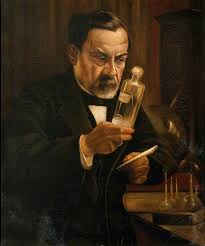
PasteurThe superstar of medical researchers, Louis Pasteur (1822-95) was a chemistry graduate. He was an outstanding microscopist whose interest in micro-organisms was stirred by studies of fermentation in connection with wine and beer making and he devised elegant experiments to scotch the old theory of spontaneous generation. Maggots, he showed, arose from insect-laid eggs and from organisms in the atmosphere. He developed his acclaimed method for eliminating microbes from milk: ‘pasteurization’ – heating to a prescribed temperature to kill them – ensuring that milk would cease to be a source of tuberculosis and other ailments.

The problem of aetiology – what causes disease was one of medicine’s key unresolved questions and it was brought to a head by the terrible wave of of epidemics blighting Europe at the time. Many espoused the ‘miasmatic’ theory – the idea that disease originated in effluvia and other emanations from the soil and atmosphere. Others embraced ‘contagionism’ – disease was something passed from person to person.

Pasteur by no means invented the ‘germ theory’ that disease is caused by microscopic living organisms, but he was the first to show that particular microbes caused particular diseases. His researches into chicken cholera, swine erysipelas and anthrax led to new ‘vaccines’ – the term he coined to honour Edward Jenner who had championed cowpox inoculation against smallpox (vacca is Latin for cow).

The efficacy of Pasteur’s anthrax vaccine was shown in one of the many spectacular experiments which were his forte. On 28 April 1881 he injected 24 sheep with his new vaccine, repeating it after 3 weeks. A fortnight later, this group, along with a control group of unvaccinated animals was implanted with virulent anthrax bacilli. When the sheep were again inspected on 2 June, all the vaccinate animals were healthy and all the unvaccinated ones were dead or dying. Pasteur’s crowning achievement, the rabies vaccine he developed in 1885, was for a ghastly and fatal disease which, like anthrax, killed both animals and human beings.

Pasteur’s linking of streptococci and staphylococci to specific diseases put bacteriology on the scientific map. But it was his younger German contemporary, Robert Koch, later professor of public health in Berlin, whose meticulous demonstrations clinched the microbial theory of disease. In 1879 Koch published a paper which differentiated between different bacteria, connected specific micro-organisms to specific infections and sought to prove that bacteria were the cause of infections. To this end he spelt out what are known as ‘Koch’s postulates’ – four requirements to prove that a particular micro-organism produces a particular condition:

  • The specific organism must be present in every instance of the infectious disease.
  • The organism must be capable of cultivation in pure culture.
  • Inoculating an experimental animal with the culture would reproduce the disease.
  • The organism could be recovered from the inoculated animal and grown again in a pure culture.

As lately with AIDS, ‘Koch’s postulates’ are still invoked in attempts to test whether a specific micro-organism is the true – necessary and sufficient – cause of a disease. Koch’s greatest discoveries were the bacillae which produce tuberculosis (1882) and cholera (1883). His students and rivals went on to use his methods to identify the causal microbes for typhoid, diphtheria, pneumonia, gonorrhoea, meningitis, leprosy, tetanus, plague, syphilis, whooping cough and many other staphylococcal and streptococcal infections.

From Blood and Guts by Roy Porter (Penguin, 2002) chapter 4: The Laboratory

Tasks :

  1. Briefly define the following key words: Antibody, Bacterium (plural: bacteria), Fungus (plural: fungi), Immune system, Immunity, Microbe, Toxin, Vaccination, Vector, Virus.
  2. Research 5 of the diseases mentioned in the readings above and for each one describe the symptoms, the micro-organism which causes it, and what the current treatment is.
  3. Work on the sheets on John Snow and epidemiology and Koch and tuberculosis from the Nuffield website here: please attempt the questions before looking at the answers!
Posted in Learning resources, Science in Society | Tagged , , , , , | Leave a comment

A Warrior’s Lament by Nnamdi Olebara.

For remembrance day:

A Warrior’s Lament by Nnamdi Olebara

Now on the battlefield

I know what faces me.

It is death; my death.

I do not hate those I fight;

It is their deeds I hate.

Those I am fighting for do not love me;

My death shall not grieve them,

Nor shall it bring them joy.

Translated from the Igbo by Chinweizu

Read the whole poem in ‘101 Poems Against War’  (Faber & Faber 2003)

Last year’s peace poem: Five Minutes After the Air Raid by Miroslav Holub

(from the same anthology)

Posted in Poetry | Tagged , , , , | Leave a comment

Education without metaphors?

We love metaphors don’t we? They can help us to express new or complex ideas in term of more familiar ones. They can add richness and drama to our explanations. Good metaphors can help us to understand, organise and interpret things. They can reveal truths and sometimes even help us construct alternatives. What’s to dislike about a good metaphor?

Some metaphorical conventions are so familiar that we hardly question them: up / above as more important or more powerful than down / below, argument as war, change as motion, ideas as objects and the mind as a container.

But metaphors can also mislead and obscure meaning or cover up for a lack of understanding. A particular metaphor can reinforce a particular, partial, view of a complex concept. Also, we tend to choose metaphors which suit our own assumptions or prejudices so there is plenty of room for bias.

“Metaphors [in education] have all the advantage over explicit language as does theft over honest toil” R. M. Miller (1976)

Education is rich in metaphors and each contains a kernel of descriptive truth wrapped in a shiny wrapper of belief about what is really going on and what we value most. So, amongst other things, learning can variously be described as being a transaction or a journey, as growth, discovery, training, construction, performance, consumption, enlightenment or liberation.

So, which of these appeals to you most? And what does that tell you about your beliefs?

Learning as a transaction: Education is a thing of value, worth a great deal, something precious handed on from person to person as a gift or reward. Knowledge is intellectual capital, an asset which can be accumulated, cashed in, exchanged or redeemed. We invest in our education, acquire knowledge and pass it on as an inheritance.

Learning as a journey: Education takes us to undiscovered places as part of a personal adventure, an exploration. We navigate our way, moving in a particular direction. We can be steered or follow guides who open doors for us and show us the right path which might be long and winding and difficult to follow.

Learning as growth: We get bigger and stronger as we learn and we need to be carefully cultivated. We are tended by gardeners or shepherds who nurture us and help us reach maturity. The tiny seed grows into a great tree and the helpless baby grows into an adult.

Learning as discovery: education helps to uncover what is already there within us, to draw out our natural capacities and fulfil our potential. We can find ourselves and learn about ourselves through learning.

Learning as training: We need to be tamed and channelled to get our wild side under control. We need to practice the standard routines, disciplines and habits which will help us function as useful members of society.

Learning as construction: We are engaged in building ourselves and our understanding of the world piece by piece and school is a factory for learning, an assembly plant for personal and social production. We use learning tools from toolkits, we scaffold our knowledge and become ‘hard wired’ for learning.

Learning as performance: Education is a sporting event, a competition with winners and losers. We need determination, fitness, efficiency and stamina to achieve high performance, beat other learners and win the top prizes.

Learning as consumption: We are hungry and thirsty, maybe even insatiable, for learning. We are empty vessels to be filled with nutritious knowledge which should be delivered as fast as possible like a take-away on a scooter.

Enlightenment: Learning shines a light in the terrible darkness, illuminating our world, making things clearer and leading us to light more fires. We have ‘light bulb’ moments and flashes of inspiration.

Liberation: Learning frees us from the shackles of ignorance and the control of others, allowing us to take control of our lives, shape our destiny, escape our cages and fly.

Many of these metaphors are used in a comforting way to reinforce our particular world-view. If we regularly use a metaphor as our model of what education is this can blind us to other ways of seeing things and get in the way of objective evaluation and genuine debate.

So, what if we decided that education doesn’t need metaphors? What if we agreed that it is too important to require definition in terms of other processes? Would it aid our comprehension to strip away some of the unnecessary layers? We could still talk about learning, knowledge, skill and understanding while agreeing to use language as unencumbered by metaphorical baggage as possible. See how hard that is?

Maybe learning is universal enough not to need to be ‘like’ anything else. Maybe we should try to dispense with metaphor and give education a chance to stand on its own sometimes.

‘Metaphor-free Mondays’ anyone?

Posted in Education, Philosophy, Teaching and learning | Tagged , , | 3 Comments

What’s wrong with bite-sized learning?

The phrase ‘bite-sized learning’ suggests that a substantial, chunky educational programme has been chopped up into smaller pieces which are easy to take in but have lost any sense of overall meaning; little gobbets of knowledge of no real use.

We should certainly not reduce education to merely the sum of its component parts, it is far more. Being, or becoming, ‘educated’ is a complex human and social process which cannot easily be broken down. As in the well-known paradox of the sorites where it is impossible to say exactly how many grains of sand make a heap of sand, we cannot define the moment when the sum of our learning makes us educated; the point of transition between quantity and quality. Like Rabindranath Tagore, we want an education “where the world has not been broken up into fragments by narrow domestic walls” which is not a series of atomized and disconnected experiences

Nevertheless, our learning is episodic, or ‘bite-sized’. We do learn in small pieces which then need to be connected to the pieces we already have and join a bigger mental structure or schema which helps us makes sense of these smaller units of knowledge by connecting them in a particular way. It is essential to join up and integrate these units of learning and this can take time. The process is highly personal and the way each student does this connecting will be different.

So we can describe an educational programme as being about both wholes and parts as well as the relationship between them. The parts only make sense in terms of the whole they are being connected to and vice versa.

Each of us is a whole person engaging with the whole world: questioning, thinking and doing. We recognise the educated whole person as being knowledgeable, skilled, questioning, critical, confident and resilient. The process of educating this whole person involves a multitude of educational parts or learning experiences; some carefully orchestrated, others unplanned. In a well-conceived educational programme planned as a whole, knowledge or practice can usefully be reduced to parts, experienced in parts and accredited and valued in parts; as topics, modules and qualifications. Ralph Waldo Emerson wrote that “life is a succession of lessons which must be lived to be understood”. To contribute to a successful education, these lessons must also be connected.

Is there an alternative to this way of learning? Clearly it is impossible to learn everything all at once. Nevertheless, the anti-‘bite size’ argument is still used against all sorts of fairly substantial learning programmes. This is the critique which has prompted the move away from modular A level assessment in England, where a full A-level can be achieved through aggregating the achievement in 6 (or 4) modules over 2 years with different content at different points in the course. The AS qualification represents the first half of the A-level content and allows for separate accreditation of this in the first year of study from which to build A-level achievement in the second year. With the abolition of January exams last year and the imminent ‘decoupling’ of AS levels, A-level students will soon be assessed mainly on their performance in terminal written exams at the end of 2 years; a so-called ‘linear’ approach.

The case for reform rests on the very shaky claim that modular or end-of-first-year assessment is less rigorous, fails to prepare for degree level study and lacks synopticity (making connections between topics). The only really robust argument here is about reducing the time given to exams and releasing more time for teaching, something we can only welcome.

There is nothing intrinsically less rigorous about assessing mastery of AS level content after a year or indeed of a single module after half a year. There is nothing intrinsically more rigorous about waiting 2 years before external assessment. The linear v. modular debate is not about rigour, it’s about the impression of rigour. What it does is raise the stakes for learners whose futures depend on the grades they achieve and increase the risk and fear of unexpected or unfair outcomes.

The rationale for abolishing modular assessment in January as well as June and for de-coupling AS from A level is pretty spurious and convinces very few of the sixth form teachers who actually teach the courses or the university admissions tutors who rely on AS results to help with their selection processes.

What is wrong with the time-honoured notion of end of year exams which assess comprehension and application of what has been learned in an academic year? This usually involves more synoptic assessment at the final stage to demonstrate cumulative learning and growing confidence built up over several years. The universities for which we are preparing our A level students themselves use modular, semesterised or annual assessment and do not see this as being less demanding.

An AS level or a single A-level module can hardly be described as an easily digestible bite-sized gobbet of learning. An AS level represents well over 100 taught hours on a range of topics providing plenty of opportunity to integrate knowledge from different areas, to master content in depth and breadth and to demonstrate understanding.

So let’s recognize the value of both the whole and the parts and not let dogma get in the way of a recoupling of AS and A2 assessment.

Posted in Education policy, Teaching and learning | Tagged , , , , , , , , , , | Leave a comment

Education and skills coming together?

The appointment of Peter Lauener as the chief executive of the Skills Funding Agency (SFA) while remaining as chief executive of the Education Funding Agency (EFA) has prompted speculation that the two agencies could soon be merged, although this has been denied by ministers.

The creation of a single agency would make a lot of sense, particularly if it signalled a more joined-up approach to post-16 education and training policy in England. The division of responsibilities between the Department for Education (DFE) which hosts the EFA and the Business Innovation and Skills department (BIS) which looks after the SFA has held us back. The fact that school and academy sixth forms and sixth form colleges are sponsored by one department and FE colleges by another makes no sense, given the overlap of their work.

The funding for 16-19 year olds mostly flows through the EFA, while for those 19+ students who are not at university it comes via the SFA meaning that most colleges have to relate to both funding agencies. Amongst other problems, this arbitrary division means that the system can lose the focus on providing what is best for learners rather than what agencies are prepared to fund. It also starts from the assumption that pre-19 learning is essentially ‘educational’ while post-19 strategy is mainly ‘economic’ or employment-related; a gross simplification which does a disservice to both. Separating ‘skills’ from education makes no sense at any level.

The EFA/SFA divide has also created a twilight zone at the boundary meant that few in government have been prepared to speak up for those less qualified 18 year olds who were hit by a 17.5% cut in funding for their programmes this year and who are now the most disadvantaged young people in the system; neither fully funded nor able to access loans for their education. This ‘aspiration tax’ is neither justifiable nor sustainable in the long term but who will grasp the nettle?

The EFA / SFA and DFE / BIS divides are symptoms of a more fundamental failure of the way we think about the purpose of education in this country. We have no national educational objectives for 16 and 17 year olds other than ‘getting a substantial qualification and passing GCSE English and Maths at grade C’. We have no system, just an incoherent patchwork of overlapping and competing providers trying their best to identify and meet some local needs. Funding is pumped into opening more and more selective sixth forms which then compete to attract well qualified A-level students. Vocational programmes are judged in labour market terms and blamed for the lack of jobs for young people rather than being celebrated as educationally valid and successful routes to university. Adult education has been decimated.

There is no ambitious educational strategy for upper secondary education. What do we mean by an educated 19 year old? What knowledge and skills should they all have? How should we prepare them for the challenges facing them as individuals and members of society? What kind of curriculum and institutional arrangements would best ensure that all these young adults can flourish and start to contribute to their society; not just its economy?

Instead of asking these fundamental questions, we obsess over how to sort students into narrow and outdated categories in order to label and segregate them. What we then have to offer is too often driven by the qualification system and the competing interests of providers rather than the needs of the students and the world they are entering.

Creating a national consensus about the education of young adults and designing a new post-16 architecture is a tall order and is unlikely to get very far in the last few months before a general election. But we can and should be debating these questions urgently.

The fact that the two major post-16 educational funding bodies now have the same leadership could be a positive step towards more coherent policy-making and implementation in this important area. Let’s hope it is.

Posted in Education policy | Tagged , , , , , , , , , , , , , , , | 2 Comments

Learning and xenophilia.

Xenophobia is the fear of difference or the dislike of foreigners. Across Europe we have seen the rise in support for parties espousing xenophobic views. In difficult times, these parties play the blame game and tap into people’s suspicion and mistrust of those who are different to them whether ethnically or culturally, in terms of their religious beliefs or language. In responding to the challenge of racism and xenophobia there is too often an assumption that xenophobia is ‘natural’, a default state of mind that needs to be mitigated rather than countered directly. This is sometimes described as ‘being honest’ about the immigration debate for example. People are basically suspicious of foreigners, the argument goes, so instead of celebrating all the benefits of immigration, let’s tell them how tough we’ll be in keeping people out.

This acceptance of a xenophobic discourse only makes things worse by reminding people to find the easiest scapegoat for their troubles and look no further. Using phrases like ‘feeling swamped’ adds to the problem itself by creating a siege mentality. When offering solutions, using words like ‘tolerance’ only serves to emphasise the perceived threat posed by the ‘other’. To tolerate is to put up with something we basically dislike.

If we really want to take on xenophobia, we need to tap into our equally strong potential for xenophilia; the love of the ‘other’, the foreign or the unfamiliar. Being xenophilic requires us to see the stranger as having much in common with us as well as being different. As an impulse it is about finding the ‘other’ interesting because of our differences and not despite them.

It means being curious about what we don’t know about someone while building on what we have in common, which is, at the most basic level, being human – although there is usually more: shared interests, shared experiences of childhood, play, love, grief, parenthood, work and social relationships. We choose to spend time with people we have something in common with, this is comforting and helps us build our identity. But we don’t have everything in common with anyone and it is by understanding and exploring our differences that we will develop most as human beings.

This means going towards difference, reaching out to the stranger and standing alongside them in solidarity rather than turning away and avoiding them in incomprehension or ‘tolerating’ them from a distance. Tolerance is like charity, it is offered conditionally from a perspective of superiority. Solidarity in contrast is an expression of equality and starts with no conditions and allows for the possibility of a change in perspective. Contrary to the assumptions of some politicians, poor and vulnerable people with much to be anxious about in their lives are just as capable of xenophilia as anyone else.

Xenophilia is also the springboard for effective learning. To learn well we need to be attracted to the unknown, to be curious and ask questions about it, to enter into dialogue with it and to treat it with respect and humility. We need to be prepared to bring it close and find out what we can about both how it resembles and differs from what we already know. While the familiar is comforting in its security, it is in the encounter with the unfamiliar that we will learn most. To be useful, what we discover needs to connect to existing schemata within our mind as we construct a better understanding of what was previously unknown in order to make it known.

Intellectual xenophobia makes us shy away from the unknown, the unexplained and the difficult to grasp. If we only seek comforting, repetitive and unchallenging tasks and limit our aspirations by building walls around our knowledge we are leaving important connections unmade and we miss out on the best of what learning can do for us.

If learners need to be xenophiles, teachers need to be its highly accomplished advocates; champions of xenophilia, venturing far and wide, whether physically or metaphorically, to find the unknown and help their students make some sense of it.

Posted in Education, Politics, Teaching and learning | Tagged , , , , , | Leave a comment

Le numérique en questions : une perspective anglaise

Mon intervention au colloque e-éducation: ‘le numérique en questions’ à l’ESEN-ESR, Poitiers le 15 Octobre 2014.

Je vous propose à la fois une perspective personnelle et une perspective de mon établissement dans un contexte anglais.

Nous ne sommes qu’au début d’une transformation de la communication et de la connectivité humaine. Les possibilités du partage et de la démocratisation des savoirs sont immenses. Pour comprendre l’effet de cette transformation dans le cadre de l’éducation il faut d’abord comprendre son effet social et global.

Nous avons vécu d’autres révolutions de la communication, avec l’écrit, l’imprimerie et l’audiovisuel, et nous avons certains repères pour comprendre les défis. Par exemple, au début de la révolution de la langue écrite, Socrate avait prévenu que l’écrit était inflexible par rapport à l’oral, qu’il détruirait la mémoire et que nous perdrions notre maitrise de la langue. Ce genre d’inquiétude a été réitéré à chaque révolution de la communication et à chaque fois on peut constater que les nouvelles technologies élargissent l’accès aux connaissances et approfondissent les interactions humaines et que les anciennes technologies ne se perdent pas mais trouvent de nouveaux rôles.

Plusieurs d’entre nous ont vécu l’époque de l’introduction des premiers ordinateurs dans l’éducation. Il faut rappeler que, confronté à ces nouveaux outils, on s’est demandé à quoi ils pourraient bien servir en classe. Maintenant nous sommes inquiets que nos étudiants ne vont réclamer que le divertissement et la simplicité de leur lecture en ligne. Pourtant il est bien possible de créer des matériaux qui encouragent un effort de concentration, un apprentissage en profondeur, la collaboration et la créativité en commun. Ces matériaux ne sont pas toujours d’origine pédagogique. J’observe, par exemple, la popularité du site Wattpad qui permet aux jeunes abonnés de partager leur esquisses et leurs avant-projets de roman, de critiquer et de répondre aux critiques et de trouver un public global qui apprécie leurs essais.

Une perspective anglaise

Il faut d’abord préciser qu’en Angleterre nous n’avons pas de système national. Chaque établissement existe comme une entreprise dans un marché plus ou moins compétitif et nous sommes surtout jugés sur les résultats de nos étudiants.

Newham est un quartier défavorisé qui a bénéficié d’immenses investissements infrastructurels, une régénération commerciale depuis les Jeux Olympiques de 2012, le centre commercial de Westfield à Stratford City, les Royal Docks ou se trouvent l’aéroport de London City et une nouvelle ligne Crossrail de transit urbain. Tout cela donne l’impression que le centre de Londres se déplace vers l’Est, donc vers nous. Malgré tout, c’est toujours un quartier economiquement défavorisé.

Newham est une des 32 communes du grand Londres avec 270,000 habitants, un quartier d’immigration dont 70% de la population sont de minorités ethniques. Une population jeune, diverse, en croissance, riche en ressources culturelles et intellectuelles: c’est une des 3 communes les plus pauvres de Londres qui sont l’East End de la capitale,

Il y a 14 collèges (11-16 et 11-18 ans), 4 lycées et 2 universités. Le nombre d’établissements concurrents pour les classes de 1ere et de terminale (en lycée ou en collège-lycée) est en croissance: nous étions 3 à Newham en 2008, en 2014 nous sommes 7. La réussite scolaire à 16 ans est en hausse et la participation dans l’éducation des jeunes de 16-18 ans est en excès de 90%.

NewVIc est un lycée polyvalent général et professionnel de plus de 2,600 étudiants de 16-19 ans, le plus populeux de Londres. Nous recevons un budget de l’état d’environ £15 million qui nous est versé entièrement en fonction du nombre d’étudiants. La gestion de ce budget dépend entièrement du chef d’établissement et de son conseil d’administration.

On trouve à NewVIc une mixité ethnique, culturelle et linguistique extraordinaire qui rassemble des jeunes d’origine africaine, bangladeshi, pakistanaise, indienne, antillaise, chinoise, européenne et bien plus d’autres avec plus de 80 langues parlées, y compris le Français.

Tous nos étudiants bénéficient d’un enrichissement culturel et sportif et d’un encadrement personnalisé. Un Sports Academy spécialiste en cricket, basketball et coaching, un partenariat et colocation avec le Newham Academy of Music, un conservatoire de jeunes pour toute la commune, un partenariat avec le centre culturel de Stratford Circus qui attire un public de plus de 20,000 par an: théâtre, musique, danse, medias, colloques littéraires – animation culturelle de la commune

La plus grande proportion de nos étudiants suivent des programmes Advanced levels: 15-21h par semaine pour 2 ans d’éducation générale avec 3 ou 4 sujets sélectionnés parmi plus de 40 options. Ils sont au niveau du Bac et sont une préparation pour les programmes universitaires pour quasiment tous les étudiants.

Ils suivent aussi les Advanced vocational programmes: 15h-21h / semaine. 2 ans d’éducation professionnelle ou technique. C’est une préparation pour la formation professionnelle et l’emploi et 85% progressent vers l’université.

Une minorité de nos étudiants suivent des Intermediate programmes: 17h / semaine :1 an d’éducation générale our préprofessionnelle qui prépare les classes Advanced (donc 3 ans en tout) ou les Foundation programmes: réintégration, compétences et savoirs de base et préparation aux études du niveau “intermediate” (donc possibilité de rester 4 ans au lycée)

Nos candidats à l’équivalent du Bac réussissent en grande proportion : 96% de succès global (A levels), 100% de réussite pour un grand nombre de sujets et plus de 200 de nos étudiants de terminale dépassent la moyenne nationale. 767 étudiants de terminale ont progressé en faculté en 2013 dont 130 aux universités les plus cotées.

Notre projet d’établissement est de « créer une communauté réussie d’apprentissage» Pour le numérique, nous voulons que nos enseignants et étudiants utilisent l’informatique pour l’apprentissage: d’une façon effective, créative et confiante. La politique d’établissement pour l’informatique fait partie d’une politique pédagogique et administrative qui propose la creation d’un environnement riche, accessible et stimulant en ligne. C’est un élément clé de l’apprentissage.

L’autonomie de l’établissement nous permet de choisir comment investir nos ressources – humaines et technologiques. Nous bénéficions du Wi-fi et somme équipés pour le  BYOD (bring your own device) et le video streaming partout. Les chiffres de participation en ligne sont en hausse, en Mars 2014 notre espace numérique de travail (iVIc) qui intègre Moodle, Mahara et Planet e-stream, a enregistré plus de 48,000 vues étudiantes par mois pendant l’année scolaire 2013/14.

Le système Anglais est très différent, nous avons une autonomie quasiment totale, en revanche il nous faut être très performants. Nos résultats sont très publics, ils sont en ligne et le public, les responsables politiques et les medias comparent les établissements constamment.

L’autonomie de nos établissements et notre système d’inspection en Angleterre seront les sujets de futurs billets en Francais sur ce blog.

Plus de questions que de réponses

En parlant du numérique et de l’éducation je pense qu’il faut que notre point de départ soit absolument l’apprentissage et la pédagogie plutôt que la technologie ou les outils particuliers. Il faut surtout se demander « pourquoi ? » avant de se demander « comment ? »

Je veux poser quelques questions qui me semblent importantes et proposer quelques tentatives de réponse :

Tout d’abord : pourquoi éduquer ? L’éducation est un projet à la fois personnel et social. Un projet qui doit mener à l’épanouissement de l’individu et de sa communauté. Si nous voulons une société démocratique et plurielle qui peut résoudre les défis globaux qui nous confrontent, il nous faudra créer un accès démocratique et pluriel aux connaissances qui permettent aux jeunes de comprendre la culture et l’histoire humaine, de participer au progrès social et connaitre le plaisir personnel d’apprendre. Nous avons de nouveaux outils mais le rôle de l’éducation a-t-il vraiment changé ?

Et pourquoi l’école ? Quel est le rôle de ce lieu que nous connaissons bien mais qui devra certainement changer ? Prison ou fenêtre sur le monde ? Espace d’évasion ou place du village ? Usine ou lieu de débat philosophique ? Centre de formation sociale ou centre de culture et de connaissance ? Les unités de la classe sont peut-être éclatées mais je suis convaincu que l’école restera un lieu essentiel de la construction sociale.

Et le rôle de l’enseignant ? Il ne sera pas simplement un guide ou un conseiller, mais restera certainement un agent essentiel de la transmission culturelle, de l’interprétation et de l’évaluation des savoirs, du débat et de la créativité.

De quelles compétences et de quelles connaissances les jeunes auront-ils le plus besoin ? Je ne suis pas convaincu qu’il nous faut des compétences différentes pour le 21eme siècle. Sinon des compétences nouvelles, certainement certaines compétences améliorées : le triage, la sélection, la lecture, l’évaluation et l’analyse de l’information. Quel rapport entre l’élargissement et l’approfondissement – tous deux essentiels dans l’éducation ? Quel rapport entre le canon ; les connaissances spécialistes et le pluridisciplinaire ; la recherche et l’exploration personnelle ?

Tout en se demandant ce qu’il faudra changer il faut aussi bien se demander ce qu’il faudra ne pas changer.

En conclusion

Hannah Arendt a dit:

“L’éducation est le moment où nous décidons si nous aimons le monde assez pour en être responsables.”

En tant qu’éducateurs il nous faut accepter que nous sommes responsables. Si nous aimons le monde et que nous voulons sa continuité, sa survie et son progrès nous devons avant tout présenter et interpréter ce monde pour nos étudiants d’une façon éducative qui leur permettra de changer les choses pour le mieux. Et finalement il n’y a rien de plus important.


 

Posted in en Francais | Tagged | 1 Comment

Homology, analogy and metaphor. Science in Society 5.

Reading

‘Much scientific argument and hypothesis-making proceeds through the use of analogy and metaphor’. Steven Rose.

To help us understand a scientific process we often liken it to something we’re already familiar with. We use homology, analogy and metaphor.

A homology implies identity and a common origin or shared history, eg: the bones of the font feet of a horse are homologous to those of the human hand.

An analogy implies a resemblance between two phenomena but accepts that this is only partial, eg: the blood in animals has a similar role to sap in plants. Often analogy is only metaphor and the likeness we imagine is poetic rather than exact.

A metaphor doesn’t imply any identity of process or function, but offers a new perspective on things. It help us think about our subject but it may also be a hindrance as it can limit the way we think. A metaphor brings baggage with it which can shape the way hypotheses and experiments are designed. We often use metaphors which simplify because we think they will help us understand better. There is a temptation to rely on mechanical or industrial metaphors for living processes. The metaphors and analogies we find attractive are loaded with cultural values which reflect our experience. It is a mistake to treat analogy or metaphor as homology.

A simile is where two things are directly compared because they share a common feature. The words ‘as’ or ‘like’ are used to compare the two things.

Task

Pick 3 of the following statements about scientific ideas and for each one say how it might help us understand a process and how it might also hinder our understanding. Be as precise as you can in pointing out the accuracy and limitations of these analogies or metaphors.

  • The solar system is like a clock
  • Light waves are like sound waves
  • The atom is like a billiard ball / a plum pudding…
  • Electrons are like planets orbiting the nucleus which is like the sun
  • Electrons are waves / particles
  • Electrical current is like the flow of water
  • Genes are a code
  • Evolution is the survival of the fittest
  • Cells are building blocks
  • Hormones are messengers, homeostasis is like a thermostat
  • The heart is a pump
  • The brain is like a computer
  • Dealing with infection is a battle against germs which attack our body
  • A mammal’s limbs are like an insect’s legs
  • A plane’s wings are like a bird’s wings

2013-01-27-metaphor


Posted in Learning resources, Science in Society | Tagged , , , , , | Leave a comment

Mastering my Zenit

ZenitFor my 12th birthday my dad gave me a Zenit-E single lens reflex camera. This summer, over 40 years later, I came across it while sorting through some boxes, and it all came flooding back.

At the time I was using a basic point-and-click Kodak Brownie box camera, so handing me a Zenit was a major upgrade. It seemed impossibly complicated at first as taking a decent picture required giving attention to at least 4 related variables; light intensity, focus, aperture and shutter speed while also evaluating their impact on depth of field and picture sharpness, all before getting around to picture composition. If you wanted to capture the moment, you needed to prepare several minutes in advance, twiddling dials and interpreting and transferring information from one to another. Still, thanks to the flap-up mirror shutter mechanism, at least you got to look through the lens at the exact view you were photographing.

The gift was a bit of a risk for my dad in several ways. First, my track record with technological appliances was not good; I had managed to break a basic record player on the first day of ownership the year before. Second, I hadn’t asked for a new camera and wasn’t particularly keen on photography. Third, despite being at the cheaper end of the range, the robust Soviet-era Zenit was still a big investment for something which might well end up unused on a shelf.

In the event, I was very impressed by the Zenit and its potential. I learnt each of the rather cumbersome steps of the picture-taking process and managed to bring them together and master the skill of producing a decent photo and took many hundreds with it over the years. It was hard work but it was worth it and I still have some of the contact sheets of 35mm film which I would get from the chemist from which to choose which pictures to print. Handling my Zenit again this summer after such a long break reminded me that I really loved that camera.

I started to wonder what it was about acquiring that particular skill which worked well as a learning process compared to other, less successful attempts. It was unplanned and unexpected and it started with the challenge represented by the equipment itself; could I master this exciting but rather bewildering piece of kit? It also came via my dad, although he was not an expert photographer. He helped me at the beginning, but this was always going to be my camera and my skill, in contrast to clarinet-playing which I enjoyed but which my dad was so good at that there seemed little prospect of ever ‘catching up’ however much I worked at it. Also, with the Zenit, the results could be appreciated within a reasonable timescale as film could be processed and photos printed within days or weeks.

There were many other skills which I didn’t stuck with, like painting where I couldn’t cope with the puddling of the watery poster paints at school and the wrinkling of the paper they caused, chess which I could tell would be a really long haul or football where I just didn’t have the necessary tolerance of mud or jostling.

The skills needed to use the Zenit-E are now redundant and I can take serviceable photos with my smartphone without worrying about shutter speed, light intensity or f-stops. Even if I used a great camera the process would be automated and the skills needed would be very different.

But, in learning to use my Zenit, I also learnt wider lessons about the need for effort, concentration, reflection and practice as well as quite a bit of physics. I could, and did, learn some of these things in other contexts too or in more systematic and planned ways, but not all learning happens on cue. My Zenit was just one way in to the pleasure of mastering a skill and doing it well. That’s why finding it and handling it again meant so much to me. Also it reminded me of my dad.

Posted in Teaching and learning | Tagged , , | Leave a comment

Debating the Liberal Arts

The Future of Liberal Arts conference: The Liberal Arts and Schools

I was delighted to be asked to contribute to the panel on ‘The Liberal Arts and Schools’ at the ‘Future of Liberal Arts’ conference organised by Martin Robinson (author of Trivium 21c, reviewed here) at King’s College, London on 14th October.

A video of the whole day is available here with this particular discussion under ‘Liberal arts in schools’ http://www.newvic.ac.uk/futureliberalarts/

The panel was chaired by Claire Fox, who directs the Institute of Ideas and also included Stuart Lock who is Deputy Head of Rushcroft school in Waltham Forest, Hywel Jones, head of West London Free School and Martin Robinson himself. Tom Sherrington, head of Highbury Grove school was scheduled to contribute but was unable to attend.

My contribution can be found here so I won’t go over the same ground except to say that I started with a provocation; defending a utilitarian outlook albeit one based on a very broad notion of utility or usefulness. Like the Chartists, we should be searching for ‘really useful knowledge’ and I think this is totally compatible with a commitment to a broad liberal education for all. In this definition, usefulness should include ‘wanting to understand things better’.

While the panellists probably expected to disagree with each other, there was a degree of consensus about some of the things that matter most:

  • The need for a strong common knowledge-base to build learning on.
  • The right of all young people to a broad liberal arts education.

This was a good starting point and reminded me of some of the 11 potential points of agreement I proposed for progressives and traditionalists around educational aims, content and methods. See my post about this: ‘Progs and trads: is a synthesis possible?’

We might have disagreed about pedagogic methods had we got onto those more deeply. For example, Hywel was fairly critical of interdisciplinary project work whereas I would argue that this can be of great educational value if it has a coherent purpose and is based on sound knowledge. The suggestion that interdisciplinary work has to wait until full disciplinary mastery is a bit like saying we shouldn’t start learning to write until we are fully versed in the art of speaking with a total grasp of vocabulary and rhetoric. Clearly, there is a sequence, but the two processes also support each other.

Stuart emphasised that the aim of education was to make young people ‘smarter’. I couldn’t disagree, but this does beg the prior question: ‘smarter in what way and to what end?’

Where we seemed to disagree most was on the value of practical or vocational courses. While I am aware that their use by many schools to help accumulate point equivalences was often counter-educational this should not lead us to reject a practical curriculum outright. In my view, practical, skill-based and problem-solving elements should be a key part of a liberal education for all and, as many members of the audience pointed out, there is a long tradition of developing practical skills within a broad education.

Hywel’s main criticism of vocational qualifications seemed to be that the skills they develop are likely to go out of date rapidly compared to the study of the classical canon which raises fundamental and timeless questions about the human condition. While this is true, this is not an argument for not acquiring skills while they are still current. They will usually form a good basis for developing the new skills required by new techniques. Learning by doing and developing a high level of skill is a good way of developing as an effective learner of further skills and knowledge.

The expert and professional Advanced BTEC Media students from my college who spent the day recording this conference demonstrated a wide range of different technical, creative and social skills combined with a good knowledge of the equipment and requirements to do a good job within various constraints. The fact that by the time they graduate in 2018 they may be using very different equipment and new techniques at work does not invalidate the skills they have today.

So within the panel, Martin and I felt the need to champion the ‘learning by doing’ which seemed to have a limited place in the accounts of Hywel and Stuart. But I think the key is not to privilege either at any stage of education. I think the interplay between knowing, reflecting and acting is crucial if the knowledge you need to acquire is to join the knowledge you already have. A one-dimensional approach to acquiring knowledge (grammar) leaves out the two further dimensions of Martin’s Trivium, namely rhetoric and dialectic.

So finally, what of ‘learning for its own sake’? Claire rightly defended the educational value of reading poetry ‘off-syllabus’ or staring into space and explained that her view was partly a reaction to the strong cultural pressure she faced where she grew up to ‘get educated for a job’ and this is still pervasive today. My upbringing tended the other way, for which I am grateful, and this may have led me to come to this from the other side and look harder for links between learning and what use it might be in the world. Ultimately, I think we reached a very similar position about what one might call ‘the usefulness of the useless’.

I was recently discussing Walt Whitman’s poem When I heard the Learn’d Astronomer with some science students as part of an AS class on poetry and science. The poet tires of the dry proofs and the figures ranged before him by the scientist and wanders off into the night to look up at the stars. There can clearly be different readings of the poem and the students recognised the tension between the two ways of seeing the world but they also felt that both were important and that Whitman was not necessarily criticising science as boring or irrelevant but pointing out that it was missing something if it ignored the awesomeness of its subject. We need a constant, informed, dynamic dialogue between imagination and application, the canon and the contemporary, knowledge and skill.

As this enjoyable and stimulating panel session came to an end we seemed to be converging towards a shared view of the benefits of a broad and challenging liberal arts education for all. However, I think everyone there was also well aware of the challenge we face to make this a more mainstream view. Joining Martin Robinson’s network of Trivium schools can only help us in this important task.

Posted in Culture, Education, Teaching and learning | Tagged , , , , , , , , | 1 Comment

Learning to love liberal education

Talk given at the The Future of Liberal Arts conference at King’s College London on 14th October 2014.

A video of this talk is available here: http://www.newvic.ac.uk/futureliberalarts/ (select ‘Liberal Arts in Schools’ starting at 3:33)

I want to start by saying that I take a utilitarian view of education and don’t like the phrase ‘learning for its own sake’. This may seem a dangerous thing to say at a conference promoting liberal education so I’d better explain my reasoning. Our learning always has some purpose or utility, even if it is highly individual such as ‘to make me happy’ or ‘to satisfy my curiosity’. To detach learning from purpose is to detach it from life. So, as long as we take a broad view of utility, both personal and social, then our utilitarianism can help us ask the right questions about education. It’s narrow instrumentalism which is anti-educational if it is allowed to become dominant.

So, what is the purpose of education? A big question and clearly the answer is both personal and social and these are interrelated. Education should aim to help everyone flourish and live a good life and it should also help us address the many challenges we face as a human beings and to help us create the kind of society we want. It is a continuous personal life project and a social project. Education requires us to give some structure and meaning to the otherwise rather random and bitty learning experiences we have throughout life. So, education gives purpose to learning.

Education is about acquiring power, both personal and social, or perhaps ‘mastery’. Like the Chartists we should be hungry for ‘really useful knowledge’, the powerful knowledge that will give us greater control of our lives as well as greater power to shape our world.

However, in this country we have an unhealthy obsession with class and hierarchies and this extends to our education system. We are too eager to sort young people into categories and provide them with different kinds of education to suit their ‘potential’, their ‘aptitudes’ or their ‘aspiration’ before they have even been exposed to the full range of what education can offer them.

The enemies of liberal education for all include fixed ability thinking and our tendency to label, select, segregate, sort and stream or to create the institutions which box people into our invented categories: secondary modern schools, university technical colleges, technical schools etc.

Martin Robinson has done liberal education a great service by dusting down the trivium, polishing it up and giving it a new lease of life for the 21st century. Like Martin, I am in favour of a progressive traditionalism as long as it’s for all. We want a liberal education for all and the trivium is a good starting point because it transcends the traditional v. progressive, academic v. vocational, knowledge v. skill debates and draws together a necessary emphasis on a core, canonic knowledge (or ‘grammar’), the reflection, communication and application which makes that knowledge your own (rhetoric) and the questioning and challenge which lead to new insights and the creation of new knowledge (the dialectic).

So what might a realistic post-16 liberal arts curriculum for all look like?

  • There should be opportunities both to broaden and deepen: A-levels can be broadening but some combinations are narrowing, vocational courses are motivating and deepening but their educational value is misunderstood and they shouldn’t be seen to be about job training or economic performance. Mixed programmes can work well, but are ignored by government and performance tables actively discourage them.
  • We need to find time for broadening studies, cultural studies, reading and discussion without necessarily adding the dead hand of a new qualification with all the prescription and assessment that implies.
  • We need to encourage students to undertake research projects, alone and with others. The Higher and Extended Project should become the norm giving all young people the opportunity to produce original work of the highest standard in their chosen field, like an apprentice’s masterpiece.
  • Learning skills, character, resilience and grit. Whatever they are, if we can describe them, these should not be isolated but embedded.

The proposed National Bac (incorporating the Tech Bac and the A-Bac) could be a real springboard for the development of a broad, challenging, liberal curriculum for all.

I also have some broader questions about how we might implement a ‘trivium’ view of the curriculum:

  1. How do we decide when students know enough ‘grammar’ to usefully engage in rhetoric and dialectic? Are there stages of development which recapitulate human development and learning, for example speaking and listening before writing and reading or interacting socially? Are these different levels of skill best developed in sequentially or simultaneously?
  2. How do we help young people discover their ‘genius’, pursue personal interests, apply themselves to in-depth research and produce at least one ‘masterpiece’?
  3. How do we find the balance between ‘horizontal’ learning; access to information, discussion, sharing, debating as equals where our judgement is valued and the ‘vertical’; authoritative, canonical, ‘best that the culture has to offer’ where the weight of historical judgement is valued. Given the sheer quantity of information which is available to young people using digital technologies, learning to select, interpret and evaluate is more difficult than ever and the teacher’s role in this is more important than ever.

Today’s conference is a timely contribution to the debate about the purpose of education and I support the aim of promoting a broader and richer education for everyone. We have a long way to go before that can be a reality for all young people in England and I am keen to help develop and trial practical ways forward.

See my review of Martin Robinson’s Trivium 21c here.

I have written about the proposed National Bac here.

Posted in Education | Tagged , , , , , , , , , | 1 Comment

The oath and the compass

It sounds like the title of a medieval thriller; the brotherhood of educators send their top monks out to roam the world having sworn to serve learning and they solve all sorts of intractable problems with the help of a golden compass which mysteriously steers people in the right direction. Philip Pullman or Umberto Eco could do a great treatment and film rights could follow.

Every aspiring Labour secretary of state for education has to have to have their ‘upsetting teachers’ moment. It seems to be a necessary ritual; make a lot of teachers angry to prove that you’re not in their pocket, then move on. But it helps when the chosen issue is one which actually matters and could substantially improve education. Unfortunately today’s suggestion by Tristram Hunt that we should seriously consider introducing a Singaporean-style oath for teachers will have difficulty passing that impact assessment.

These sorts of symbolic proposals are only of value if they connect with some genuine popular concerns. In this case, as with Michael Gove’s gift of a King James Bible to every school or the great search for ‘British values’ we are periodically asked to embark on, it feels pretty empty. The danger of such proposals is that they can breed cynicism and strengthen the ‘keep politics out of education’ case just when we most need the political will and action to create a better system.

Today’s story on the BBC website also quotes the shadow secretary of state as rightly criticising the ‘relentless structural change’ English education has been subjected to and the lack of accountability and transparency in the system while pledging to do little to unpick it. He also seems keen to distance himself from the ‘one size fits all school’ and is in favour of ‘a multiplicity of provision: academy chains, community schools and parent-led academies.’

Those Singaporean teachers are apparently also given a symbolic compass, presumably to remind them of their moral purpose and their direction of travel. We may scoff, but I think we are in need of such a compass here in England too. In our case, it is potential Labour voters who need to give the party they want to support a political compass to remind it of its core values and to apply them to education policy.

The politics of education in England seems to be stuck with a bipartisan consensus about the need for choice and diversity, in other words an acceptance of an essentially market based model where competition is still the default setting in the system. Labour has a selection of good policies but is not sending out a message consistent with its core ‘one nation’ message. The same is not true in health policy, where the party is leading a full frontal attack on marketization in the system.

So, what would a Labour political compass tell the party’s spokespeople to do?

  1. Emphasise that we need ‘one nation schools’ with a common status, with fair and comprehensive admissions (preferably up to 18). Only a genuinely comprehensive system can guarantee that choice and diversity works for all. Using the phrase ‘one size fits all’ in a derogatory way feels like an attack on the comprehensive ideal.
  2. Emphasise that we need a ‘one nation curriculum’ and say more about the excellent proposal of a National Bac for all, which incorporates all types of learning and skill development. The Tech Bac we hear so much about already exists. It needs to be a subset of the National Bac if we are to avoid a ‘two-nation’ qualification system and claims that it will transform the youth labour market are pure hyperbole.
  3. Emphasise that we need a ‘one nation system’ with clear democratic accountability for ensuring that schools work together to serve their communities and help each other improve. Anything less will allow the  rampant competition between providers and chains to gather pace and this will not achieve the goal of a functional and successful system which meets the needs of all young people.

And the oath? Well, I’m trying to steer clear of oaths as the firewall doesn’t like profanities.

Posted in Education policy, Politics | Tagged , , , , , , , , , , , | 2 Comments